Showing posts with label Frantisek Drtikol. Show all posts

11 Works, RELIGIOUS ART - Contemporary Interpretation of the Bible! with Footnotes - #9

Joyce Tenneson
Angel and Lit Wings - 2016
Archival Pigment Photograph
30 × 24 in, 76.2 × 61 cm

Joyce Tenneson (born in Weston, Massachusetts on May 29, 1945) is an American fine art photographer known for her distinctive style of photography, which often involves nude or semi-nude women. Tenneson earned her master's degree in photography from George Washington University after starting as a model for Polaroid. She left her job as a photography professor at 39, and moved from Washington to New York. Tenneson shoots primarily with the Polaroid 20x24 camera. As a child, her parents worked on the grounds of a convent, which is where she grew up with her two sisters. She and her sister "were enlisted to be in holiday pageants and processions. It was a mysterious environment - something out of Fellini - filled with symbolism, ritual, beauty, and also a disturbing kind of surreal imagery."  Tenneson moved from Manhattan to Rockport, Maine in 2004.

Her work has been displayed in more than 100 exhibitions around the world.[4] Tenneson has had cover images on several magazines including Time, Life, Entertainment Weekly, Newsweek, Premiere, Esquire and The New York Times Magazine. More on Joyce Tenneson

Thomas Bijen (b. 1980)
Devotion
Stained glass fresco

An iconic artwork of two women, emblazoned across a stained crimson and turquoise-blue glass layer. The shot mimics a portrait style photograph, taboo in its insistence of evoking religious imagery. Are these two women lovers? Sisters? Although the connection is brief, the mystery of their touch endures. More on this painting

Thomas Bijen (1980) is a Dutch Artist. For the past ten years he has been living and working from his studio in The Hague, The Netherlands. In 2007 Thomas acquired his Masters of Science in Industrial Design Engineering at the Technical University of Delft. Coming from a diverse background originating in the creative technical sciences, the arts have always been his prime interest.

More recently, he has been commissioned to create his art live to the public, through murals and large art objects. For Thomas, creating art is an expression of his quest for mystery, playfulness and innocence, in which he strives to recapture his childhood days. More on Thomas Bijen


Jessica van Haselen
Higher Power I
Photographic Print
Private collection

The pose is commanding as the strong arms self-embrace. Her head looks up as if uniting with a higher power while her eyes are closed to underline the spiritual connection and release from reality. 

Jessica van Haselen is a Dutch designer and artist originally from a small town in the Netherlands. A deep interest in foreign cultures, languages, and countries has led her to travel and live all over the world. Her style developed as she absorbed these cultures, translating her experience into the visual medium. Originally trained as a master goldsmith, her work always contains a high level of precision, detail, and technique. Later studying Interactive Media Design at the Royal Academy of Art in The Hague, and Art History at the University of Amsterdam, she likes to combine new and unconventional digital media into her artwork while focusing on the story and historical significance that inspires each work. More on Jessica van Haselen 

Frantisek Drtikol
Woman crucified , 1913
Gelatin silver print on bromide paper
22 x 16.4 cm. ( 8 ¾ x 6 ½ in.)
Private collection

František Drtikol (3 March 1883, Příbram – 13 January 1961, Prague) was a Czech photographer of international renown. He is especially known for his characteristically epic photographs, often nudes and portraits.

He had his own studio, until 1935 where he operated an important portrait photostudio in Prague. Drtikol made many portraits of very important people and nudes which show development from pictorialism and symbolism to modern composite pictures of the nude body with geometric decorations and thrown shadows, where it is possible to find a number of parallels with the avant-garde works of the period. 

He began using paper cut-outs in a period he called "photopurism". These photographs resembled silhouettes of the human form. Later he gave up photography and concentrated on painting. After the studio was sold Drtikol focused mainly on painting, Buddhist religious and philosophical systems. In the final stage of his photographic work Drtikol created compositions of little carved figures, with elongated shapes, symbolically expressing various themes from Buddhism. In the 1920s and 1930s, he received significant awards at international photo salons. More on František Drtikol

Iva Troj, United Kingdom
What Noah Forgot
Acrylic on Sound.
15.7 H x 23.6 W x 0.4 in

Iva Troj seamlessly incorporates her vast experience of traditional painting techniques with postmodern elements to create engaging Renaissance-style works that challenge the notion of societal conformity. Born in Bulgaria, based in Scandinavia and the UK, Troj creates work originating fundamentally in the crossing of two realities: the one she grew up in and the one she has embraced. 

“I’ve been told I have artistic talents since I was a little girl. The problem was I spent most of my time worrying about the meaning of it all. I grew up in a rough neighborhood, in the outskirts of Plovdiv. At times it felt like the whole place was full of violent men. My family was very strict, loving and protective of me so I managed to keep my head above water. More on Iva Troj 

MPUMELELO “LAYZIEHOUND” COKA
A mere Nephilim (Fallen from grace), 2017
Mixed media on canvas
39 3/5 × 28 1/10 in, 100.5 × 71.5 cm
Private collection

Mpumelelo “Layziehound” Coka. South African, Bilanyoni A, Frischgewaagd, KwaZulu-Natal, South Africa, based in Johannesburg, Gauteng, South Africa. 

His work seems to be a social commentary of sorts, but perhaps what works best is his loose mark-making and almost direct use of paint. The influence of graffiti, which the artist has practised for many years, is evident. Yet he also employs methods of a pre-Renaissance drawing style, such as outlines, a certain flatness and symbolic colour.

He uses signs; incisive line and figures that convey emotional discord. Text sometimes is included and adds to the drama, a sense of a system that is failing or that has failed. It appears that such a failing may be because of a drive for power, coercive force and ideological and institutional might. More on Mpumelelo “Layziehound” Coka.

MPUMELELO “LAYZIEHOUND” COKA
The Devil made me do it, c.  2017
Charcoal and acrylic on canvas
51 1/5 × 47 in, 130 × 119.5 cm
Private collection

MPUMELELO “LAYZIEHOUND” COKA
She makes salvation scream, c. 2017
Mixed media on canvas
54 9/10 × 50 2/5 in
139.5 × 128 cm
Private collection

PAUL INSECT
Psychedelic Saints, c. 2012
Acrylic and gold leaf on panel
14 1/5 × 11 in, 36 × 28 cm
Private collection

Paul Insect is UK street artist, who is most famous for his 2007 solo show Bullion exhibition at London's Art gallery, Lazarides Gallery. Damien Hirst is reported to be a fan of Insect, having purchased the show days before it opened. Insect, who also goes by the name of PINS, worked alongside artist Banksy at the Cans Festival, the Santa's Ghetto project in Bethlehem, and on the separation wall in Palestine.

Insect is well known for his collective named 'insect' which started in 1996, and disbanded in 2005. Insect held an exhibition at London's Kings Cross area in 2008 in partnership with Lazarides Gallery. 

Insect created the artwork for San Francisco-based hip hop producer DJ Shadow's 2006 The Outsider album More on Paul Insect

PAUL INSECT
Psychedelic Saints, c. 2012
Acrylic and gold leaf on panel
14 1/5 × 11 2/5 in, 36 × 29 cm
Private collection

PAUL INSECT
Psychedelic Saints, c. 2012
Acrylic and gold leaf on panel
13 4/5 × 11 in, 35 × 28 cm
Private collection

GEE VAUCHER, b. 1945
Our Father (Gold)
Screenprint in colours
19 7/10 × 27 3/5 in, 50 × 70 cm
Private collection

Gee Vaucher is a visual artist who was born in 1945 in Dagenham, Essex. Her work with Anarcho-punk band Crass was ovular to the 'protest art' of the 1980s. Vaucher has always seen her work as a tool for social change, and has expressed her strong anarcho-pacifist and feminist views in her paintings and collages. Vaucher also uses surrealist styles and methods.

She continues to design sleeves for Babel Label, and also designed the sleeve for The Charlatans (English band)' Who We Touch album. Vaucher has exhibited at the 96 Gillespie gallery in London. In 2007 and 2008 the Jack Hanley Gallery in San Francisco and Track 16 in Santa Monica ran exhibitions entitled "Gee Vaucher: Introspective", showing a wide selection of Vaucher's work.

In 2016, Vaucher was awarded an honorary doctorate from the University of Essex. More on Gee Vaucher


Please visit my other blogs: Art Collector, Mythology, Marine Art, Portrait of a Lady, The Orientalist, Art of the Nude and The Canals of Venice, Middle East Artists, 365 Saints and 365 Days, also visit my Boards on Pinterest

Images are copyright of their respective owners, assignees or others. Some Images may be subject to copyright

I don't own any of these images - credit is always given when due unless it is unknown to me. if I post your images without your permission, please tell me.

I do not sell art, art prints, framed posters or reproductions. Ads are shown only to compensate the hosting expenses.

If you enjoyed this post, please share with friends and family.

Thank you for visiting my blog and also for liking its posts and pages.

Please note that the content of this post primarily consists of articles available from Wikipedia or other free sources online.

16 Photographs, RELIGIOUS ART - Photography from the Bible by William Mortensen, Frantisek Drtikol, Clive Barda ang Michal Baratz Koren, with footnotes, #3

Hedy Lamarr and Victor Mature
Samson and Delilah directed by Cecil B. DeMille, 1949
I have no further description, at this time

Samson and Delilah, see below

František Drtikol (3 March 1883, Příbram – 13 January 1961, Prague) was a Czech photographer of international renown. He is especially known for his characteristically epic photographs, often nudes and portraits.

William Mortensen. Joyzelle Joyner as Salomé. Via historicalzg.piwigo
William Mortensen
Joyzelle Joyner as Salomé
I have no further description, at this time

William Mortensen (27 January 1897 – 12 August 1965) was an American art photographer, primarily known for his Hollywood portraits in the 1920s-1940s in the pictorialist style. He was born William Herbert Mortensen on January 27, 1897 in Park City, Utah, the son of Danish immigrants. During World War I, Mortensen served with the United States Infantry from August 6, 1918 to May 16, 1919. At his enlistment, he recorded his occupation as painting.

After his discharge from the army, Mortensen briefly studied illustration at the Art Students League in New York City. In May 1920 he traveled in Greece, Italy, Egypt and Constantinople to "sketch for educational purposes." He returned to Utah, then traveled to Hollywood.

Mortensen began his photographic career taking portraits of Hollywood actors and film stills. In 1931 he moved to the artist community of Laguna Beach, California, where he opened a studio and the William Mortensen School of Photography. More on William Mortensen

Salome was the daughter of Herod II and Herodias. She is infamous for demanding and receiving the head of John the Baptist, according to the New Testament. According to Flavius Josephus's Jewish Antiquities, Salome was first married to Philip the Tetrarch of Ituraea and Trakonitis. After Philip's death in 34 AD she married Aristobulus of Chalcis and became queen of Chalcis and Armenia Minor. They had three children. Three coins with portraits of Aristobulus and Salome have been found. Her name in Hebrew meaning "peace". More Salome

Frantisek Drtikol. Ervina Kupferova as Salome with the Head of John the Baptist Via artnet:
Frantisek Drtikol
Ervina Kupferova as Salome with the head of John the Baptist
I have no further description, at this time

Frantisek Drtikol | DantéBéa | Page 4:
FRANTIŠEK DRTIKOL (1883–1961)
Salome with the head of John the Baptist, 1924
2 gelatin silver prints
4 5/8 x 3 1/2 in. (11.8 x 9 cm.)
Private collection

FRANTISEK DRTIKOL SALOME, C. 1919:
FRANTISEK DRTIKOL
SALOME, C. 1919
I have no further description, at this time

Clive Barda
Salome
I have no further description, at this time

Oscar Wilde originally wrote this play in French because English law forbade the depiction of biblical characters on stage, although this was probably more down to the nature of the tale than anything else.  The French were not so fussy.   Still to a modern, perhaps more jaded, audience Salome now seems a little staid.  So Herod wanted his stepdaughter to dance for him.  She was a grown woman and she’s fair game.  One might be puzzled as to why he would have given way to her incendiary demand for the head of Jokanaan (played convincingly by Dave Brickwood). More on this play

Clive Blackmore Barda OBE, FRSA (born 14 January 1945) is a London-based, British freelance photographer[1] best known for capturing the performances of classical musicians and artists of the stage (opera, ballet and theatre). During his career spanning over five decades, Barda has created a collection of over a million photographs of performers, composers, and conductors. More on Clive Barda

Anja Silja as Salome:
Anja Silja as Salome
I have no further description, at this time

Anja Silja Regina Langwagen, born April 17, 1940 in Berlin) is a German soprano who is known for her great abilities as a singing-actress and for the vastness of her repertoire. More on Anja Silja

Soprano Nicola Beller-Carbone as Salome
I have no further description, at this time

Born in Germany, Nicola Beller Carbone grew up in Spain where she initially studied to be an actress but later turned to singing, studying at the Escuela Superior di Canto of Madrid with Dolores Ripollès. In Munich she studied under Astrid Varnay and in 1991 obtained a permanent contract at the Opernstudio of the State Opera of Munich. More on Nicola Beller Carbone

Michal Baratz Koren
Adam & Eve, 2014
C-Print
Private collection

Adam and Eve, according to the creation myth of the Abrahamic religions, were the first man and woman and the ancestors of all humans. The story of Adam and Eve is central to the belief that YHWH created human beings to live in a paradise on earth, although they fell away from that state and formed the present world full of suffering and injustice. It provides the basis for the belief that humanity is in essence a single family, with everyone descended from a single pair of original ancestors. It also provides much of the scriptural basis for the doctrines of the fall of man and original Sin, important beliefs in Christianity, although not generally shared by Judaism or Islam. More on Adam and Eve

Michal Baratz Koren is a brilliant photographer. Her photos recall painters like Rembrandt, whose Biblical narratives and chiaroscuro lighting still stand as some of the best artwork of all time. Here the artist specifically focuses on depicting Biblical women, but ignores the most well known of our matriarchs, and sets them in the recent past in such a beautiful way that evokes the greater narratives at play. More on Michal Baratz Koren

MICHAL BARATZ KOREN Bathsheba, 2014 C- Print 72 4/5 × 61 in 185 × 155 cm:
Michal Baratz Koren
Bathsheba, 2014
C- Print
72 4/5 × 61 in, 185 × 155 cm
Private collection

According to the Hebrew Bible, "Bat Sheva," , "daughter of the oath"; was the wife of Uriah the Hittite and later of David, king of the United Kingdom of Israel and Judah. She is most known for the Bible story in which she was summoned by King David who had seen her bathing and lusted after her.

Bathsheba was from David's own tribe and the granddaughter of one of David's closest advisors. She was the mother of Solomon, who succeeded David as king, making her the Queen Mother. More on Bathsheba

Michal Baratz Koren, 'Queen of Sheba,' 2014, Corridor Contemporary:
Michal Baratz Koren
Queen of Sheba, 2014
C-Print
Private collection

The Queen of Sheba is a Biblical figure. The tale of her visit to King Solomon has undergone extensive Jewish, Arabian and Ethiopian elaborations, and has become the subject of one of the most widespread and fertile cycles of legends in the Orient.

The queen of Sheba came to Jerusalem "with a very great retinue, with camels bearing spices, and very much gold, and precious stones"). "Never again came such an abundance of spices" as those which she gave to Solomon. She came "to prove him with hard questions", all of which Solomon answered to her satisfaction. They exchanged gifts, after which she returned to her land. More on The Queen of Sheba

Michal Baratz Koren, 'Hagar,' 2014, Corridor Contemporary:
Michal Baratz Koren
Hagar, 2014
C-Print
Private collection

Hagar is a biblical person in the Book of Genesis Chapter 16. She was an Egyptian handmaid of Sarah, who gave her to Abraham "to wife" to bear a child. The product of the union was Abraham's firstborn, Ishmael, the progenitor of the Ishmaelites.

The name Hagar originates from the Book of Genesis, and is only alluded to in the Qur'an. She is considered Abraham's second wife in the Islamic faith and acknowledged in all Abrahamic faiths. In mainstream Christianity, she is considered a concubine to Abraham. More on Hagar

Michal Baratz Koren, 'Daughters of Lot,' 2014, Corridor Contemporary:
Michal Baratz Koren
Daughters of Lot, 2014
C-Print
Private collection

Lot is a person mentioned in the biblical Book of Genesis chapters 11–14 and 19. Notable episodes in his life include his travels with his uncle Abram (Abraham), his flight from the destruction of Sodom and Gomorrah, during which Lot's wife became a pillar of salt, and the seduction by his daughters so that they could bear children.


The story, usually called Lot and his daughters, has been the subject of many paintings over the centuries, and became one of the subjects in the Power of Women group of subjects, warning men against the dangers of succumbing to the temptations of women, while also providing an opportunity for an erotic depiction. The scene generally shows Lot and his daughters eating and drinking in their mountain refuge. Usually the background contains a small figure of Lot's wife, and in the distance the city or cities burn. More on Lot

Michal Baratz Koren, 'Jehudith,' 2014, Corridor Contemporary:
Michal Baratz Koren
Jehudith, 2014
C-print
63 × 44 9/10 in | 160 × 114 cm
Private collection

The Book of Judith is the Old Testament of the Bible. The story revolves around Judith, a daring and beautiful widow, who is upset with her Jewish countrymen for not trusting God to deliver them from their foreign conquerors. She goes with her loyal maid to the camp of the enemy general, Holofernes, with whom she slowly ingratiates herself, promising him information on the Israelites. Gaining his trust, she is allowed access to his tent one night as he lies in a drunken stupor. She decapitates him, then takes his head back to her fearful countrymen. The Assyrians, having lost their leader, disperse, and Israel is saved. Though she is courted by many, Judith remains unmarried for the rest of her life. More on Judith

Michal Baratz Koren, 'Delilah,' 2014, Corridor Contemporary:
Michal Baratz Koren
Delilah, 2014
C-Print
55 1/10 × 43 3/10 in | 140 × 110 cm
Private collection

Delilah is a woman in the Book of Judges, where she is the "woman in the valley of Sorek" whom Samson loved, and who was his downfall. Her figure, one of several dangerous temptresses in the Hebrew Bible, has become emblematic: "Samson loved Delilah, she betrayed him, and, what is worse, she did it for money."

The story of Samson in Judges 13–16 portrays a man who was given great strength by God but who ultimately loses his strength when Delilah allows the Philistines to shave his hair during his slumber (Judges 16:19). Samson was born into an Israelite family, the son of Manoah and his wife who is never named. Both are visited by the Angel of the Lord and told that their child will be a Nazirite from birth. More on Samson

Michal Baratz Koren, 'Rahav,' , Corridor Contemporary:
Michal Baratz Koren
Rahav
C-Print
I have no further description, at this time

Rahab was, according to the Book of Joshua, a prostitute who lived in Jericho in the Promised Land and assisted the Israelites in capturing the city. She became a figure of fascination to the writers of the New Testament, where she is reckoned among the ancestors of Jesus, and is lauded as an example of living by faith, while being justified by her works. More on Rahab


Please visit my other blogs: Art Collector, Mythology, Marine Art, Portrait of a Lady, The Orientalist, Art of the Nude and The Canals of Venice, Middle East Artists, 365 Saints and 365 Days, also visit my Boards on Pinterest

Images are copyright of their respective owners, assignees or others. Some Images may be subject to copyright

I don't own any of these images - credit is always given when due unless it is unknown to me. if I post your images without your permission, please tell me.

I do not sell art, art prints, framed posters or reproductions. Ads are shown only to compensate the hosting expenses.

If you enjoyed this post, please share with friends and family.

Thank you for visiting my blog and also for liking its posts and pages.

Please note that the content of this post primarily consists of articles available from Wikipedia or other free sources online.

28 Photographs, RELIGIOUS ART - Photography from the Bible, with footnotes, 1

Salome Lyda Borelli
Mario Nunes Vais (1856-1932)
Lyda Borelli posing as Oscar Wilde's Salomè


Lyda Borelli (22 March 1884 – 2 June 1959) was an Italian actress of cinema and theatre. She was born in Genoa, and died in Rome. Her career in theatre started when she was a child, acting on stage with Paola Pezzaglia in the French drama I due derelitti. More

Mario Nunes Vais ( Florence , 1856 - Florence , 1932 ) was a Italian photographer. Mario Nunes Vais, the greatest Italian photographer of the early twentieth century, was born in Florence in 1856. His father hoped for him to launch a career in finance, but the young artist had a passion for photography. He enrolled in the Italian Photographic Society and worked with the Alinari company. At a resident of Florence, Nunes Vais received important guests over the years.

He became the official photographer of the House of Savoy and in 1908, he ‘immortalized’ the protagonists of the X ° Socialist Congress, including Filippo Turati and his wife Anna Kuliscioff. Nunes Vais was not only a great celebrity portraitist, he also captured collective scenes featuring realistic, everyday life in the cities and countryside of Tuscany and Italy. The photographer died in Florence in 1932 and his enormous archive (including more than 70,000 negatives) was donated to the National Photographic Archives in Rome, while other negatives are now deposited at the Alinari Museum. More

SALOME (1953)
Actors: Rita Hayworth, Stewart Granger, Charles Laughton, Judith Anderson, Sir Cedric Hardwicke
Directors: William Dieterle


Salome is an early-'50s release about King Herod's sensuous and provocative dancing stepdaughter, Salome, who requested the head of John the Baptist from her stepfather. 

Plot Summary. In the reign of emperor Tiberius, Gallilean prophet John the Baptist preaches against King Herod and Queen Herodias. The latter wants John dead, but Herod fears to harm him due to a prophecy. Enter beautiful Princess Salome, Herod's long-absent stepdaughter. Herodias sees the king's dawning lust for Salome as her means of bending the king to her will. But Salome and her lover Claudius are (contrary to Scripture) nearing conversion to the new religion. And the famous climactic dance turns out to have unexpected implications... More


Katarzyna Widmanska
Matka Boska Zielna, Madonnas
Model Nela Ly


Assumption of the Blessed Virgin Mary, Latin. Assumptio Beatissimae Mariae Virginis in caelum - the object of faith concerning the taking into heaven body and soul of Mary at the end of her earthly life. Dogma is regarded in the Catholic Church. According to the theology of the Catholic Mary is the power of God was taken up to heaven like Enoch and Elijah. More

The images that make up the photo series Madonnas by Katarzyna Widmanska, a photographer based in Warszawa, Poland, are visually striking. Inspired by the historical and religious artworks revolving around Mother Mary and Baby Jesus, models Nela Ly, Alicja Sułek and Joanna Grabska take on the role of the former for a powerful photoshoot that will speak to people on many different levels.

Although clearly a fashion photoshoot, Madonnas by Katarzyna Widmanska is so beautifully executed that it is sure to resonate with more than just fashionistas. Nevertheless, it showcases the costume designs of Katarzyna Konieczka. Captured in studio against various curtained backdrops, each image is full of emotion and reverence. The looks were perfected with flawless faces by makeup artists Kasia Świebodzińska and Magda Moniczewska and hair by Wojtek Kasprzak. More


Niccolo Cosme
Mater


Our Lady of Sorrows, the Sorrowful Mother or Mother of Sorrows, and Our Lady of Piety, Our Lady of the Seven Sorrows or Our Lady of the Seven Dolours are names by which the Virgin Mary is referred to in relation to sorrows in her life. As Mater Dolorosa, it is also a key subject for Marian art in the Catholic Church.

The Seven Sorrows of Mary are a popular Roman Catholic devotion. In common religious Catholic imagery, the Blessed Virgin Mary is portrayed in a sorrowful and lacrimating affect, with seven daggers piercing her heart, often bleeding. Devotional prayers that consist of meditation began to elaborate on her Seven Sorrows based on the prophecy of the Rabbi Simeon. Common examples of piety under this title are Servite rosary, or the Chaplet of the Seven Sorrows of Our Lady and the Seven Joys of Mary and more recently, "Sorrowful and Immaculate Heart of Mary". More

Madonnas - photo  style Katarzyna Widmańska costume design Katarzyna Konieczka:
Katarzyna Widmanska
Czarna Madonna/Black Madonna 
costume design Katarzyna Konieczka
model Anita Sayior


The Black Madonna was painted by St. Luke the Evangelist; and it was while painting the picture, Mary told him about the life of Jesus, which he later incorporated into his gospel. The next time we hear of the painting is in 326 A.D. when St. Helen found it in Jerusalem and gave it to her son and had a shrine built for it in Constantinople.

During a battle, the picture was placed on the walls of the city, and the enemy army fled. Our Lady saved the city from destruction. The picture was owned by many other people until 1382 when invading Tartars attacked a Prince Ladislaus' fortress, where the painting was located. A artar's arrow lodged into through the throat of the Madonna. The Prince transfered the painting to a church in Czestochowa, Poland. More

Hussites stormed the Pauline monastery in 1430, plundering the sanctuary. Among the items stolen was the icon. After putting it in their wagon, the Hussites tried to get away but their horses refused to move. They threw the portrait down to the ground and one of the plunderers drew his sword upon the image and inflicted two deep strikes. When the robber tried to inflict a third strike, he fell to the ground and writhed in agony until his death. Despite past attempts to repair these scars, they had difficulty in covering up those slashes as the painting was done with tempera infused with diluted wax.

Another legend states that, as the robber struck the painting twice, the face of the Virgin Mary started to bleed; in a panic, the scared Hussites retreated and left the painting More

Katarzyna Widmanska
Matka Boska Śnieżna/ Lady of the Snow

During the pontificate of Liberius, the Roman patrician John and his wife, who were without heirs, made a vow to donate their possessions to the Virgin Mary. They prayed that she might make known to them how they were to dispose of their property in her honour. On 5 August, at the height of the Roman summer, snow fell during the night on the summit of the Esquiline Hill. In obedience to a vision of the Virgin Mary that they had the same night, the couple built a basilica in honour of Mary on the very spot that was covered with snow.  More

Miles Aldridge<br/><strong>Immaculee #1</strong><br/>Lambda print<br/>2007<br/>53 x 33 cm | 101 x 66 cm | 152 x 100 cm
Miles Aldridge
Immaculee #1
Model: Alana Zimmer
Lambda print
2007
53 x 33 cm | 101 x 66 cm | 152 x 100 cm


Miles Aldridge (born 1964, London) is a fashion photographer and artist. Born in North London to graphic designer Alan Aldridge, Miles grew up inured to celebrity. When he was a kid, he posed with his father for Lord Snowdon. At the age of 12, Alan Aldridge moved to Los Angeles where he formed a new family. Miles stayed in London with his mother Rita, a housewife, and his sister Saffron Aldridge. His other two sisters Lily Aldridge and Ruby Aldridge are also models. He studied Illustration at the Central St Martins to follow his father's steps, afterwards briefly directed pop videos before moving into photography by chance. He sent some photos of an aspiring model girlfriend to an agency and fell into fashion when British Vogue called him as well as her. By then he'd hung out on shoots with his sister and travelled to New York in the mid-nineties where he started working almost immediately.

Initially Aldridge shot covers of the American monthly fashion magazine W, then he worked for Numéro, Teen Vogue, Vogue Nippon, The New York Times Magazine, GQ, The New Yorker, The Face, Paradis and Harper's Bazaar. For many years he has been an important contributor for Vogue Italia, building a solid friendship with Franca Sozzani.

Aldridge worked as an advertising photographer for Longchamp, MAC Cosmetics, Sergio Rossi, Carolina Herrera, Lavazza and Mercedes E-Class, among the others. He shot for noted fashion designers such as Karl Lagerfeld, Giorgio Armani, Yves Saint Laurent e Paul Smith. More

Miles Aldridge is famous for his decadent colour-saturated fashion photography in magazines such “Pictures for Photographs” as Vogue and Numéro, but the sensual sketches that inform his photographic work are scarcely known. Pictures for Photographs addresses this descrepancy by exploring the delectable relationship between the sketches and photographs. More

Miles Aldridge<br/><strong>Immaculee #2</strong><br/>Lambda print<br/>2007<br/>53 x 33 cm | 101 x 66 cm | 152 x 100 cm
Miles Aldridge
Immaculee #2, Mater Dolorosa, Our Lady of Sorrows
Model: Alana Zimmer
Lambda print
2007
53 x 33 cm | 101 x 66 cm | 152 x 100 cm

Mater Dolorosa, Our Lady of Sorrows, see above

Published in 2007, in the magazine Numéro issue 83 in May, the editorial Immaculée is a work of photographer Miles Aldridge with model Alana Zimmer, a representation of the Virgin Mary, that is, the Immaculate. Like a wax statue, Alana is the ecstasy of a holy and pale to receive the divine message, making the pictures partly macabre in sacred part, as well as the baroque images. A really astonishing working climate capture and color, expressions and effect achieved with the lighting and makeup, making artificial model while alive. More


Miles Aldridge
Immaculee #3
Model: Alana Zimmer
Lambda print
2007

53 x 33 cm | 101 x 66 cm | 152 x 100 cm


This picture would be portraying Saint Mary of Egypt. Blue dress and one sleeveless shoulder.

Mary of Egypt,  (ca. 344 – ca. 421), was a desert ascetic who repented of a life of prostitution. She lived during the sixth century, and passed away in a remarkable manner in 522. She began her life as a young woman who followed the passions of the body, running away from her parents at age twelve for Alexandria. There she lived as a harlot for seventeen years, refusing money from the men that she copulated with, instead living by begging and spinning flax.

One day, however, she met a group of young men heading toward the sea to sail to Jerusalem for the veneration of the Holy Cross. Mary went along for the ride, seducing the men as they traveled for the fun of it. But when the group reached Jerusalem and actually went towards the church, Mary was prohibited from entering by an unseen force. After three such attempts, she remained outside on the church patio, where she looked up and saw an icon of the Theotokos. She began to weep and prayed with all her might that the Theotokos might allow her to see the True Cross; afterwards, she promised, she would renounce her worldly desires and go wherever the Theotokos may lead her.

After this heart-felt conversion at the doors of the church, she fled into the desert to live as an ascetic. She survived for years on only three loaves of bread and thereafter on scarce herbs of the land. For another seventeen years, Mary was tormented by "wild beasts—mad desires and passions." After these years of temptation, however, she overcame the passions and was led by the Theotokos in all things.

Following 47 years in solitude, she met the priest St. Zosima in the desert, who pleaded with her to tell him of her life. She recounted her story with great humility while also demonstrating her gift of clairvoyance; she knew who Zosima was and his life story despite never having met him before. Finally, she asked Zosima to meet her again the following year at sunset on Holy Thursday by the banks of the Jordan.
Zosima did exactly this, though he began to doubt his experience as the sun began to go that night. Then Mary appeared on the opposite side of the Jordan; crossing herself, she miraculously walked across the water and met Zosima. When he attempted to bow, she rebuked him, saying that as a priest he was far superior, and furthermore, he was holding the Holy Mysteries. Mary then received communion and walked back across the Jordan after giving Zosima instructions about his monastery and that he should return to where they first met exactly a year later. When he did so, he found Mary's body with a message written on the sand asking him for burial and revealing that she had died immediately after receiving the Holy Mysteries the year before (and thus had been miraculously transported to the spot where she now lay). So Zosima, amazed, began to dig, but soon tired; then a lion approached and began to help him, that is, after Zosima had recovered from his fear of the creature. Thus St. Mary of Egypt was buried. Zosima returned to the monastery, told all he had seen, and improved the faults of the monks and abbot there. He died at almost a hundred years old in the same monastery. More


Miles Aldridge
Immaculee, The Ecstasy of Saint Teresa 
Model: Alana Zimmer
Lambda print
2007

53 x 33 cm | 101 x 66 cm | 152 x 100 cm


Saint Teresa of Ávila, also called Saint Teresa of Jesus, original name Teresa de Cepeda y Ahumada   (born March 28, 1515, Ávila, Spain—died October 4, 1582, Alba de Tormes; canonized 1622; feast day October 15). St. Theresa of Avila was a Spanish nun, mystic and writer during the Counter-Reformation. Some sources suggest that as a girl, Theresa was willful and spoiled, and chose to enter the Carmelite sisterhood instead of marrying a wealthy hidalgo based on the mistaken belief that as a nun she would be afforded more freedom.

Upon entering the convent aged 19, Theresa became seriously ill (she has now become a patron saint for the infirm), possibly depressed and subjecting her body to self-mutilation.

By the time she reached her forties, Theresa had settled down to her new spiritual life, when one day, while praying and singing the hymn "Veni Creator Spiritus," she experienced the first of the episodes that would accompany her for the rest of her life: a rapture.

In her writings, Theresa describes how she would feel suddenly consumed by the love of God, feel the bodily presence of Christ or of angels, and be lifted to an exalted state of ecstasy. Although in her own lifetime Theresa was sometimes ridiculed for such claims, or even accused of communing with the devil, she became a prominent figure in the church. Theresa was one of only three female church doctors and was finally canonized in 1622.


Miles Aldridge
Immaculee
Model: Alana Zimmer
Lambda print
2007

53 x 33 cm | 101 x 66 cm | 152 x 100 cm

Pierre et Gilles‘La Madone au coeur blessé’1991
Pierre et Gilles (French)
La Madone au coeur blessé - Lio , 1991–1991, Madonna of the wounded heart
168 x 130 cm. (66.1 x 51.2 in.)


Mater Dolorosa, Our Lady of Sorrows, Madonna of the wounded heart, see above

Pierre Commoy, the photographer, was born in 1950 in La Roche-sur-Yon. Gilles Blanchard, the painter, was born in 1953 in Le Havre. In the early 1970s, Blanchard took a degree at the École des Beaux-Arts in Le Havre, while Commoy studied photography in Geneva

Pierre et Gilles’s hand-painted photographs are both highly revered—the likes of New York’s Museum of Modern Art. Exquisitely colorful and perversely naïve, the French artists’ dreamlike portraits capture the intensity of their subjects, who include Andy Warhol, Iggy Pop, Madonna, Marc Jacobs, and Catherine Deneuve. “Their images are iconic, yet none of their sitters look robotic,” says shoe designer Christian Louboutin, a friend since the late 1970s. “That’s because everything is done by hand and they don’t use a computer, which can rub out the character of the face.”

Their first professional portrait was of Andy Warhol for Façade magazine. Their second cover portrait was of Iggy Pop. Their reputation quickly attracted the attention of designer Thierry Mugler and led to their creating his invitations for three years. They also began to work with Jean Paul Gaultier and to take pop-world portraits, ranging from Sylvie Vartan to Madonna. More

Both Katarzyna’s have other works featured in ISSUE 13.5 - http://bit.ly/DBM_13bPhotographer: Katarzyna WidmanskaDesigner: Katarzyna KonieczkaHair: Wojtek KasprzakMakeup: Katarzyna ŚwiebodzińskaModel: Ewa Galon
Katarzyna Widmanska
Madonnas
Model: Ewa Galon

Inspired by the work of Kasia Widmanska  Katarzyna Konieczka - http://on.fb.me/V03XHe  Photographer: Ivascu Cristina Designer: Nifty By Josephine Accessories: Molnar Claudiu Hair/Necklace: Soutache by Alina Emandi Makeup: Molnar Anca Model: Romina Pasculovici:
Ivascu Cristina 
Designer: Nifty By Josephine Accessories
Model: Romina Pasculovici
Inspired by the work of Kasia Widmanska

Hauntingly Surreal Photography - Christopher McKenney Captures Seemingly Supernatural Occurrences (GALLERY):
Katarzyna Widmanska
Tricheirousa, Mother of God, “Of the Three Hands”
Model Meghan Young
Hauntingly Surreal Photography


The Icon of the Mother of God, “Of the Three Hands”: In the eighth century during the time of the Iconoclasts, St. John of Damascus (December 4) was zealous in his veneration of holy icons. Because of this, he was slandered by the emperor and iconoclast Leo III the Isaurian (717-740), who informed the Damascus caliph that St. John was committing treasonous acts against him. The caliph gave orders to cut off the hand of the monk and take it to the marketplace. Towards evening St. John, having asked the caliph for the cut-off hand, put it to its joint and fell to the ground before the icon of the Mother of God. The monk begged Our Lady to heal the hand, which had written in defense of Orthodoxy. After long prayer he fell asleep and saw in a dream that the All-Pure Mother of God had turned to him promising him quick healing.

Having awakened from sleep, St. John saw that his hand was unharmed. In thankfulness for this healing St. John placed on the icon a hand fashioned of silver, from which the icon received its name “Of Three Hands.” More


Katarzyna Widmanska
Mater Dolorosa, Our Lady of Sorrows
Model Joanna Grabska


Mater Dolorosa is one of the Latin titles of the Madonna, which means "Sorrowful Mother" or "Mother of Sorrows." She is the patron of Apulia, Italy. September 15 is the feast day honoring the Madonna as Mater Dolorosa or La Donna de Dolorosa. According to Sicilian tradition, mothers who are born on September 15 are especially blessed as healers or are said to have the healing touch.

In Catholic iconography, Mater Dolorosa is often represented with a sword piecing her heart and with an expression sadness or tears. More
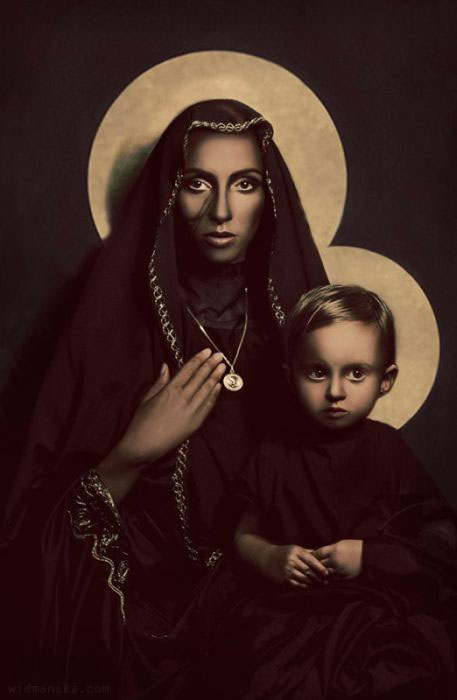

Katarzyna Widmanska
Madonna and Child
Models Iwona Cieniawska, Franio Skawiński 

Talents on September 35
Sylwia Makris
Model: Angelique Lang
Location: Rabenstein Castle, Zwiesel


Sylwia Makris was born in 1973 in Gdynia, Poland. She worked as a sculptor before finding her way to photography in 2007. Today she lives in Munich as freelance photographer. The Photo-Artist was first specialized in Portraits but later on shifted her interest also on reportage and fashion-photography. She had many Publications in Art- and Photogrphic-Magazines and there exists a row of Novels with her Pictures on the Cover. More

Madonna The White photo, concept and style Katarzyna Widmanska model Anna Niczyporuk mua Katarzyna Świebodzińska Make-Up Artist hair style Wojtek Kasprzak tatoo Tatuaże Zmywalne:
Katarzyna Widmanska
Madonnas, The White Madonna
Model Catherine Świebodzińska 
.
The White Madonna. As the story goes, during the French occupation in 1399, Portovenere, Italy,  was being devastated by a plague. Lucciardo, a local devout man, was praying in front of an image of the Virgin Mary asking for his village to be freed from the terrible disease when, suddenly, the colors of the painting lit up, gleaming. The plague disappeared after this miraculous event.

Prior to the miracle – still according to pious tradition – the painting was a faded hand-drawn parchment that had washed ashore on Portovenere inside a log with other relics in 1204. Following the transformation, the painting was kept in the Church of San Lorenzo for it to be worshiped. More

costume design Katarzyna Konieczka photography and style Katarzyna Widmanska model Alicja Sułek makeup Kasia Świebodzińska assistant Wojtek Kasprzak:
Katarzyna Widmanska
Madonnas
Model Angela Olszewska


Assumption of the Blessed Virgin Mary,  the object of faith concerning the taking into heaven body and soul of Mary at the end of her earthly life. Dogma is regarded in the Catholic Church. According to the theology of the Catholic Mary is the power of God was taken up to heaven like Enoch and Elijah.

Kathryn Stanley as Salome (1926, photo by Edwin Hesser):
Edwin Bower Hesser
Kathryn Stanley as Salome (1926)
“Thou rejectedest me. Thou didst speak evil words against me. Thou didst bear thyself toward me as to a harlot, to me, Salome, daughter of Herodias, Princess of Judaea!"
"Well, I still live, but thou art dead, and thy head belongs to me.”
-Oscar Wilde


Kathryn Stanley by Edwin Bower Hesser - Lost Hollywood Collection (c.1926). Still (9.5" X 13.5"). Glamour shot of Kathryn Stanley, a Mack Sennett bathing beauty who appeared in numerous short films. Stanley apparently plays the role of Salome contemplating the severed head of John the Baptist, in an image that would certainly have gotten much media play in the pre-Hays Code era. More

drtikol1.jpg
Frantisek Drtikol
Salome, 1919


František Drtikol (3 March 1883, Příbram – 13 January 1961, Prague) was a Czech photographer of international renown. He is especially known for his characteristically epic photographs, often nudes and portraits. From 1907 to 1910 he had his own studio, until 1935 he operated an important portrait photostudio in Prague. Drtikol made many portraits of very important people and nudes which show development from pictorialism and symbolism to modern composite pictures of the nude body with geometric decorations and thrown shadows, where it is possible to find a number of parallels with the avant-garde works of the period. These are reminiscent of Cubism, and at the same time his nudes suggest the kind of movement that was characteristic of the futurism aesthetic.

He began using paper cut-outs in a period he called "photopurism". These photographs resembled silhouettes of the human form. Later he gave up photography and concentrated on painting. After the studio was sold Drtikol focused mainly on painting, Buddhist religious and philosophical systems. In the final stage of his photographic work Drtikol created compositions of little carved figures, with elongated shapes, symbolically expressing various themes from Buddhism. In the 1920s and 1930s, he received significant awards at international photo salons. More

drtikol2.jpg
Frantisek Drtikol
Salome, 1920

Frantisek Drtikol
Salome
6.69 X 5.28 in (17 X 13.4 cm)
Vintage silver print, Bromografia
Creation Date:  Circa 1925

Frantisek Drtikol
Salome
11.22 X 8.62 in (28.5 X 21.9 cm)
vintage gelatin silver print
Creation Date:  1919


Frantisek Drtikol
Femme crucifiée, 1913
8.66 X 6.46 in (22 X 16.4 cm)
gelatin silver print on bromide paper

As I have searched the internet to find religious photographs with themes of love and religion within them, I came across these images; dark and with shadows or, in black and white. Here are just a few I found. (More)

Giovanni Squatriti
Ora Pro Nobis' (Pray For Us
model Joanna Augusciuk.

The December 2010 issue of Kurv magazine features this religious themed editorial 'Ora Pro Nobis' (Pray For Us) by Italian photographer Giovanni Squatriti, featuring model Joanna Augusciuk. 

The photographer Giovanni Squatriti explains, "The omnipresent Madonna has inspired not only the faithful but also the artistic. This shoot is a respectful, yet bold tribute to the blessed Virgin Mary. I represent the pain of the stigmata, the tears of blood, the Annunciation plunged into blue, and a black Mary, inspired by the most ancient testimonies of Christian iconography, where Madonna was portrayed with dark skin."  More

Giovanni Squatriti, is from Calabria, South Italy, and - like his fellow countryman - Gianni Versace evokes the iconographic images from his hometown through his work. Blue skies, breathtaking architecture, and classic statues all awaken the photographic inspirations behind Squatriti’s images, as he revives the freshness of the Magna Grecia with his color explosion photography. They evoke a sense of beauty very similar to the classic style, with poses and three dimensional sense study probably also owed to his birth country " More


Sebastian Faena
"Nun Head"

Sebastian Faena (born September 15, 1980 in Buenos Aires) is a fashion photographer and film director. He has photographed celebrities and models including Cindy Crawford, Celine Dion, Sky Ferreira, Milla Jovovich, Lady Gaga, Ashley Olsen, Irina Shayk, Daria Werbowy and Kate Upton. Faena has worked with Carlyne Cerf de Dudzeele, Katie Grand, Miuccia Prada and Carine Roitfeld. He has photographed campaigns for BCBG Max Azria, Blumarine, DVF by Diane von Furstenberg, Georg Jensen, Lord & Taylor, Mavi Jeans and Sam Edelman. Faena has photographed covers for Pop, V, Vogue Turkey, and six international versions of Harper's Bazaar. Several of his editorials have been publicized for their controversial themes. More

Sebastian Faena
"Nun Head"


Sebastian Faena
"Nun Head"


Mert Alas & Marcus Piggott
Model: Lara Stone


Mert and Marcus is the working name of two fashion photographers (Mert Alaş and Marcus Piggott) who work together on a collaborative basis. Their work and style is influenced by the photographer Guy Bourdin and have pioneered the use of digital manipulation within their field. They were both born in 1971. More

Alas in Turkey and Piggott in Wales. The pair met in 1994 in England. At the time Piggott was a photographer’s assistant and Alas was a fashion model, and the two quickly built a rapport and decided to work together. Their joint abilities were clear from the beginning. The first photos the duo submitted to Dazed & Confused made the cover. More


Marc Hom
Models: Jessica Hart and Lydia Hearst


Marc Hom was born in 1967 in Copenhagen, Denmark. He studied photography at the Københavns Tekniske Skole in Denmark and moved to New York City in 1989. After completing over a year of freelance work with established New York-based photographers, he was commissioned to do a photo book for the Vienna Ballet. Hom spent the next six months in Vienna photographing the ballet's principal dancers and directors and compiled a book of 80 images. Upon completion of the assignment, he returned to New York and began working with the late Liz Tilberis and Fabien Baron of Harper's Bazaar. This marked his introduction into the world of fashion photography and his establishment as a renowned photographer in the fashion world. More


Marc Hom
Model: Lara Stone for Vogue Paris, January 2010