Sir Edward John Poynter, Bt., P.R.A., R.W.S., 1836-1919
ANDROMEDA, c. 1869
Oil on canvas
51 by 36cm.; 20 by 14in.
Private Collection
Andromeda is the daughter of the Aethiopian king Cepheus and his wife
Cassiopeia. When Cassiopeia's hubris leads her to boast that Andromeda is more
beautiful than the Nereids, Poseidon sends a sea monster, Cetus, to ravage
Aethiopia as divine punishment. Andromeda is stripped and chained naked to a
rock as a sacrifice to sate the monster, but is saved from death by Perseus.
As a subject, Andromeda has been popular in art
since classical times; it is one of several Greek myths of a Greek hero's
rescue of the intended victim of an archaic hieros gamos, giving rise to the
"princess and dragon" motif. From the Renaissance, interest revived
in the original story, typically as derived from Ovid's account. More
Sir Edward John Poynter, 1st Baronet GCVO PRA (20 March 1836
in Paris – 26 July 1919 in London) was
an English painter, designer, and draughtsman who served as President of the
Royal Academy. Poynter was born in Paris, though his parents returned to
Britain soon after. He was educated at Brighton College and Ipswich School, but
left school early for reasons of ill health, spending winters in Madeira and
Rome. In 1853 he met Frederick Leighton in Rome, who made a great impression on
the 17-year-old Poynter. On his return to London he studied at Leigh's academy
in Newman Street and the Royal Academy Schools, before going to Paris to study
in the studio of the classicist painter Charles Gleyre where James McNeill
Whistler and George du Maurier were fellow-students. He became best known for
his large historical paintings. More
ANVERSOISE School 1650
Meleager and Atalanta
Copper.
68 x 85.5 cm
Private Collection
Meleager was the son of Althaea and the vintner Oeneus and. When Meleager was born, the the Fates predicted he would only live until a piece of wood, burning in the family hearth, was consumed by fire. Overhearing them, Althaea immediately doused and hid it.
Oeneus sent Meleager to gather up heroes from all over Greece to hunt the Calydonian Boar that had been terrorizing the area and rooting up the vines. In addition to the heroes he required, he chose Atalanta, a fierce huntress, whom he loved.According to one account of the hunt, when Hylaeus and Rhaecus, two centaurs, tried to rape Atalanta, Meleager killed them. Then Atalanta wounded the boar and Meleager killed it. He awarded her the hide since she had drawn the first drop of blood.
Meleager's brother Toxeus, the "archer",and Plexippus (Althaea's brother) grew enraged that the prize was given to a woman. Meleager killed them in the following argument. He also killed Iphicles and Eurypylus for insulting Atalanta. When Althaea found out that Meleager had killed her brother and one of her sons, Althaea placed the piece of wood that she had stolen from the Fates (the one that the Fates predicted, once engulfed with fire, would kill Meleager) upon the fire, thus fulfilling the prophecy and killing Meleager, her own son. The women who mourned his death were turned into guineafowl (Meleagrides).
More Meleager and Atalanta

ANVERSOISE School 1650
Meleager and Atalanta
Detail
The Antwerp School is a term for the artists active in Antwerp, first during the 16th century when the city was the economic center of the Low Countries, and then during the 17th century when it became the artistic stronghold of the Flemish Baroque under Peter Paul Rubens.
Antwerp took over from Bruges as the main trading and commercial center of the Low Countries around 1500. Painters, artists and craftsmen joined the Guild of Saint Luke, which educated apprentices and guaranteed quality. More Ecole Anversoise
Sir William Russell Flint, RA, PRWS (British, 1880-1969)
Judgement of Paris
Tempera
64 x 89.5cm (25 3/16 x 35 1/4in).
Private Collection
THE JUDGEMENT OF PARIS was a contest
between the three most beautiful goddesses of Olympos--Aphrodite, Hera and
Athena--for the prize of a golden apple addressed "To the Fairest."
The story began with the wedding of Peleus and
Thetis which all the gods had been invited to attend except for Eris, goddess
of discord. When Eris appeared at the festivities she was turned away and in
her anger cast the golden apple amongst the assembled goddesses addressed
"To the Fairest." Three goddesses laid claim to the apple--Aphrodite,
Hera and Athena. Zeus was asked to mediate and he commanded Hermes to lead the
three goddesses to Paris of Troy to decide the issue. The three goddesses
appearing before the shepherd prince, each offering him gifts for favour. He
chose Aphrodite, swayed by her promise to bestow upon him Helene, the most
beautiful woman, for wife. The subsequent abduction of Helene led directly to
the Trojan War and the fall of the city. More THE JUDGEMENT OF PARIS
Sir William Russell Flint (4 April 1880 – 30 December
1969) was a Scottish artist and illustrator who was known
especially for his watercolour paintings of women. He also worked in oils,
tempera, and printmaking. He was born in Edinburgh then educated at Daniel
Stewart's College and Edinburgh Institution. From 1894 to 1900 Flint
apprenticed as a lithographic draughtsman while taking classes at the Royal
Institute of Art, Edinburgh. From 1900 to 1902 he worked as a medical
illustrator in London while studying part-time at Heatherley's Art School. He
furthered his art education by studying independently at the British
Museum.
Flint was elected president of Britain’s Royal Society of
Painters in Watercolours (now the Royal Watercolour Society) in 1936 to 1956,
and knighted in 1947.
More William Russell Flint

Frederic, Lord Leighton, P.R.A., 1830-1896
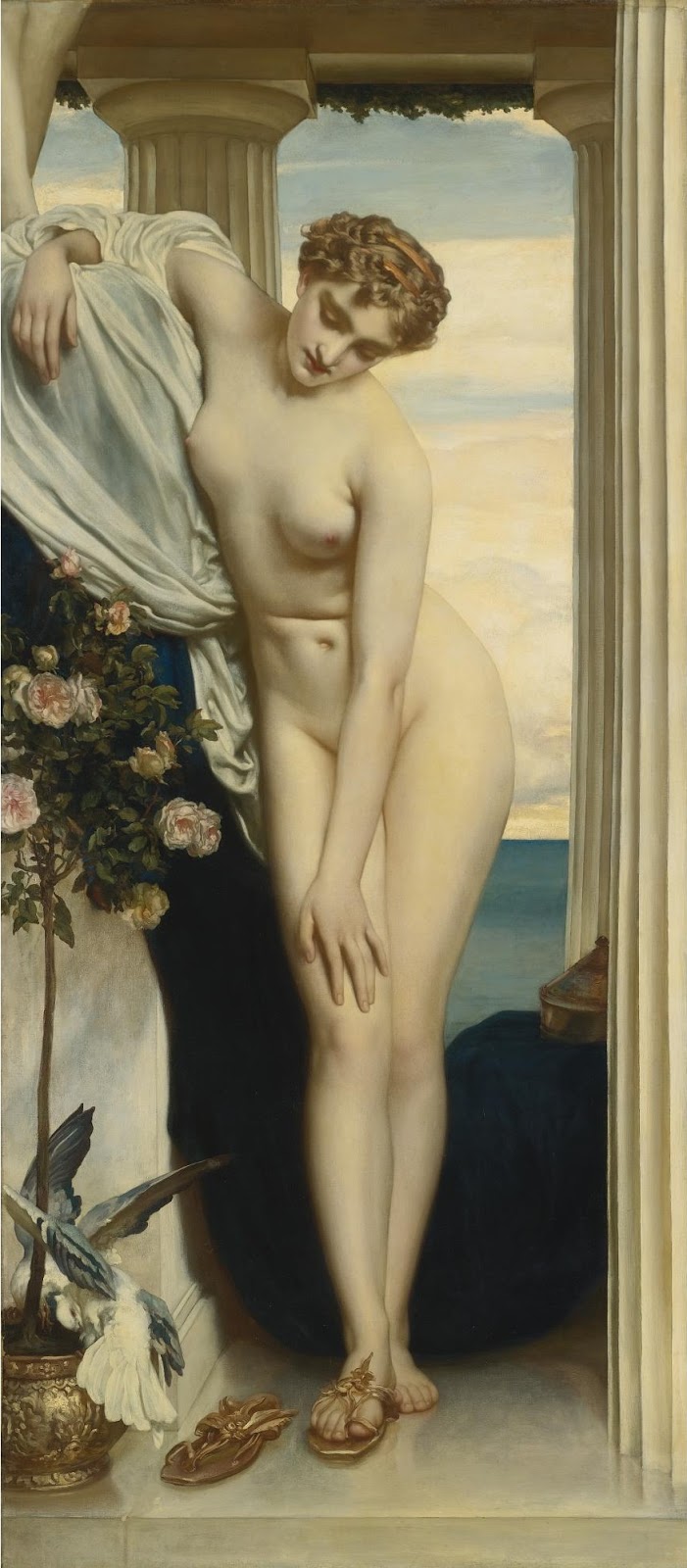
VENUS DISROBING FOR THE BATH
Oil on canvas
80 1/8 by 35 7/8 in., 203 by 91 cm
Private Collection
Framed by Doric columns with a background of azure sea and sky touched by the crimson setting sun, Venus' downward gaze and expanse of exposed, cool-toned skin invites observation as she steps out of a golden sandal while her robe, tangled in upraised arm, further emphasizes the vulnerable moment of undress.
Venus' pose references the Roman bronze and marble copies of Venus Loosening her Sandal and the Venus de Medici. Ultimately, Venus Disrobing was not intended as a didactic copy of specific antique sculpture nor a narrative, character-driven exercise; instead, it reveals the artist's decision to evoke classical models while suggesting a new experimentation with painterly expression. More
Venus is the Roman goddess whose functions encompassed love, beauty, desire, sex, fertility, prosperity and victory. In Roman mythology, she was the mother of the Roman people through her son, Aeneas, who survived the fall of Troy and fled to Italy. Julius Caesar claimed her as his ancestor. Venus was central to many religious festivals, and was revered in Roman religion under numerous cult titles.
The Romans adapted the myths and iconography of her Greek counterpart Aphrodite for Roman art and Latin literature. In the later classical tradition of the West, Venus becomes one of the most widely referenced deities of Greco-Roman mythology as the embodiment of love and sexuality. More Venus
Frederic Leighton, 1830–1896, British, English. (Born Scarborough, 3 December 1830; died London, 25 January 1896). English painter, draughtsman, and occasional sculptor, one of the dominant figures of late Victorian art. He travelled widely in Europe as a boy and his artistic education was gained principally in Frankfurt, Rome, and Paris. It was not until 1859 that he settled in England, but he had earlier made his name with Cimabue's Celebrated Madonna is Carried in Procession through the Streets of Florence, which he painted in Rome: it was exhibited at the 1855 Royal Academy exhibition and bought by Queen Victoria (it is now on loan from the Royal Collection to the National Gallery, London).
From the mid-1860s he enjoyed a level of worldly success. He became president of the Royal Academy in 1878, was made a baronet in 1886, and a few days before he died was raised to the peerage, the first (and so far only) British artist to be so honoured.
He is best known for his paintings of classical Greek subjects, the finest of which are distinguished by magnificently opulent colouring as well as splendid draughtsmanship. As a sculptor his output was small. The finished life-size bronze is in Tate Britain and there are various smaller models and versions, including one in Leighton House, the sumptuously decorated house and studio he built in the fashionable Holland Park area of London, now a museum dedicated to him. More Frederic Leighton
Frederic Leighton, (1830–1896)
Perseus and Andromeda, c. 1891
Oil on canvas
Height: 2,350 mm (92.52 in). Width: 1,292 mm (50.87 in).
Walker Art Gallery, Liverpool
Perseus and Andromeda, see above
Frederic Leighton (1830–1896), see above
Schiele, Egon (1907)
Water Spirits I
27.5 x 53.5 cm
Private Collection
From 1907 Schiele had already deduced subjects from the landscapes that Gustav Klimt had painted between 1899 and 1907, but it's in the two versions of Water spirits, of 1907 and 1908, the artist uses an artistic language openly inspired by Klimt, even if more geometrical and rough, perfectly in line with the Wiener Werkstätte. More
Schiele, Egon (1907)
Water Spirits I
Oil and gouache
27.5 x 53.5 cm
Private Collection
Schiele, Egon (1908)
Water Elves - Water Sprites
Gouache, crayon, watercolor, white body color and gold paint on paper
27,5 x 53,5 cm (10,8 x 21,1 in)
Egon Schiele (German: 12 June 1890 –
31 October 1918) was
an Austrian painter. A protégé of Gustav Klimt, Schiele was a major figurative
painter of the early 20th century. His work is noted for its intensity and its
raw sexuality, and the many self-portraits the artist produced, including naked
self-portraits. The twisted body shapes and the expressive line that
characterize Schiele's paintings and drawings mark the artist as an early
exponent of Expressionism. More Egon Schiele
Jean Raoux, 1677 - 1734
Vestal Carrying the Sacred Fire, circa 1728-1729
Oil on canvas
105.5 cm (41.54 in.), Width: 80 cm (31.5 in.)
Musée Fabre (France - Montpellier)
In ancient Rome, the Vestals or Vestal Virgins (Latin: Vestālēs, singular Vestālis [wɛsˈtaː.lɪs]) were priestesses of Vesta, goddess of the hearth. The College of the Vestals and its well-being were regarded as fundamental to the continuance and security of Rome. They cultivated the sacred fire that was not allowed to go out. The Vestals were freed of the usual social obligations to marry and bear children, and took a vow of chastity in order to devote themselves to the study and correct observance of state rituals that were off-limits to the male colleges of priests. More Vestal Virgins
Jean Raoux (1677 – 10 February 1734), French painter, was born at Montpellier. After the usual course of training he became a member of the Academy in 1717 as an historical painter. His reputation had been previously established by the credit of decorations executed during his three years in Italy on the palace of Giustiniani Solini at Venice, and by some easel paintings. To this latter class of subject Raoux devoted himself, nor did he even paint portraits except in character. The list of his works is a long series of sets of the Seasons, of the Hours, of the Elements, or of those scenes of amusement and gallantry in the representation of which he was immeasurably surpassed by his younger rival Watteau. After his stay in England (1720) he lived much in the Temple, where he decorated several rooms. He died in Paris in 1734. More Jean Raoux
Images are copyright of their respective owners, assignees or others