Edwin Longsden Long
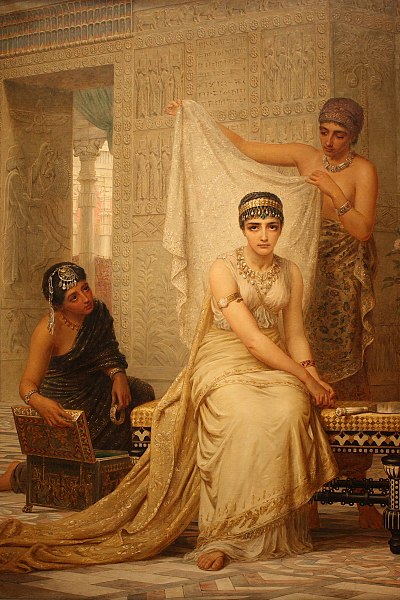
Ester, c. 1878
National Gallery of Victoria, Melbourne
Esther is being groomed to take up her role as a wife of King Ahasuerus. Her face shows resignation and a certain foreboding. She already knows enough of the king's personality to realize the danger she is in, and the difficult road ahead of her. More
Edwin Longsden Long RA (12 July 1829 – 15 May 1891) was an English genre, history, biblical and portrait painter. Long was born in Bath, and was educated at Dr. Viner's School in Bath. Adopting the profession of a painter, Long came to London and studied in the British Museum. He was subsequently a pupil in the school of James Mathews Leigh in Newman Street London, and practiced first as a portrait artist painting Charles Greville, Lord Ebury and others.
Long made the acquaintance of John Phillip RA, and accompanied him to Spain, where they spent much time. Long was greatly influenced by the paintings of Velasquez and other Spanish masters, and his earlier pictures, such as 'La Posada' (1864) and 'Lazarilla and the blind beggar' (1870), were painted under Spanish influence. His first important pictures were 'The Suppliants' (1872) and 'The Babylonian marriage market' (both subsequently purchased by Thomas Holloway). In 1874, he visited Egypt and Syria, and subsequently his work took a new direction. He became thoroughly imbued with middle-eastern archaeology and painted oriental scenes like 'The Egyptian Feast' (1877), 'The Gods and their makers' (1878) etc.
Long was elected an associate of the Royal Academy in 1870 and an academician (RA) in 1881. His pictures suited the taste and appealed to the religious sentiment of a large portion of the public, and their popularity was increased by a wide circulation of engravings. He consequently determined to exhibit his next pictures in a separate gallery of his own in Bond Street, London and there in 1883, and the following years, his 'Anno Domini' and 'Zeuxis at Crotona' met with great commercial success.
Long died from pneumonia resulting from influenza, at his home, "Kelston" in Netherhall Gardens, Hampstead, on 15 May 1891, in his sixty-second year. He was buried in West Hampstead Cemetery. More
Esther, born Hadassah, is the eponymous heroine of the Book of Esther. According to the Hebrew Bible, Esther was a Jewish queen of the Persian king Ahasuerus. Ahasuerus is traditionally identified with Xerxes I during the time of the Achaemenid empire. In many ways, Esther's story – known as the Book of Esther in the Christian Old Testament and the Megillah (Scroll) of Esther in the Jewish Bible – reads like a Cinderella tale.
Theodore Chasseriau
The Toilette of Esther, c. 1841
oil on canvas
45.5 x 35.5 cm
Paris, Louvre
Esther's beauty is apparent, as she is helped by her maidservants to complete her toilette. The process of preparation for entry into the King's harem lasted twelve months.
Théodore Chassériau (September 20, 1819 – October 8, 1856) was a French Romantic painter noted for his portraits, historical and religious paintings, allegorical murals, and Orientalist images inspired by his travels to Algeria.
Chassériau was born in El Limón, Samaná, in the Spanish colony of Santo Domingo (now the Dominican Republic). In December 1820 the family left Santo Domingo for Paris, where the young Chassériau soon showed precocious drawing skills. He was accepted into the studio of Jean-Auguste-Dominique Ingres in 1830, at the age of eleven, and became the favorite pupil of the great classicist, who regarded him as his truest disciple.
After Ingres left Paris in 1834 to become director of the French Academy in Rome, Chassériau fell under the influence of Eugène Delacroix, whose brand of painterly colorism was anathema to Ingres. Chassériau's art has often been characterized as an attempt to reconcile the classicism of Ingres with the romanticism of Delacroix. He first exhibited at the Paris Salon in 1836, and was awarded a third-place medal in the category of history painting. In 1840 Chassériau travelled to Rome and met with Ingres, whose bitterness at the direction his student's work was taking led to a decisive break.
In 1846 Chassériau made his first trip to Algeria. From sketches made on this and subsequent trips he painted such subjects as Arab Chiefs Visiting Their Vassals and Jewish Women on a Balcony...
After a period of ill health, exacerbated by his exhausting work on commissions for murals to decorate the Churches of Saint-Roch and Saint-Philippe-du-Roule, Chassériau died at the age of 37 in Paris, on October 8, 1856. More
François-Léon Benouville (1821–1859)
Esther, c 1844
Oil on canvas
124 × 162 cm (48.8 × 63.8 in)
Current location
Musée des beaux-arts de Pau
François-Léon Benouville (Paris 30 March 1821 – 16 February 1859 Paris) was a French painter. He first studied with his elder brother Jean-Achille Benouville (1815–1891) in the studio of François-Edouard Picot before he transferred to École des Beaux-Arts in 1837. Like his brother he received the Prix de Rome in 1845. In Rome, as a Prix de Rome pensionary at the Villa Medici. His works produced in Rome are influenced by early Christianity and often show representations of antiquity. More
King Ahasuerus (Xerxes I) held a 180-day feast in Susa (Shoushan). While in "high spirits" from the wine, he ordered his queen, Vashti, to appear before him and his guests to display her beauty. But when the attendants delivered the king's command to Queen Vashti, she refused to come.
Azor masters ca. 1430
Queen Vashti Refuses to Appear before Ahasuerus, c. 15th century
Illumination
(62 × 87 mm)
Museum Royal Library, The Hague
The beautiful queen Vashti declines the invitation for her husband King Ahasuerus' long drinking-bout. [..] therefore was the king very wroth, and his anger burned in him. Ahasuerus then repudiates his wife. His eye goes out to Esther. More
Azor masters, ca. 1430. Dutch master, or masters, working in Utrecht around 1430. Belonged to what was known as the 'Bible Masters of the First Generation'. Utrecht was at the time renowned for its fabrication of illustrated bibles.
In 1430 the Azors contribute to the production of a historical bible and a Book of Hours, manufactured at some time between 1430 and 1450. No information exists on their identity – the Azor masters may in fact have been one person. The name Azor is biblical in origin and appears in the genealogy of Matthew 1 as a forefather of Jesus'. More
Edwin Long, R.A. (1829–1891)
Vashti Refuses the King's Summons, c. 1878
Bob Jones University Museum and Gallery, Greenville, United States
Edwin Long, R.A. (1829–1891), see below
Jacopo del Sellaio (1441/1442–1493)
The Banquet of Ahasuerus, circa 1490
Tempera on panel
Height: 81 cm (31.9 in). Width: 44 cm (17.3 in).
Uffizi Gallery, Firenze, Italy
The Persian king Ahasuerus is surrounded by his courtiers, who seem nonplussed, even aghast, at something that has just happened. They have probably heard about Queen Vashti's message to the king: that she refuses to obey his order to parade herself before the half- or fully-drunk men. Disobedience of a royal order was unthinkable, even for a queen, since the king wielded absolute power. More
Jacopo da Sellaio (c. 1441–1493[1]), sometimes known as Jacopo di Arcangel, was an eclectic Italian painter from the early Renaissance, who painted in the style of the Florentine School. He was a pupil of Fra' Filippo Lippi, with his contemporary Sandro Botticelli, who became a lasting influence on him. It is noted that by 1460, he had joined the Confraternity of Saint Luke in Florence, and in 1473, he is documented to have shared a studio with Filippo di Giuliano.
A number of da Sellaio's paintings for decorative chests survive in collections. His piece now in the Uffizi Gallery, The Banquet of Ahasuerus, was also painted with two other panels, including Esther before Ahasuerus (Museum of Fine Arts, Budapest) for a cassoni.
Da Sellaio's small devotional pieces were well known, several of which depicted Saint Jerome and Saint John the Baptist. He also painted religious works for the church of San Lucia dei Magnoli and the church of San Frediano, both in Florence. More
Alexandre Cabanel, (French, 1823 - 1889)
Queen Vashti, c. 1880
Oil on canvas
51.00 in. (129.54 cm.) (height) by 39.00 in. (99.06 cm.) (width)
Alexandre Cabanel (28 September 1823 – 23 January 1889) was a French painter born in Montpellier, Hérault. He painted historical, classical and religious subjects in the academic style. He was also well known as a portrait painter. According to Diccionario Enciclopedico Salvat, Cabanel is the best representative of the L'art pompier and Napoleon III's preferred painter. More
Furious at her refusal to obey, the king asked his wise men what should be done. One of them said that all the women in the empire would hear that "The King Ahasuerus commanded Vashti the queen to be brought in before him, but she came not." Then these women would despise their husbands, which would cause many problems in the kingdom. Therefore it would be prudent to depose Vashti.
Ernest Normand (1859–1923)
Queen Vashti deposed, c. 1890
Oil on canvas
172.6 x 304.6 cm
Royal Holloway, University of London
Unlike Esther, Vashti was born into a noble family and married to King Ahasuerus, but she was now disgraced. She had refused to appear before her husband's drunken friends, and her enemies at court persuaded the King that this act of disobedience would set a bad example to all the women in his kingdom - who would refuse to obey their own husbands. They encouraged him to exile her from his presence, and so she was banished to a back room of the palace harem where she would remain for the rest of her life.
Normand's wonderful painting shows Vashti's despair. She has lost everything - her political power, her dignity, her chance to bear children, her friends and supporters, her entire future. She was now a prisoner - well-fed and well-housed perhaps, but permanently trapped and alone. More
Many beautiful maidens were then brought before the king in order that he might choose a successor to the unruly Vashti. The King chose Esther, an orphan daughter of a Benjamite named Abihail.
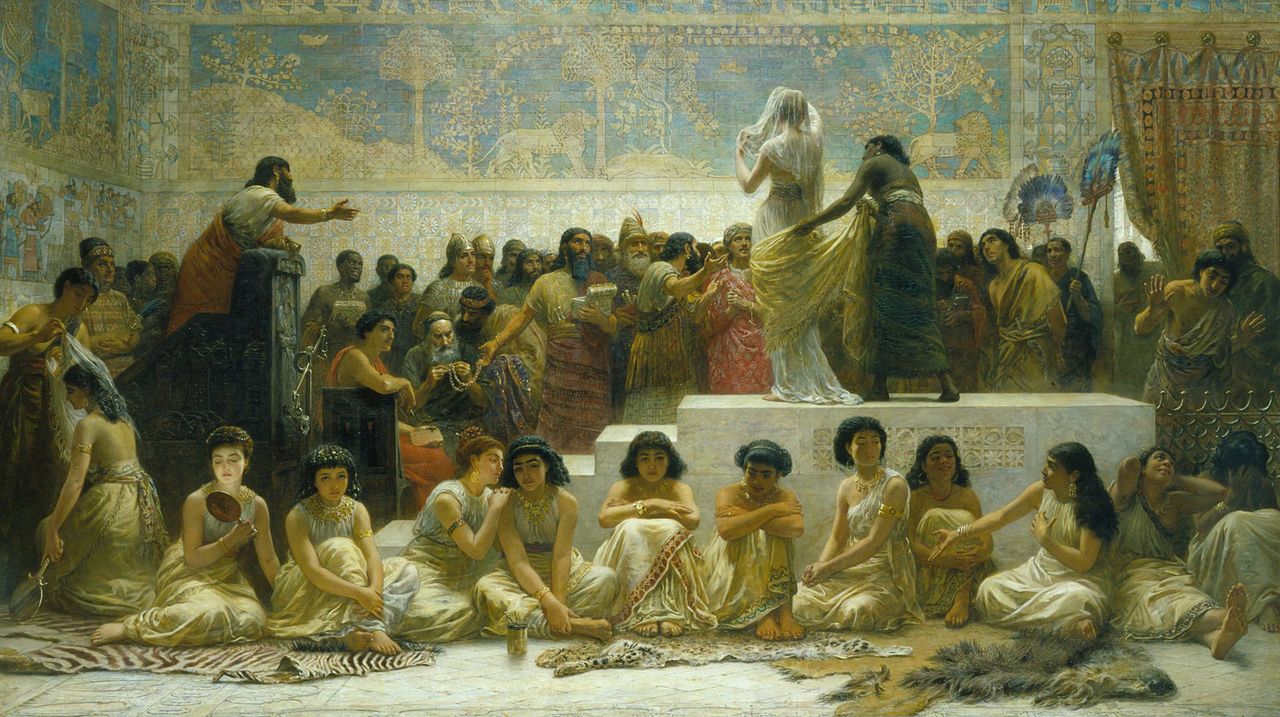
Edwin Long (1829–1891)
The Babylonian Marriage Market
Oil on Canvas
Royal Holloway College (London)
Edwin Long (1829–1891), see below
Aert de Gelder (1645–1727)
Esther Bedecked, c. 1684
Oil on canvas
Alte Pinakothek
Esther has 'pleased' King Ahasuerus, and he has chosen her as his future queen. The touch of ermine on the edges of Esther's cloak signal to the viewer that this is the moment when she is acknowledged as Queen, replacing the exiled Vashti. More
Aert de Gelder (1645–1727), see below
Paolo Veronese (1528–1588)
Esther Crowned by Ahasuerus, c. 1556
Oil on canvas
Height: 450 cm (177.2 in). Width: 370 cm (145.7 in).
San Sebastiano, Venice
Paolo Caliari, known as Paolo Veronese (1528 – 19 April 1588) was an Italian Renaissance painter based in Venice, most famous for large history paintings of both religious and mythological subjects, such as The Wedding at Cana and The Feast in the House of Levi. With Titian, who was at least a generation older, and Tintoretto, ten years older, he was one of the "great trio that dominated Venetian painting of the cinquecento" or 16th-century late Renaissance. Veronese is known as a supreme colorist, and after an early period with Mannerist influence turned to a more naturalist style influenced by Titian.
His most famous works are elaborate narrative cycles, executed in a dramatic and colorful style, full of majestic architectural settings and glittering pageantry. His large paintings of biblical feasts, crowded with figures, painted for the refectories of monasteries in Venice and Verona are especially famous, and he was also the leading Venetian painter of ceilings. Most of these works remain in situ, or at least in Venice, and his representation in most museums is mainly composed of smaller works such as portraits that do not always show him at his best or most typical.
He has always been appreciated for "the chromatic brilliance of his palette, the splendor and sensibility of his brushwork, the aristocratic elegance of his figures, and the magnificence of his spectacle", but his work has been felt "not to permit expression of the profound, the human, or the sublime", and of the "great trio" he has often been the least appreciated by modern criticism. Nonetheless, "many of the greatest artists ... may be counted among his admirers, including Rubens, Watteau, Tiepolo, Delacroix and Renoir". More
Esther was originally named Hadassah, meaning myrtle. She had spent her life among the Jewish exiles in Persia, where she lived under the protection of her cousin Mordecai. When Cyrus gave permission for the exiles to return unto Jerusalem, she stayed with Mordecai.
Claude Vignon (1593–1670)
Ahasuerus Showing his Treasure to Mordecai
Oil on canvas
40.64 x 27.94cm
King Ahasuerus obliged everyone in his kingdom to pay taxes. Mordecai was the next highest official in the Mede-Persia kingdom. The great things that King Ahasuerus did were written in the book of the chronicles. Mordecai was a popular leader among the Jews because he always helped them; and spoke to the king on behalf of them. More
Claude Vignon (1593–1670), see below
Mordecai was the son of Jair, a Benjamite, who had been carried into captivity together with Jeconiah by Nebuchadnezzar, King of Babylon. Mordecai became chief minister of Ahasuerus and lived in the Persian capital of Susa.
Galle, Philips & Heemskerck, Maerten van, 16th / 17th century
Mordechai listen to the betrayal of Bigthan and Teresh
Engraving
192 mm x 240 mm; hxw 2 (CA): 205 mm x 242 mm
Museum Boijmans Van Beuningen, Rotterdam, Netherlands
Mordecai Overhearing the Conspirators Bigthan and Teresh; The Hanging of Bigthan and Teesh from a series of the Story of Esther
South Lowlands, 1510-1520
One day, while sitting at the gate of the king's palace, Mordecai overheard a plot of two eunuchs, Bigthan and Teresh, to kill the king. Having informed the king through Esther of the conspiracy, Mordecai brought about the execution of the two conspirators, and the event was recorded in the royal chronicles.
Arent de Gelder 1645 – 1727
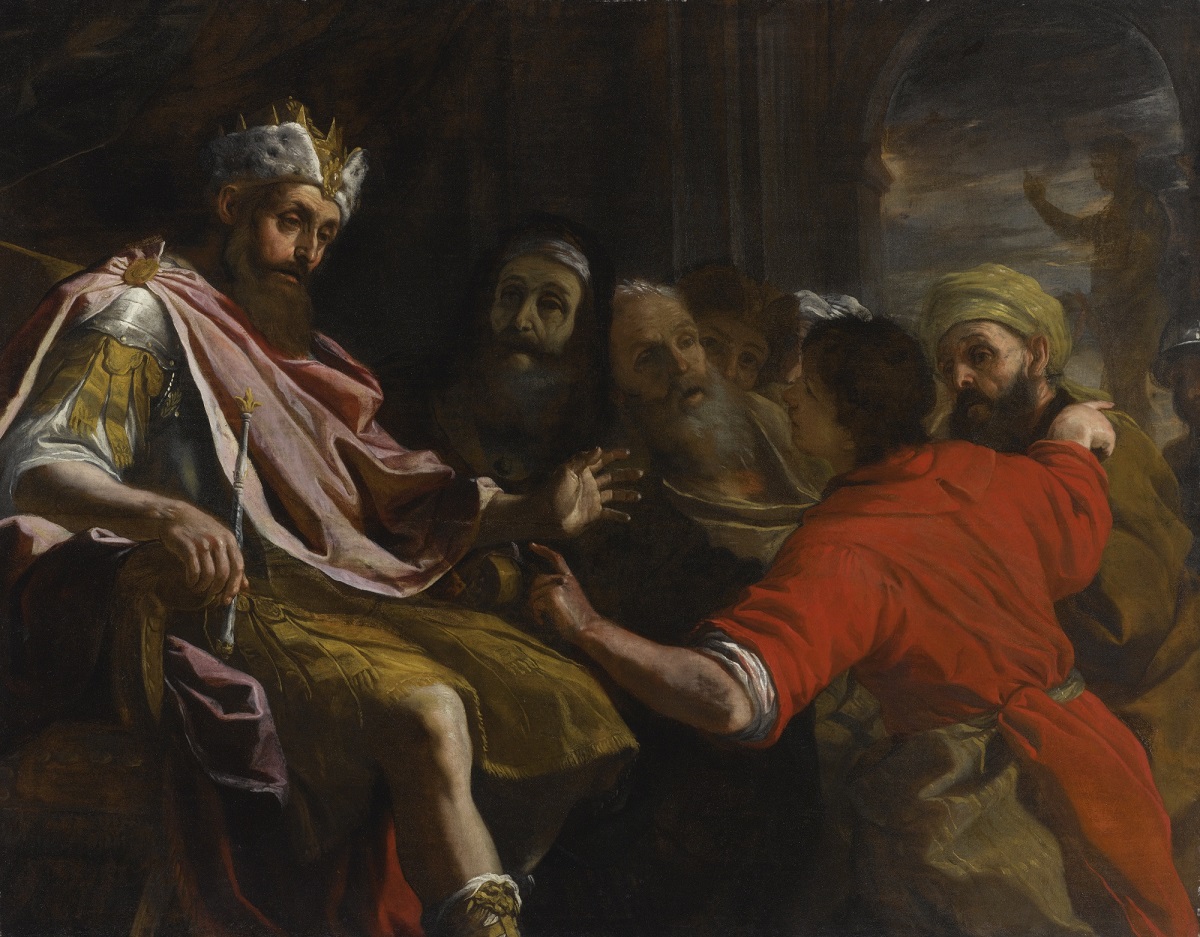
Ahasuerus and Haman, c. 1682
oil on canvas
138 × 117 cm
Museum Barber Institute of Fine Arts, Birmingham (UK)
Aert de Gelder (or
Arent; October 26, 1645 – August 27, 1727) was a Dutch painter. De Gelder was born and died in
Dordrecht. He was one of Rembrandt’s last pupils while in Amsterdam, studying
in his studio from 1661 to 1663. He was not only one of the most talented of
Rembrandt’s pupils, but also one of his most devoted followers, for he was the
only Dutch artist to paint in the tradition of Rembrandt's late style into the
18th century. Following Rembrandts lead, De Gelder would paint such artworks as
"The Baptism of Christ" and ".Ahimelech Giving the Sword of
Goliath to David". Story telling and with transparent emotionalism, and an
emphasizing the human element to biblical characters is one of the
distinguishing elements of this style, as opposed to the courtly and distant
emotions and imagery of other artists, even in the Renaissance period. More
Haman (Also known as Haman the Agagite) is the main antagonist in the Book of Esther, who, according to the Hebrew Bible, was a vizier in the Persian empire under King Ahasuerus, traditionally identified as Xerxes I. As his name indicates, Haman was a descendant of Agag, the king of the Amalekites, a people who were wiped out in certain areas by King Saul and David.
Paul Alexandre Alfred Leroy (1860 in Paris – 1942)
Haman and Mordecai, 1884
Odessa Museum of Western and Eastern Art
Paul Alexandre Alfred Leroy (1860 in Paris – 1942) was a French Orientalist painter. He spent his childhood in Odessa, which gave him interest in the East. More
The grand vizier, Haman the Agagite, commanded Mordecai to do obeisance to him. Upon Mordecai's refusal to prostrate himself, Haman informed the king that the Jews were a useless and turbulent people and inclined to disloyalty, and he promised to pay 10,000 silver talents into the royal treasury for the permission to pillage and exterminate this alien race. The king then issued a proclamation ordering the confiscation of Jewish property and a general extermination of all the Jews within the empire.
Sir John Everett Millais, 1st Baronet, (8 June 1829 – 13 August 1896)
Ester, c. 1865
Oil on canvas
Esther, dressed in royal robes, stands outside the entrance to the throne room of her husband, King Ahasuerus. She raises her right hand to untie the pearls which hold back her thick hair. In her left hand she holds her crown, which she is about to place on her head. This is the moment of decision.
The strong blue, gold and white of this painting accentuates the drama of this moment, as Esther pauses outside the royal throne room of her husband. The robe she wears in the painting was a real one, given to General Gordon by the grateful Chinese emperor after Gordon helped suppress the Taiping Rebellion (1850-64) - though Millais turned the garment inside out, and so it is the lining of the robe that is seen in this painting.
Sir John Everett Millais, 1st Baronet, (8 June 1829 – 13 August 1896) was an English painter and illustrator. he was one of the founders of the Pre-Raphaelite Brotherhood.
A child prodigy, at the age of eleven Millais became the youngest student to enter the Royal Academy Schools. The Pre-Raphaelite Brotherhood was founded at his family home in London. Millais became the most famous exponent of the style, his painting Christ in the House of His Parents (1850) generating considerable controversy. By the mid-1850s Millais was moving away from the Pre-Raphaelite style and developing a new and powerful form of realism in his art. His later works were enormously successful, making Millais one of the wealthiest artists of his day. While early 20th-century critics, reading art through the lens of Modernism, viewed much of his later production as wanting, this perspective has changed in recent decades, as his later works have come to be seen in the context of wider changes and advanced tendencies in the broader late-nineteenth-century art world.
Millais's personal life has also played a significant role in his reputation. His wife Effie was formerly married to the critic John Ruskin, who had supported Millais's early work. The annulment of the marriage and her wedding to Millais have sometimes been linked to his change of style, but she became a powerful promoter of his work and they worked in concert to secure commissions and expand their social and intellectual circles. More
Giovanni Andrea Sirani (1610–1670)
Esther before Ahasuerus, circa 1640 and circa 1660
Oil on canvas
101 × 140 cm (39.8 × 55.1 in)
Museum of Fine Arts (Budapest)
Giovanni Andrea Sirani (4 September 1610 – 21 May 1670) was an Italian Baroque painter from Bologna. He is best known as the father of the female painter Elisabetta Sirani. Sirani trained initially with Giacomo Cavedone, then worked in the studio with Guido Reni. He became entangled in various conspiracies circling around the death of his daughter in 1665. While Giovanni accused a maid of poisoning his daughter, others saw Giovanni as the origin of death from stomach ulcer by overwork. More
Mordecai tore his robes and put ash on his head (signs of mourning or grieving) on hearing this news.
Now when Mordecai found out all that was done, Mordecai tore his clothes, and put on sackcloth with ashes, and went out into the midst of the city, and wailed loudly and a bitterly.
Sheltered in the harem, Esther was unaware of the decree until Mordecai advised her of it through Hathach, one of the king's chamberlains. He informed her that she should not think that she would escape simply because she was in the palace. At the request of Esther, Mordecai instituted at Susa a general fast for three days.
Claude Vignon (1593–1670)
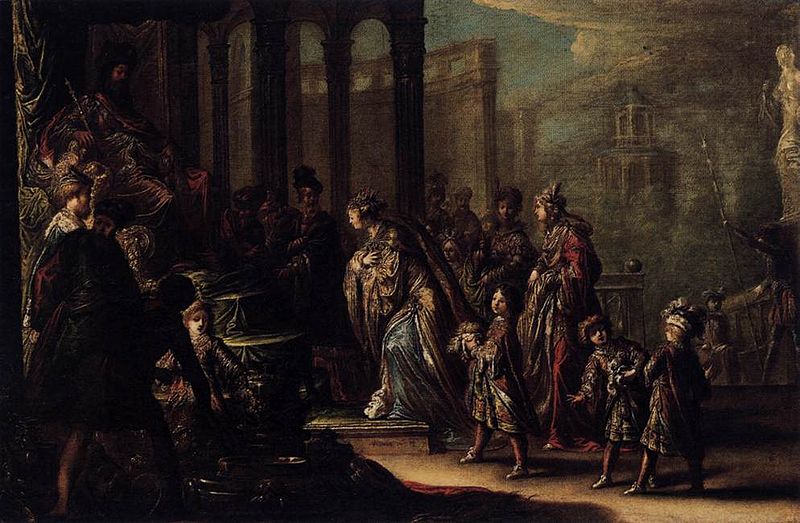
Esther before Ahasuerus, c. 1624
Oil on canvas
Height: 80 cm (31.5 in). Width: 119 cm (46.9 in).
Louvre Museum
Esther, gorgeously dressed and accompanied by a retinue of servants, bows before the King, her husband. He sits impassively watching her. Perhaps Vignon was suggesting that the King's measured stare was the cause of her terror and subsequent fainting spell. More
Claude Vignon (19 May 1593 – 10 May 1670) was a leading French painter and engraver working in the Baroque manner. He was born at Tours and received early training in Paris. About 1610 he travelled to Rome where his mature style was formed in the circle of French painters there that included Simon Vouet and Valentin de Boulogne, a prominent member of the Caravaggisti working, like Bartolomeo Manfredi, in the manner established by Caravaggio.
He returned from Italy, after a tour in Spain, in 1623. His paintings are represented in most of the major museums. More
Esther attended the court in regal dress in order to appeal to Ahasuerus. 'But as she was speaking, she fell fainting. The King was agitated, and all his servants sought to comfort her.

'
TINTORETTO, (b. 1518, Venezia, d. 1594, Venezia)
Esther before Ahasuerus, c. 1547-48
Oil on canvas
207,4 x 273 cm
Royal Collection, Windsor
Tintoretto; born Jacopo Comin, (late September or early October, 1518 – May 31, 1594) was an Italian painter and a notable exponent of the Renaissance school. For his phenomenal energy in painting he was termed Il Furioso. His work is characterized by its muscular figures, dramatic gestures, and bold use of perspective in the Mannerist style, while maintaining color and light typical of the Venetian School.
In his youth, Tintoretto was also known as Jacopo Robusti as his father had defended the gates of Padua in a way that others called robust, against the imperial troops during the War of the League of Cambrai (1509–1516). His real name "Comin" has only recently been discovered by Miguel Falomir, the curator of the Museo del Prado, Madrid, and was made public on the occasion of the retrospective of Tintoretto at the Prado in 2007. Comin translates to the spice cumin in the local language. More
Antoine Coypel
Esther before Ahasuerus, c. 1697
Oil Painting on Canvas
36” inches wide by 27” inches high
Antoine Coypel (11 April 1661 – 7 January 1722) was a history painter, the more famous son of the French painter Noël Coypel. Antoine was born in Paris. He studied under his father, with whom he spent four years at Rome. At the age of eighteen he was admitted into the Académie de peinture et de sculpture, of which he became professor and rector in 1707, and director in 1714. In 1716 he was appointed king's painter, and he was ennobled in the following year.
His great work of decoration was the ceiling of the Royal chapel at Versailles (1716), in the manner of the Roman Baroque. He also carried out large-scale paintings illustrating themes of the Aeneid for the Palais-Royal (1714–1717).
Antoine Coypel received a careful literary education, the effects of which appear in his works; but the graceful imagination displayed by his pictures is marred by the fact that he was not superior to the artificial taste of his age. He was a clever etcher, and engraved several of his own works. His Discours prononcés dans les conferences de 1'Academie royale de Peinture, etc.; first appeared in 1721.
He died in 1722, he was 61 years old. More
Artemisia Gentileschi (Italian, Rome 1593–1651/53 Naples)
Esther before Ahasuerus
Oil on canvas
82 x 107 3/4 in. (208.3 x 273.7 cm)
The Metropolitan Museum of Art
Artemisia Gentileschi; (July 8, 1593 – c. 1656) was an Italian Baroque painter, today considered one of the most accomplished painters in the generation following that of Caravaggio. In an era when women painters were not easily accepted by the artistic community or patrons, she was the first woman to become a member of the Accademia di Arte del Disegno in Florence.
She painted many pictures of strong and suffering women from myth and the Bible – victims, suicides, warriors.
Her best-known work is Judith Slaying Holofernes (a well-known medieval and baroque subject in art), which "shows the decapitation of Holofernes, a scene of horrific struggle and blood-letting". That she was a woman painting in the seventeenth century and that she was raped and participated in prosecuting the rapist, long overshadowed her achievements as an artist. For many years she was regarded as a curiosity. Today she is regarded as one of the most progressive and expressionist painters of her generation. More
Esther could not approach the king without being summoned, on pain of death, and the king had not summoned her in thirty days, implying that she may have fallen out of favor. Nevertheless, at the end of the three days, Esther dressed in her royal apparel and went before the king. When the king asked her what her request was, she invited the king and Haman to come to a banquet she had prepared.
Johann Spilberg the Younger (German, 1619–1690)
The Feast of Esther, ca. 1644
Oil on canvas
Size Notes:
54 1/4" high x 66 1/4" wide
Johannes Spilberg (30 April 1619 – 10 August 1690) was a German Baroque painter, active in Amsterdam during the period known as the Dutch Golden Age. He is known for portraits, landscapes, and historical allegories in the Rembrandt school. Spilberg was born and died in Düsseldorf. He learned to paint from his father, who painted in oils and on glas, who then sent him to Antwerp, to learn under Rubens. While underway, he heard that Rubens had died, so he settled in Amsterdam and became apprentice to Govert Flink, a student of Rembrandt, for seven years. He won a commission for a schutterstuk from the Burgomasters of Amsterdam that still hangs in Amsterdam.
Though he worked in Düsseldorf, he kept his family in Amsterdam, since he was traveling with his patron most of the time anyway. He taught his daughter Adriana to paint, and her talents became so well known, that she was offered a position in Düsseldorf as well. More
At the banquet they accepted her invitation to dine with her again on the following day.
Rembrandt (1606–1669)
Ahasuerus and Haman at the Feast of Esther, c. 1660
Oil on canvas
Height: 73 cm (28.7 in). Width: 94 cm (37 in).
Pushkin Museum, Moscow, Russia,
Rembrandt Harmenszoon van Rijn (15 July 1606 – 4 October 1669) was a Dutch painter and etcher. He is generally considered one of the greatest painters and printmakers in European art and the most important in Dutch history. His contributions to art came in a period of great wealth and cultural achievement that historians call the Dutch Golden Age when Dutch Golden Age painting, although in many ways antithetical to the Baroque style that dominated Europe, was extremely prolific and innovative, and gave rise to important new genres in painting.
Having achieved youthful success as a portrait painter, Rembrandt's later years were marked by personal tragedy and financial hardships. Yet his etchings and paintings were popular throughout his lifetime, his reputation as an artist remained high, and for twenty years he taught many important Dutch painters. Rembrandt's greatest creative triumphs are exemplified most notably in his portraits of his contemporaries, self-portraits and illustrations of scenes from the Bible. His self-portraits form a unique and intimate biography, in which the artist surveyed himself without vanity and with the utmost sincerity.
In his paintings and prints he exhibited knowledge of classical iconography, which he molded to fit the requirements of his own experience; thus, the depiction of a biblical scene was informed by Rembrandt's knowledge of the specific text, his assimilation of classical composition, and his observations of Amsterdam's Jewish population. Because of his empathy for the human condition, he has been called "one of the great prophets of civilization." More
Haman, carried away by the joy that this honour gave him, issued orders for the erection of a gallows on which he purposed to hang the hated Mordecai.
But that night the king, being sleepless, ordered the chronicles of the nation to be read to him. Recalling that Mordecai had never been rewarded for his service in revealing the plot of the eunuchs, he asked Haman, the next day, to suggest a suitable reward for one "whom the king desired to honour". Thinking it was himself that the king had in mind, Haman suggested the use of the king's apparel and insignia. These the king ordered to be bestowed on Mordecai.
REMBRANDT (1606–1669)
Haman Sets Forth to Honour Mordecai, c. 1665
Oil on Canvas
Hermitage, Leningrad
Only at the second dinner party, when the king was sufficiently beguiled by her charms, did Esther reveal for the first time her identity as a Jew, and accused Haman of the plot to destroy her and her people.
Jan Lievens, 1607-1674
The Feast of Esther, circa 1625
Oil on canvas
51 1/2 x 64 1/2 in. (130.8 x 163.8 cm)
North Carolina Museum of Art
One of the most dramatic moments from the Book of Esther comes when the queen accuses the king’s advisor Haman of treachery against her people (Esther 7:1–7). Through her efforts, Haman’s plot for the slaughter of all the Jews in Persia was unmasked before King Ahasuerus (Xerxes). Seated before his chamberlain, Harbonah, the king reacts in anger with arms outstretched and hands clenched. Across from him sits the isolated, shadowy figure of Haman, who cowers at the king’s wrath. Shortly thereafter, Haman’s life would end on the gallows. - More
Jan Lievens (24 October 1607 – 4 June 1674) was a Dutch painter, usually associated with Rembrandt, working in a similar style. According to Arnold Houbraken, Jan was the son of a tapestry worker, and was trained by Joris Verschoten. He was sent to Pieter Lastman in Amsterdam at about the age of 10 for two full years. After that he began his career as an independent artist, at about the age of 12 in Leiden. He became something of a celebrity because of his talent at such a young age. This attracted the attention of Maurice of Nassau, Prince of Orange, around 1620, who bought a life-size painting of a young man reading by the light of a turf-fire. He gave this painting in turn to the English Ambassador, who presented it to James I. This was the reason why, when Lievens was 31, he was invited to the British court. When he returned from England he settled in Antwerp, where he married Suzanna Colyn de Nole, the daughter of the sculptor Michiel Colyns. In this period he won many commissions from royalty, mayors, and city halls.
Lievens collaborated and shared a studio with Rembrandt van Rijn from about 1626 to 1631. Their competitive collaboration, represented in some two dozen paintings, drawings and etchings, was intimate enough to cause difficulties in the attribution of works from this period. Lievens showed talent for painting in a life-size scale, and his dramatic compositions suggest the influence of the Caravaggisti. Lievens was more inventive, yet less expressive than Rembrandt. The two men split in 1631, when Rembrandt moved to Amsterdam and Lievens to England. In 1656 Rembrandt still owned paintings by his former friend.
During his time in England Lievens painted a portrait for Thomas Howard, 21st Earl of Arundel, and became influenced by the works of Anthony van Dyck. Lievens worked in Antwerp, and cooperated with Adriaen Brouwer. After being a court painter in The Hague and Berlin, he returned to Amsterdam in 1655. After his first wife died he married a sister of Jan de Bray in 1648. After 1672, the Rampjaar Lievens had increasing financial difficulties and his family voided all claims of inheritance on his death due to his debts. More
Ernest Normand
Esther denouncing Haman, c. 1888
Sunderland Museum & Winter Gardens, United Kingdom
The dramatic style of this work uses light, shadow, and theatrical posing to create a vivid scene, typical of the history painting style of the period. The composition places Esther at the left edge, pointing accusingly at the astonished Haman, a disloyal adviser to her husband King Ahaseurus (Xerxes) of Persia. Ahaseurus is painted in the background shadows, highlighting the action between Esther and Haman. According to the biblical book of Esther, Ahaseurus made Esther his queen because of her beauty, unaware that she was a Jew. Esther is shown dramatically unveiling a plot by Haman to kill all the Jews of Persia as King Ahaseurus looks on unaware of the treachery. More
Ernest Normand (1859–1923) was a notable painter in Victorian England. He painted history and orientalist paintings, and also undertook portraits. His work was influenced by the Pre-Raphaelites.
In 1884 he married the painter Henrietta Rae (1859–1928). They both painted the nude in lush settings, and were criticised for an apparent tendency towards an excess of sensuality in some of their paintings. He and his wife were based in London from the early 1890s, where he had his studio and received support from the circle around Lord Leighton. More
Jan Victors
The banquet of Esther
161.3 x 179.7 cm
Oil on canvas
Bob Jones University, Collection of Sacred Art, Greenville, S.C.
Jan Victors or Fictor (bapt. June 13, 1619 – December 1679) was a Dutch Golden Age painter that focused mainly on painting subject from the Bible. Victors was born in Amsterdam. He was known in Haarlem on a taxation catalog in 1722 as a student of Rembrandt van Rijn. Though it is not certain that he worked for Rembrandt, it is clear from his Young girl at a window that he had looked carefully at Rembrandt's paintings. He was only twenty when he painted this scene, and the look of expectation on the girl's face shows a remarkable study of character. Like many painters in Amsterdam after the rampjaar of 1672, he fell onto bad times and took a position as ziekentrooster, a combi-job as professional nurse and cleric, with the Dutch East India Company in 1676. He died soon after arrival in Indonesia, then the Dutch East Indies.
He was a conscientious member of the Reformed Church, and for this reason he avoided creating art which depicts Christ, angels, or nudity. More
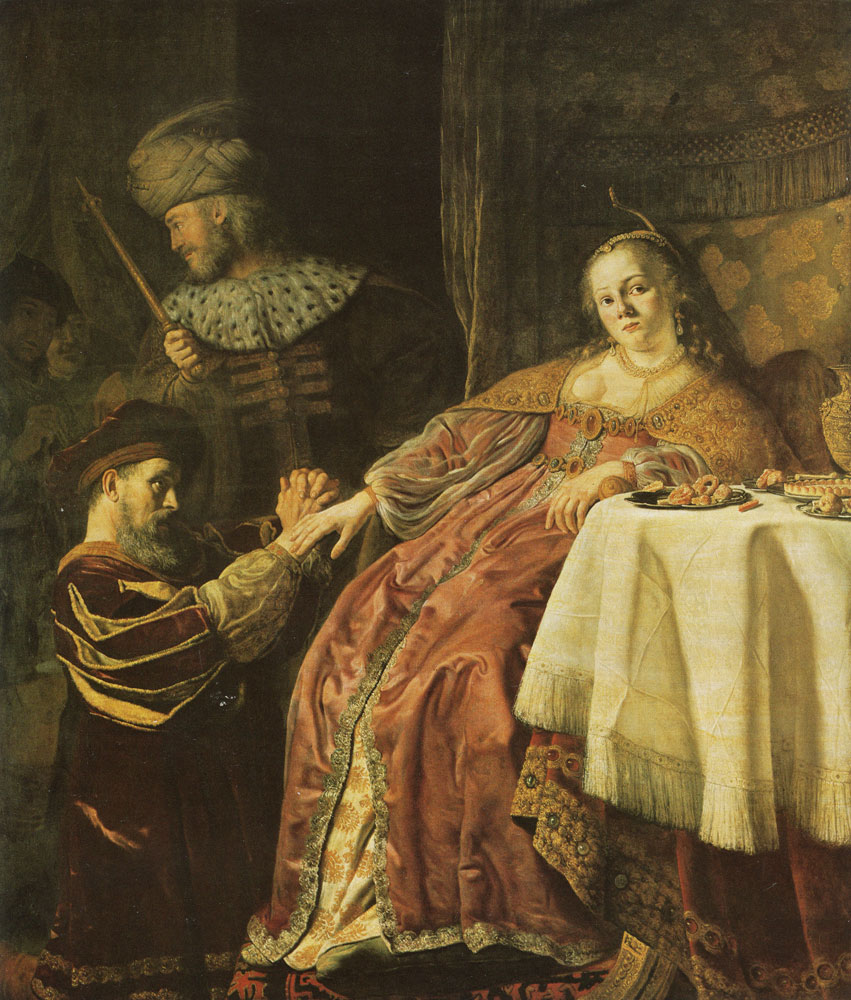
The king ordered that Haman should be hanged on the gallows prepared for Mordecai, and, confiscating his property, bestowed it upon the intended victim.
Jan Victors
Haman begging Queen Esther for mercy
1642
192 x 167 cm
Oil on canvas
Herzog Anton Ulrich-Museum, Braunschweig
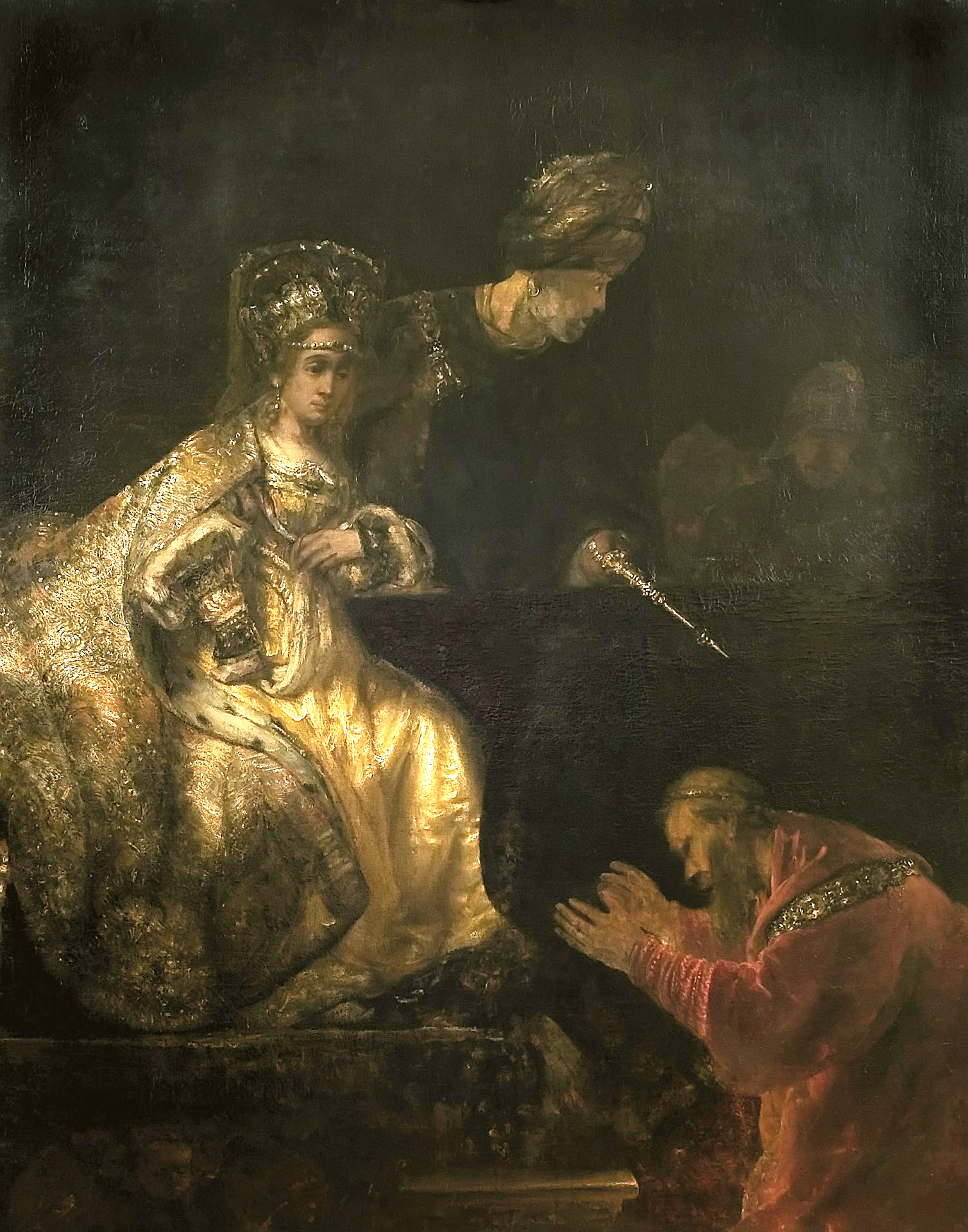
Rembrandt, (1606–1669)
Haman Begging the Mercy of Esther, circa 1635 and 1660s
Oil on canvas
Height: 236 cm (92.9 in). Width: 186 cm (73.2 in).
National Museum of Art of Romania
Edward Armitage (1817-1896)
The Festival of Esther, 1865
Oil on canvas
1200 X 1830 mm
In his painting Edward Armitage, R.A. shows the angry King ordering Haman to his death. Haman begs Esther for mercy, as guards cover his head and drag him from the royal table. Mordecai stands behind the table looking down upon the treacherous Haman. The queen's pale skin and white costume denote her regal status and her innocence. Although the scene is a dramatic one, the tension is measured in keeping with Armitage's classical principles. Understated details such as Haman's overturned goblet and the carpet's flipped up corner serve to signal unrest. More
Edward Armitage RA (May 20, 1817 – May 24, 1896), a history and biblical painter; born 20 May 1817, in London. Studied in Germany and Paris, under Paul Delaroche, whom he assisted with Hémicycle for the Palais des Beaux-Arts (1838–41); settled in London 1848, exhibiting ambitious works at RA and elsewhere; two frescoes in Houses of Parliament 1852–4; Crimean subjects 1856; Retribution, an allegory of the Indian insurrection for Leeds Town Hall 1858; church and institutional murals 1860s; settled in St John’s Wood 1850s; elected ARA 1867, RA 1872; an amateur entomologist and Fellow of the Royal Geographical Society; died 24 May 1896, at Tunbridge Wells. More
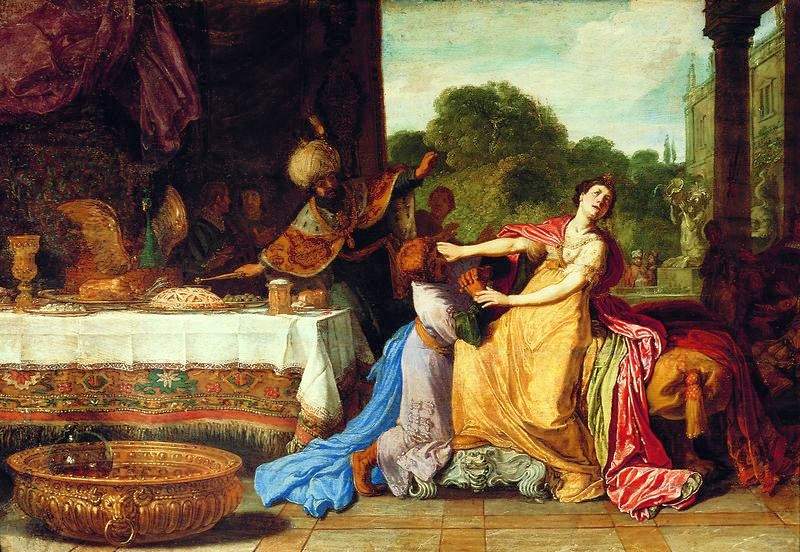
Pieter Lastman (1583–1633)
Haman begging Esther for mercy, circa 1618
Oil on panel
52 × 78 cm (20.5 × 30.7 in)
National Museum in Warsaw
Pieter Lastman (1583–1633), see below
The king then appointed Mordecai as his prime minister, and issued a decree authorizing the Jews to defend themselves.
Jan Steen
The Wrath of Ahasuerus
Jan Havickszoon Steen (c. 1626 – buried 3 February 1679) was a Dutch genre painter of the 17th century (also known as the Dutch Golden Age). His works are known for their psychological insight, sense of humour and abundance of colour. Steen was born in Leiden, where his well-to-do, Catholic family. He was the eldest of eight or more children. Like his even more famous contemporary Rembrandt van Rijn, Jan Steen attended the Latin school and became a student in Leiden. He received his painterly education from Nicolaes Knupfer (1603–1660), a German painter of historical and figurative scenes in Utrecht. Influences of Knupfer can be found in Steen's use of composition and colour. Other sources of inspiration were Adriaen van Ostade and Isaac van Ostade, painters of rural scenes, who lived in Haarlem. Whether Steen actually studied with Ostade is not known.
In 1648 Jan Steen and Gabriël Metsu founded the painters' Guild of Saint Luke at Leiden. Soon after he became an assistant to the renowned landscape painter Jan van Goyen and moved into his house on the Bierkade in The Hague. On Oct 3, 1649 he married van Goyen's daughter Margriet, with whom he would have eight children. Steen worked with his father-in-law until 1654, when he moved to Delft, where he ran the brewery De Slang for three years without much success.
Steen lived in Warmond, just north of Leiden, from 1656 till 1660 and in Haarlem from 1660 till 1670 and in both periods he was especially productive. In 1670, after the death of his wife in 1669 and his father in 1670, Steen moved back to Leiden, where he stayed the rest of his life. When the art market collapsed in 1672, called the Year of Disaster, Steen opened a tavern. In April 1673 he married Maria van Egmont, who gave him another child. In 1674 he became president of the Saint Lucas Guild. Frans van Mieris became one of his drinking companions. He died in Leiden in 1679 and was interred in a family grave in the Pieterskerk. More
Jan Steen
The Wrath of Ahasuerus, c. 1671
Oil on Canvas
167 x 129 cm
King Ahasuerus rises in fury as his wife Esther reveals the treachery of his chief minister Haman, who cringes to the left. More
Francesco (Cecco Bravo) Montelatici (Italian, 1607–1661)
Esther standing before Haman, behind them King Ahasuerus
Oil on canvas
58.5 x 73 cm. (23 x 28.7 in.)
Cecco Bravo (15 November 1601 – 1661) was an Italian painter of the Florentine Baroque school. His true name is Francesco Montelatici. He trained with Giovanni Biliverti and was also close to Sigismondo Coccapani. In the early 1620s he worked in the studio of Matteo Rosselli.
By 1629, he had his own independent studio. His first recorded work is a fresco of the Virgin, St John & Angels, and a painting of Charity. In 1633, he painted six lunettes with scenes from the Life of the Blessed Bonaventura Bonaccorsi for the church of Santissima Annunziata in Pistoia, continuing a series begun in 1601 by Bernardino Poccetti. He painted a frieze depicting children’s Games and stories from Orlando Furioso (c. 1631) for Villa Corsini a Mezzomonte in Impruneta.
He was commissioned to decorate the library in the Casa Buonarroti of Florence. After his depiction of Fame on the ceiling of the library, he became disenchanted with the patron’s excessive instructions, and the panels of illustrious Florentines on the walls were completed by others. He was commissioned to complete work initiated by Giovanni da San Giovanni for the Sala degli Argenti in Palazzo Pitti, in a commission shared with Ottavio Vannini and Francesco Furini. The frescoes, intended to celebrate Lorenzo de' Medici, were commissioned in 1635 by Ferdinando II de' Medici prior to his marriage to the daughter of the Duke of Urbino. In the south wall, Bravo completed Lorenzo as messenger of peace.
Howard Hibbard contrasted the murky sensuality of the paintings of Pignoni, Furini and Bravo with the piety of Carlo Dolci. Bravo is one of the few Florentines to violate the crisp drawn edges of figures, and aim for a general bravura of execution, nearly becoming a pintore del tocco. Some attribute this to influences he encountered in Venice. More
Claeissens, Anthuenis (1536-1613)
Esther before King Ahasuerus with Haman being sent to the Gallows beyond, c. 1577
oil on panel
Anthuenis, or Antoon Claeissens, Claessens, or Claeissins (c.1536 – 1613) was the son of Pieter Claes the elder and painted historical and allegorical subjects, and portraits.
He was a native of Bruges and became a pupil of Pieter Pourbus. He entered the Bruges Guild of Saint Luke in 1575, and became its dean in 1586, 1590, and 1601. His works, several of which are in the Hôtel-de-Ville and churches of Bruges, are distinguished by their fine colouring and finish. In the Hotel-de-Ville is a 'Grand Banquet' with many portraits of magistrates of the time, dated 1574. He died in 1613.
His son, Pieter Anthonie, was dean of the Guild of St. Luke at Bruges in 1607, and died in 1608. More
Michelangelo
The Punishment Of Haman, c. 1512
Fresco
985 x 585 cm
Location: Sistine Chapel, Vatican City, Italy
Michelangelo
The Punishment Of Haman, Detail
Michelangelo
The Punishment Of Haman, Detail
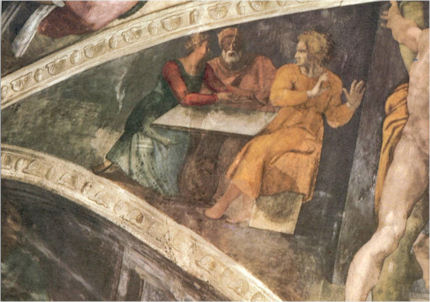
In the irregular field of the pendentive on the left is the story of Esther, Ahasueras, and Haman. On the right of the pendentive, the king sends Haman to provide royal apparel for Mordecai, who is sitting at the king's door. On the left Esther reveals Haman's plot to Ahasueras. The whole fresco is dramatically dominated, in the central scene, by the punishment of Haman. The daring foreshortening of the body, which literally cuts through the picture plane, is reinforced by by that of the white frame of the door leading into Ahasueras' room. More
Esther kneeling before Ahasuerus begging for the lives of her fellow Jews. Ahasuerus, flanked by attendants and a bearded man, who might be Mordecai, extends his golden scepter to Esther. The story progresses from the left, where Esther kneels, to her right, where a near-naked Haman is crucified behind the seated scribe. More
Michelangelo di Lodovico Buonarroti Simoni (March 1475 – 18 February 1564), was an Italian sculptor, painter, architect, poet, and engineer of the High Renaissance who exerted an unparalleled influence on the development of Western art. Despite making few forays beyond the arts, his versatility in the disciplines he took up was of such a high order that he is often considered a contender for the title of the archetypal Renaissance man, along with contemporary rival and fellow Florentine Medici client, Leonardo da Vinci.
A number of Michelangelo's works in painting, sculpture, and architecture rank among the most famous in existence. His output in every field of interest was prodigious; given the sheer volume of surviving correspondence, sketches, and reminiscences taken into account, he is the best-documented artist of the 16th century.
Two of his best-known works, the Pietà and David, were sculpted before the age of thirty. Despite his low opinion of painting, Michelangelo also created two of the most influential frescoes in the history of Western art: the scenes from Genesis on the ceiling of the Sistine Chapel in Rome, and The Last Judgment on its altar wall. As an architect, Michelangelo pioneered the Mannerist style at the Laurentian Library. At the age of 74, he succeeded Antonio da Sangallo the Younger as the architect of St. Peter's Basilica. Michelangelo transformed the plan, the western end being finished to Michelangelo's design, the dome being completed after his death with some modification.
In his lifetime he was also often called Il Divino ("the divine one"). One of the qualities most admired by his contemporaries was his terribilità, a sense of awe-inspiring grandeur, and it was the attempts of subsequent artists to imitate Michelangelo's impassioned and highly personal style that resulted in Mannerism, the next major movement in Western art after the High Renaissance. More
After Haman's plans for the extermination of all Jews in Persia is frustrated by Esther and Mordecai, King Ahasuerus grants the Jews permission to wreak vengeance. In grand old Testament style, the Jews slaughter tens of thousands of perceived enemies and then whoop it up.
Pieter Lastman (1583–1633)
The Triumph of Mordechai, c. 1624
Oil on panel
58 × 83 cm (22.8 × 32.7 in)
Rembrandt House Museum, Amsterdam, Netherlands
Mordecai once saved the King's life, but was never rewarded. Later when he was reminded of the deed, King Ahasuerus decided to honor Mordecai by letting him ride through the streets dressed in the King's own royal robes, riding on the King's horse, and wearing the royal crown. More
Pieter Lastman (1583–1633) was a Dutch painter. He is considered important because of his work as a painter of history pieces and because his pupils included Rembrandt and Jan Lievens. In his paintings Lastman paid a lot of attention to the faces, hands and feet.
Pieter Lastman was born in Amsterdam, the son of a town-beadle, who was dismissed in 1578 for being a Catholic. His mother was an appraiser of paintings and goods. His apprenticeship was with Gerrit Pietersz Sweelinck, the brother of Jan Pieterszoon Sweelinck. Between approximately 1604 and 1607 Lastman was in Italy, where he was influenced by Caravaggio and by Adam Elsheimer. Back in Amsterdam he moved in with his mother in the Sint Antoniesbreestraat, living next to mayor Geurt van Beuningen. Lastman never married although he promised to marry the sister of Gerbrand Adriaensz Bredero. Because of his health Lastman moved in with his brother in 1632. He died the next year and was buried in the Oude Kerk on 4 April 1633.
Because Rembrandt never visited Italy, it is likely that he was influenced by Caravaggio mainly or significantly via Lastman. His pupils besides Rembrandt and Lievens were Bartholomeus Breenbergh, Nicolaes Lastman, Pieter Pieterz Nedek and Jan Albertsz Rotius. More
The Jews established an annual feast, the feast of Purim, in memory of their deliverance. Haman set the date of Adar 13 to commence his campaign against the Jews. This determined the date of the festival of Purim.
Aert de Gelder (1645–1727)
Esther and Mordecai write letters to the Jews, c. 1675
Oil on canvas
111 × 132 cm (43.7 × 52 in)
National Museum of Fine Arts in Buenos Aires
" (Jorge Glusberg, Masterpieces from the Museo Nacional de Bellas Artes , Buenos Aires. MNBA, 1996, p 38). Inspiration, "wrote Mordecai... and sent letters to all the Jews who were in all the provinces of King Xerxes, near and far, obliging them to celebrate the fourteenth day of the month Adar, and the fifteenth of the month , each year, as days when the Jews were at peace with their enemies and as the month that sadness turned into joy, and mourning feast, which turned into days of feasting and joy, and send gifts each to his neighbor, and gifts to the poor "(Esther 9: 20-22). Alternately known as Esther and Mordecai writing the first letter of Purim . More
Aert de Gelder (or Arent; October 26, 1645 – August 27, 1727) was a Dutch painter. De Gelder was born and died in Dordrecht. He was one of Rembrandt’s last pupils while in Amsterdam, studying in his studio from 1661 to 1663. He was not only one of the most talented of Rembrandt’s pupils, but also one of his most devoted followers, for he was the only Dutch artist to paint in the tradition of Rembrandt's late style into the 18th century. Following Rembrandts lead, De Gelder would paint such artworks as "The Baptism of Christ" and ".Ahimelech Giving the Sword of Goliath to David". Story telling and with transparent emotionalism, and an emphasizing the human element to biblical characters is one of the distinguishing elements of this style, as opposed to the courtly and distant emotions and imagery of other artists, even in the Renaissance period. More
Arent de Gelder 1645 – 1727
Esther and Mordecai Writing the Second Letter of Purim, c. 1685
oil on canvas
59 × 143 cm
Museum RISD Museum of Art, Providence RI
Together they write a letter to the Jews in all 127 provinces of Persia, reminding them to annually commemorate this victory on the 14th and 15th day of the month of Adar. That letter became known as the first letter of Purim. The second was sent not much later, confirming the first.
Acknowledgement: Wikipedia, About.com,
All the images shown above are the copyright of their respective owners, assignees or others.















_-_Aert_de_GELDER_-_Google_Cultural_Institute.jpg)