
Polidoro de Renzi, called Polidoro da Lanciano
LANCIANO CIRCA 1515 - 1565 VENICE
MADONNA AND CHILD WITH SAINTS CATHERINE AND THE INFANT JOHN THE BAPTIST, c. 1555
Oil on canvas
31 1/2 by 42 1/2 in.; 80 by 108 cm. Bode-Museum
Polidoro de Rienzo da Lanciano (Lanciano, 1515 - 1565) was an Italian painter.
Relatively little is known of his life. He was born in Lanciano, a town that is a few miles inland from Ortona, a port on the Adriatic Sea. This is in the Abruzzi region of Italy, lying southeast of Pescara. His grandfather, Alessandro Rienzo, was a ceramic painter in Lanciano. Based on Venetian documents Polydoro's birthdate is taken to be 1515. At an early age he apparently showed great artistic talent. and for that reason he moved to Venice, the center of art in that region of Italy, at a young age. There he assumed a Venetian form for his name, Lanzani. His first mention in official Venetian documents is 1536, when he would have been 21 years of age. He probably came to Venice at least five years prior to that in order to begin his artistic training. His name appears as a witness to a document in the years 1536 and 1549. His Last Will and Testament bears his signature, and is dated 20 July 1565. He died the following day, with his age reported as 50. He likely worked as an assistant to Titian (c.1488/90-1576) for many years, especially given the close resemblance of his style with that of the Venetian master. This would have been in the 1530s and possibly early 1540s. It is not known whether he then set up his own studio, but that was common practice.
More on Polidoro de Renzi
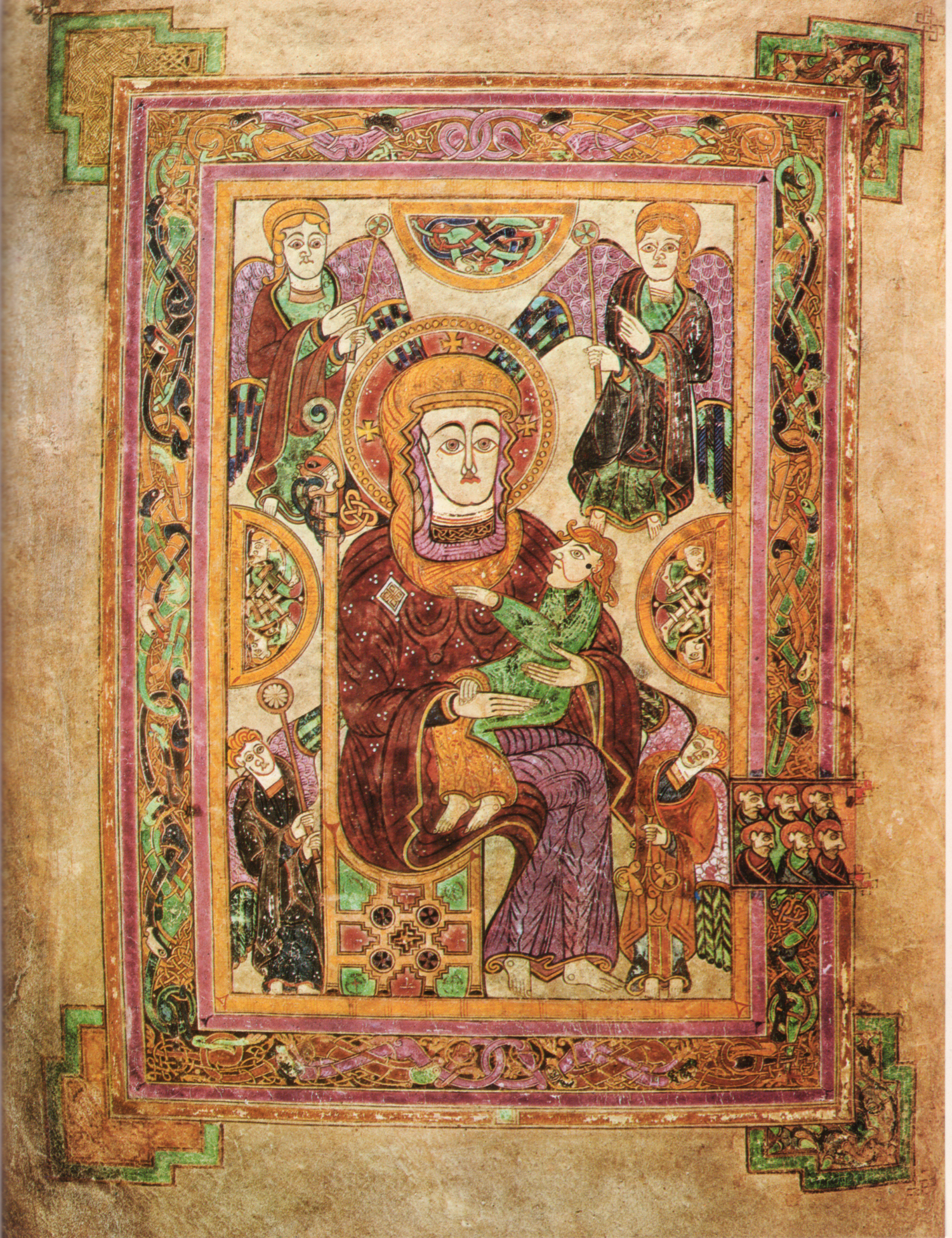
Treasures of Irish Art, 1500 B.C. to 1500 a.D.
Book of Kells, Madonna and Child
From the Collections of the National Museum of Ireland
Royal Irish Academy, & Trinity College, Dublin
There is only one depiction of a woman in the entire Book of Kells. This is found on folio 7v and is the earliest known, or surviving, image of the Virgin and Child in Western manuscript art.
Contrary to the biblical description of Mary coming from relatively humble origins, here she is shown as an empress, enthroned and wearing the type of clothing associated with royalty. She is surrounded by four ‘courtiers’, in this case replaced by angels. The Christ child is seated on her lap, with his hand placed on the Virgin’s clearly visible breast – an allusion to milk of Christian instruction, and also perhaps the fons vitae – the fountain of life. The elaborate frame around the image is perhaps an allusion to its ultimate source.
The composition and symbolism of the image finds some close parallels in panel paintings of the Virgin and Child from the Byzantine east.
More on this painting
The Book of Kells; Dublin, Trinity College Library, MS A. I., sometimes known as the Book of Columba, is an illuminated manuscript Gospel book in Latin, containing the four Gospels of the New Testament together with various prefatory texts and tables. It was created in a Columban monastery in Ireland or may have had contributions from various Columban institutions from both Britain and Ireland. It is believed to have been created c. 800. The text of the Gospels is largely drawn from the Vulgate, although it also includes several passages drawn from the earlier versions of the Bible known as the Vetus Latina. It is a masterwork of Western calligraphy and represents the pinnacle of Insular illumination. It is also widely regarded as Ireland's finest national treasure. More on The Book of Kells

Giannicola di Paolo
ACTIVE IN PERUGIA 1484-1544
THE MADONNA AND CHILD IN A LANDSCAPE
Oil on panel
24 1/4 by 18 1/2 in.; 61.6 by 47 cm.
Private collection
Rather than show the figures full length, Giannicola ends the composition at the Madonna’s knees and excludes figures in the background. The Christ Child is heavily reliant on Pietro Perugino’s design, while the face of the Virgin is painted very much in Giannicola’s own idiom. The features are sweeter and less linear and the flesh appears softer and rounder. More on this painting
Giannicola di Paolo (c. 1460–1544, also known as Giannicola di Paolo Manni or Smicca, was an Italian painter of the Renaissance period, active mainly in Perugia. He was born in Città della Pieve. His most prominent work is the Madonna delle Grazie in the Duomo of Perugia. He was a pupil of Pietro Perugino, but was also influenced by Raphael. The Museo Gazzola in Piacenza has one of his works. More on Giannicola di Paolo
Sienese School, 14th Century
THE MADONNA AND CHILD
Tempera on panel, gold ground, in an engaged frame
18 1/2 by 13 5/8 in.; 46.8 by 34.7 cm.
Private collection
This Madonna and Child once formed part of a diptych, paired with a Man of Sorrows, formerly in the Horace Buttery collection, London, but whose current whereabouts is unknown. It was first published by Bernard Berenson in 1930, who considered it the work of an anonymous Sienese master dating to circa 1380. Serena Padovani included it her 1982 article, this time alongside its mate, and proposed an attribution to two Sienese painters, Cristoforo di Bindoccio and Meo di Pero. Padovani compared the painting to a small set of saints among the fresco decorations in the Ospedale di Santa Maria della Scala. More on this painting
Workshop of Antonio di Benedetto Aquilio, called Antoniazzo Romano
ROME BEFORE 1452- 1508/12
THE MADONNA AND CHILD
Oil on panel, gold ground, unframed
19 1/2 by 15 3/8 in.; 49.8 by 39 cm.
Private collection
Antoniazzo Romano, born Antonio di Benedetto Aquilo degli Aquili (c. 1430 – c. 1510) was an Italian Early Renaissance painter, the leading figure of the Roman school during the latter part of the 15th century. He "made a speciality of repainting or interpreting older images, or generating new cult images with an archaic flavor", in particular by very often using the gold ground style, which was unusual by this period. More on Antoniazzo Romano
Attributed to Boccaccio Boccaccino
FERRARA 1466-1525 CREMONA
THE MADONNA AND CHILD
Oil on panel, unframed
18 3/8 by 14 1/4 in.; 46.7 by 36.2 cm.
Private collection
The faces of the Madonna and Christ Child correspond in style to those painted by Boccaccio Boccaccino during a sojourn in Venice early in his career. Boccaccino was documented in Venice in 1505 and his works from this period bear the influence of Giovanni Bellini, reflected here in the serene expressions, harmonious composition and elegantly posed figures.
More on this painting
Boccaccio Boccaccino (c. 1467 – c. 1525) was a painter of the early Italian Renaissance, belonging to the Emilian school.
He was born in Ferrara and studied there, probably under Domenico Panetti. Few facts of his life are known. His principal artistic activity was in Venice, Ferrara, and especially in Cremona, where he founded a school in which Garofalo was a pupil.
His most celebrated achievement is the frescoes in the Cathedral of Cremona (1506–1519) representing the Birth of the Virgin and some subjects from her life. His position there was taken over by Altobello Melone. His remaining works, which include the Marriage of Saint Catherine (Gallerie dell'Accademia, Venice), the Virgin and Child with Four Saints (Venice, San Giuliano), the Virgin and Two Saints (Cremona, San Quirilo), and the Holy Family (Paris, Louvre), are considered by Lanzi remarkable for richness of drapery, variety of color, spirit and grace of attitude, and harmony of landscape.
More on Boccaccio Boccaccino

Bartolomeo Veneto
DOCUMENTED FROM 1502 - 1531 TURIN
THE MADONNA AND CHILD, SEATED BEHIND A LEDGE, A RIVER LANDSCAPE AND A TOWN BEYOND
Oil on panel
18 1/4 by 14 1/2 in.; 46.5 by 37 cm.
Private collection
The Christ Child and his Mother are presented behind a marble ledge, a typically Bellinian device, intended to separate the humble viewer from the holy figures. More on this painting
Bartolomeo Veneto (1470–1531) was an Italian painter who worked in Venice, the Veneto (the mainland), and Lombardy. During his time in Venice, he studied under Gentile Bellini. The little information available about Bartolomeo's life has been derived from his signatures, dates, and inscriptions. His best known works are portraits or pictures with portrait-like character. Bartolomeo's later works, and especially those done on commission in Milan, indicate an influence from the artist Leonardo da Vinci.
More on Bartolomeo Veneto
Genoese School, 15th century
THE MADONNA AND CHILD
Tempera and gold on panel, unframed
24 1/2 by 18 1/4 in.; 61.4 by 46.5 cm.
Private collection
This anonymous painter shows the influence of the Genoese master Donato de' Bardi. The sculptural quality of the molded flesh, the roundness of the Madonna's face and the precise, linear treatment of her downcast eyes all recall de' Bardi's Saint Stephen, formerly in the Cicogna Mozzoni collection, Milan. This painting was cleaned recently, which revealed the open eye underneath. The overpaint was likely done at some point in the 19th/20th Century. More on this painting
Follower of Andrea Mantegna
THE MADONNA AND CHILD SEATED ON A LEDGE WITH MUSICAL ANGELS, A MOUNTAINOUS LANDSCAPE BEYOND
oil on panel
20 1/8 by 16 1/4 in.; 51.2 by 41.1 cm.
Private collection
The monumental figures in this composition and the manner in which they fill the picture plane is clearly derived from the work of Andrea Mantegna. While no prototype by the artist is known, the Christ Child and musical putti can be compared the figures in Mantegna's Holy Family in the National Gallery, London (inv. no. NG5641) and the Madonna is similar to that in his Holy Family with a Saint belonging to the Museo di Castelvecchio, Verona. More on this painting
Andrea Mantegna ( c. 1431 – September 13, 1506) was an Italian painter, a student of Roman archeology, and son-in-law of Jacopo Bellini. Like other artists of the time, Mantegna experimented with perspective, e.g. by lowering the horizon in order to create a sense of greater monumentality. His flinty, metallic landscapes and somewhat stony figures give evidence of a fundamentally sculptural approach to painting. He also led a workshop that was the leading producer of prints in Venice before 1500.
More on Andrea Mantegna
Giovanni Francesco Tura
ACTIVE IN MANTUA IN THE FIRST HALF OF THE 16TH CENTURY
THE HOLY FAMILY IN A WOODED RIVER LANDSCAPE WITH SHIPS AND A CASTLE ACROSS THE RIVER BEYOND
Oil on panel, unframed
19 1/2 by 15 3/8 in.; 49.5 by 39 cm.
Private collection
The soft sfumato effects, coupled with the mystical, dream-like landscape, recall the styles of Ferrarese artists such as Garofalo, Mazzolino and Dosso, but the influence of Parmigianino, Lotto and Giulio Romano are also perceptible. Despite all the variety of artistic references, Tura’s overall painting manner remains distinctly Mantuan in style. The artist often employed curious iconography, exemplified in the far background of this painting, where smoke rises from a ship aflame among the vessels in the harbor on the city’s shore. The face of the Virgin is reminiscent of that of Saint Sebastian in Tura’s Saint Eleanor with Saints Sebastian, Dominic, Peter and Jerome, now in the collection of the Banca Popolare dell’Emilia Romagna, Modena. More on this painting
Giovanni Francesco Tura is documented from 1510 to 1546. This highly unusual artist developed a fascinating style, encompassing the influences of a wide range of painters. The soft sfumato effects, coupled with the mystical, dream-like landscape, recall the styles of Ferrarese artists such as Garofalo, Mazzolino and Dosso Dossi, but the influence of Parmigianino, Lotto and Giulio Romano are also perceptible. Despite all the variety of artistic references, Tura's overall painting manner remains distinctly Mantuan in style.
The corpus ascribed to Tura was formerly grouped under the name of the Orembelli Master, a moniker derived from a Holy Family with Sts Elizabeth and the Infant John the Baptist in the collection of Alfonso Orembelli, Milan. Many of the paintings in this group had previously been thought to be the early activity of Correggio. However, it was suggested that the group of works given to the Orembelli Master is expansive and may in fact encompass more than one hand.
More on Giovanni Francesco Tura

Ferrarese School, 15th century
THE MADONNA AND CHILD
Tempera and gold on panel, unframed
24 1/4 by 16 1/2 in.; 62.1 by 42.6 cm.
Private collection
This highly stylized Madonna and Child follows the composition of a panel in the Cambò collection, Barcelona, which is thought to be the work either of Francesco del Cossa or the Master of the Boston Desco. While the hand of this anonymous painter is very different to that in the Cambò panel, the design and poses of the central figures are almost identical. In the present painting, the artist has omitted the angel at right and exchanged the rosebush background for a window opening onto a skyscape, framing the composition with a draped brocade curtain. More on this painting
The School of Ferrara was a group of painters which flourished in the Duchy of Ferrara during the Renaissance. Ferrara was ruled by the Este family, well known for its patronage of the arts. Patronage was extended with the ascent of Ercole d'Este I in 1470, and the family continued in power till Alfonso II, Ercole's great-grandson, died without an heir in 1597. The duchy was then occupied in succession by Papal and Austrian forces. The school evolved styles of painting that appeared to blend influences from Mantua, Venice, Lombardy, Bologna, and Florence.
The ties to Bolognese School were particularly strong. Much of the local collections, like those of the Gonzaga family in Mantua, were dispersed with the end of the Este line in 1598. Especially in the late 15th century Ferrara was also a main centre of engraving in Italy. The most famous prints it produced are the two sets traditionally, if inaccurately, known as the Mantegna Tarocchi, each by an unidentified master. More on The School of Ferrara

Master of the Castello Nativity
ACTIVE IN FLORENCE CIRCA 1445-1475
THE MADONNA AND CHILD ENTHRONED
Oil and gold on panel
34 5/8 by 22 7/8 in.; 88 by 58.1 cm.
Private collection
The Master of the Castello Nativity was an Italian religious artist of the mid-15th century. He was a follower of Fra' Filippo Lippi and was probably employed at his workshop in Prato.
His notname derives from a panoramic painting of the Nativity, originally at the Chiesa di San Michele a Castello; now in the collection of the Galleria dell'Accademia in Florence.
He specialized in paintings for devotional purposes, featuring the Virgin and Child or related scenes. Typically characteristic of his work are the variations in placement and pose of the Child in the Virgin's arms; something which is generally more static.
In 1995, Chiara Lachi, of the Marino Marini Museum, identified him as the young Piero di Cosimo, a proposal that has received little agreement. In the exhibition catalog, Officina pratese, edited by Andrea De Marchi of the University of Florence , speaks of Piero di Lorenzo di Pratese di Bartolo Zuccheri, documented around 1450 as the author of an altarpiece for the Chiesa dei Santi Giusto e Clemente a Faltugnano, as a possible candidate. His work is now divided between museums in Prato, London and Philadelphia.
More on Master of the Castello Nativity

Workshop of Joos van Cleve
CLEVE 1485 - 1540/1 ANTWERP
HOLY FAMILY
Oil on panel
21 1/4 by 14 1/4 in.; 54 by 36.2 cm.
Private collection
Joos van Cleve (1485 – 1540/1541) was a painter active in Antwerp around 1511 to 1540. He is known for combining traditional Netherlandish painting techniques with influences of more contemporary Renaissance painting styles.
An active member and co-deacon of the Guild of Saint Luke of Antwerp, he is known mostly for his religious works and portraits of royalty. As a skilled technician, his art shows sensitivity to color and a unique solidarity of figures. He was one of the first to introduce broad landscapes in the backgrounds of his paintings, which would become a popular technique of sixteenth century northern Renaissance paintings.
More on Joos van CleveStudio of Jacopo del Sellaio
FLORENCE CIRCA 1441 - 1493
The Madonna and Child before ruins, a mountainous landscape beyond
Oil on panel, with an arched top
27 1/4 by 17 3/8 in.; 69.2 by 44.2 cm
Private collection
Jacopo del Sellaio (1441/2–1493), was an Italian painter of the early Renaissance, active in his native Florence. His real name was Jacopo di Arcangelo. He worked in an eclectic style based on those of Botticelli, Filippino Lippi, and Domenico Ghirlandaio. The nickname Sellaio derives from the profession of his father, a saddle maker.
Sellaio was a pupil of Fra Filippo Lippi. In Lippi's workshop he would have met Sandro Botticelli, who had a lasting influence on Sellaio's work. Sellaio joined the Florentine painters' confraternity the Compagnia di San Luca in 1460. In 1472 he was sharing a workshop with Biagio d'Antonio, and in 1473 he formed a partnership with Filippo di Giuliano that he maintained until his death in 1493. A painter named Zanobi di Giovanni is documented in the workshop in 1490. Neither Filippo nor Zanobi's extant works have been identified, but the former is sometimes identified with the anonymous painter known as the Master of the Fiesole Epiphany.
More on Jacopo del Sellaio

Giovanni di Ser Giovanni Guidi, called Scheggia
SAN GIOVANNI VALDARNO NEAR AREZZO 1406 - 1486 FLORENCE
THE MADONNA AND CHILD WITH A HOST OF MUSICAL ANGELS
Tempera on panel, gold ground
58 1/8 by 50 1/2 in.; 147.6 by 128.3 cm
Private collection
Like many of the artist's early works the painting shows the influence of his elder brother, Masaccio, but also that of Fra Angelico. Both these painters also favored the theme of the Madonna of Humility, in which the Virgin is shown seated on the ground, and the delicate flowers in the foreground of this panel are strongly reminiscent of those in Fra Angelico's Deposition, painted for the church of Santa Trinità in Florence.
The strong influence of both Fra Angelico and Masaccio in the present panel would indicate, as Bellosi suggests, that this is a youthful work by Lo Scheggia, datable to the 1420s. More on this painting
Giovanni di Ser Giovanni Guidi (Lo Scheggia), (Florentine), 1406 - 1486. A notary's son and younger brother of Masaccio, Giovanni di Ser Giovanni Guidi was once a mercenary soldier. In 1421 he was working in a International style painter's workshop in Florence and probably also collaborating closely with Masaccio's workshop. By his 1430 enrollment in the Guild of Saint Luke, he was called "Scheggia," meaning splinter, a Tuscan nickname given to individuals of slight stature or to someone who is associated with wood. Between 1436 and 1440, he collaborated on the intarsia, or wood-mosaic, designs for cupboards in Florence Cathedral's new sacristy. He joined the painters' guild in 1433.
Giovanni's known paintings are primarily small panels intended for private devotion, mostly depicting the Virgin and Child, and paintings for furniture, including paneling and strong boxes. He also painted birth salvers, including one for Lorenzo de' Medici's birth in 1449. Until 1969, his works were often attributed to the Master of the Adimari Cassone, also called the Master of Fucecchio. More on Giovanni di Ser Giovanni Guidi
Please visit my other blogs: Art
Collector, Mythology, Marine
Art, Portrait of a Lady, The
Orientalist, Art of the Nude and The
Canals of Venice, Middle
East Artists, 365
Saints and 365 Days, also visit my Boards on Pinterest
Images are copyright of their respective owners, assignees or others.
Some Images may be subject to copyright
I don't own any of these images - credit is always given when due unless
it is unknown to me. if I post your images without your permission, please tell
me.
I do not sell art, art prints, framed posters or reproductions. Ads are
shown only to compensate the hosting expenses.
If you enjoyed this post, please share with friends and family.
Thank you for visiting my blog and also for liking its posts and pages.
Please note that the content of this post primarily consists of articles
available from Wikipedia or other free sources online.


