Bruges is situated in the northeastern part of the West-Flanders province, not far from the North Sea. A Gallo-Roman settlement dates habitation back 2000 years. In the 9th century the city is mentioned in writing for the first time.
A Carved Figure of Christ Crucified, Spanish, 15th C.
Carved wood and pigmented
Spain, 15th century
Height: 175 cm
Private collection
The golden age of Bruges is the period between the 13th and 15th century. A series of floods in the 12th century had left a wide seaway: the Zwin. Despite increasing silting of the Zwin, Bruges grows to the likely status of Western Europe's most important 13th century trading town, maintaining close relations with other Flemish towns, and with Cologne and England. Bruges provides a major link for trade between Northern and Southern Europe. At first trade centres around worsted, but after the 14th century luxury goods and banking start taking priority.
Carved wood and pigmented,
Austria, 17th Century
Height: 92 cm
Good restored condition
Private collection
Brugge is an outstanding example of a medieval historic settlement, which has maintained its historic fabric as this has evolved over the centuries, and where original Gothic constructions form part of the town's identity. As one of the commercial and cultural capitals of Europe, Brugge developed cultural links to different parts of the world. It is closely associated with the school of Flemish Primitive painting.
A French Gothic Architectural Fragment, Our Lady, 16th
Limestone
Dimensions: 89 x 38 x 34 cm
Private collection
Extensive weathering and erosion throughout consistent with age. There are two missing flanking figures and the head of baby Christ.
In the 15th century, Brugge was the cradle of the Flemish Primitives and a centre of patronage and painting development for artists such as Jan van Eyck and Hans Memling. Many of their works were exported and influenced painting styles all over Europe. Exceptionally important collections have remained in the city until today.
A Figure of Saint Roch, 16th C.
Carved lindenwood, polychrome paint
German-speaking areas in the alpine region, late 16th century
Height: 102 cm
Private collection
Saint Roch or Rocco , c. 1348 – 15/16 August 1376/79, was a Catholic saint, a confessor whose death is commemorated on 16 August; he is specially invoked against the plague. He is a patron saint of dogs and falsely accused people, among other things.
He was born at Montpellier, at that time "upon the border of France", the son of the noble governor of that city. Even his birth was accounted a miracle, for his noble mother had been barren until she prayed to the Virgin Mary. Miraculously marked from birth with a red cross on his breast that grew as he did, he early began to manifest strict asceticism and great devoutnes.
On the death of his parents in his twentieth year he distributed all his worldly goods among the poor like Francis of Assisi—though his father on his deathbed had ordained him governor of Montpellier—and set out as a mendicant pilgrim for Rome. Coming into Italy during an epidemic of plague, he was very diligent in tending the sick in the public hospitals at Acquapendente, Cesena, Rimini, Novara and Rome, and is said to have effected many miraculous cures by prayer and the sign of the cross and the touch of his hand. At Rome he preserved the "cardinal of Angleria in Lombardy" by making the mark of the cross on his forehead, which miraculously remained. Ministering at Piacenza he himself finally fell ill. He was expelled from the town; and withdrew into the forest, where he made himself a hut of boughs and leaves, which was miraculously supplied with water by a spring that arose in the place; he would have perished had not a dog belonging to a nobleman named Gothard Palastrelli supplied him with bread and licked his wounds, healing them. Count Gothard, following his hunting dog that carried the bread, discovered Saint Roch and became his acolyte.
On his return incognito to Montpellier he was arrested as a spy (by orders of his own uncle) and thrown into prison, where he languished five years and died on 16 August 1327, without revealing his name, to avoid worldly glory. More on Saint Roch
Small-scale carvings in ivory and wood were among the rare objects collected by princes and wealthy citizens of the Low Countries and Central Europe during the sixteenth and seventeenth centuries. Many of their palaces had a Kunstkammer or a Wunderkammer (chamber for art or curiosities), where their treasures were displayed. The intention was to suggest the wealth and learning of the collector and to impress guests.
A Figure of a Monk, Probably South America, Early 17th C.
Carved wood and paint
Probably South America, early 17th century
Height: 36 cm
Private collection
The rise of the Kunstkammer coincided with the European age of exploration, when collectors sought to acquire exotic materials brought home from newly discovered lands. Ivories carved by African artists were followed by virtuoso carvings that European artists made from the raw ivory arriving on their shores, as well as particularly intricate, often grotesque, wood carvings.
A Late Gothic Pieta, Rhenish, Late 15th/Early 16th C.
Carved wood, possibly lindenwood, hollow and encased at the back, pigementation
Rhineland, late 15th/early 16th century
Height: 79 cm
Private collection
The Pietà is a subject in Christian art depicting the Virgin Mary cradling the dead body of Jesus, most often found in sculpture. As such, it is a particular form of the Lamentation of Christ, a scene from the Passion of Christ found in cycles of the Life of Christ. When Christ and the Virgin are surrounded by other figures from the New Testament, the subject is strictly called a Lamentation in English, although Pietà is often used for this as well, and is the normal term in Italian. More on the The Pietà
Much as the Baroque Kunstkammer included numerous ivory carvings. Devout individuals, monasteries, and church treasuries amassed religious collections. They collected small-scale devotional sculptures in boxwood as well as ivory, a medium particularly suited to the depiction of Christ’s suffering. Carvers portrayed every phase of Christ’s Passion with acute attention to expression and unrivaled anatomical richness.
A Figure of Saint Sebastian, Probably German, 17th/18th C
Carved oak, gilding and stucco
Probably German
Height: 100 cm
Private collection
Saint Sebastian (died c. 288) was an early Christian saint and martyr. According to Christian belief, he was killed during the Roman emperor Diocletian's persecution of Christians. He is commonly depicted in art and literature tied to a post or tree and shot with arrows. Despite this being the most common artistic depiction of Sebastian, he was, according to legend, rescued and healed by Irene of Rome. Shortly afterwards he went to Diocletian to warn him about his sins, and as a result was clubbed to death. He is venerated in the Catholic and Orthodox Churches. More on Saint Sebastian
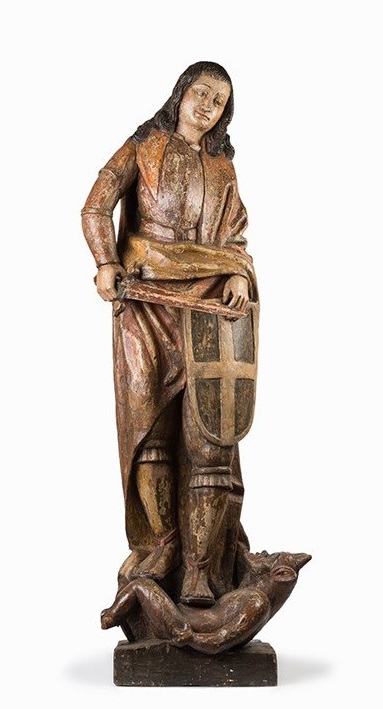
A Figure of Saint George, Flemish or Dutch, 16th C.
Carved hardwood, polychrome
Flanders or Holland, 16th century
St. George slaying the devil
Height: 139 cm
Private collection
Saint George (circa 275/281 – 23 April 303 AD) was a soldier in the Roman army who later became venerated as a Christian martyr. His parents were Christians of Greek background; his father Gerontius was a Roman army official from Cappadocia and his mother Polychronia was from Lydda, Syria Palaestina. Saint George became an officer in the Roman army in the Guard of Diocletian, who ordered his death for failing to recant his Christian faith.
In the fully developed Western version of the Saint George Legend, a dragon, or crocodile, makes its nest at the spring that provides water for the city of "Silene" (perhaps modern Cyrene in Libya or the city of Lydda in Palistine, depending on the source). Consequently, the citizens have to dislodge the dragon from its nest for a time, to collect water. To do so, each day they offer the dragon at first a sheep, and if no sheep can be found, then a maiden is the best substitute for one. The victim is chosen by drawing lots. One day, this happens to be the princess. The monarch begs for her life to be spared, but to no avail. She is offered to the dragon, but then Saint George appears on his travels. He faces the dragon, protects himself with the sign of the Cross, slays the dragon, and rescues the princess. The citizens abandon their ancestral paganism and convert to Christianity. More on Saint George
Given the fact thay Flemish artisans were well organised into Guilds that established exactly how each of their members had to carry out their tasks in painstaking detail, Flemish workshops were able to create a true industry as far as religious figures and works of art were concerned. Their production was characterised by the outstanding quality of the items manufactured, items which were increasingly appreciated throughout the whole of Europe and which was in tune with the prevailing pious mentality of the period. More on the Flemish artisans
A Gothic Figure of a Young Monk, Eastern France, 15th C
Carved limestone, pigmenation, parcel-gilt
Eartern France, Burgundy, 15th century
Height: 97 cm
Private collection
A Carved Limestone Pieta, Auvergne Region, 16th C.
Carved limestone
France, Auvergne region, 16th century
Architectural fragment depicting a Pieta
Dimensions: 51 x 46 x 20 cm
Private collection
A Sculpture of the Pieta, Flemish, 17th Century
Carved wood and pigmented
Flanders, 17th century
Height: 90 cm
Private collection
Santa Cruz altarpiece in San Lesmes Church, Burgos
Many merchants, having made their fortunes and eager to show off their newly-acquired social position by building temples and chapels which they would then lavishly decorate, frequently with Flemish altarpieces. And this is exactly what a merchant from Burgos by the name of García de Salamanca did. In fact, this very merchant appears depicted in a pious stance together with his wife and patron saints in the Santa Cruz relief of the Church of San Lesmes. In this way, merchants sought to redeem their sins and save their souls.
A Sculpture of Virgin and Child, Flemish, 17th C.
Carved wood, pigmentation
Flemish, 17th century
A polychrome painted sculpture of Our Lady and Child
Height: 67 cm
Private collection
Though many works were acquired by religious chapters, others were acquired thanks to the donations of private individuals. Parishioners would also gather together to purchase "worthy" furnishings in consonance with the prevailing artistic style of the moment for the most representative of their parish buildings.
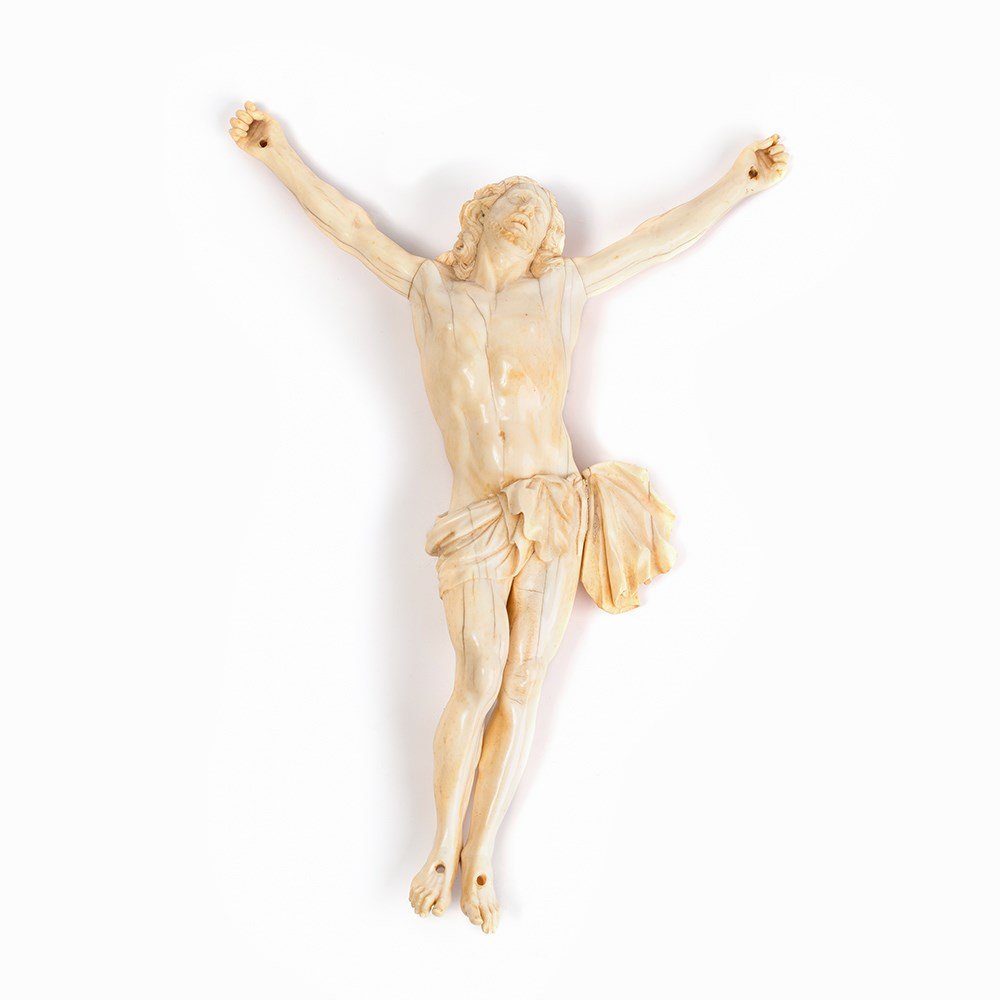
An Ivory Figure of Christ Crucified, Italian, Late 17th C
Ivory
Italy, late 17th century
Dimensions: 29 x 20 cm
Private collection
The use of ivory for important sculpture declined in the late Middle Ages, coinciding with the demise of the ivory trade between Europe and Africa after the Ottoman conquest of North Africa. With rare exceptions, European sculptors of small-scale works turned to boxwood, a medium that shares some attributes of ivory.
An Ivory Figure of the Madonna and Child, France, 17th C
Private collection
A Figure, probably of St John the Baptist, Flemish
Polychrome painted wood
Flanders, 17th century
Height: 54 cm
Private collection
John the Baptist, known as the prophet Yahya in the Qur'an, was a Jewish itinerant preacher in the early first century AD. John is revered as a major religious figure in Christianity, Islam, the Bahá'í Faith, and Mandaeism. He is called a prophet by all of these traditions, and honoured as a saint in many Christian traditions.
John used baptism as the central sacrament of his messianic movement.[ Most scholars agree that John baptized Jesus. Scholars generally believe Jesus was a follower or disciple of John and several New Testament accounts report that some of Jesus' early followers had previously been followers of John. John the Baptist is also mentioned by the Jewish historian Josephus. Some scholars maintain that John was influenced by the semi-ascetic Essenes, who expected an apocalypse and practiced rituals corresponding strongly with baptism, although no direct evidence substantiates this.
According to the New Testament, John anticipated a messianic figure greater than himself, and Jesus was the one whose coming John foretold. Christians commonly refer to John as the precursor or forerunner of Jesus, since John announces Jesus' coming. John is also identified with the prophet Elijah. More on John the Baptist
Late Gothic Figure of a Female Saint, Germany, 16th C.
The colouring suggests that she was interpreted as representing the Virgin Mary.
Carved lindenwood with a hollow back, pigmentation
Germany, 16th century
Height: 80 cm
Private collection
Group of Anna Selbdritt in Majesty, Spanish, 12th-13th C
Carved pinewood, extensive traces of pigmentation
Spain, 12th-13th century
Height: 84 cm
Private collection
The Virgin and Child with Saint Anne or Madonna and Child with Saint Anne is a subject in Christian art showing Saint Anne with her daughter, the Virgin Mary, and her grandson Jesus. This depiction has been popular in Germany and neighboring countries since the 14th century. More on The Virgin and Child with Saint Anne
A Late Gothic Figure of a Bishop Saint, Flemish, 16th C
Carved walnut, pigmentation
Flemish or Nothern France, 16th century
Height: 59 cm
Private collection
Late Gothic Figure of Mary, Flemish, Early 16th C.
Carved oak, traces of original pigmentation
Flemish, 16th century
Height: 25 cm
Private collection
A Late Gothic Figure of the Virgin and Child, German, 15 C
Terracotta
South Germany, late 15th century
Height: 108 cm
Private collection
A Figure of the Virgin Mary, German, 16th C.
Carved softwood, on a base covered in red velvet
Germany, 16th century
Height: 41 cm
Private collection
A Statue of the Madonna and Child, Western Euorpe, 16th C
Carved softwood, polychrome paint and parcel-gilt
Western Europe, 16th century
Height: 120 cm
Private collection
A Pair of Sculptures Depicting St John and St Anne,
Terracotta
17th century
Height: 42 cm
John the Apostle ( c. AD 6 – c. 106) was one of the Twelve Apostles of Jesus according to the New Testament. He was the son of Zebedee and Salome. His brother was James, who was another of the Twelve Apostles. Christian tradition holds that he outlived the remaining apostles and that he was the only one not to die a martyr's death (excluding Judas Iscariot who died by suicide). The Church Fathers considered him the same person as John the Evangelist, John of Patmos, John the Elder and the Beloved Disciple, although modern theologians and scholars have not formed a consensus on the relative identities of these men. The tradition of most Christian denominations holds that John the Apostle is the author of several books of the New Testament. More on John the Apostle
Saint Anne (also known as Ann or Anna ) of David's house and line, was the mother of the Virgin Mary and grandmother of Jesus Christ, according to Christian and Islamic tradition. Mary's mother is not named in the canonical gospels, nor in the Qur'an. Anne's name and that of her husband Joachim come only from New Testament apocrypha, of which the Protoevangelium of James (written perhaps around 150) seems to be the earliest that mentions them. More on Saint Anne
A Flemish Statue of Saint Barbara, 17th C.
Carved oak
Flanders, 17th century
Dimensions: 216 x 60 x 38 cm
Private collection
Saint Barbara, known in the Eastern Orthodox Church as the Great Martyr Barbara, was an early Christian saint and martyr. Accounts place her in the 3rd century in Nicomedia, present-day Turkey or in Heliopolis of Phoenicia, present-day Baalbek, Lebanon. There is no reference to her in the authentic early Christian writings nor in the original recension of Saint Jerome's martyrology. Her name can be traced to the 7th century, and veneration of her was common, especially in the East, from the 9th century.
Because of doubts about the historicity of her legend, she was removed from the General Roman Calendar in the 1969 revision, though not from the Catholic Church's list of saints.
Saint Barbara is often portrayed with miniature chains and a tower. As one of the Fourteen Holy Helpers, Barbara continues to be a popular saint in modern times, perhaps best known as the patron saint of armourers, artillerymen, military engineers, miners and others who work with explosives because of her old legend's association with lightning, and also of mathematicians. Many of the thirteen miracles in a 15th-century French version of her story turn on the security she offered that her devotees would not die without making confession and receiving extreme unction.
According to the hagiographies, Barbara, the daughter of a rich pagan named Dioscorus, was carefully guarded by her father who kept her locked up in a tower in order to preserve her from the outside world. Having secretly become a Christian, she rejected an offer of marriage that she received through him.
Before going on a journey, he commanded that a private bath-house be erected for her use near her dwelling, and during his absence, Barbara had three windows put in it, as a symbol of the Holy Trinity, instead of the two originally intended. When her father returned, she acknowledged herself to be a Christian; upon this he drew his sword to kill her, but her prayers created an opening in the tower wall and she was miraculously transported to a mountain gorge, where two shepherds watched their flocks. Dioscorus, in pursuit of his daughter, was rebuffed by the first shepherd, but the second betrayed her and was turned to stone and his flock changed to locusts.
Dragged before the prefect of the province, Martinianus, who had her cruelly tortured, Barbara held true to her faith. During the night, the dark prison was bathed in light and new miracles occurred. Every morning her wounds were healed. Torches that were to be used to burn her went out as soon as they came near her. Finally she was condemned to death by beheading. Her father himself carried out the death-sentence. However, as punishment for this, he was struck by lightning on the way home and his body was consumed by flame. Barbara was buried by a Christian, Valentinus, and her tomb became the site of miracles. More on Saint Barbara
A Carved Figure of Saint Sebastian, Probably Rhenish,
Carved walnut and pigmented
Proabably Rhineland, 17th century
Dimensions: 123 x 33 x 32 cm
Private collection
Saint Sebastian, see above
A Figure of Saint Sebastian, France, 17th Century
Carved stone, pigmented
France, 17th century
Dimensions: 92.5 x 30 x 22 cm
Private collection
Saint Sebastian, see above
A Figure Likely to be Saint Bridget of Sweden, Flemish,
Carved walnut wood
Flemish, early 16th century
Dimensions: 97 x 32 x 30 cm
Private collection
Bridget of Sweden (1303 – 23 July 1373); or Saint Birgitta, was a mystic and saint, and founder of the Bridgettines nuns and monks after the death of her husband of twenty years. Outside of Sweden, she was also known as the Princess of Nericia and was the mother of Catherine of Vadstena.
She is one of the six patron saints of Europe, together with Benedict of Nursia, Saints Cyril and Methodius, Catherine of Siena and Edith Stein.
She was the daughter of the knight Birger Persson of the family of Finsta, governor and lawspeaker of Uppland, and one of the richest landowners of the country, and his wife, a member of the so-called Lawspeaker branch of the Folkunga family. Through her mother, Ingeborg, Birgitta was related to the Swedish kings of her era.
Bridget was born in June 1303. In 1316, at the age of 14 she married Ulf Gudmarsson, Lord of Närke, to whom she bore eight children. One daughter is now honored as St. Catherine of Sweden. Bridget became known for her works of charity, particularly toward Östergötland's unwed mothers and their children. When she was in her early thirties, she was summoned to be lady-in-waiting to the new Queen of Sweden, Blanche of Namur. In 1341 she and her husband went on pilgrimage to Santiago de Compostela.
In 1344, shortly after their return, Ulf died at the Cistercian Alvastra Abbey in Östergötland. After this loss, Birgitta became a member of the Third Order of St. Francis and devoted herself wholly to a life of prayer and caring for the poor and the sick.
It was about this time that she developed the idea of establishing the religious community which was to become the Order of the Most Holy Saviour, or the Brigittines. One distinctive feature of the pre-Reformation houses of the Order was that they were double monasteries, with both men and women forming a joint community, though with separate cloisters. They were to live in poor convents and to give all surplus income to the poor. However, they were allowed to have as many books as they pleased.
In 1350, a Jubilee Year, Bridget braved a plague-stricken Europe to make a pilgrimage to Rome accompanied by her daughter, Catherine, and a small party of priests and disciples. This was done partly to obtain from the Pope the authorization of the new Order and partly in pursuance of her self-imposed mission to elevate the moral tone of the age. This was during the period of the Avignon Papacy within the Roman Catholic Church, however, and she had to wait for the return of the papacy to Rome from the French city of Avignon, a move for which she agitated for many years.
It was not until 1370 that Pope Urban V, during his brief attempt to re-establish the papacy in Rome, confirmed the Rule of the Order, but meanwhile Birgitta had made herself universally beloved in Rome by her kindness and good works. Save for occasional pilgrimages, including one to Jerusalem in 1373, she remained in Rome until her death on 23 July 1373, urging ecclesiastical reform.
In her pilgrimages to Rome, Jerusalem and Bethlehem, she sent "back precise instructions for the construction of the monastery" now known as Blue Church, insisting that an "abbess, signifying the Virgin Mary, should preside over both nuns and monks."[4]
Although she never returned to Sweden, her years in Rome were far from happy, being hounded by debts and by opposition to her work against Church abuses. She was originally buried at San Lorenzo in Panisperna before her remains were returned to Sweden. She was canonized in the year 1391 by Pope Boniface IX, which was confirmed by the Council of Constance in 1415. Because of new discussions about her works, the Council of Basel confirmed the orthodoxy of the revelations in 1436. More on Bridget of Sweden
The Circumcision of Christ, Flemish, Early 16th C.
Carved oak, pigmented
Flanders, early 16th century
Dimensions: 48 x 51 cm
Private collection
Please visit my other blogs: Art Collector, Mythology, Marine Art, Portrait of a Lady, The Orientalist, Art of the Nude and The Canals of Venice, Middle East Artists, 365 Saints and 365 Days, also visit my Boards on Pinterest
Images are copyright of their respective owners, assignees or others.
Some Images may be subject to copyright
I don't own any of these images - credit is always given when due unless
it is unknown to me. if I post your images without your permission, please tell
me.
I do not sell art, art prints, framed posters or reproductions. Ads are
shown only to compensate the hosting expenses.
If you enjoyed this post, please share with friends and family.
Thank you for visiting my blog and also for liking its posts and pages.
Please note that the content of this post primarily consists of articles
available from Wikipedia or other free sources online.