01 Paintings, scenes from the Bible, Table of the Seven Deadly Sins,, with footnotes # 38

Hieronymus Bosch, 
S'Hertogenbosch (Holanda), 1450 - S'Hertogenbosch (Holanda), 1516
Table of the Seven Deadly Sins, c. 1505 - 1510
Oil on poplar panel
119.5 x 139.5 cm
Museo Nacional del Prado, Madrid

Two banderoles (flags), one above and the other below the central circle, contain Latin texts from Deuteronomy (32: 28-29 and 20), warning against the wages of sin. 

The upper banderole,

The upper banderole, between the tondos of Death and the Last Judgment, reads: For they are a nation void of counsel, neither is there any understanding in them. O that they were wise, that they understood this, that they would consider their latter end!

The lower banderole

The lower banderole, set between Hell and Glory, reads: I will hide my face from them, I will see what their end shall be. 

Christ, portrayed in the innermost ring

Man, bereft of reason, seems to have set out in unbridled pursuit of the Seven Deadly Sins. Yet all is not lost: Christ, portrayed in the innermost ring of the large central roundel, is ever alert. According to the Latin inscription beneath him: Beware, beware, the Lord is watching. 

These three texts link God’s omnipresence with man’s freedom and the fruits of sin. As in The Haywain, the dismantled Pilgrimage of Life triptych and The Garden of Earthly Delights, the message conveyed by the Table of the Seven Deadly Sins is that Hell awaits those who stray from God’s path.

Christ rising from his tomb

Bosch represents the message in five circles. At the centre of the largest, central circle, which resembles a huge eye or a concave mirror, Christ is shown rising from his tomb as the Man of Sorrows, displaying the wound in his side.  It is an appeal to the faithful, urging them to follow the path that Jesus has shown them and to meditate on his death on the cross for the forgiveness of man’s sins. 

The  innermost circle is surrounded by gilded rays stretching to the outer ring,divided into seven segments each depicting one of the seven Deadly Sins,

This innermost circle or pupil is surrounded by gilded rays stretching to the outer ring, which is divided into seven segments of varying size, each depicting one of the seven Deadly Sins, identified by an inscription. Bosch conveyed this moral teaching through everyday situations involving people from different social classes, observed by the all-seeing eye of God. Yet, regardless of the message, some of the scenes -particularly Gluttony- mark him out as a pioneer in genre painting, which was later to acquire such importance.

Anger or Wrath (ira)

Anger or Wrath (ira), placed in a privileged position with regard to the banderoles and the figure of Christ, occupies the space traditionally held by Pride and Envy as the sources of all human sin. Here, it is depicted in the form of a drunken brawl outside a tavern. 

A woman preening herself in a mirror

Lust shows two courtly couples dallying in a tent, with entertainment provided by a jester.

Sloth is personified by a man asleep by the fire, unwilling to devote himself to prayer

The family embodying Gluttony gorge themselves with food and drink

Greed is conveyed by a magistrate accepting a bribe

Envy a couple clearly covet the falcon being shown off by a rich man, whilst two dogs fight over a bone.

Moving anticlockwise, the next segment represents Pride, as a woman preening herself in a mirror held up by a devil. Lust shows two courtly couples dallying in a tent, with entertainment provided by a jester. Sloth is personified by a man asleep by the fire, unwilling to devote himself to prayer. The family embodying Gluttony gorge themselves with food and drink. Greed is conveyed by a magistrate accepting a bribe, and in 

At the corners of the Table, four smaller circles contain representations of the Last Things:

The protagonist is receiving the last rites
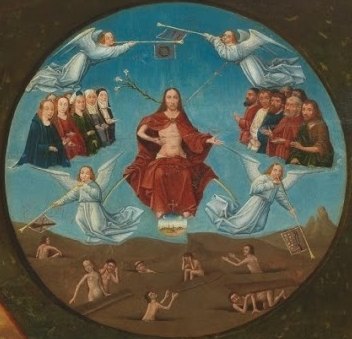
The Last Judgment

Glory, Saint Peter welcomes the souls of the blessed to Heaven

Hell, with sinners receiving the punishments they deserve

At the corners of the Table, four smaller circles contain representations of the Last Things, Death, the Last Judgment, Hell and Glory. The scene in the Death tondo closely resembles that depicted in Death and the Miser in Washington, but here the protagonist is receiving the last rites, and the angel has clearly won the contest. Bosch’s treatment of the Last Judgment echoes the tradition of Rogier van der Weyden, with the dead rising from their tombs. In Glory, Saint Peter welcomes the souls of the blessed to Heaven, represented as a Gothic building with a shining gold background. Bosch offers a more personal view of Hell, with sinners receiving the punishments they deserve.

Poplar wood cannot be dated dendrochronologically, so it is impossible to fix a terminus post quem for this panel. However, the style and some of the costumes -particularly the hats- suggest that it was probably painted in around 1505-10, that is, late in Bosch’s career. Most of the scholars who reject Bosch’s authorship of this panel take as their starting-point a passage in Felipe de Guevara’s Comentario de la pintura, written in around 1560 and first published by Antonio Ponz in 1788, in which it seems to suggest that the Table of the Seven Deadly Sins was the work of an unnamed gifted follower of Bosch. In my view, however, the passage is ambiguous and, rather than a possible connection between this follower and the work in the Prado, it would seem to refer to the genre of painting to which it corresponds. It seems unlikely that Felipe de Guevara would tell Philip II, albeit indirectly in the form of a book (unpublished until 1788), that the panel of which he was so fond was not in fact by Bosch. Indeed, the king still regarded it as an original when he sent it to El Escorial in 1574, and throughout the time it hung in his private apartment, that is, until his death. Moreover, at that point Felipe de Guevara could no longer distinguish between Bosch originals and copies; he thought, for example, that the version of The Haywain sold by his heirs to Philip II in 1570 was by the master’s own hand; technical analysis has since revealed that it is a copy of the original in the Museo del Prado. The king sent it to El Escorial in 1574, and it remains there today.

The Table of the Seven Deadly Sins is signed by Bosch, and there is no evidence to suggest that the signature is apocryphal. Certain features of the underdrawing -including the wide range of kinds of strokes also found in The Haywain- are found in other late Bosch works, which also share a similar approach to the execution of the painting stage. If this were not enough to confirm Bosch’s authorship, the highly original design of the composition -a truly inventive forerunner to genre painting- could hardly be the work of some nameless follower. Perhaps the only other painter capable of such inventiveness was the second Bosch, Pieter Bruegel the Elder (c. 1525/30-1569). As for its provenance, nothing is known of the painting’s first owner, its destination or its purpose. According to Felipe de Guevara’s Comentario de la pintura, it was in Philip II’s possession before 1560. We do not know how it came into his hands, but we may assume either that he acquired it during his time in Flanders or that he ordered it to be purchased there. Nor do we know where it hung before the king sent it to El Escorial in 1574 (Text drawn from Silva, P.: Bosch. The 5th Centenary Exhibition, Museo Nacional del Prado, 2016, pp. 302-312). More Hieronymus Bosch,


Acknowledgement: Museo Nacional del Prado


Images are copyright of their respective owners, assignees or others. Some Images may be subject to copyright


I do not sell art, art prints, framed posters or reproductions. Ads are shown only to compensate the hosting expenses.


If you enjoyed this post, please share with friends and family.


Thank you for visiting my blog and also for liking its posts and pages.


04 Carvings, Biblical Carvings & Sculpture from Mexico With Footnotes 5

Mexican Painted Wood Christ - After Crucifixion

Mexico, 18th century CE. An expressive and beautiful wooden carving of Christ, seated , wearing a red cape and a crown of thorns. Small patches of color - the cape, the green of the crown, and small blue dots on the eyes - draw the viewers' attention. The rest is black and cream painted. A sensitive religious folk art carving. Size: 7.25" W x 12.6" H (18.4 cm x 32 cm) 

Carved Mexican Wooden Angel - Gabriel

Mexico, Spanish Colonial period, late 18th to early 19th century CE. A tall, elegant carved wooden statue of the angel Gabriel, shown here with long, narrow wings and holding a Bible with a cross on its cover. His clothing is highly detailed and his face has a serene expression. Size: 5.4" W x 13.35" H (13.7 cm x 33.9 cm) 

Early Mexican Carved Wooden Friar

Mexico, Spanish Colonial period, 18th century CE. A carved wooden santo or friar, short and a little portly, wearing a well-painted cloak and with a smiling expression on his face. Perhaps once a decorative element in a home or small church. Size: 4.75" W x 12.2" H (12.1 cm x 31 cm) 

In the Abrahamic religions, Gabriel is an angel who typically serves as a messenger sent from God to certain people.

In the Old Testament, he appears to the prophet Daniel, delivering explanations of Daniel's visions. In the Gospel of Luke, Gabriel appeared to Zechariah and the Virgin Mary, foretelling the births of John the Baptist and Jesus. In the Book of Daniel, he is referred to as "the man Gabriel", while in the Gospel of Luke, Gabriel is referred to as "an angel of the Lord". Gabriel is not called an archangel in the Bible, but is so called in Intertestamental period sources like the Book of Enoch. In the Roman Catholic and Eastern Orthodox churches, the archangels Michael, Raphael, and Gabriel are also referred to as saints. In Islam, Gabriel is considered an archangel whom God is believed to have sent with revelation to various prophets, including Muhammad. The 96th chapter of the Quran, The Clot, is believed by Muslims to have been the first chapter revealed by Gabriel to Muhammad. More on St. Gabriel

Large Mexican Wooden Santos - Saint Francis

Mexico, 19th or early 20th century CE. A large, sensitive statue of a saint, probably St Francis of Assisi, carved in wood with a dynamic stance - one foot standing atop a ball, arms out, with his head tilted to one side. He has a classically Franciscan haircut and beard, wide, staring eyes that probably once had inlays, and a wonderfully sculpted flowing belted robe, complete with dangling rope. A pattern of gilding and black marks the robe, very clearly seen on the back. Interestingly, the figure stands atop a carved dais (all part of the same piece of wood) that has a face carved in its front side. Size: 10.55" W x 24.5" H (26.8 cm x 62.2 cm) 

Saint Francis Xavier, S.J. (7 April 1506 – 3 December 1552), was a Navarrese-Basque Roman Catholic missionary, born in Javier, Kingdom of Navarre (now part of Spain), and a co-founder of the Society of Jesus. He was a companion of St. Ignatius of Loyola and one of the first seven Jesuits who took vows of poverty and chastity at Montmartre, Paris in 1534. He led an extensive mission into Asia, mainly in the Portuguese Empire of the time and was influential in evangelization work, most notably in India. He also was the first Christian missionary to venture into Japan, Borneo, the Maluku Islands, and other areas. In those areas, struggling to learn the local languages and in the face of opposition, he had less success than he had enjoyed in India. Xavier was about to extend his missionary preaching to China but died in Shangchuan Island shortly before he could do so.


He was beatified by Pope Paul V on 25 October 1619 and canonized by Pope Gregory XV on 12 March 1622. In 1624 he was made co-patron of Navarre alongside Santiago. Known as the "Apostle of the Indies," and the "Apostle of Japan", he is considered to be one of the greatest missionaries since St. Paul. In 1927, Pope Pius XI published the decree "Apostolicorum in Missionibus" naming St. Francis Xavier, along with St. Thérèse of Lisieux, co-patron of all foreign missions. He is now co-patron saint of Navarre with San Fermin. The Day of Navarre (Día de Navarra) in Spain marks the anniversary of Saint Francis Xavier's death, on 3 December 1552. More on Saint Francis


Images are copyright of their respective owners, assignees or others. Some Images may be subject to copyright

I do not sell art, art prints, framed posters or reproductions. Ads are shown only to compensate the hosting expenses.

If you enjoyed this post, please share with friends and family.

Thank you for visiting my blog and also for liking its posts and pages.


08 Painting by The Old Masters, Michael Pacher, Altarpiece of the Church Fathers. 30

Michael Pacher, (1430–1498)
Altarpiece of the Church Fathers, c. 1471-1475
Fathers of the Church: Jerome , Augustine , Gregory , Ambrose
Color on wood
103 × 91 cm (40.6 × 35.8 in)
Alte Pinakothek,  Munich, Germany

The picture shows the internal panels of the Altarpiece of the Doctors of the Church: Sts Augustine and Gregory on the central panel, Sts Jerome and Ambrose on the side panels.

The Altarpiece of the Church Fathers was created in 1483 for the Neustift Monastery near Brixen. With it Pacher reached a point at which the borders between painting and sculpture in the north were no longer clearly distinct, the altarpiece translates the subject of a carved shrine into panel painting. It thereby follows on from Rogier van der Weyden's Deposition from the Cross (Prado, Madrid, below), but goes far beyond the earlier painting in its optical missing of the two genres.

Rogier van der Weyden (1399/1400–1464)
Deposition, c. 1435
 Oil on oak panel
220 x 262 cm
Prado Museum

Rogier van der Weyden (1399 or 1400 – 18 June 1464) was an Early Netherlandish painter. His surviving works consist mainly of religious triptychs, altarpieces and commissioned single and diptych portraits. He was highly successful and internationally famous in his lifetime; his paintings were exported – or taken – to Italy and Spain, and he received commissions from Netherlandish nobility and foreign princes. By the latter half of the 15th century, he had eclipsed Jan van Eyck in popularity. However his fame lasted only until the 17th century, and largely due to changing taste, he was almost totally forgotten by the mid-18th century. His reputation was slowly rebuilt during the following 200 years; today he is known, with Robert Campin and van Eyck, as the third of the three great Early Flemish artists, and as the most influential Northern painter of the 15th century. Karel van Mander wrote that the great artistic contribution of Rogier van der Weyden lies in his ideas, his composition and rendering of the soul's expression through pain, happiness or anger, and the tempering of this emotional testimony to the subject matter of his work.


Van der Weyden worked from life models, and his observations were acute, yet he often idealised certain elements of his models' facial features, and they are typically statuesque, especially in his triptychs. All of his forms are rendered with rich, warm colourisation and a sympathetic expression, while he is known for his expressive pathos and naturalism. His portraits tend to be half length and half profile. Van der Weyden used an unusually broad range of colours and varied tones; in his finest work the same tone is not repeated in any other area of the canvas; even the whites are varied. More

The altarpiece is a depiction of the four great Fathers of the Church. On the far left, Jerome is portrayed as a cardinal with the lion from whose paw he drew the thorn. Next comes Augustine, accompanied by a child in a reference to one of the legends surrounding his life: one day by walking by the sea sunk in thought, the saint came across a child scooping up water with a spoon. Third comes Pope Gregory the Great, who is seen delivering Emperor Trajan from Purgatory, and finally, on the right, the archbishop Ambrose, busy writing. The dove of Holy Ghost appears beside all four saints as a symbol of their divine inspiration.

The foreshortened floor tiles combine with the apparently projecting baldachins to confuse the eye, as real and pictorial space seem to overlap, The virtuosity of the foreshortening is not matched by the modelling of the figures, however, who acquire their volume primarily from the suggestive power of the vaulted canopy above them. More

PACHER, Michael
Altarpiece of the Church Fathers: St Jerome, c. 1483
Color on wood
216 x 91 cm
Alte Pinakothek, Munich

Jerome of Stridonium, who was born around 347AD, and is best known for the legend in which he drew a thorn from a lion’s paw, and in Michael Pacher’s depiction of the saint (above), we see him draped in the red robes of a cardinal, stroking the lion.  was a priest, confessor, theologian and historian. He was the son of Eusebius, born at Stridon, a village near Emona on the border of Dalmatia and Pannonia, then part of northeastern Italy. He is best known for his translation of most of the Bible into Latin (the translation that became known as the Vulgate), and his commentaries on the Gospels. His list of writings is extensive.

The protégé of Pope Damasus I, who died in December of 384, Jerome was known for his teachings on Christian moral life, especially to those living in cosmopolitan centers such as Rome. In many cases, he focused his attention to the lives of women and identified how a woman devoted to Jesus should live her life. This focus stemmed from his close patron relationships with several prominent female ascetics who were members of affluent senatorial families.

He is recognised as a Saint and Doctor of the Church by the Roman Catholic Church, the Eastern Orthodox Church, the Lutheran Church, and the Anglican Communion. More

PACHER, Michael
Altarpiece of the Church Fathers: St Augustine, c. 1483
Color on wood
216 x 91 cm
Alte Pinakothek, Munich


The reason for the child’s inclusion harks back to the legend regarding St Augustine and his struggle to understand the mystery of the Holy Trinity. More

Augustine of Hippo (13 November 354 – 28 August 430), was an early Christian theologian and philosopher whose writings influenced the development of Western Christianity and Western philosophy. He was the bishop of Hippo Regius (modern-day Annaba, Algeria), located in Numidia (Roman province of Africa). Scholars generally agree that Augustine and his family were Berbers, an ethnic group indigenous to North Africa,. He is viewed as one of the most important Church Fathers in Western Christianity for his writings in the Patristic Era. Among his most important works are The City of God and Confessions.

According to Jerome, Augustine "established anew the ancient Faith." In his early years, he was heavily influenced by Manichaeism and afterward by the neo-Platonism of Plotinus. After his baptism and conversion to Christianity in 386, Augustine developed his own approach to philosophy and theology, accommodating a variety of methods and perspectives. Believing that the grace of Christ was indispensable to human freedom, he helped formulate the doctrine of original sin and made seminal contributions to the development of just war theory.

When the Western Roman Empire began to disintegrate, Augustine developed the concept of the Church as a spiritual City of God, distinct from the material Earthly City. His thoughts profoundly influenced the medieval worldview. The segment of the Church that adhered to the concept of the Trinity as defined by the Council of Nicaea and the Council of Constantinople closely identified with Augustine's City of God. More

PACHER, Michael
Altarpiece of the Church Fathers: St Gregory, c. 1483
Color on wood
216 x 91 cm
Alte Pinakothek, Munich


The legend surrounding  Pope Gregory the Great, was that while he was walking through the Forum of Trajan, he thought of the justice of that emperor towards a poor widow deprived of her only son by a violent death.  On entering St. Peter’s he prayed that the soul of so virtuous an emperor might not be forever lost, and his prayers were answered.  The panel painting depicts Gregory rescuing the Roman Emperor Trajan from Purgatory by the power of prayer. More

Pope Saint Gregory I (c. 540 – 12 March 604) was pope of the Catholic Church from 3 September 590 to his death in 604. Gregory is famous for instigating the first recorded large-scale mission from Rome to convert a pagan people to Christianity. Gregory is also well known for his writings, which were more prolific than those of any of his predecessors as pope. The epithet Saint Gregory the Dialogist has been attached to him in Eastern Christianity because of his Dialogues. For this reason, English translations of Eastern texts will sometimes list him as Gregory "Dialogos" or the Latinized equivalent "Dialogus".

A senator's son and himself the Prefect of Rome at 30, Gregory tried the monastery but soon returned to active public life, ending his life and the century as pope. Although he was the first pope from a monastic background, his prior political experiences may have helped him to be a talented administrator, who successfully established papal supremacy. During his papacy he greatly surpassed with his administration the emperors in improving the welfare of the people of Rome, and successfully challenged the theological views of Patriarch Eutychius of Constantinople before the emperor Tiberius II. Gregory regained papal authority in Spain and France, and sent missionaries to England. The realignment of barbarian allegiance to Rome from their Arian Christian alliances shaped medieval Europe. Gregory saw Franks, Lombards, and Visigoths align with Rome in religion.

Throughout the Middle Ages he was known as "the Father of Christian Worship" because of his exceptional efforts in revising the Roman worship of his day. His contributions to the development of the Divine Liturgy of the Presanctified Gifts, still in use in the Byzantine Rite, were so significant that he is generally recognized as its de facto author. More

Michael Pacher (1430–1498)
Fathers Altar, St. Ambrose, c. 1471-1475
Color on wood
216 × 91 cm (85 × 35.8 in)
Alte Pinakothek

Legend has it that a swarm of bees settled on Ambrose’s face while he lay in his cradle, leaving behind a drop of honey. His father considered this a sign of his future eloquence and “honeyed tongued”.  For this reason, bees and beehives often appear in depictions of St Ambrose. More

Aurelius Ambrosius, better known in English as Saint Ambrose, was a bishop of Milan who became one of the most influential ecclesiastical figures of the 4th century. He was consular prefect of Liguria and Emilia, headquartered in Milan, before being made bishop of Milan by popular acclamation in 374. Ambrose was a staunch opponent of Arianism, and has been accused of fostering persecutions of Arians, Jews, and pagans.

Ambrose was one of the four original doctors of the Church, and is the patron saint of Milan. More

On the reverse sides of the two wing panels there are two further paintings which can only be viewed when the altarpiece is closed.

PACHER, Michael
Altarpiece of the Church Fathers: St Augustine Liberating a Prisoner, c. 1483
Color on wood
103 x 91 cm
Alte Pinakothek, Munich

PACHER, Michael
Altarpiece of the Church Fathers: Vision of St Sigisbert, c. 1483
Color on wood
103 x 91 cm
Alte Pinakothek, Munich

Sigebert III (c. 630–656/660) was the king of Austrasia from 634 to his death; around 656–660. Sigebert was the eldest son of King Dagobert I and his concubine Ragnetrude and half-brother of King Clovis II. His wife was Queen Chimnechild of Burgundy and their son was King Dagobert II. His granddaughters were said to be saints Adela and Irmina.

To satisfy the Austrasian aristocracy, Sigebert's father gave him the kingdom of Austrasia, although it remained part of the larger Frankish realm. On the death of his father, Sigebert ruled Austrasia independently and free from any subjection to Neustria. Under the tutelage of Pepin of Landen and other saints of the time, the young king grew into pious adulthood.

He tried in vain to add Thuringia to his kingdom, but was defeated by Duke Radulph in 640. Though only ten years of age, he was the leader of his army. The Chronicle of Fredegar records that the rout left him weeping in his saddle. The downfall of the Merovingian dynasty was a result of child rule, for both Sigebert and his younger half-brother, who ruled in Neustria, were prepubescent children who could not fight on the field and whose regents had their own interests at heart.

It was under his reign that the Mayor of the Palace began to play the most important role in the political life of Austrasia. Mayor Grimoald, the son of Pepin, managed to convince the king to adopt his son Childebert. When Sigebert finally had a son of his own, the future Dagobert II, the mayor felt threatened, and on the death of Sigebert (at the age of 25) he exiled the young Dagobert to Ireland. Sigebert's remains, defiled during the French Revolution, are preserved in the cathedral at Nancy.

Though not a success as a king, he was revered as the founder of numerous monasteries, hospitals, and churches. He is regarded as a saint by the Catholic Church and is the patron saint of Nancy. More


Michael Pacher (c. 1435 – August 1498) was an Austrian painter and sculptor from Tyrol, active during the second half of the fifteenth century. He was one of the earliest artists to introduce the principles of Renaissance painting into Germany. Pacher was a comprehensive artist with a broad range of sculpting, painting, and architecture skills producing works of complex wood and stone. He painted structures for altarpieces on a scale unparalleled in North European art.

Pacher's masterpiece, the St. Wolfgang Altarpiece (1471–1481), is considered one of the most remarkable carved and painted altar shrines in all of European art. It contains scenes from the life of Jesus and the Virgin Mary. Pacher's other great work, the Altarpiece of the Church Fathers, created in 1483 for Neustift Monastery, combined painting and sculpture to produce a unique art form.

Pacher's influence was primarily North Italian, and his work shares characteristics with that of painters such as Andrea Mantegna. German influences, however, are also evident in his work, especially in his wood sculpture. Pacher's fusion of Italian Renaissance and Northern Gothic realism helped him to produce a uniquely personal style of painting. More


 Images are copyright of their respective owners, assignees or others. Some Images may be subject to copyright

I do not sell art, art prints, framed posters or reproductions. Ads are shown only to compensate the hosting expenses.

If you enjoyed this post, please share with friends and family.

Thank you for visiting my blog and also for liking its posts and pages.