Showing posts with label RELIGIOUS ICONS. Show all posts

01 Works, RELIGIOUS ART - CONTEMPORARY & 20th Century Interpretation of the Bible! With Footnotes - 26

Richard Williams, (American, 20th Century)
Salome, 2016
Oil on canvas
48 x 30 in.
Private collection

Salome was the daughter of Herod II and Herodias. She is infamous for demanding and receiving the head of John the Baptist, according to the New Testament. According to Flavius Josephus's Jewish Antiquities, Salome was first married to Philip the Tetrarch of Ituraea and Trakonitis. After Philip's death in 34 AD she married Aristobulus of Chalcis and became queen of Chalcis and Armenia Minor. They had three children. Three coins with portraits of Aristobulus and Salome have been found. Her name in Hebrew meaning "peace". More on Salome

Richard Williams' illustration work has appeared in many national magazines, most notably MAD Magazine for whom he was the cover artist during the 1980s. He has also illustrated children’s books and painted covers for many young adult books such as Encyclopedia Brown.

A partial list of his clients include: IBM, NBC television, Hallmark Cards, Nabisco, Chesebrough-Pond, Mad magazine, Esquire, MS, Reader's Digest, TV Guide, Time, Family Circle, Parents, Field & Stream, Women’s Day, Atlantic Monthly, Guideposts, Redbook, Cosmopolitan, Forbes, Bantam books, Simon & Schuster, Holiday House, Dell pub., Doubleday pub., Scholastic Books, Harper Collins, Putnam pub., Clarion Books, MacMillan press, Ballantine, Atheneum Books, David C. Cooke Pub., EP Dutton, Recorded Books, Henry Holt, Aladdin Books, Canard Design, Abrams Art Books, National Park Service, Della Femina McNamee, Drambuie, Strathmore Paper, and the Library of Congress.

His paintings have been purchased by Steven Spielberg, George Lucas, and Howard Stern and are in the collections of the Society of Illustrators and the Library of Congress.

Richard Williams holds a master's degree in illustration from Syracuse University. More on Richard Williams' 


Please visit my other blogs: Art Collector, Mythology, Marine Art, and The Canals of Venice

Images are copyright of their respective owners, assignees or others. Some Images may be subject to copyright

I don't own any of these images - credit is always given when due unless it is unknown to me. if I post your images without your permission, please tell me.

I do not sell art, art prints, framed posters or reproductions. Ads are shown only to compensate the hosting expenses.

If you enjoyed this post, please share with friends and family.


Thank you for visiting my blog and also for liking its posts and pages.

03 Paintings, scenes from the Bible, by The Old Masters, with footnotes # 43

Georges Moreau de Tours (1848-1901)
Une stigmatisée au Moyen-Age, 19e siècl
A stigmatized in the Middle Ages, 19th century
Oil on wood
Museum of Fine Arts of Nantes

Stigmata is a term used by members of the Christian faith to describe body marks, sores, or sensations of pain in locations corresponding to the crucifixion wounds of Jesus Christ, such as the hands, wrists, and feet. An individual bearing the wounds of Stigmata is referred to as a Stigmatist or a Stigmatic.

The term originates from the line at the end of Saint Paul's Letter to the Galatians where he says, "I bear on my body the marks of Jesus." Stigmata is the plural of the Greek word stigma, meaning a mark, tattoo, or brand such as might have been used for identification of an animal or slave.

Stigmata are primarily associated with the Roman Catholic faith. Many reported stigmatics are members of Catholic religious orders. St. Francis of Assisi was the first recorded stigmatic in Christian history. For over fifty years, St. Padre Pio of Pietrelcina of the Order of Friars Minor Capuchin reported stigmata which were studied by several 20th-century physicians. A high percentage (perhaps over 80%) of all stigmatics are women. More on 

Georges Moreau de Tours, (1848-1901)
Une stigmatisée au Moyen-Age, 19e siècl
A stigmatized in the Middle Ages, 19th century
Detail

Georges Moreau de Tours (4 April 1848, Ivry-sur-Seine - 12 January 1901, Bois-le-Roi) was a French history painter and illustrator. In 1865 he entered the École des Beaux-Arts, where he studied with Alexandre Cabanel. He was a regular exhibitor at the Salon from that time until 1896. In addition to his canvas paintings, he produced three scenes for the wedding chamber at the Town Hall in the Second Arrondissement. More on Georges Moreau de Tours

Franciszek Smuglewicz,  (1745–1807)
Esther before Ahasuerus, c.1778

This painting recounts the story of the Jewish heroine Esther, who appeared before King Ahasuerus to plead for her people. She, thus, broke court etiquette and risked death. She fainted in the king’s presence, but her request found favor

Esther, born Hadassah, is the eponymous heroine of the Book of Esther.

King Ahasuerus (Xerxes I Darius I) held a feast in Susa (Shoushan). He ordered his queen, Vashti, to appear before him and his guests. But Queen Vashti, refused to come. Furious at her refusal to obey, the king deposed of Vashti


Many beautiful maidens were then brought before the king in order that he might choose a successor to Vashti. The King chose Esther. Esther had spent her life among the Jewish exiles in Persia, where she lived under the protection of her cousin Mordecai.

Mordecai became chief minister of Ahasuerus. One day Mordecai overheard a plot of two eunuchs to kill the king. Having informed the king through Esther of the conspiracy, Mordecai brought about the execution of the two conspirators.

The grand vizier, Haman the Agagite, commanded Mordecai to do obeisance to him. Upon Mordecai's refusal to prostrate himself, Haman informed the king that the Jews were a useless and turbulent people and inclined to disloyalty, and he promised to pay 10,000 silver talents into the royal treasury for the permission to pillage and exterminate this alien race. The king then issued a proclamation ordering the confiscation of Jewish property and a general extermination of all the Jews within the empire.

Sheltered in the harem, Esther was unaware of the decree until Mordecai advised her of it. He informed her. At the request of Esther, Mordecai instituted at Susa a general fast for three days.

At the end of the three days, Esther dressed in her royal apparel and went before the king. When the king asked her what her request was, she invited the king and Haman to come to a banquet she had prepared. At the banquet they accepted her invitation to dine with her again on the following day. Haman, carried away by the joy that this honour gave him, issued orders for the erection of a gallows on which he intended to hang the hated Mordecai.

That night the king, being sleepless, ordered the chronicles of the nation to be read to him. Recalling that Mordecai had never been rewarded for his service in revealing the plot of the eunuchs, he asked Haman, the next day, to suggest a suitable reward for one "whom the king desired to honour". Thinking it was himself that the king had in mind, Haman suggested the use of the king's apparel and insignia. These the king ordered to be bestowed on Mordecai.

Only at the second dinner party, when the king was sufficiently beguiled by her charms, did Esther reveal for the first time her identity as a Jew, and accused Haman of the plot to destroy her and her people. The king ordered that Haman should be hanged on the gallows prepared for Mordecai, and, confiscating his property, bestowed it upon the intended victim. The king then appointed Mordecai as his prime minister, and issued a decree authorizing the Jews to defend themselves. More on Esther

Franciszek Smuglewicz, or Pranciškus Smuglevičius, 6 October 1745 – 18 September 1807) was a Polish-Lithuanian draughtsman and painter. Smuglewicz is considered a progenitor of Lithuanian art in the modern era. Franciszek was born in Warsaw into a Polish-Lithuanian family. He journeyed to Rome, where he began the study of fine arts under the tutorship of Anton von Maron. He stayed in Rome for 21 years, where he embraced the Neo-Classical style.

In 1765 he received a royal scholarship from the King of Poland and the Grand Duke of Lithuania Stanisław August Poniatowski and was admitted into the Saint Lucas Academy. As a colleague of Vincenzo Brenna he participated in cataloging artifacts from Nero's Domus Aurea. In 1784 he returned to Warsaw, where he founded his own school of fine arts, one of the predecessors of the modern Academy of Fine Arts.

 Smuglewicz became a notable representative of historical paintings, a genre that dominated the fine arts of Poland throughout the 19th century. Around 1790 he started working on a series of sketches and lithographies inspired by Adam Naruszewicz's History of the Polish Nation. Although never finished, this series gained him much popularity.

Smuglewicz brought to Lithuania classical ideas and views of enlightened classicism. He painted everyday life, and the architecture of Vilnius in a realistic manner. His works helped with the ongoing reconstruction of the Royal Palace of Lithuania in Vilnius. More on Franciszek Smuglewicz

Giuseppe Bartolomeo Chiari (Italian, Lucca or Rome 1654–1727 Rome)
Bathsheba at Her Bath, ca. 1700
Oil on canvas
53 1/2 x 38 1/2 in. (135.9 x 97.8 cm)
 The Metropolitan Museum of Art

The Biblical story of Bathsheba and King David is recounted in 2 Samuel 11. David spied the beautiful Bathsheba from the roof of his palace as she bathed. Although she was married, he seduced her and she became pregnant. David later had her husband, Uriah, killed in battle and made Bathsheba his wife. Although God punished David for his acts with the death of their first child. More on Bathsheba at Her Bath

Giuseppe Bartolomeo Chiari (10 March 1654 – 8 September 1727), was an Italian painter of the late-Baroque period, active mostly in Rome. Born in Rome, he was one of the main assistants, along with Giuseppe Passeri and Andrea Procaccini. 

By the age of 22, he had frescoed the lateral lunettes (Birth of Virgin and Adoration of Magi) of the Marchionni chapel in the church of Santa Maria del Suffragio. He also painted the ceiling of a chapel in Santa Maria in Cosmedin. He frescoed rooms in the Palazzo Barberini 

He was a teacher of William Kent, Paolo Anesi, and Giovanni Andrea Lazzarini. His studio is described as highly frequented by French artists.He became director or principe of the Accademia di San Luca. More on Giuseppe Bartolomeo Chiari


Images are copyright of their respective owners, assignees or others

We do not sell art prints, framed posters or reproductions. Ads are shown only to compensate the hosting expenses.

If you enjoyed this post, please share with friends and family.

03 Russian Icons from the Bible, with footnotes, #13

 Eastern Europe, Russia, ca. 18th century CE
Egg tempera and gold leaf 
61.625" L x 19.75" H (156.5 cm x 50.2 cm)
Private collection

A portable iconostasis comprised of 15 folding hinged panels including a central double panel with 14 side panels presenting 4 finely painted registers, each icon identified in handwritten Cyrillic. The uppermost register depicts half-length portrayals of patriarchs and prophets surrounding God the Father, and the Son, on the central lunette. Full-length saints engaged in intercessionary prayer Central register of painted icons commemorating feast days. In the lowest register, a central panel depicting Christ the Savior Enthroned holding the gospel on his knees surrounded by a blue mandorla with faint monochromatic. Images of angels and a red rhombus with signs of the 4 evangelists occupying the corners, surrounded by smaller full-length panels depicting the Virgin, various archangels, and saints.


An iconostasis is a wall of icons arranged in tiers according to strict theological and iconographical guidelines that traditionally separates the sanctuary and the nave of a church, symbolizing a visual synthesis of Orthodox Christians' spirituality and faith. More on this iconostasis 


19th C. Russian Icon, Chosen Saints Blessed by Our Lord
Egg tempera and gold leaf 
Size: 14.75" W x 17.5" H (37.5 cm x 44.4 cm)
Private collection

This icon presents an ensemble of blessed saints  - including Ann, Elizabeth, Paraskeva, Eudokia, Gregory of Nazianzus or Gregory of Nyssa, Josef, and Mary of Egypt standing in two rows, each saint identified with a gold on blue banner, all beneath Jesus as he descends from the heavens on billowing clouds donning pastel pink and blue robes. 


19th C. Russian Icon, Chosen Saints Blessed by Our Lord
Detail

In the Eastern Orthodox tradition every individual is named in honor of a specific saint when baptized, and this saint is regarded as a patron for the person's entire life. In addition, there are patron saints of activities and occupations, ailments and dangers, as well as locales. This icon venerates Saint Anne - Ann, Mother of the Virgin and patron saint of childless people, carpenters, grandparents, homemakers, lace makers, lost articles, miners, mothers, poverty, pregnancy, seamstresses, and children; Saint Elizabeth - the mother of John the Baptist, known for tending to the sick, especially those with leprosy and skin diseases; Saint Paraskeva, patron of embroiderers, needle workers, spinners, weavers, and marriage; Saint Eudokia, a wealthy saint who was known for her charitable projects; Saint Gregory, one of the four Latin Fathers of the Church known for establishing Roman liturgy and its music as well as vows of celibacy; Saint Josef, the father of Jesus Christ and spouse of the Blessed Virgin Mary regarded as the patron of unborn children, fathers, immigrants, workers, and carpenters; and Mary of Egypt, the patron saint of penitents, chastity, deliverance from demons, fever, and temptations of the flesh. More on this Icon

The Eastern Orthodox Church subscribes to a belief in the intercession of saints. In the Eastern Orthodox tradition every individual is named in honor of a specific saint when baptized, and this saint is regarded as a patron for the person's entire life. In addition, there are patron saints of activities and occupations, ailments and dangers, as well as locales.

Acknowledgement: Artemis Gallery   , and others

Images are copyright of their respective owners, assignees or others. Some Images may be subject to copyright

I do not sell art, art prints, framed posters or reproductions. Ads are shown only to compensate the hosting expenses.

If you enjoyed this post, please share with friends and family.

Thank you for visiting my blog and also for liking its posts and pages.


04 Carvings, Biblical Carvings & Sculpture from Mexico With Footnotes 5

Mexican Painted Wood Christ - After Crucifixion

Mexico, 18th century CE. An expressive and beautiful wooden carving of Christ, seated , wearing a red cape and a crown of thorns. Small patches of color - the cape, the green of the crown, and small blue dots on the eyes - draw the viewers' attention. The rest is black and cream painted. A sensitive religious folk art carving. Size: 7.25" W x 12.6" H (18.4 cm x 32 cm) 

Carved Mexican Wooden Angel - Gabriel

Mexico, Spanish Colonial period, late 18th to early 19th century CE. A tall, elegant carved wooden statue of the angel Gabriel, shown here with long, narrow wings and holding a Bible with a cross on its cover. His clothing is highly detailed and his face has a serene expression. Size: 5.4" W x 13.35" H (13.7 cm x 33.9 cm) 

Early Mexican Carved Wooden Friar

Mexico, Spanish Colonial period, 18th century CE. A carved wooden santo or friar, short and a little portly, wearing a well-painted cloak and with a smiling expression on his face. Perhaps once a decorative element in a home or small church. Size: 4.75" W x 12.2" H (12.1 cm x 31 cm) 

In the Abrahamic religions, Gabriel is an angel who typically serves as a messenger sent from God to certain people.

In the Old Testament, he appears to the prophet Daniel, delivering explanations of Daniel's visions. In the Gospel of Luke, Gabriel appeared to Zechariah and the Virgin Mary, foretelling the births of John the Baptist and Jesus. In the Book of Daniel, he is referred to as "the man Gabriel", while in the Gospel of Luke, Gabriel is referred to as "an angel of the Lord". Gabriel is not called an archangel in the Bible, but is so called in Intertestamental period sources like the Book of Enoch. In the Roman Catholic and Eastern Orthodox churches, the archangels Michael, Raphael, and Gabriel are also referred to as saints. In Islam, Gabriel is considered an archangel whom God is believed to have sent with revelation to various prophets, including Muhammad. The 96th chapter of the Quran, The Clot, is believed by Muslims to have been the first chapter revealed by Gabriel to Muhammad. More on St. Gabriel

Large Mexican Wooden Santos - Saint Francis

Mexico, 19th or early 20th century CE. A large, sensitive statue of a saint, probably St Francis of Assisi, carved in wood with a dynamic stance - one foot standing atop a ball, arms out, with his head tilted to one side. He has a classically Franciscan haircut and beard, wide, staring eyes that probably once had inlays, and a wonderfully sculpted flowing belted robe, complete with dangling rope. A pattern of gilding and black marks the robe, very clearly seen on the back. Interestingly, the figure stands atop a carved dais (all part of the same piece of wood) that has a face carved in its front side. Size: 10.55" W x 24.5" H (26.8 cm x 62.2 cm) 

Saint Francis Xavier, S.J. (7 April 1506 – 3 December 1552), was a Navarrese-Basque Roman Catholic missionary, born in Javier, Kingdom of Navarre (now part of Spain), and a co-founder of the Society of Jesus. He was a companion of St. Ignatius of Loyola and one of the first seven Jesuits who took vows of poverty and chastity at Montmartre, Paris in 1534. He led an extensive mission into Asia, mainly in the Portuguese Empire of the time and was influential in evangelization work, most notably in India. He also was the first Christian missionary to venture into Japan, Borneo, the Maluku Islands, and other areas. In those areas, struggling to learn the local languages and in the face of opposition, he had less success than he had enjoyed in India. Xavier was about to extend his missionary preaching to China but died in Shangchuan Island shortly before he could do so.


He was beatified by Pope Paul V on 25 October 1619 and canonized by Pope Gregory XV on 12 March 1622. In 1624 he was made co-patron of Navarre alongside Santiago. Known as the "Apostle of the Indies," and the "Apostle of Japan", he is considered to be one of the greatest missionaries since St. Paul. In 1927, Pope Pius XI published the decree "Apostolicorum in Missionibus" naming St. Francis Xavier, along with St. Thérèse of Lisieux, co-patron of all foreign missions. He is now co-patron saint of Navarre with San Fermin. The Day of Navarre (Día de Navarra) in Spain marks the anniversary of Saint Francis Xavier's death, on 3 December 1552. More on Saint Francis


Images are copyright of their respective owners, assignees or others. Some Images may be subject to copyright

I do not sell art, art prints, framed posters or reproductions. Ads are shown only to compensate the hosting expenses.

If you enjoyed this post, please share with friends and family.

Thank you for visiting my blog and also for liking its posts and pages.


07 Icons, RELIGIOUS ART - Icons from the 14 and 15 Centuries, with footnotes - 5

Lorenzo di Bicci (c. 1350 – 1427), DOCUMENTED IN FLORENCE 1370 - 1427
A PORTABLE TRIPTYCH SHOWING THE MADONNA AND CHILD ENTHRONED WITH SAINTS, WITH THE ANNUNCIATION, NATIVITY, AND CRUCIFIXION DEPICTED ON THE WINGS
Tempera on panel, gold ground, pointed tops
central panel: 73.9 by 39.8 cm.; 29 by 15 5/8  in.
wings, each: 56.4 by 13.5 cm.; 22 1/8  by 5 1/2  in
Private collection

The arrangement and combination of subjects in this devotional triptych were common throughout the Florentine Trecento and early Quattrocento, a tried and tested formula which found its origin in Bernardo Daddi's Bigallo Triptych of 1333, in the Museo del Bigallo, Florence. The left wing depicts the Nativity; the right wing shows the Crucifixion. The pinnacles above each wing form a single narrative representing the Annunciation. At centre, below a blessing Christ, the Virgin sits on a Gothic throne, adorned with a red and gold cloth of honour. A corporeal Christ Child sits upon her lap and, with an innovative gesture of tenderness, clutches her finger. Surrounding them are a group of six saints, which include John the Baptist and John the Evangelist.

Lorenzo di Bicci (c. 1350 – 1427) was an Italian painter of the Florentine school, traditional in outlook. He is believed to have learned his trade from his father, about whom little other than his name, Bicci, is known. By 1370, Lorenzo was a member of the Guild of Saint Luke, the painters' guild of Florence. Lorenzo's earliest documented work, Saint Martin Enthroned, dates from 1380 and is now in the Depositi Galleria Arte in Florence. More on Lorenzo di Bicci

Cola di Petruccioli da Orvieto
ACTIVE ORVIETO 1372 - 1401 PERUGIA
THE MADONNA AND CHILD ENTHRONED, FLANKED BY SAINT CATHERINE OF ALEXANDRA, SAINT VERONICA, SAINT MUSTIOLA AND SAINT LUCY
signed lower centre: COLA DE URBIUETERI / PINXIT
Tempera on poplar panel, gold ground with a shaped top
64.3 by 32 cm.; 25 1/4  by 12 5/8  in
Private collection

The present work has a decorated gable featuring a small depiction of The Crucifixion contained within a roundel supported by three angels; Cola acknowledges the predestined scene of Christ’s suffering in his representation of a small bird flying away from the Christ Child, yet tethered to his finger by a fine thread. Since pagan antiquity the motif of the bird has signified the soul of a man that flies away at his death – a meaning that is retained in Christian iconography. More on this work

Saint Catherine of Alexandria is, according to tradition, a Christian saint and virgin, who was martyred in the early 4th century at the hands of the pagan emperor Maxentius. According to her hagiography, she was both a princess and a noted scholar, who became a Christian around the age of fourteen, and converted hundreds of people to Christianity. She was martyred around the age of 18. Over 1,100 years following her martyrdom, St. Joan of Arc identified Catherine as one of the Saints who appeared to her and counselled her.

The emperor condemned Catherine to death on a spiked breaking wheel, but, at her touch, it shattered. Maxentius ordered her to be beheaded. Catherine herself ordered the execution to commence. A milk-like substance rather than blood flowed from her neck.
 
The Eastern Orthodox Church venerates her as a Great Martyr, and celebrates her feast day on 24 or 25 November (depending on the local tradition). In the Catholic Church she is traditionally revered as one of the Fourteen Holy Helpers. In 1969 the Catholic Church removed her feast day from the General Roman Calendar; however, she continued to be commemorated in the Roman Martyrology on 25 November. More on Saint Catherine of Alexandria

Saint Veronica is known as the woman who offered a cloth to Jesus so He could wipe His face on the way to His crucifixion. The cloth is believed to exist today in the Vatican and is considered one of the most treasured relics of the Church.

Saint Veronica is not mentioned in the Bible, but is known to us by Catholic tradition and in the Sixth Station of the Cross, "Veronica Wipes the Face of Jesus."

Legend states that as Christ was walking to Calvary, his face dripping with sweat and blood, Saint Veronica, a bystander, was moved with compassion. She approached Jesus and offered Him a cloth, likely her veil, which He accepted and used to wipe His face.

The image of his face was subsequently imprinted on the cloth. More on Saint

Saint Mustiola was first identified in this painting by Roberto Longhi in 1962.6 Saint Mustiola was the patron saint of Chiusi, an Umbrian town only fifty kilometres from Orvieto and Perugia. Her cult is strongly linked with the cult of the Santo Anello (the holy quartz ring that Saint Joesph is said to have given the Virgin Mary upon their marriage) which had been kept at different locations in Chiusi, at one time alongside the remains of the Saint. Longhi speculates that the inclusion of Saint Mustiola in the present work might indicate that it was commissioned by a patron from Chiusi. More on Saint Mustiola

Lucia of Syracuse (283–304), better known as Saint Lucy, was a Roman Christian martyr who died during the Diocletianic Persecution. She is one of eight women (including the Virgin Mary) explicitly commemorated by Catholics in the Canon of the Mass. Lucia of Syracuse was honored in the Middle Ages and remained a well-known saint in early modern England. She is one of the best known virgin martyrs, along with Agatha of Sicily, Agnes of Rome, Cecilia of Rome and Catherine of Alexandria. More on Saint Lucy

Cola di Petruccioli, a native of Orvieto, was first recorded as the author of a fresco of The Crucifixion, signed and dated 1380, in the crypt under the tribune of the Duomo in Orvieto. Cola is known to have been one of several pupils working under Ugolino di Prete Ilario, the first well-known figure in the school of Orvieto, who was charged with much of the decoration of the Duomo between 1372–78. Ugliono appears to have been significantly influenced by the Sienese master Luca di Tommé and indeed documentation exists that confirms Luca’s presence in Orvieto at this time, and Ugolino’s acquaintance with him. Since Sienese masters such as Luca di Tommé travelled to neighbouring towns and often far further into the Italian peninsular, the particular artistic style of the Sienese that had developed from the radical and progressive works of masters such as Giotto and Simone Martini (who himself had worked in Orvieto around 1320), had an influence that extended far beyond Siena’s own city walls. 

Here, in Cola’s enthroned Madonna and Child, we see proof of that influence on a charming, provincial Umbrian artist. Bernard Berenson was the first to endeavour to define Petruccioli's œuvre, and was able to give a name to this new small body of work on the basis of a signed diptych, at that time in the Spello Library and now in the Pinacoteca Communale, Spello. The two Spello panels represent The Coronation of the Virgin and The Crucifixion. As in the present work, the pinnacles of the Spello panels are separated from the lower part by an ornamentation in relief, and the gables above depict the Annunciation. For Berenson, the common indicators of Cola’s style were ‘the saucy female faces, with their pointed little noses, sensitive mouths, and mad eyes, […] their quaint piquancy gave me pleasure.’ The present work is, like the Spello diptych, a rare signed example by Cola. In this panel he signs his name COLA DE URBIUETERI, 'Urbiueteri' being the Latin name for the town of Orvieto, providing us with primary evidence of Cola's origin. More on Cola di Petruccioli

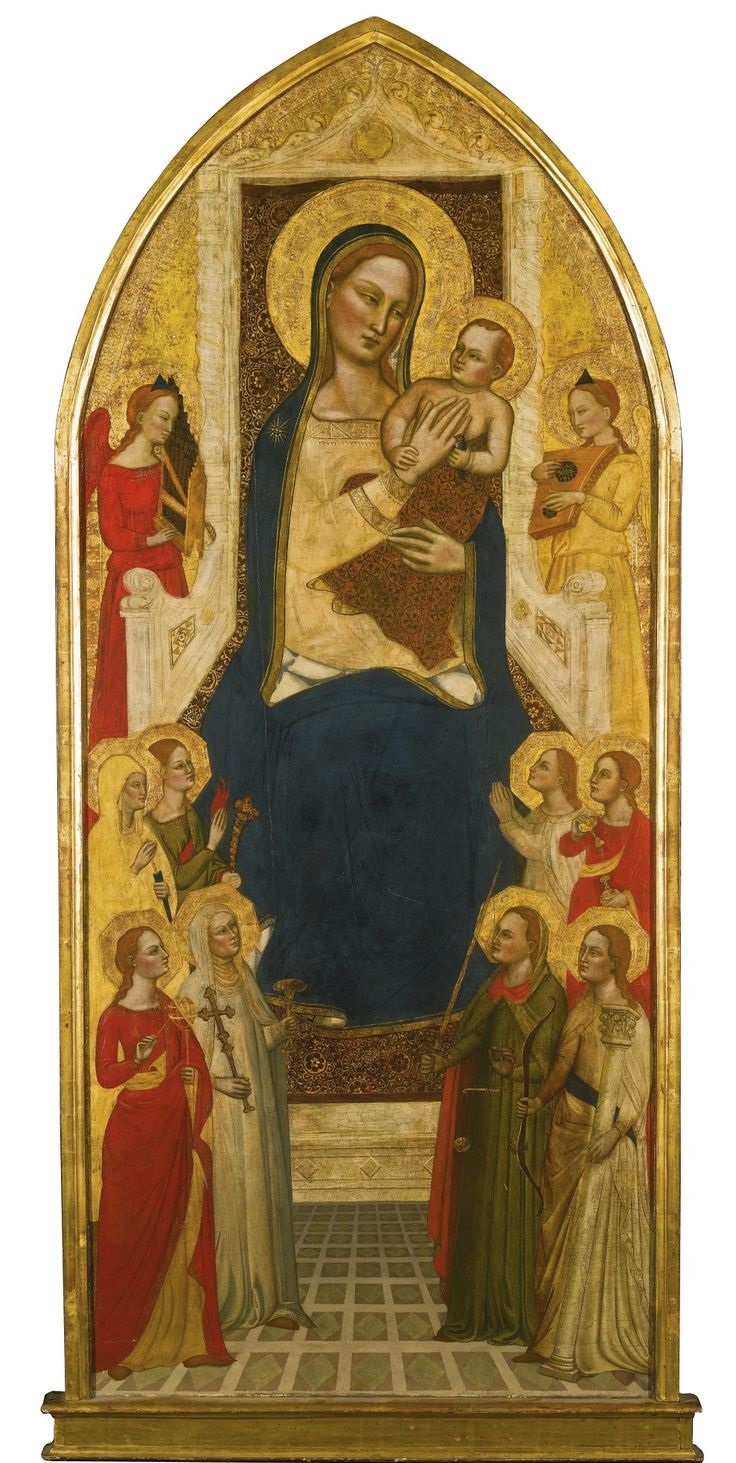
Jacopo di Cione
DOCUMENTED IN FLORENCE 1365 - 1398
THE MADONNA AND CHILD ENTHRONED WITH MUSIC-MAKING ANGELS AND VIRTUES
Tempera on panel, gold ground, arched top
162 by 68.5 cm.; 63 3/4  by 27 in
Private collection

The Madonna and Child are here shown together with the three Theological Virtues: Faith with a cross and chalice, Hope, with hands joined in prayer, and Charity, shown with a flaming heart and cornucopia. They are shown together with the four Cardinal Virtues: Prudence, with a sphere and a wand, Justice with the traditional symbols of scales and a sword, Temperance with two vases, and Fortitude, who holds a bow and a column. They are joined by the additional figure of Humility, who holds a lighted candle. Though not accorded a formal position among the Virtues, Humility was usually linked to Temperance in terms of importance to spiritual growth.

Jacopo di Cione was the younger brother of Andrea (Orcagna) and Nardo di Cione, and was admitted to the Arte dei Medici e Speziali in Florence in January of 1369, although he had probably been active for some years before that date. Following the deaths of his brothers in 1366 and 1368, he took over the running of the family workshop, which he continued until his own death thirty years later. In 1368, for example, he took over Orcagna's Saint Matthew altarpiece for Orsanmichele (Florence, Uffizi), which had been left unstarted. The magnificent polyptych commissioned for the Albizzi family for the high altar of San Pier Maggiore, documented to 1370–71 (principal panels now London, National Gallery), together with a Coronation of the Virgin of 1373, commissioned by the Mint in Florence and now in the Gallerie dell'Accademia2 there, together form the basis for the reconstruction of his œuvre. Both are thought to have been completed in collaboration with Niccolò di Pietro Gerini (c. 1340–1414), whose contribution to Jacopo's most prestigious commissions seems to have been important.
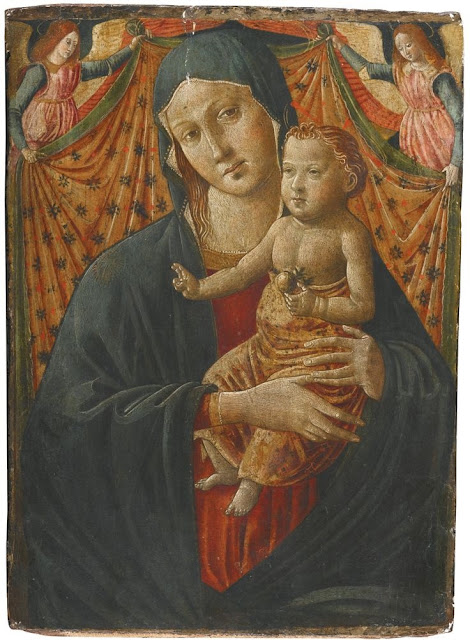
Alesso di Benozzo, ('Maestro Esiguo') (1473 in Florence – 1528)
ACTIVE IN FLORENCE AND PISTOIA AT THE END OF THE 15TH CENTURY
MADONNA AND CHILD BEFORE A CLOTH-OF-HONOUR HELD ALOFT BY TWO ANGELS
tempera on panel
33.8 by 24.6 cm.; 13 1/4  by 9 3/4  in.
Private collection

The composition of the present work may be associated with Benozzo's own Mystic Marriage of St Catherine in Terni and his Madonna of Humility with Sts Mary Magdalene and Martha in Berlin (now destroyed). Both those works show the Christ child bénissant seated on his mother's lap, before a cloth of honour held aloft by two angels. In the ex-Berlin painting the angels are particularly close to those here.

Alesso di Benozzo (1473 in Florence – 1528) was an Italian painter, son of Benozzo Gozzoli. He is mainly known for works, along with his brothers Gerolamo and Francesco, they completed in collaboration with their father. He painted an Annunciation now in New York. He is different from the contemporary painter Alesso Baldovinetti. Bennozo himself is sometimes called Benozzo di Lese (Alesso) after his father Lese.

After 1495, Benozzo was invited to Pistoia, by his son Francesco. There, along with Alesso and Gerolamo painted various works, including an incomplete Maestà for the Palazzo Comunale More on Alesso di Benozzo

Girolamo di Benvenuto, 1347 - 1380, SIENA 1470 - 1524
MADONNA AND CHILD WITH SAINT JOHN THE BAPTIST AND SAINT CATHERINE
tempera on panel, gold ground
82.4 by 64.2 cm.; 32 1/2  by 25 1/4  in.
Private collection

Striking parallels can be drawn between this work and a group of late works by the artist, which shows the Madonna and Child enthroned and surrounded by saints. The rosy-cheeked and sweet-faced Virgin turned to three-quarters in the present work is extremely close to both that in the Bagatti-Valsecchi altarpiece and another work from this period, a panel in the Landesgalerie, Hannover, showing the Mystic Marriage of Saint Catherine. These three works are evidence of the enrichment of Girolamo's style through the influence of Bernardino Fungai, something particularly visible in the docile figures, greater spatial awareness and decorative sensibility in the use of colour and treatment of drapery. More on this work

Saint Catherine of Siena, T.O.S.D. (March 25 1347 in Siena – April 29 1380 in Rome), was a tertiary of the Dominican Order and a Scholastic philosopher and theologian. She also worked to bring the papacy of Gregory XI back to Rome from its displacement in France and to establish peace among the Italian city-states. Since 18 June 1939, she is one of the two patron saints of Italy, together with St. Francis of Assisi. More on Saint Catherine of Siena

John the Baptist was the son of Zachary, a priest of the Temple in Jerusalem, and Elizabeth, a kinswoman of Mary who visited her. He was probably born at Ain-Karim southwest of Jerusalem after the Angel Gabriel had told Zachary that his wife would bear a child even though she was an old woman. He lived as a hermit in the desert of Judea until about A.D. 27. When he was thirty, he began to preach on the banks of the Jordan against the evils of the times and called men to penance and baptism "for the Kingdom of Heaven is close at hand". He attracted large crowds, and when Christ came to him, John recognized Him as the Messiah and baptized Him, saying, "It is I who need baptism from You". When Christ left to preach in Galilee, John continued preaching in the Jordan valley. Fearful of his great power with the people, Herod Antipas, Tetrarch of Perea and Galilee, had him arrested and imprisoned at Machaerus Fortress on the Dead Sea when John denounced his adultrous and incestuous marriage with Herodias, wife of his half brother Philip. John was beheaded at the request of Salome, daughter of Herodias, who asked for his head at the instigation of her mother. John inspired many of his followers to follow Christ when he designated Him "the Lamb of God," among them Andrew and John, who came to know Christ through John's preaching. John is presented in the New Testament as the last of the Old Testament prophets and the precursor of the Messiah. His feast day is June 24th and the feast for his beheading is August 29th. More on John the Baptist

Girolamo di Benvenuto (September 1470 - June 1524) was an Italian painter of the High Renaissance and son of the painter Benvenuto di Giovanni. He was born and died in Siena. Learning the basics of art under his father's watchful supervision and trained in the traditional Sienese style of painting (he was a contemporary of Giacomo Pacchiarotti, Bernardino Fungai and Pinturicchio), he worked on several frescoes and altarpieces undertaken by his father's studio. His first independent work, The Assumption of Mary of 1498 for the city of Montalcino (whose museum still holds it), Girolamo shows several differences to his father's style, with more elongated figures with more pronounced expressions.

His most notable work, signed and dated to 1508, is his Madonna of the Snow, now in the Pinacoteca in Siena. It echoes two female portraits painted by him at about the same time (one in the National Gallery of Art, Washington). Surviving documents and works show he mainly produced religious works, but also created paintings on secular themes for domestic settings and cassoni - the latter include his Judgement of Paris tondo (intended for a bedroom and now in the Louvre). More on Girolamo di Benvenuto

Workshop of Alessandro Filipepi, called Sandro Botticelli
FLORENCE 1445 - 1510
MADONNA AND CHILD WITH THE YOUNG ST JOHN
Tempera on panel, marouflaged, a tondo
diameter: 86.5 cm.; 34 in.
Private collection

Sandro Botticelli painted some of his most celebrated images of the Madonna and Child in the circular format of the tondo. In terms of treatment, subject and setting, this particular composition, which exists in more than one variant, is characteristic of his production of the 1480s, yet no prototype by the artist is known. The central motif of the Madonna del latte is relatively uncommon in Botticelli’s work. The prime example is the altarpiece now at the Gemäldegalerie, Berlin, originally painted for the Bardi Chapel of the Church of Santo Spirito in Florence, datable to 1485, but other smaller-scale works designed for domestic settings also exist. More on Sandro Botticelli

John Aitchison CBE RSA RA (1926 – 2009)
Nativity and Angels
16.02 X 11.97 in (40.7 X 30.4 cm)
Oil on canvas
Private collection

John Ronald Craigie Aitchison CBE RSA RA (13 January 1926 – 21 December 2009) was a Scottish painter.[1] He was best known for his many paintings of the Crucifixion,[2] one of which hangs behind the altar in the chapter house of Liverpool Cathedral,[3] Italian landscapes, and portraits (mainly of black men, or of dogs). His simple style with bright, childlike colours defied description, and was compared to the Scottish Colourists, primitivists or naive artists, although Brian Sewell dismissed him as "a painter of too considered trifles".

His career-long fascination with the crucificion was triggered by a visit to see Salvador Dalí's Christ of St John of the Cross in 1951 after it was acquired by the Kelvingrove Gallery. More on John Ronald Craigie Aitchison


Please visit my other blogs: Art Collector, Mythology, Marine Art, Portrait of a Lady, The Orientalist, Art of the Nude and The Canals of Venice, Middle East Artists, 365 Saints and 365 Days, also visit my Boards on Pinterest

Images are copyright of their respective owners, assignees or others. Some Images may be subject to copyright

I don't own any of these images - credit is always given when due unless it is unknown to me. if I post your images without your permission, please tell me.

I do not sell art, art prints, framed posters or reproductions. Ads are shown only to compensate the hosting expenses.

If you enjoyed this post, please share with friends and family.

Thank you for visiting my blog and also for liking its posts and pages.

Please note that the content of this post primarily consists of articles available from Wikipedia or other free sources online.


Acknowledgement: Old Master & British Paintings,