Showing posts with label Russia. Show all posts

03 Russian Icons from the Bible, with footnotes, #13

 Eastern Europe, Russia, ca. 18th century CE
Egg tempera and gold leaf 
61.625" L x 19.75" H (156.5 cm x 50.2 cm)
Private collection

A portable iconostasis comprised of 15 folding hinged panels including a central double panel with 14 side panels presenting 4 finely painted registers, each icon identified in handwritten Cyrillic. The uppermost register depicts half-length portrayals of patriarchs and prophets surrounding God the Father, and the Son, on the central lunette. Full-length saints engaged in intercessionary prayer Central register of painted icons commemorating feast days. In the lowest register, a central panel depicting Christ the Savior Enthroned holding the gospel on his knees surrounded by a blue mandorla with faint monochromatic. Images of angels and a red rhombus with signs of the 4 evangelists occupying the corners, surrounded by smaller full-length panels depicting the Virgin, various archangels, and saints.


An iconostasis is a wall of icons arranged in tiers according to strict theological and iconographical guidelines that traditionally separates the sanctuary and the nave of a church, symbolizing a visual synthesis of Orthodox Christians' spirituality and faith. More on this iconostasis 


19th C. Russian Icon, Chosen Saints Blessed by Our Lord
Egg tempera and gold leaf 
Size: 14.75" W x 17.5" H (37.5 cm x 44.4 cm)
Private collection

This icon presents an ensemble of blessed saints  - including Ann, Elizabeth, Paraskeva, Eudokia, Gregory of Nazianzus or Gregory of Nyssa, Josef, and Mary of Egypt standing in two rows, each saint identified with a gold on blue banner, all beneath Jesus as he descends from the heavens on billowing clouds donning pastel pink and blue robes. 


19th C. Russian Icon, Chosen Saints Blessed by Our Lord
Detail

In the Eastern Orthodox tradition every individual is named in honor of a specific saint when baptized, and this saint is regarded as a patron for the person's entire life. In addition, there are patron saints of activities and occupations, ailments and dangers, as well as locales. This icon venerates Saint Anne - Ann, Mother of the Virgin and patron saint of childless people, carpenters, grandparents, homemakers, lace makers, lost articles, miners, mothers, poverty, pregnancy, seamstresses, and children; Saint Elizabeth - the mother of John the Baptist, known for tending to the sick, especially those with leprosy and skin diseases; Saint Paraskeva, patron of embroiderers, needle workers, spinners, weavers, and marriage; Saint Eudokia, a wealthy saint who was known for her charitable projects; Saint Gregory, one of the four Latin Fathers of the Church known for establishing Roman liturgy and its music as well as vows of celibacy; Saint Josef, the father of Jesus Christ and spouse of the Blessed Virgin Mary regarded as the patron of unborn children, fathers, immigrants, workers, and carpenters; and Mary of Egypt, the patron saint of penitents, chastity, deliverance from demons, fever, and temptations of the flesh. More on this Icon

The Eastern Orthodox Church subscribes to a belief in the intercession of saints. In the Eastern Orthodox tradition every individual is named in honor of a specific saint when baptized, and this saint is regarded as a patron for the person's entire life. In addition, there are patron saints of activities and occupations, ailments and dangers, as well as locales.

Acknowledgement: Artemis Gallery   , and others

Images are copyright of their respective owners, assignees or others. Some Images may be subject to copyright

I do not sell art, art prints, framed posters or reproductions. Ads are shown only to compensate the hosting expenses.

If you enjoyed this post, please share with friends and family.

Thank you for visiting my blog and also for liking its posts and pages.


RELIGIOUS ART - Icons from the Bible, Our Lady of Kazan Russia, Black Madonna of Kazan, 18th century

1

Our Lady of Kazan Russia, Black Madonna of Kazan18th century. Hardwood single board with two back side Sponki (lost). Tempera on gesso (plaster). Brustbildnis (half-lengthportrait) of the Virgin with the Christ Child standing on her left. He raises his right hand in a blessing gesture. Driven, engraved and gilded Metall oklad with floral decor. 31 x 28 cm

Kazan is the capital and largest city of the Republic of Tatarstan, Russia. It is the eighth most populous city in Russia, and lies at the confluence of the Volga and Kazanka Rivers in European Russia.

Our Lady of Kazan, Black Madonna of Kazan (so-called both because of the often dusky color of their skin (in some cases, after cleaning, attributed to the accumulation of generations of soot from candles burnt under the images) and because in many cases they were either excavated from underground ruins or were originally worshipped in underground caverns, perhaps due to Marian persecutions). The history of the convent of Our Lady of Kazan is inseparably linked with finding, glorifying and honoring the mira­cle-working icon of Our Lady of Kazan in Russia. This icon is one of the most honored and esteemed in the Russian Church. 

At the beginning of July, 1579 there was a conflagration in Kazan, the capital of Tatarstan. The fire enveloped quite a district that joined the Kremlin's north­east. The yard of Danila Onuchin, the strelets sotnik (Russian light infantry command of a hundred men in Age of Empires), were burned down. Many families had lost their homes, and had to rebuild  before the Russian winter would come. Among those people trying to restore their homes was Daniel Onuchin. He had a daughter Matrona, nine years old.  

The Mother of God appeared in a dream to Matrona and commanded her to find Her icon, hidden in the ground by secret confessors of Orthodoxy, in the time of Moslem rule. Thrice the Mother of God appeared and pointed out the spot, where the wonder working icon had been concealed. Finally, Matrona, with her mother began to dig in the indicated place and they found the sacred icon. To the place of the miraculous discovery came archbishop Jeremii at the head of his clergy and transported the holy image into a church of Saint Nicholas situated nearby; then,  amidst a church procession they transferred it to the Annunciation cathedral – the first Orthodox temple in the city of Kazan, erected by tsar Ivan the Terrible. During the procession there occurred the healing of two blind men – Iosif and Nikita.

Tsar Ivan the Terrible gave orders to build at the place of its appearance a temple in honour of the Kazan Icon, and to found there also a women's monastery. Matrona and her mother, instrumental in finding the sacred icon, accepted monastic tonsure at this monastery. 

Invocation of the Virgin Mary through the icon was credited to the Russian commanders, Dmitry Pozharsky and Mikhail Kutuzov, with helping the country to repel the Polish invasion of 1612, the Swedish invasion of 1709, and Napoleon's invasion of 1812.

On the night of June 29, 1904, the icon was stolen from the church in Kazan where it had been kept for centuries (the cathedral was later blown up by the communist authorities). Thieves apparently coveted the icon's gold frame. The Orthodox Church interpreted the disappearance of the icon as a sign of tragedies that would plague Russia after the image of the Holy Protectress of Russia had been lost. Indeed, the Russian peasantry was wont to credit all the evils of the Revolution of 1905, as well as Russia's defeat in the Russo-Japanese War, to the desecration of the image. More

Vladimir Putin ordered that the Black Madonna of Kazan, the holiest icon of the Russian Orthodox Church, be flown over the Black Sea, many believed he wished to secure blessings for the Winter Olympics in Sochi.

RELIGIOUS ART - Icons from the Bible, Our Lady of Vladimir (Vladimirskaya) Mother of God, Russia, 17th / 19th Century

1

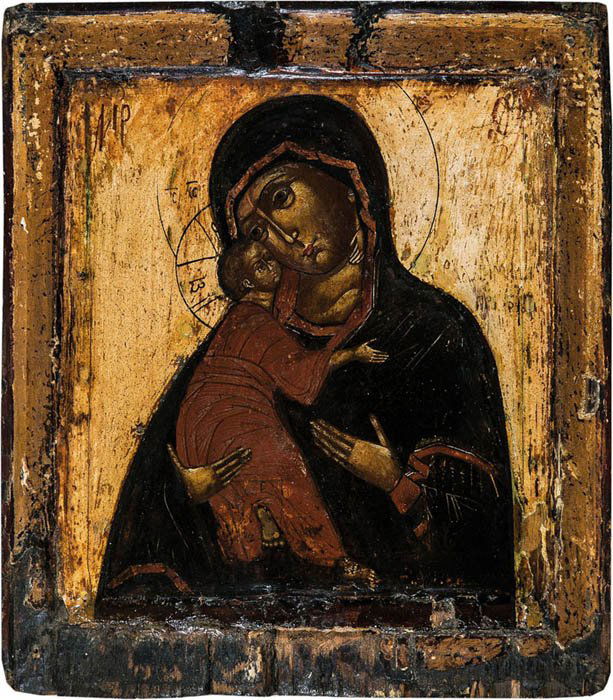
Our Lady of Vladimir (Vladimirskaya) Mother of God, Russia, 17th / 19th Century. Hardwood single board with two back side Sponki (lost). Double Kowtscheg (Ark), tempera on groundchalk . Background and border uncovered. Field used later in old board. Verso Cyrillic labels (scratched). Presentation of the The Mother of God shown in half-length with Christ in her right arm. Christ touching his cheek to his Mother's face. Border with losses. Almost Completely restored. . Field largely in the 19th century. Revised. Rand strong substance losses. 31.5 x 27.5 cm 

Mother of God Vladimirskaya: The Mother of God of Vladimir, also known under the name of Our Lady of Vladimir, Virgin of Vladimir Vladimirskaya, Our Lady of Vladimir, Our Lady of Tenderness, The Lady Who Saves Russia, is one of the icons orthodox most revered in Russia. The Theotokos (Greek Theotokos: Marie) is considered the patron saint of Russia.

The miraculous image given the title, Our Lady of Vladimir, is known as an Eleousa,the Greek word meaning, Mother of Tenderness. The Christ Child nestles tenderly close to his mother, he gazes at her and is so closely linked to her that his left arm embraces her fully. His right hand gently touches her left cheek. The original image is a large painting of the type known as the St. Luke icons. Mary looks out at the people. Yet, there is no doubt that she is intimately united to her Divine Son.

The origin of the ancient Marian icon, Our Lady of Vladimir, can be traced back to 1125. The oldest known representation of Our Lady of Vladimir  was commissioned in Constantinople by a Russian, who then had the painting taken from city to city during the period of united Ukranian-Russian history. In 1169, Duke Andrej Bogoljubskij had the icon brought from Kiev to the new cathedral of Vladimir. Due to the honor and reverence of the people, who attributed gracious assistance to Our Lady's help throughout the Ukraine, a large cathedral was built for her in Vladimir.

When the Mongol invasion threatened Moscow in 1395, the original icon was brought to Moscow, where she was honored as the unconquerable shield of the Russian people. Important state transactions took place before her image; her blessing was sought before battle. In time, Our Lady of Vladimir became the sign of the Russian Orthodox Church. More

Vladimir  is a city in Russia and the administrative center of the oblast Vladimir. Vladimir is part of the Golden Ring of ancient Russia around Moscow.