01 Work, Olympian deities, Federico Barocci's AENEAS AND HIS FAMILY FLEE OUT OF TROY, with footnotes #28

Federico Barocci, 1526/35 - 1612, circle of the
AENEAS AND HIS FAMILY FLEE OUT OF TROY, c. 1598
Oil on canvas. 
76 x 95.5 cm
Private collection

In Greco-Roman mythology, Aeneas was a Trojan hero, the son of the prince Anchises and the goddess Aphrodite (Venus). His father was a first cousin of King Priam of Troy, making Aeneas a second cousin to Priam's children (such as Hector and Paris). He is a character in Greek mythology and is mentioned in Homer's Iliad. Aeneas receives full treatment in Roman mythology, most extensively in Virgil's Aeneid, where he is an ancestor of Romulus and Remus. He became the first true hero of Rome. 

He played a prominent part in defending his city against the Greeks during the Trojan War, being second only to Hector in ability. Homer implies that Aeneas did not like his subordinate position, and from that suggestion arose a later tradition that Aeneas helped to betray Troy to the Greeks. The more common version, however, made Aeneas the leader of the Trojan survivors after Troy was taken by the Greeks. More on Aeneas

Federico Barocci, original name Federico Fiori Barocci, (born c. 1526, Urbino, Duchy of Urbino, Papal States—died 1612, Urbino), was a leading painter of the central Italian school in the last decades of the 16th century and an important precursor of the Baroque style.

Barocci studied in Urbino with Battista Franco, a follower of Michelangelo’s maniera. Although he made two visits to Rome—one in about 1550 to study the works of Raphael, and another in 1560 when, with Federico Zuccaro, he worked on the frescoes for Pope Pius IV’s Casino in the Vatican Gardens—Barocci lived and worked all his life in Urbino and the surrounding small towns. He executed altarpieces and devotional paintings for local churches and patrons such as the Duke of Urbino and, in time, the cathedrals of Genoa and Perugia.

Barocci may have never seen an original Correggio, yet Correggesque motifs appear in his compositions. Warmth of feeling, tenderness of expression, and a painterly approach are common to the work of both artists. This is particularly evident in the many paintings by Barocci on the theme of the Madonna; two of the most famous are the Madonna del Popolo (1579) and the exquisitely beautiful Nativity (1597). Barocci was unusual in the Mannerist period for his numerous and extremely sensitive life drawings. His distinctive use of colour is central Italian in origin—pale, fugitive colours blended chiefly from vermilion pinks, mother-of-pearl whites, and grays. More on Federico Barocci


Please visit my other blogs: Art CollectorMythologyMarine ArtPortrait of a Lady, The OrientalistArt of the Nude and The Canals of VeniceMiddle East Artists365 Saints and 365 Days, also visit my Boards on Pinterest

Images are copyright of their respective owners, assignees or others. Some Images may be subject to copyright

I don't own any of these images - credit is always given when due unless it is unknown to me. if I post your images without your permission, please tell me.

I do not sell art, art prints, framed posters or reproductions. Ads are shown only to compensate the hosting expenses.

If you enjoyed this post, please share with friends and family.

Thank you for visiting my blog and also for liking its posts and pages.

Please note that the content of this post primarily consists of articles available from Wikipedia or other free sources online.


06 Works, RELIGIOUS ART - Interpretation of the Koran, by Lubin Baugin Pithiviers, Francesco Peluso, Ludwig Deutsch, Grigori Grigorevich Gagarin, Fabio Fabbi and Vittorio Amadeo, with Footnotes - #175

Wishing all a happy Eid al-Fitr foe 2023!

Francesco Peluso, Italian, b. 1836
Evening Prayer in the Desert
Oil on canvas
65 by 143cm., 25½ by 56½in.
Private collection

Francesco Peluso (1836 - 1916) was active/lived in Italy.  Francesco Peluso is known for Genre scene painting of socializing figures dancing, sharing fun.

Francesco Peluso was born in Naples in 1836. His work was particularly admired for his inventive bourgeois and folk genre scenes in the eighteenth century style.

Eid-al-Fitr marks the end of Ramadan, the holy month of fasting, and the first day of the Islamic month of Shawwal. The date is determined annually by the sighting of the moon and varies each year on the Gregorian calendar. Eid begins with communal prayers that are followed by a sermon or a khutba. The following day is marked by celebrations, merry-making, the exchange of food and gifts, and charity or zakat.

Ludwig Deutsch (Austrian, 1855-1935)
Early morning, Id el-fitr, visit the tombs of their relatives, Cairo c. 1902
signed, inscribed and dated 'L. Deutsch Le Caire 1902' (lower left)
Oil on canvas
45 1/4 x 62 1/2in (115 x 158.7cm)
Private collection

On one or more days of the festival  'Idu 'L-Fitr festival, some or all of the members of most families, but chiefly the women, visit the tombs of their relatives. This they also do on the occasion of the other grand festival. ["Idu 'l-Azha"] The visitors, or their servants, carry palm branches, and sometimes sweet basil, to lay upon the tomb which they go to visit. The palm-branch is broken into several pieces, and these, or the leaves only, are placed on the tomb.

Numerous groups of women are seen on these occasions, bearing palm-branches, on their way to the cemeteries in the neighborhood of the metropolis. They are also provided, according to their circumstances, with cakes, bread, dates, or some other kind of food, to distribute to the poor who resort to the burial-ground on these days. Sometimes tents are pitched for them; the tents surround the tombs which is the object of the visit. More on this painting

Ludwig Deutsch, 1855-1935, was born in Vienna to a well-to-do family. He began studying at the Academy of Fine Arts after completing high school. He studied in the atelier of Alselm Feuerbach along with the painter Rudolf Ernst, his contemporary, who was also an Orientalist and lifelong friend. 
Deutsch decided to move to Paris to continue his studies. He was accepted into the class of Leopold Carl Muller, another Austrian Orientalist, who had moved to Paris. By 1880, he had decided to cut all his ties with his life in Vienna, apart from his friend Rudolf Ernst, who had also moved to Paris.  Deutsch set up a studio on the Rue Pelletier, and sent a portrait to the Paris Salon in 1879. He was then studying with Jean-Paul Laurens, who promoted his student’s work to Parisian high society. It was in 1881 that he began painting Orientalist works. He began making paintings that focused on single figures instead of the groups of people that he had been painting before. 
Deutsch traveled to Egypt in 1886 for the first time, resulting in a number of paintings of everyday street scenes. He visited again in 1890, and frequently did so over the next few years. 
Deutsch wanted accuracy in his work, and so hired local photographers to take pictures of the sites that he would later paint.  Deutsch won the Gold Medal at the Paris Salon in 1900. His work sold well, with buyers being drawn to his incredible attention to detail. He continued painting through the next decade and a half till the outbreak of the First World War, when he was forced to flee Paris. 
Deutsch became a French citizen in around 1919. Throughout his career, he worked towards improving his photo-realistic technique. Though he was a studio-painter who often painted with models in Paris, his travels in Egypt lent color and atmosphere that rendered his paintings authentic. Deutsch continued living and working in Paris till his death in 1935. More on Ludwig Deutsch

Vittorio Amadeo
Ali Muhittin Haci, Istanbul
Water colour
43*58 cm
Louvre Museum

Children gather in small choir groups in front of a home and sing. The song is intended to call on God to bless the youngest child of the family, to keep him or her healthy that the mother will remain happy. The more they sing, the more nuts and sweets they receive. The Qarqee'an tradition is intended to spread love, happiness and affection among adults and children Gargee'an.

Vittorio Amadeo Preziosi (1816 - 1882) was active/lived in Turkey, Malta, Italy.  Vittorio Preziosi is known for City genre, buildings and landscape painting-Orientalist.

Count Amadeo Preziosi was descended from a family which had migrated from Corsica to Malta in the 17th century and been awarded a title by the king of Sicily. Preziosi was born in Valetta on 2 December 1816, and spent his childhood and youth in Malta. His father Count Gio Francois was an eminent figure in Malta and a wealthy man.

Preziosi was educated by private tutors, and his passion for drawing and painting began as a child. Although he studied law in compliance with his parents' wishes he eventually abandoned this profession to devote himself to painting, first entering the studio of Giuseppe Hyzler, and subsequently going to France to complete his art education at the Paris Academy of Fine Arts. This was a time when European painters were flocking to the Gateway to the East, as Istanbul was known, and under this influence Preziosi packed up his paints and brushes and set out from Malta in 1842, travelling first to Italy and then to Istanbul. More on Vittorio Amadeo

Grigori Grigorevich Gagarin
Outdoor Fete in Turkey
Oil on canvas
Peterhof Palace, St. Petersburg

After the Eid al-Fitr prayer, the people of Jerusalem will decorate the courtyards of the Al-Aqsa Mosque with toys for children who come from all Palestinian areas to participate in the Eid al-Fitr prayer rituals. Many Palestinians go out to visit the families of those imprisoned, visit the prisons themselves, and visit the graves of the martyrs to lay wreaths on them.

Palestinians and Jordanians, decorate their homes and prepare sumptuous meals for family and friends. They prepare new clothes and shoes for the festival. Eid festivities in Palestine and Jordan may vary culturally depending on the region, but one common thread in all celebrations is generosity and hospitality. It is a common for families to gather at the patriarchal home after the Eid prayers. Before the special Eid meal is served, young children will line up in front of each adult family member, who dispense money as gifts to the children. Jordanians would also hang fanous lanterns.

In Lebanon, many concerts take place during Eid al-Fitr by Lebanese and other Arab superstars. Musicians also perform on the Beirut waterfront. Other activities include art exhibitions.

Ma'amoul and Kahk are popular cookie treats baked and consumed during Eid in Palestine, Jordan, Syria and Lebanon. More on Eid al-Fitr celebrations

Prince (Duke) Grigori Grigorievich Gagarin (1810 - 1893) was active/lived in Russian Federation.  Prince Duke Grigori Grigorievich Gagarin is known for Painting.

Biography photo for Prince (Duke) Grigori Grigorievich Gagarin
Duke Grigory Grigorievich Gagarin belonged to one of the oldest aristocratic families which left some significant trace in Russian history. He was an artist, illustrator, art researcher, architect, Royal Court attendant of Her Imperial Majesty, Vice President of the Fine Arts Academy since 1859 and Privy Councillor. Karl Brüllow was one of his teachers. Gagarin spent most of his childhood and youth in Rome and Paris. In 1832 he came to Saint Petersburg and entered the service of the Asian Department in the Ministry of Foreign Affairs. He met the famous Russian poets Alexander Pushkin und Michail Lermentow. Gagarin's serious passion for the orient began when he sailed on the brig “Themistokles” from Athens to Constantinople between 1834 and 1836. Two sojourns to the orient followed: In 1840 Gagarin served in the army and sojourned in the Caucasus and in 1848 was appointed deputy of the governor of the Caucasus Duke Michail Vorontsov in Tiflis. More on Grigori Grigorievich Gagarin

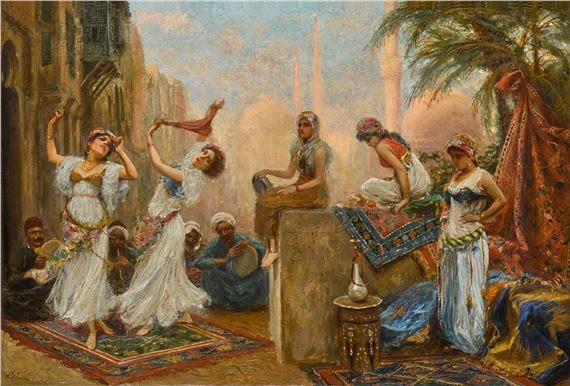
Fabio Fabbi (Italian, 1861–1946)
The dancers
Oil on board
40.2 x 49.5 cm. (15.8 x 19.5 in.)
Private collection

Fabio Fabbi
The Dancers
Oil on canvas
81 by 120cm. 31¾ by 47¼in.
Private collection

Fabio Fabbi was an Italian painter working in the Orientalist tradition. Born in Bologna, Italy in 1861, he began his artistic career by studying at the Accademia Di Belle Arti in Florence in the 1880s. He would gain considerable popularity for his exoticized, Neoclassical paintings, usually depicting Middle Eastern and North African street scenes and featuring harem women, dancers, and Muslim warriors. Fabbi's work was considered more commercial than many of his peers, resulting in the artist’s fiscal prosperity and his frequent contributions to exhibitions in Turin, Milan, and Florence. He died in 1946. More on Fabio Fabbi


Please visit my other blogs: Art CollectorMythologyMarine ArtPortrait of a Lady, The OrientalistArt of the Nude and The Canals of VeniceMiddle East Artists365 Saints and 365 Days, also visit my Boards on Pinterest

Images are copyright of their respective owners, assignees or others. Some Images may be subject to copyright

I don't own any of these images - credit is always given when due unless it is unknown to me. if I post your images without your permission, please tell me.

I do not sell art, art prints, framed posters or reproductions. Ads are shown only to compensate the hosting expenses.

If you enjoyed this post, please share with friends and family.

Thank you for visiting my blog and also for liking its posts and pages.

Please note that the content of this post primarily consists of articles available from Wikipedia or other free sources online.


05 Works , Interpretation of the Bible! Christ is Risen! Indeed He is Risen! - with footnotes #203

Happy Pascha (Eastern Church Easter)

The resurrection of Jesus Christ from the dead is the center of the Orthodox Christian faith. Twelve weeks of preparation precede it. This is made up of pre-lenten Sundays, Great Lent, and Holy Week. The faithful try to make this long journey with repentance, forgiveness, reconciliation, prayer, fasting, almsgiving, and study. When the feast finally arrives, it is celebrated with a collection of services combined as one...

Christ is Risen
I have no description of this artwork. It may appear later

In this modern Greek icon Christ stands here over the broken doors of Hades and pulls Adam and Even out of their tombs to bring them back to paradise, while St. John the Baptist and Kings David and Solomon both look on and are also brough with them into the brightness of heaven.

On the right is Abel, son of Adam and Eve, holding his shepherd’s staff. Abel is considered the protomartyr — the “first martyr,” because he was killed by his brother Cain.

The keys to Hell and the grave are depicted trampled beneath His feet, and in many icons in this motif Death is depicted vanquished and chained.


Augustin Hirschvogel, German
The Risen Christ, c. 1550
Etching
4 5/8 × 6 1/16 in. (11.8 × 15.4 cm)
 The Metropolitan Museum of Art

According to Jewish customs, the seven myrrh -bearing women decided to anoint the body of the Savior with fragrant myrrh - hence their name Myrrhbearer comes from. Wives followed the Savior throughout His earthly life, taking upon themselves His worldly and domestic concerns. They remained faithful to the Son of God when he was dying on the cross, and then asked the procurator Pontius Pilate for permission to take away the body of the Savior in order to perform the burial.

Not afraid of the guards and overcoming the natural fear of a person before death, the myrrh-bearing women were the first to receive the happy news of the Resurrection. From now on, in the third week after the end of Easter, Christians celebrate a holiday in their honor. More on Seven myrrh -bearing women

Robert Anning Bell RA (1863 - 1933)
The Women going to the Sepulchre, c. 1912
Oil on canvas
760 mm x 1270 mm
Royal Academy of Arts

Robert Anning Bell's painting shows the Virgin Mary leading a procession of holy women into Christ's tomb (or sepulchre) on the day following the Crucifixion. The women carry fragrant oils to anoint the body and Mary Magdalen, identified by her long red hair, can be seen on the right holding a jar of myrrh

Anning Bell specifically chose this quiet moment just before the women discover that Christ's body has disappeared. The painting has an air of solemn piety evoked by the cool, subdued colours, frieze-like composition and barren landscape. The artist also worked as a sculptor, illustrator and designer of stained glass and mosaics. Here, the colouring and simplicit. More on this painting

Robert Anning Bell was British painter, sculptor, designer, illustrator, and teacher, born in London. His highly varied artistic training began with two years in an architect's office, continued at the *Royal Academy and the Westminster School of Art, and was rounded off with stays in Paris and Italy. He gained some of his sculptural expertise by sharing a studio for a while with Sir George *Frampton. Bell's interest in the architectural setting of art helped him to win numerous decorative commissions for mosaics, stained glass, and relief sculpture. His clear, linear style, influenced by Italian Renaissance art, was well suited to this type of work. Examples of his mosaics are in Westminster Cathedral and the Houses of Parliament, and his stained glass includes the Shakespeare window in Manchester Reference Library.

His second wife, Laura Anning Bell (1867–1950), was a portraitist, mainly in pastel. More on Robert Anning Bell

Russian icon
Seven myrrh-bearing women, c. 17th
I have no further description, at this time

Above in the valley between the mountains, the resurrected Christ (between earth and sky) against the backdrop of Mount Jerusalem (the city on the upper right) is talking with Mary Magdalene. 

With all the variety of icon-painting creations dedicated to this biblical story, the images of the icons of the Holy Myrrh-bearing Women often differ greatly from each other in composition and artistic solution. Even the number of depicted female figures on the image can be different, from seven to three. This is due to the different versions of the texts interpreting the story of women who came early in the morning to the Holy Sepulcher.

The White Angel of the Lord, with raised wings, sits on a stone that shuts the entrance to the cave, near the empty tomb, where the shroud of Christ lies.
In front of the angel are seven myrrh-bearing women with vessels with the world in their hands: first row: Martha of Bethany (Mary's sister); Virgin Mary (Mother of God; was there according to Gregory of Nyssa); Maria (sister of Martha); Salome;
top row: Maria (other), Susanna, Anna. More on this work

Augustin Hirschvogel, German
Risen Christ Appearing to the Disciples, c. 1547
Etching
4 11/16 in. × 6 in. (11.9 × 15.3 cm)
The Metropolitan Museum of Art

Augustin Hirschvogel (b. 1503, Nürnberg, d. 1553, Wien) was a German glass painter, etcher, cartographer and mathematician, part of a family of artists. They were Nuremberg's leading stained-glass painters during the late 15th century and the 16th. Veit Hirschvogel the Elder, the son of a glazier named Heinz (d. 1485), established the family workshop and became the city's official glazier. Augustin, the most talented of the family, left it in 1525 to pursue a varied career outside Nuremberg, producing many etchings and also innovations in cartography. 

Augustin Hirschvogel trained as a stained-glass painter in his father's workshop and remained there until his father's death in 1525. In that year Nuremberg accepted the Reformation, spelling the end of monumental stained-glass commissions. This must have profoundly reduced the production of the workshop, now run by his elder brother Veit, and may have forced Augustin to become more versatile. By 1530 he had established his own workshop but in 1531 formed a partnership with the Nuremberg potters Hanns Nickel (active c. 1530) and Oswald Reinhart (active c. 1530), presumably to share their kiln. This partnership, coupled with Johann Neudörfer's confusing comments about Hirschvogel in his Nachrichten (1547), formerly led to speculation about his having made a ceramic stove and pots in a classicizing Italianate style. It is more likely that the vessels made by Augustin and described in documents as in a Venetian style were glass, not earthenware. More on Augustin Hirschvogel


Please visit my other blogs: Art CollectorMythologyMarine ArtPortrait of a Lady, The OrientalistArt of the Nude and The Canals of VeniceMiddle East Artists365 Saints and 365 Days, also visit my Boards on Pinterest

Images are copyright of their respective owners, assignees or others. Some Images may be subject to copyright

I don't own any of these images - credit is always given when due unless it is unknown to me. if I post your images without your permission, please tell me.

I do not sell art, art prints, framed posters or reproductions. Ads are shown only to compensate the hosting expenses.

If you enjoyed this post, please share with friends and family.

Thank you for visiting my blog and also for liking its posts and pages.

Please note that the content of this post primarily consists of articles available from Wikipedia or other free sources online.