Showing posts with label Aeneas. Show all posts

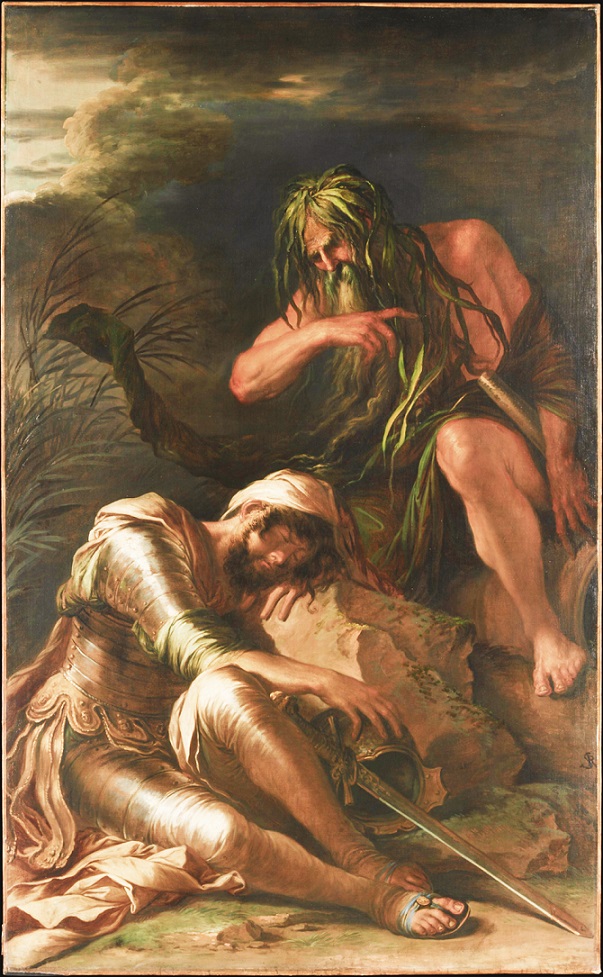
01 Work, Interpretations of Hellenic and Roman legends. Salvator Rosa's Interpretation of The Dream of Aeneas, with footnotes #190

Salvator Rosa (Italian, Arenella (Naples) 1615–1673 Rome)
The Dream of Aeneas, c. 1660–65
Oil on canvas
77 1/2 x 47 1/2 in. (196.9 x 120.7 cm)
The Metropolitan Museum of Art

In Book VIII of Virgil’s Aeneid, the Trojan hero Aeneas has landed in Latium, exhausted from the brewing hostilities with the local Rutili and their leader Turnus. “This way and that he turns his anxious mind; thinks, and rejects the counsel he designed; explores himself in vain, and gives no rest to his distracted heart.” Aeneas finally finds nocturnal repose on the banks of the Tiber, when “thro’ the shadows of the poplar wood, arose the father of the Roman flood an azure robe was over his body spread, a wreath of shady reeds adorned his head.” Tiberinus, the river god himself, tells Aeneas not to fear, for “when thirty rolling years have run their race, thy son Ascanius, on this empty space, shall build a royal town, of lasting fame”—a prophecy of the foundation of Rome. More on this painting

Salvator Rosa (June 20 or July 21, 1615 – March 15, 1673) was one of the least conventional artists of 17th-century Italy, and was adopted as a hero by painters of the Romantic movement in the later 18th and early 19th centuries. He was mainly a painter of landscapes, but the range of his subject matter was unusually wide and included portraits and allegories. He also depicted scenes of witchcraft, influenced by Northern prints.

Rosa's training took place in Naples, where he was born, and the main influences on his early work were Ribera and Aniello Falcone, a painter best known for his battle scenes. Following visits to Rome in the later 1630s Rosa worked in Florence and its neighbourhood (1640-9), before returning to Rome, where he eventually died. More on Salvator Rosa


Please visit my other blogs: Art Collector, Mythology, Marine Art, Portrait of a Lady, The Orientalist, Art of the Nude and The Canals of Venice, Middle East Artists, 365 Saints, 365 Days, and Biblical Icons, also visit my Boards on Pinterest

Images are copyright of their respective owners, assignees or others. Some Images may be subject to copyright

I don't own any of these images - credit is always given when due unless it is unknown to me. if I post your images without your permission, please tell me.

I do not sell art, art prints, framed posters or reproductions. Ads are shown only to compensate the hosting expenses.

If you enjoyed this post, please share with friends and family.

Thank you for visiting my blog and also for liking its posts and pages.

Please note that the content of this post primarily consists of articles available from Wikipedia or other free sources online.


01 Painting, Olympian deities, by the Old Masters, with footnotes #34

Unknown Artist, 17th century
Aeneas' Farewell to Dido
Oil on canvas
55 x 65 cm
Private collection

One of the Trojan heroes, Aeneas wandered for six years after the fall of Troy and reached Carthage for some rest. The queen Dido welcomed them whole-heartedly and heard their story. During his stay, Aeneas and Dido fell in love with each other and Dido declared him her lord and began to rule Carthage together.

But, Aeneas had many tasks to accomplish yet. He was contacted by Jupiter through Mercury to remind him of his yet to complete tasks. The religious Aeneas had no other choice but obey him. 


Dido felt betrayed and ashamed against all her citizens and relatives. At that moment, she cursed Aeneas and declared the enmity between Carthage and Rome which ultimately led those cities into the infamous Punic wars. More on Aeneas and Dido


Please visit my other blogs: Art Collector, Mythology, Marine Art, Portrait of a Lady, The Orientalist, Art of the Nude and The Canals of Venice, And visit my Boards on Pinterest

Images are copyright of their respective owners, assignees or others. Some Images may be subject to copyright

I don't own any of these images - credit is always given when due unless it is unknown to me. if I post your images without your permission, please tell me.

I do not sell art, art prints, framed posters or reproductions. Ads are shown only to compensate the hosting expenses.

If you enjoyed this post, please share with friends and family.


Thank you for visiting my blog and also for liking its posts and pages.

01 Paintings, Olympian deities, by the Old Masters, Federico Barocci's Aeneas flees burning Troy, with footnotes # 28

Federico Barocci, (1535–1612)
Aeneas flees burning Troy, c. 1598
Oil on canvas
Borghese Gallery

In Greco-Roman mythology, Aeneas was a Trojan hero, the son of the prince Anchises and the goddess Aphrodite (Venus). His father was a first cousin of King Priam of Troy, making Aeneas a second cousin to Priam's children (such as Hector and Paris). He is a character in Greek mythology and is mentioned in Homer's Iliad. Aeneas receives full treatment in Roman mythology, most extensively in Virgil's Aeneid, where he is an ancestor of Romulus and Remus. He became the first true hero of Rome. 

He played a prominent part in defending his city against the Greeks during the Trojan War, being second only to Hector in ability. Homer implies that Aeneas did not like his subordinate position, and from that suggestion arose a later tradition that Aeneas helped to betray Troy to the Greeks. The more common version, however, made Aeneas the leader of the Trojan survivors after Troy was taken by the Greeks. More on Aeneas


Federico Barocci, original name Federico Fiori Barocci, (born c. 1526, Urbino, Duchy of Urbino, Papal States—died 1612, Urbino), was a leading painter of the central Italian school in the last decades of the 16th century and an important precursor of the Baroque style.

Barocci studied in Urbino with Battista Franco, a follower of Michelangelo’s maniera. Although he made two visits to Rome—one in about 1550 to study the works of Raphael, and another in 1560 when, with Federico Zuccaro, he worked on the frescoes for Pope Pius IV’s Casino in the Vatican Gardens—Barocci lived and worked all his life in Urbino and the surrounding small towns. He executed altarpieces and devotional paintings for local churches and patrons such as the Duke of Urbino and, in time, the cathedrals of Genoa and Perugia.

Barocci may have never seen an original Correggio, yet Correggesque motifs appear in his compositions. Warmth of feeling, tenderness of expression, and a painterly approach are common to the work of both artists. This is particularly evident in the many paintings by Barocci on the theme of the Madonna; two of the most famous are the Madonna del Popolo (1579) and the exquisitely beautiful Nativity (1597). Barocci was unusual in the Mannerist period for his numerous and extremely sensitive life drawings. His distinctive use of colour is central Italian in origin—pale, fugitive colours blended chiefly from vermilion pinks, mother-of-pearl whites, and grays. More on Federico Barocci


Please visit my other blogs: Art Collector, Mythology, Marine Art, Portrait of a Lady, The Orientalist, Art of the Nude and The Canals of Venice, Middle East Artists, 365 Saints and 365 Days, also visit my Boards on Pinterest

Images are copyright of their respective owners, assignees or others. Some Images may be subject to copyright

I don't own any of these images - credit is always given when due unless it is unknown to me. if I post your images without your permission, please tell me.

I do not sell art, art prints, framed posters or reproductions. Ads are shown only to compensate the hosting expenses.

If you enjoyed this post, please share with friends and family.

Thank you for visiting my blog and also for liking its posts and pages.

Please note that the content of this post primarily consists of articles available from Wikipedia or other free sources online.