Showing posts with label Artists. Show all posts

02 Paintings, Irish deities, Henry Meynell Rheam's La Belle Dame sans Merci (Banshee), with footnotes # 43

Henry Meynell Rheam (1859-1920)
La Belle Dame sans Merci/ The beautiful lady without mercy (Banshee), c. 1901
Pencil, watercolour and bodycolour on paper laid on board
103⁄8 x 23 in. (26.4 x 58.5 cm.)
Private collection

Sold for GBP 3,780 in Jul 2022

John Keats's 1819 ballad La Belle Dame sans Merci provided inspiration for several Pre-Raphaelite artists, including John William Waterhouse, Arthur Hughes, Walter Crane and Frank Dicksee. Its subject is a fairy who seduces a knight with her eyes and singing voice, before lulling him to sleep and abandoning him on an empty hillside. The present watercolour depicts the moment when the fading knight dreams of the fairy he saw across the meadow, and his own initial approach to her on horseback. Meynell Rheam also made a much larger upright watercolour of the subject in 1901 (see below), in which the fairy stands over the dying knight in a misty clearing. More on this painting

Henry Meynell Rheam (1859-1920)
La Belle Dame sans Merci/ The beautiful lady without mercy (Banshee), c. 1897
Another version of La Belle Dame sans Merci
Watercolour on paper
24 × 57 cm
Unknown location

Henry Meynell Rheam (1859-1920), The eldest surviving son of a large Quaker family, with Yorkshire roots on both sides, he was born in Birkenhead on Merseyside. His father "became a successful hide and leather merchant" (Cartmell), and he went to boarding school in Weston-super-Mare. He was in Germany at some point, but in 1884 he went to Heatherly's school in London in 1884, and on from there in 1886 to the popular Académie Julian in Paris. Like so many young artists of that time, on his return to England he was attracted to the fishing villages and artists' colonies in Cornwall, moving first to Polperro and then to Newlyn.

Mainly a watercolourist, Rheam became part of the inner circle of the Newlyn School as Honorary Secretary of the Newlyn Society of Artists. He also made a name for himself in the wider art circle. The Cornish Masters website also tells us that "Rheam exhibited at the Royal Academy, was elected to the R.B.A. (Royal Society of British Artists) in 1889, and R.I. (Royal Institute of Painters in Water Colours) in 1892 and exhibited regularly in all 3 institutions." Later on, he became more interested in fantasy and He was ony 61 when he died in nearby Penzance. — Jacqueline Banerjee


Please visit my other blogs: Art CollectorMythologyMarine ArtPortrait of a Lady, The OrientalistArt of the Nude and The Canals of VeniceMiddle East Artists365 Saints365 Days, and Biblical Icons, also visit my Boards on Pinterest

Images are copyright of their respective owners, assignees or others. Some Images may be subject to copyright

I don't own any of these images - credit is always given when due unless it is unknown to me. if I post your images without your permission, please tell me.

I do not sell art, art prints, framed posters or reproductions. Ads are shown only to compensate the hosting expenses.

If you enjoyed this post, please share with friends and family.

Thank you for visiting my blog and also for liking its posts and pages.

Please note that the content of this post primarily consists of articles available from Wikipedia or other free sources online.


01 Work, 19th Century, English School's The witch, with Footnotes

English School, 19th Century
The witch
Oil on canvas
60,7 x 48,4 cm ; 23⅞ by 19 in
Private collection

On the continent, where the witch trials first originated, an association with the Devil was one of the main indications that someone was a witch. In England, however, inflicting harm upon others, or causing maleficium, usually led to accusations of witchcraft. More on The witch

In the 18th century, English painting finally developed a distinct style and tradition again. Sir James Thornhill's paintings were executed in the Baroque style of the European Continent and William Hogarth reflected the new English middle-class temperament — English in habits, disposition, and temperament, as well as by birth. His satirical works, full of black humour, point out to contemporary society the deformities, weaknesses and vices of London life.

Portraits were, as elsewhere in Europe, most easy and most profitable way for an artist to make a living, and the English tradition continued to draw of the relaxed elegance of the portrait style developed in England by Van Dyck. By the end of the century, the English swagger portrait was much admired abroad, and had largely ceased to look for inspiration abroad.

The early 19th century also saw the emergence of the Norwich school of painters. Influenced by Dutch landscape painting and the landscape of Norfolk. It was short-lived due to sparse patronage and internal faction prominent members.

The Pre-Raphaelite Brotherhood movement, established in the 1840s, dominated English art in the second half of the 19th century. Its members concentrated on religious, literary, and genre works executed in a colorful and minutely detailed almost photographic style. More on British School, 18th & 19th century


Please visit my other blogs: Art CollectorMythologyMarine ArtPortrait of a Lady, The OrientalistArt of the Nude and The Canals of VeniceMiddle East Artists365 Saints365 Days, and Biblical Icons, also visit my Boards on Pinterest

Images are copyright of their respective owners, assignees or others. Some Images may be subject to copyright

I don't own any of these images - credit is always given when due unless it is unknown to me. if I post your images without your permission, please tell me.

I do not sell art, art prints, framed posters or reproductions. Ads are shown only to compensate the hosting expenses.

If you enjoyed this post, please share with friends and family.

Thank you for visiting my blog and also for liking its posts and pages.

Please note that the content of this post primarily consists of articles available from Wikipedia or other free sources online.


20 Works - February 5, 146 BC Punic Wars ended; as did the power of the great Hannibal Barca, with footnotes

After Giulio Romano
Detail; Zama's Battle, c. last third of XVI century
Oil on canvas
144×209 cm
Pushkin Fine Arts Museum, Moscow.

The Battle of Zama in the summer of 202 BC marked the end of the power of the great Hannibal Barca. With its greatest son, also Carthage should be at a virtual end. True, it should limp on for some time, but with its defeat at the end of the Second Punic War it no longer was a significant power.

Zama also marks the pinnacle in the career of the outstanding Roman general Publius Cornelius Scipio, whose reforms to the Roman army made him legendary.

In 204 BC, after fourteen years of war, Roman troops landed in North Africa with the goal of directly attacking Carthage.

Giulio Romano (c. 1499 – 1 November 1546), is the acquired name of Giulio Pippi, who was an Italian painter and architect. He was a pupil of Raphael, and his stylistic deviations from High Renaissance classicism help define the sixteenth-century style known as Mannerism. Giulio's drawings have long been treasured by collectors; contemporary prints of them engraved by Marcantonio Raimondi were a significant contribution to the spread of sixteenth-century Italian style throughout Europe. More on Giulio Romano 

Angus McBride
Hannibal’s army was an ethnic mix, Celtiberian on the left, a Gaul on the right.
Gouache
Private collection

For Angus McBride, see below

French School, c. 17th
Battle of Zama
Oil on Canvas
40 x 46 in
Private collection

French School, c. 17th
Detail; Battle of Zama
Oil on Canvas
40 x 46 in
Private collection

French School, c. 17th. The Académie Royale de Peinture et de Sculpture (Royal Academy of Painting and Sculpture) was established in 1648. It oversaw—and held a monopoly over—the arts in France until 1793. The institution provided indispensable training for artists through both hands-on instruction and lectures, access to prestigious commissions, and the opportunity to exhibit their work. Significantly, it also controlled the arts by privileging certain subjects and by establishing a hierarchy among its members. This hierarchical structure ultimately led to the Académie’s dissolution during the French Revolution. However, the Académie in Paris became the model for many art academies across Europe and in the colonial Americas. More on French School, c. 17th

Marzio di Colantonio Ganassini
The Battle of Zama
Oil on copper
40 x 49 cm
Private collection

Marzio di Colantonio or di Colantonio Ganassini or di Cola Antonio (c. 1580s – after 1623) was an Italian painter, as a painter of still-lifes and landscapes, and fresco decorations of grotteschi and battle scenes with small figures. His still-life paintings contain hunted game.

He was born in Rome, and trained initially under his father, a painter of Grotteschi. He is said to have then trained under Antonio Tempesta.

He painted some sacred subjects including frescoes for the church of Santa Maria della Consolazione of Rome,[2] he was best known for his battle paintings, for which he was recruited by the Cardinal of Savoy to work for a time in Piedmont for the House of Savoy.[3] He died young in Viterbo. More on Marzio di Colantonio

Led by Scipio Africanus, they succeeded in defeating Carthaginian forces led by Hasdrubal Gisco and their Numidian allies commanded by Syphax at Utica and Great Plains (203 BC). With their situation precarious, the Carthaginian leadership sued for peace with Scipio. This offered accepted by the Romans who offered moderate terms. While the treaty was being debated in Rome, Carthaginian forces captured a Roman supply fleet in the Gulf of Tunes.

After Cornelis Cort, Netherlandish, c. 1533–before April 22, 1578
The Battle of Zama, c. 1567–1578
Oil on panel
59 × 42.7 cm (23 1/4 × 16 13/16 in.)
Art Institute of Chicago

In the collection of the Gotskovskii family it was attributed to Giulio Romano, while in the Hermitage it was defined as a copy of his work. The idea behind this picture can be traced back to the composition by Raphael and Giulio Romano which has not survived, but motifs from it were used in Giulio's drawing (1523-4) held in the Ashmolean Museum (Oxford). In it is depicted an elephant by the name of Hanno, which had been presented by the King of Portugal to the Vatican Court. Other drawings by Giulio Romano with this motif are also known and engravings as well. More on this painting

Cornelis Cort (c. 1533 – c. 17 March 1578) was a Dutch engraver and draughtsman. He spent the last 12 years of his life in Italy, where he was known as Cornelio Fiammingo.

Cort moved to Venice and lived in the house of Titian in 1565 and 1566, where he produced engraving based on Titian's works. From Italy he wandered back to the Netherlands, but he returned to Venice soon after 1567, proceeding thence to Bologna and Rome, where he produced engravings from all the great masters of the time.

At Rome he founded the well-known school in which, as Bartsch tells us, the simple line of Marcantonio was modified by a brilliant touch of the burin, afterwards imitated and perfected by Agostino Carracci in Italy and Nicolaes de Bruyn in the Netherlands. In Italy he gave circulation to the works of Raphael, Titian, Polidoro da Caravaggio, Baroccio, Giulio Clovio, Muziano and the Zuccari.

He visited Florence between 1569 and 1571 probably working for the Medici family and returned to Titian in Venice in 1571-1572. He spent the last year of his life in Rome, where he died. More on Cornelis Cort

Bernardino Cesari
The Fight Between Scipio Africanus and Hannibal
Oil on copper
26 x 35 1/8 in. (66.1 x 89.1 cm.)
Villa Margherita, Bordighera

Bernardino Cesari (1571 – 30 June 1622) was an Italian painter of the late-Mannerist and early Baroque period, active mainly in Rome and Naples, where he assisted his brother Giuseppe Cesari (Cavaliere d'Arpino).

On 9 November 1592, he was sentenced to death, for consorting with bandits, and fled to Naples. On 13 May 1593, he was pardoned and returned to Rome. In 1616, he travelled with Giuseppe to Naples to assist in painting in the Certosa di San Martino, then to Piedimonte di Alife to paint a large Last Judgement in the chapel of the fathers "predicatori". He traveled to Monte Cassino where he labored with Giuseppe in the frescoes for the refectory and the stanza of San Benedict, then to Rome where he painted an oil canvas of Noli me tangere, a fresco of Constatine the great, a St. Peter, and three oil paintings for the church Santi Cosma e Damiano. More on Bernardino Cesari

This success, along with the return of Hannibal and his veterans from Italy, led to change of heart on the part of the Carthaginian senate. Emboldened, they elected to continue the conflict and Hannibal set about enlarging his army. Marching out with a total force of around 54,000 men and 80 elephants, Hannibal encountered Scipio near Zama Regia. Forming his men in three lines, Hannibal placed his mercenaries in first line, his new recruits and levies in the second, and his Italian veterans in the third. These men were supported by the elephants to the front and Numidian and Carthaginian cavalry on the flanks.

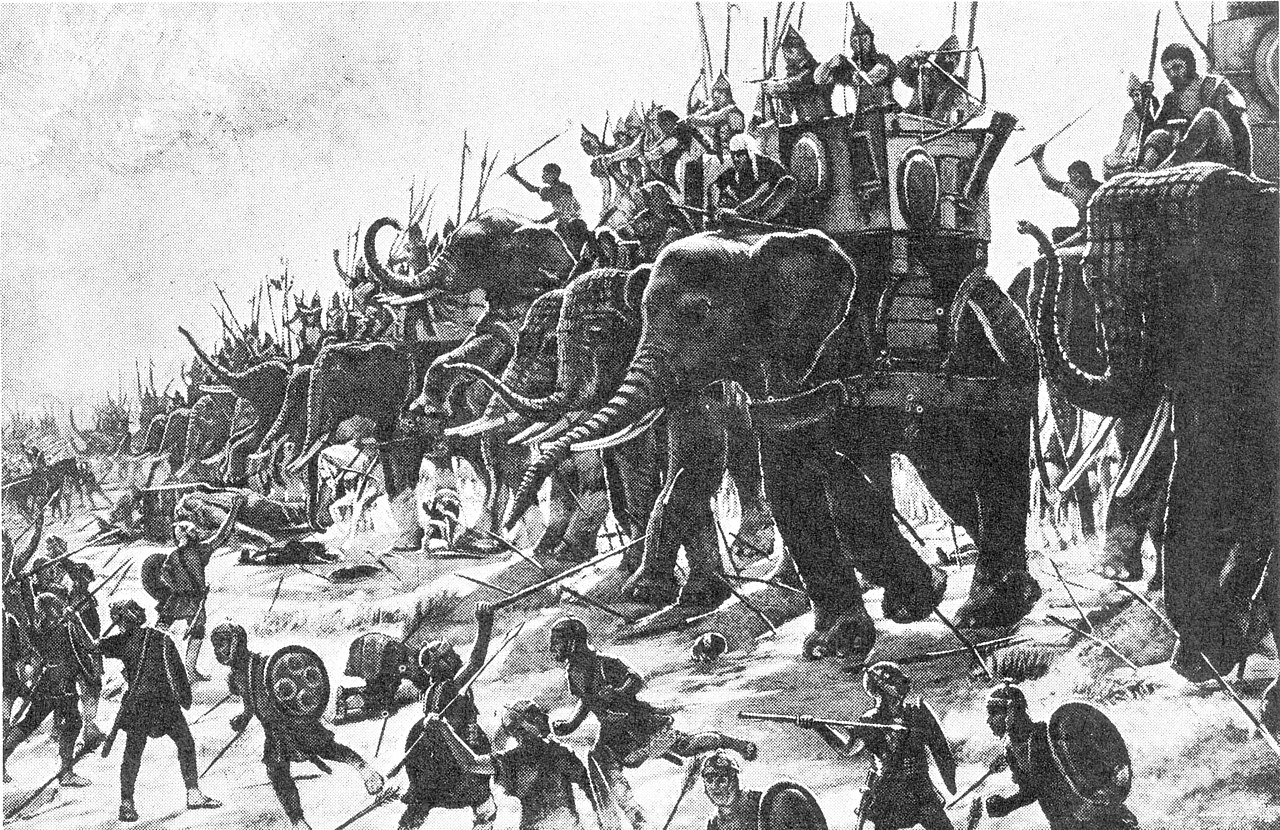
Henri-Paul Motte (1846–1922)
Carthaginian war elephants engage Roman infantry at the Battle of Zama (202 BC). around 1890
I have no further description, at this time

Henri-Paul Motte (13 December 1846 – 1 April 1922) was a 19th-century French painter from Paris, who specialised in history painting and historic genre. He was a pupil of Jean-Léon Gérôme and began to exhibit at the Paris Salon from 1874 onwards. The painting Le cheval de Troie (The Trojan horse) was the artist's début at the Salon, and was acquired by the Wadsworth Atheneum in 2011. In 1892 he was made a Chevalier de la Légion d'honneur. He won a bronze medal at the Exposition Universelle (1900). He is best known for his work of the Siege of La Rochelle, a depiction of Cardinal Richelieu in battle in the 17th century, completed in 1881. More on Henri-Paul Motte

To counter Hannibal's army, Scipio deployed his 43,000 men in a similar formation consisting of three lines, with Roman and Numidian cavalry on the flanks. Aware that Hannibal's elephants could be devastating on the attack, Scipio devised a new way to counter them. Though tough and strong, the elephants could not turn when they charged. Using this knowledge, he formed his infantry in separate units with gaps in between. These were filled with velites (light troops) which could move to allow the elephants to pass through.

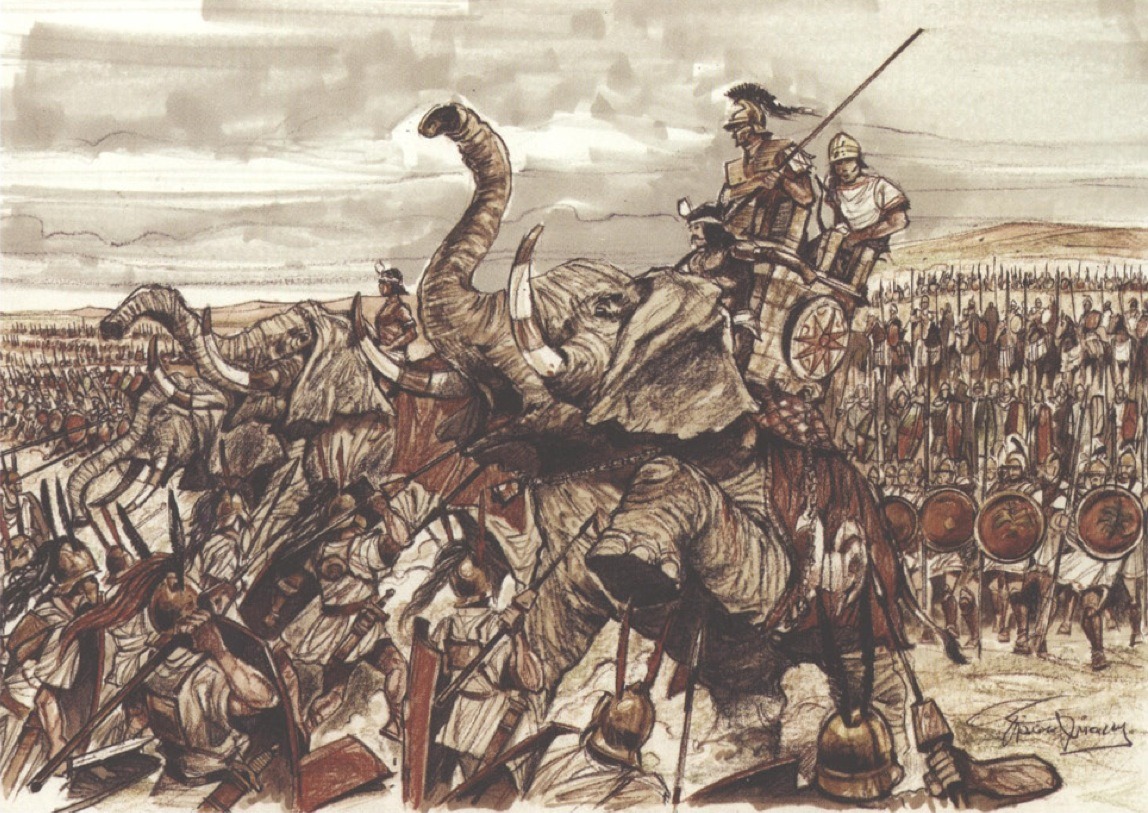
Angus McBride
The elephant charge at Zama
Gouache
Private collection

The Roman heavy-infantry maniples are shown funnelling the elephants down the avenues. The three lines of Hannibal’s infantry can be seen in the distance. 

Angus McBride (11 May 1931 – 15 May 2007) was an English historical and fantasy illustrator.

Born in London to Highland Scots parents, Angus McBride was orphaned as a child. He was educated at the Canterbury Cathedral Choir School. He served his National Service in the Royal Fusiliers, and afterward got a job as an advertising artist.

Due to Britain's poor economic state immediately following World War II, McBride found it necessary to leave for South Africa. In Cape Town, he became a fairly well known and successful artist. However, he felt that he could not expand on his artistic plans in South Africa. In 1961, McBride moved back to England. He made his first works in educational magazines. In 1975, he began to work with Osprey Publishing.

As England's economy again suffered in the 1970s, McBride moved with his family back to Cape Town, and continued to work with British and American publishers.

Although a few of his paintings are in oils, McBride mostly preferred to work in gouache colours on illustration boards, making numerous detailed sketches of the composition before starting to paint.

In 2006, McBride moved to Ireland, where he continued to work. He died from a heart attack on 15 May 2007. More on Angus McBride

Peter Dennis
War Elephants
I have no further description, at this time

Peter Dennis was born in 1950. Inspired by contemporary magazines such as Look and Learn he studied illustration at Liverpool Art College. Peter has since contributed to hundreds of books, predominantly on historical subjects, including many Osprey titles. A keen wargamer and modelmaker, he is based in North Wales.

While primarily a military and historical illustrator, he prides himself on the wide scope and variety of commissions he has taken on. One of his latest works has been the black and whte sketch-style illustrations done for Sir Terry Pratchett's The World of Poo. His association with the Discworld continues: as well as illustrating the Ankh-Morpork Boardgame, he has most recently illustrated Mrs Bradshaw's Handbook and the 2016 Discworld Diary. He also provided the full-colour illustrations in The Compleat Discworld Atlas. More on Peter Dennis

It was his goal to allow the elephants to charge through these gaps thus minimizing the damage they could inflict. As anticipated, Hannibal opened the battle by ordering his elephants to charge the Roman lines. Moving forward, they were engaged by the Roman velites who drew them through the gaps in the Roman lines and out of the battle. With Hannibal's elephants neutralized, Scipio sent forward his cavalry. Attacking on both wings, the Roman and Numidian horsemen overwhelmed their opposition and pursued them from the field.

Cort, Cornelis, 1533?-1578.
Scipio Africanus on horseback with Roman soldiers engaging Hannibal, riding a war elephant, during the battle of Zama.
Engraving
43.7 x 58 cm
 Library of Congress

Cornelis Cort (c. 1533 – c. 17 March 1578) See above

Though displeased by his cavalry's departure, Scipio began advancing his infantry. This was met by an advance from Hannibal. While Hannibal's mercenaries defeated the first Roman assaults, his men slowly began to be pushed back by Scipio's troops. As the first and second lines gave way, Hannibal's veteran's stood firm forcing the other Carthaginian troops to move outward to the flanks as they retreated. Extending his line to avoid being outflanked, Scipio pressed the attack against Hannibal's best troops.

I have no further description, at this time

With the battle surging back and forth, the Roman cavalry rallied and returned to the field. Charging the rear of Hannibal's position, the cavalry caused his lines to break. Pinned between two forces, the Carthaginians were routed and driven from the field.

As with many battles in this period, exact casualties are not known. Some sources claim that Hannibal's casualties numbered 20,000 killed, 11,000 wounded, and 15,000 taken prisoner, while the Romans lost around 1,500 and 5,000 wounded. Regardless of casualties, the defeat at Zama led to Carthage renewing its calls for peace. These were accepted by Rome, however the terms were harsher than those offered a year earlier. In addition to losing the majority of its empire, a substancial war indemnity was imposed and Carthage was effectively destroyed as a power.

Otto van Veen
The Battle of Zama, 202 BC, c.1585-90 
Scipio fighting at the Battle of Zama
Oil on canvas
28¾ x 41 5/8 in. (73 x 105.7 cm.)
Musee des Beaux-Arts, Orleans, France

Otto van Veen, also known by his Latinized name Otto Venius or Octavius Vaenius, (c.1556 – 6 May 1629) was a painter, draughtsman, and humanist active primarily in Antwerp and Brussels in the late sixteenth and early seventeenth century. He is known for running a large studio in Antwerp, producing several emblem books, and for being, from 1594 or 1595 until 1598, Peter Paul Rubens's teacher. His role as a classically educated humanist artist (a pictor doctus), reflected in the Latin name by which he is often known, Octavius Vaenius, was influential on the young Rubens, who would take on that role himself. More on Otto van Veen,

Battle of Zama by caastel
I have no further description, at this time

There has been a traditional simplifying view that Hannibal encircled his enemy at Cannae and was defeated by the same tactics at Zama. This though proves to be incorrect. Hannibal was not outgeneraled at Zama. For Scipio won the battle of Zama by winning the cavalry duel, due to superior numbers.

The Roman Army repulses the Carthaginian elephants at Zama, turning them back on their own lines
I have no further description, at this time

Cornelis Troost (Dutch, 1697–1750)
The Defeat of Hannibal at Zama, c. 1720–1720
Oil on Canvas
64.1 x 75.5 cm. (25.2 x 29.7 in.)
Private collection

Cornelis Troost (8 October 1696 – 7 March 1750) was an 18th-century actor and painter from Amsterdam.

Troost was trained as an actor and married the actress Susanna Maria van der Duyn, but became a pupil of Arnold Boonen and gave up his career for painting in 1723.

He is primarily remembered for his works depicting scenes from the Amsterdam Theatre and daily life of the upper crust in Amsterdam. One of his earliest drawings dated 1708, is of Prince Eugene of Savoy and the bookseller and spy Louis Renard visiting a chic Amsterdam brothel. Then he had an early success with a lively group portrait depicting the Amsterdam Inspectors of the Collegium Medicum. Troost painted portraits. Troost is known for his paintings of actors in famous roles as well as his witty and elegant Rococo genre scenes. Troost was possibly influenced by William Hogarth, and certainly by French artists such as Watteau, Boucher and Lancret. More on Cornelis Troost

If there is an irony in Hannibal's defeat at Zama though, it is that he was vanquished by the very thing he had sought to provoke with his invasion of Italy. Had he sought to inspire the tribes of Italy to rise against Roman rule, he had failed. Yet it was exactly the addition of the rebel Masinissa's Numidian cavalry to Scipio's forces which effectively sealed Hannibal's defeat.

Venetian School 18th Century
The officers of Hannibal Barca asking him to flee
Oil on canvas
70.5 by 94 cm.
Private collection

The Venetian school had a great influence of subsequent painting, and the history of later Western art has been described as a dialogue between the more intellectual and sculptural/linear approach of the Florentine and Roman traditions, and the more sensual, poetic, and pleasure-seeking of the colourful Venetian school. 

Although not considered part of the Venetian school, it provided the backdrop to 18th-century Venetian painting, which had a final flowering in Tiepolo's decorative painting and Canaletto's and Guardi's panoramic views. The extinction of the Republic by French Revolutionary armies in 1797 effectively brought the distinctive Venetian style to an end; it had at least arguably outlasted its rival Florence in that respect. More on The Venetian school

José Luiz Bernardes Ribeiro
I have no further description, at this time

After killing or enslaving all the inhabitants by selling them, the Romans razed and burned the city. No one was allowed to live there. Carthage had been destroyed

Carthage destroyed by the Roman army Third Punic War 146 BC
I have no further description, at this time

Luigi Ademollo
The triumph of Scipio the African, returning from Rome after the battle of Zama
Pen and brown wash heightened with white
55 x 197 cm
Private collection

Luigi Ademollo (April 30, 1764 – February 11, 1849) was an Italian painter.

He was born in Milan. He studied at the Brera Academy, where he was taught by Giulio Traballesi, Giocondo Albertolli, and Giuseppe Piermarini. He left Milan in 1783 and traveled and worked in Rome and Florence. Ademollo primarily painted frescoes with biblical scenes from the Old and New Testaments. In 1789 he was appointed professor at the Academy of Fine Arts in Florence. He painted in theaters, including the decoration of sipari (theater curtains). He helped fresco the Royal Chapel in the Pitti Palace and also the churches of Santissima Annunziata and Sant'Ambrogio. In Siena, he painted frescoes for the Palazzo Venturi Gallerani and Palazzo Segardi. He died in Florence in 1849. More on Luigi Ademollo

Acknowledgment: About.com, Roman Empire

Please visit my other blogs: Art CollectorMythologyMarine ArtPortrait of a Lady, The OrientalistArt of the Nude and The Canals of VeniceMiddle East Artists365 Saints and 365 Days, also visit my Boards on Pinterest

Images are copyright of their respective owners, assignees or others. Some Images may be subject to copyright

I don't own any of these images - credit is always given when due unless it is unknown to me. if I post your images without your permission, please tell me.

I do not sell art, art prints, framed posters or reproductions. Ads are shown only to compensate the hosting expenses.

If you enjoyed this post, please share with friends and family.

Thank you for visiting my blog and also for liking its posts and pages.

Please note that the content of this post primarily consists of articles available from Wikipedia or other free sources online.

6 works depicting the life and times of Nusaybah Bint ka'ab - The Woman Warrior of Arabia


Nusseibeh bint Ka’ab (also Umm Ammarah), a member of the Banu Najjar tribe living in Medina, was an early convert to Islam. She was one of two women  to personally pledge directly to the prophet Muhammad.

The Battle of Uhud

There were many virtues attributed to Nusaybah, yet she is most remembered for taking part in the Battle of Uhud (625). 

Abdullah bin Rowahah at the battle of Uhud

The Battle of Uhud was fought on Saturday, March 19, 625 at the valley located in front of Mount Uhud, in northwestern Arabia. It occurred between a force from the Muslim community of Medina led by the prophet Muhammad, and a force led by Abu Sufyan ibn Harb from Mecca. 


Whilst outnumbered, the Muslims gained the early initiative and forced the Meccan lines back. However, during the battle, a breach of orders by the Muslim archers allowed a surprise attack from the Meccan cavalry, which brought chaos to the Muslim ranks. Many Muslims were killed, and even the Prophet himself was badly injured. 

Nusayba b. Ka’b as depicted in the MBC TV Series ‘Umar'

At that point, Nusaybah, who was bringing water to the fighters and tending the wounded, went forward, with her sword unsheathed and her bow in her hand, to join the small group who were standing firm with the Prophet, acting as a human shield to protect him.


When a horse-mounted Meccan attacked her, she pulled on the horse's bridle and plunged her sword into its neck, toppling the horse on top of its rider. Witnessing this, the Prophet called to Abdullah to help his mother and the pair dispatched the struggling rider. Abdullah was wounded himself, as a Meccan cut across his left arm, and Nusaybah treated him, picking her sword back up, and advanced on her son's attacker, cuting his leg off with a blow of her sword. He fell to the ground where he was killed by other fighters.

But the battle was lost and the Muslims had to withdraw up the slopes of ‘Uḥud. The Meccans did not pursu, but marched back to Mecca declaring victory.


More: Wikipedia, Al ShindagahIslamophobia Today


Please visit my other blogs: Art CollectorMythologyMarine ArtPortrait of a Lady, The OrientalistArt of the Nude and The Canals of VeniceMiddle East Artists365 Saints and 365 Days, also visit my Boards on Pinterest

Images are copyright of their respective owners, assignees or others. Some Images may be subject to copyright

I don't own any of these images - credit is always given when due unless it is unknown to me. if I post your images without your permission, please tell me.

I do not sell art, art prints, framed posters or reproductions. Ads are shown only to compensate the hosting expenses.

If you enjoyed this post, please share with friends and family.

Thank you for visiting my blog and also for liking its posts and pages.

Please note that the content of this post primarily consists of articles available from Wikipedia or other free sources online.

10 Works, RELIGIOUS ART - Interpretation of the Koran, Khawla bint Al-Azwar was a Muslim Arab warrior

Henry Zaidan
Khawlah bint al Azwar
OpenArt

Khawla bint Al-Azwar, who lived in 7th Century Arabia, was the daughter of a powerful chief of the Bani Assad tribe. As a young girl Khawla learned swordsmanship and literary from her brother  Zirrar, a well-known local warrior-poet. Zerar, as the son of the chief, had been trained from birth in the art of literature and war. 
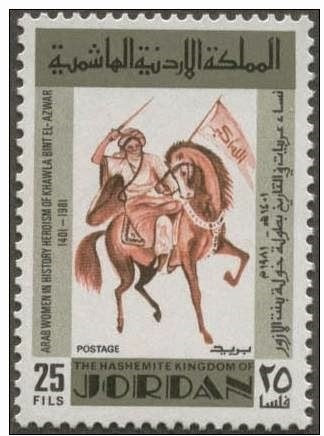
Khawla and her brother were early converts to the religion of Islam, in the early 600s, and participated in the entire Islamic Conquest, as the sons of the Prophet conquored most of the Middle East civilizations. She served as a nurse and a healer, and fought as a front-line warrior.  


Traveling with general Khalid bin Walid in Palestine, Syria and Jordan, Khawla was one of a team responsible for patching together gaping sword wounds, bringing water to dying men, and replacing bandages and cleaning out wounds. 

PIERO DELLA FRANCESCA, (b. 1416, Borgo San Sepolcro, d. 1492, Borgo San Sepolcro)
Battle between Heraclius and Chosroes, 1452-66
Fresco
329 x 747 cm
San Francesco, Arezzo

One of the most important events in that period was the famous battle near the Yarmouk River in August 636, in which the Arabs completely crushed the Byzantine army.

Piero della Francesca (c. 1415 – 12 October 1492), originally named Piero di Benedetto, was an Italian painter of the Early Renaissance. To contemporaries he was also known as a mathematician and geometer. Nowadays Piero della Francesca is chiefly appreciated for his art. His painting is characterized by its serene humanism, its use of geometric forms and perspective. His most famous work is the cycle of frescoes The History of the True Cross in the church of San Francesco in the Tuscan town of Arezzo.

He was probably apprenticed to the local painter Antonio di Giovanni d'Anghiari. He certainly took notice of the work of some of the Sienese artists active in San Sepolcro during his youth. In 1439 Piero received, together with Domenico Veneziano, payments for his work on frescoes for the church of Sant'Egidio in Florence, now lost.

Piero returned to his hometown in 1442. Three years later, he received his first commission, to paint the Madonna della Misericordia altarpiece for the church of the Misericordia in Sansepolcro. In 1449 he executed several frescoes in the Castello Estense and the church of Sant'Andrea of Ferrara, now also lost. His influence was particularly strong in the later Ferrarese allegorical works of Cosimo Tura.

In his later years, painters such as Perugino and Luca Signorelli frequently visited his workshop. More on Piero della Francesca

One day, during a battle against the Byzantine Empire outside Jerusalem, Khawla was watching the battle from a ridge when she saw her brother Zerar get knocked from his horse and dragged off by Byzantine troops as a prisoner. Rather than sit back and weep about over her brother, Khawla ran to the supply tent, grabbed a suit of armor, threw on a black robe with a green sash, turned a black strip of cloth into a mask that concealed everything on her face except her eyes, and rode out into battle on horseback carrying a heavy spear and a scimitar.

Maciej Kuciara

Stories written down from people who were there claimed that they just saw a knight in a black hood blasting into the Byzantine lines, swinging around a spear that dripped blood, and massacring everything in the way. One man mentioned that he thought this warrior fought with such fury that it must have been Khalid himself. 

Maciej Kuciara has established himself as a go-to talent for awe-inspiring concept art. Originally hailing from Poland, Maciej quit university to create artwork for tabletop games, then landed jobs at video game developers People Can Fly (Painkiller), Crytek (Crysis) and Naughty Dog (The Last of Us), and then worked on movies including the Ghost in the Shell remake, Blade Runner 2049 and Terminator: Dark Fate.

Most recently, Maciej unleashed his short film “Showtime,” a painstakingly accurate homage to classic animes Akira and Ghost in the Shell. He tells Chris about his life behind the Iron Curtain, his love of role-playing games and anime, how working hard on major games and movies helped him bring his incredible vision to life — and his plans for its future. More on Maciej Kuciara


When the real Khalid arrived, he saw this one warrior wasting an entire battalion singlehandedly, and ordered all of his men to attack; he even sent a trusted member of his personal bodyguard out to ensure that the warrior made it through the battle alive. 


In the battle that ensued, the Byzantines were driven from the field. Khawla had not only helped turn the tide of the battle, but as the Byzantine army was routing she led a small detachment that rode down their ranks, found her brother (and the other Muslim prisoners), slew the guards, and brought all of the POWs back to friendly lines.

cosplay, nightingale armor

At the end of the battle, Khalid tracked down this mysterious black-clad knight and demanded her to reveal his true identity. Once she revealed herself as a woman Khalid really didn't seem upset, but told her that while she may have started the battle standing with the women, now she was going to fight like a man. From that point on, she continued to serve throughout the campaign, battling on horseback with sword and spear in battles across Palestine, Syria and Jordan, including one fight when she personally rallied a routed Muslim force, re-organized them, and led them in an all-out counter-attack.

Khawla served the rest of the war, eventually married a powerful Arab prince, and is now remembered as one of the greatest female warriors in the Muslim world. 

Found on garoopatternandcolour.tumblr.com

ضریح خوله
Khawla bint Al-Azwar's Shrine


Please visit my other blogs: Art CollectorMythologyMarine ArtPortrait of a Lady, The OrientalistArt of the Nude and The Canals of VeniceMiddle East Artists365 Saints365 Days, and Biblical Icons, also visit my Boards on Pinterest

Images are copyright of their respective owners, assignees or others. Some Images may be subject to copyright

I don't own any of these images - credit is always given when due unless it is unknown to me. if I post your images without your permission, please tell me.

I do not sell art, art prints, framed posters or reproductions. Ads are shown only to compensate the hosting expenses.

If you enjoyed this post, please share with friends and family.

Thank you for visiting my blog and also for liking its posts and pages.

Please note that the content of this post primarily consists of articles available from Wikipedia or other free sources online.