Showing posts with label Guido Reni. Show all posts

14 Paintings, scenes from the Bible, by The Old Masters, Andrea Vicentino, Andrea Vaccaro, Guido Reni, Francesco Capella, Carlo Maratta, Robert Campin, Matteo Rosselli, Niccolò Tornioli and Bartolomeo Cavarozzi, with footnotes # 35

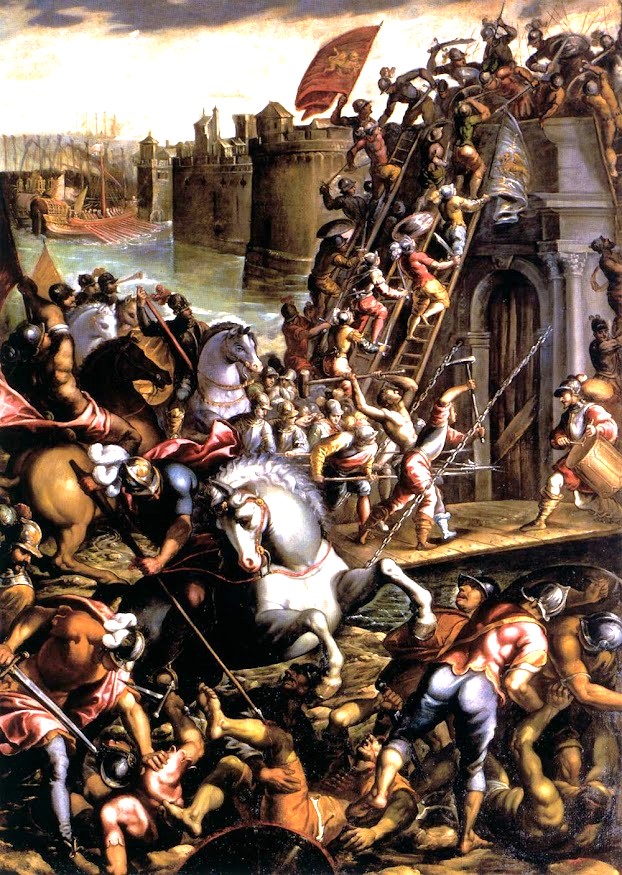
Andrea Vicentino, (1539-1614)
The Crusaders Conquering the City of Zara in 1202
Oil on canvas
Sala del Maggior Consiglio, Venezia, Italy

Andrea Vicentino (c. 1542 – 1617) was an Italian painter of the late-Renaissance or Mannerist period. He was a pupil of the painter Giovanni Battista Maganza. Born in Vicenza, he was also known as Andrea Michieli or Michelli. He moved to Venice in the mid-1570s and registered in the “Fraglia” or guild of Venetian painters in 1583. He worked alongside Tintoretto at the Palazzo Ducale in Venice, helping paint Arrival of Henry III at Venice (c. 1593) at the Sala delle Quattro Porte of the Ducal palace, as well as works in the Sala del Senato and dello Scrutinio. He also painted the altarpiece of Madonna of the Rosary (c. 1590) for the cathedral of Treviso, God the Father with Three Theological Virtues (1598) for the church in Gambara, and St Charles Borromeo (c. 1605) for a church in Mestre.Paintings by him exist in a number of galleries including the 'Raising of Lazarus' at the National Museum of Fine Arts in Valletta, Malta. More on Andrea Vicentino

The Siege of Zara or Siege of Zadar (10–24 November 1202) was the first major action of the Fourth Crusade and the first attack against a Catholic city by Catholic crusaders. The crusaders had an agreement with Venice for transport across the sea, but the price far exceeded what they were able to pay. Venice set the condition that the crusaders help them capture Zadar (or Zara), a constant battleground between Venice on one side and Croatia and Hungary on the other, whose king, Emeric, pledged himself to join the Crusade. Although a part of the crusaders refused to take part in the siege, the attack on Zadar began in November 1202 despite letters from Pope Innocent III forbidding such an action and threatening excommunication. Zadar fell on 24 November and the Venetians and the crusaders sacked the city. After spending the winter in Zadar the Fourth Crusade continued its campaign, which led to the Siege of Constantinople. More on The Siege of Zara or Siege of Zadar

ATTRIBUTED TO ANDREA VACCARO, (ITALIAN 1604-1670)
Saint Agatha of Sicily (231 AD – 251 AD) 
oil on canvas
92.8 x 72.3 cm (36 1/2 x 28 1/2 in.)
Private Collection

Was Estimated for $8,000 – $12,000 but sold for $2,560 in December 2016

Saint Agatha of Sicily (231 AD – 251 AD) is a Christian saint and virgin martyr. Agatha was born at Catania or Palermo, Sicily, and she was martyred in approximately 251. She is one of seven women, who, along with the Blessed Virgin Mary, are commemorated by name in the Canon of the Mass. 

She is the patron saint of Catania, Molise, Malta, San Marino, and Zamarramala, a municipality of the Province of Segovia in Spain. She is also the patron saint of breast cancer patients, martyrs, wet nurses, bell-founders, bakers, fire, earthquakes, and eruptions of Mount Etna. 

Although the martyrdom of Saint Agatha is authenticated, and her veneration as a saint had spread beyond her native place even in antiquity, there is no reliable information concerning the details of her death. According to Jacobus de Voragine, Legenda Aurea of ca. 1288, having dedicated her virginity to God,[ fifteen-year-old Agatha, from a rich and noble family, rejected the amorous advances of the low-born Roman prefect Quintianus, who then persecuted her for her Christian faith. He sent Agatha to Aphrodisia, the keeper of a brothel. The madam finding her intractable, Quintianus sent for her, argued, threatened, and finally had her put in prison. Amongst the tortures she underwent was the cutting off of her breasts with pincers. After further dramatic confrontations with Quintianus, represented in a sequence of dialogues in her passio that document her fortitude and steadfast devotion, Saint Agatha was then sentenced to be burnt at the stake, but an earthquake saved her from that fate; instead, she was sent to prison where St. Peter the Apostle appeared to her and healed her wounds. Saint Agatha died in prison, according to the Legenda Aurea in "the year of our Lord two hundred and fifty-three in the time of Decius, the emperor of Rome." More on Saint Agatha of Sicily

Andrea Vaccaro (baptised on 8 May 1604 – 18 January 1670) was an Italian painter of the Baroque period. Vaccaro was in his time one of the most successful painters in Naples, a city then under Spanish rule. Very successful and valued in his lifetime, Vaccaro and his workshop produced many religious works for local patrons as well as for export to Spanish religious orders and noble patrons. More on Andrea Vaccaro

Follower of Guido Reni
LOT AND HIS DAUGHTERS
oil on canvas
132 x 160 cm.; 52 x 63 in
Private Collection

Sold for 18,750 GBP in December 2016 

Guido Reni (4 November 1575 – 18 August 1642) was an Italian painter of high-Baroque style. Born in Bologna into a family of musicians, Guido Reni was the son of Daniele Reni and Ginevra de’ Pozzi. As a child of nine, he was apprenticed under the Bolognese studio of Denis Calvaert. When Reni was about twenty years old he migrated to the rising rival studio, named Accademia degli Incamminati (Academy of the "newly embarked", or progressives), led by Lodovico Carracci. He went on to form the nucleus of a prolific and successful school of Bolognese painters who followed Annibale Carracci to Rome. Like many other Bolognese painters, Reni's painting was thematic and eclectic in style. More on Guido Reni

Lot and His Daughters. Genesis 19:30-38

30 Lot and his two daughters left Zoar and settled in the mountains, for he was afraid to stay in Zoar. He and his two daughters lived in a cave. 31 One day the older daughter said to the younger, “Our father is old, and there is no man around here to give us children—as is the custom all over the earth. 32 Let’s get our father to drink wine and then sleep with him and preserve our family line through our father.”

33 That night they got their father to drink wine, and the older daughter went in and slept with him. He was not aware of it when she lay down or when she got up.

34 The next day the older daughter said to the younger, “Last night I slept with my father. Let’s get him to drink wine again tonight, and you go in and sleep with him so we can preserve our family line through our father.” 35 So they got their father to drink wine that night also, and the younger daughter went in and slept with him. Again he was not aware of it when she lay down or when she got up.

36 So both of Lot’s daughters became pregnant by their father. 37 The older daughter had a son, and she named him Moab[a]; he is the father of the Moabites of today. 38 The younger daughter also had a son, and she named him Ben-Ammi[b]; he is the father of the Ammonites of today. More on Lot and His Daughters

Francesco Capella, called Daggiù, VENICE 1714 - 1784 BERGAMO
THE MADONNA AND CHILD
Oil on canvas
80.3 x 63.9 cm.; 31 5/8  x 28 1/8  in.
Private Collection

Sold for 6.250 GBP in Dec 2016

Francesco Capella (1714–1784), called Il Capella and Francesco Dagiu, was a scholar of Giovanni Battista Piazzetta. He was born in Venice, Italy. He painted history, and was chiefly employed for the churches at Bergamo, and by the state. One of his best pictures is 'St. George and the Dragon,' in the church of San Bonate. More on Francesco Capella

Studio of Carlo Maratta, CAMERANO 1625 - 1713 ROME
THE MADONNA AND CHILD WITH THE INFANT SAINT JOHN THE BAPTIST, SAINT CECILIA AND AN ANGEL
Oil on canvas
129.5 x 107.5 cm.; 51 x 42 3/8  in
Private Collection

Sold for 13,125 GBP in Dec 2016

Saint Cecilia is the patroness of musicians. It is written that as the musicians played at her wedding she "sang in her heart to the Lord". She is one of seven women, excluding the Blessed Virgin, commemorated by name in the Canon of the Mass.

According to the story, despite her vow of virginity, she was forced by her parents to marry a nobleman named Valerian. During the wedding, Cecilia sat apart singing to God in her heart, and for that she was later declared the saint of musicians. When the time came for her marriage to be consummated, Cecilia told Valerian that she had an angel of the Lord watching over her who would punish him if he dared to violate her virginity but who would love him if he could respect her maidenhood. When Valerian asked to see the angel, Cecilia replied that he would see the angel if he would go to the third milestone on the Via Appia (the Appian Way) and be baptized by Pope Urbanus.] After his baptism, he found an angel standing by the side of Cecilia, and crowning her with a chaplet of roses and lilies.

The martyrdom of Cecilia is said to have followed that of Valerian and his brother by the prefect Turcius Almachius. The legend about Cecilia’s death says that after being struck three times on the neck with a sword, she lived for three days, and asked the pope to convert her home into a church. More on Saint Cecilia

John the Baptist, known as the prophet Yahya in the Qur'an, was a Jewish itinerant preacher in the early first century AD. John is revered as a major religious figure in Christianity, Islam, the Bahá'í Faith, and Mandaeism. He is called a prophet by all of these traditions, and honoured as a saint in many Christian traditions.

John used baptism as the central sacrament of his messianic movement.[ Most scholars agree that John baptized Jesus. Scholars generally believe Jesus was a follower or disciple of John and several New Testament accounts report that some of Jesus' early followers had previously been followers of John. John the Baptist is also mentioned by the Jewish historian Josephus. Some scholars maintain that John was influenced by the semi-ascetic Essenes, who expected an apocalypse and practiced rituals corresponding strongly with baptism, although no direct evidence substantiates this.

According to the New Testament, John anticipated a messianic figure greater than himself, and Jesus was the one whose coming John foretold. Christians commonly refer to John as the precursor or forerunner of Jesus, since John announces Jesus' coming. John is also identified with the prophet Elijah. More on John the Baptist

Studio of Carlo Maratta, CAMERANO 1625 - 1713 ROME was an Italian painter, the leading painter in Rome in the latter part of the 17th century. As the pupil of Andrea Sacchi he continued the tradition of the classical Grand Manner, based on Raphael, and he gained an international reputation particularly for his paintings of the Madonna and Child, which are reworkings of types established during the High Renaissance. The rhetorical splendour of his work is thoroughly in the Baroque idiom, however, and the numerous altarpieces he painted for Roman churches (many still in situ) give whole-hearted expression to the dogmas of the Counter-Reformation. Maratta was also an accomplished fresco painter, and the finest portraitist of the day in Rome. He had a large studio and his posthumous reputation suffered when the inferior works of his many pupils and imitators were confused with his own paintings. More on Carlo Maratta

Workshop of Robert Campin (Netherlandish, ca. 1375–1444 Tournai)
Annunciation Triptych (Merode Altarpiece), Date:ca. 1427–32
Oil on oak
Dimensions:Overall (open): 25 3/8 x 46 3/8 in. (64.5 x 117.8 cm) Central panel: 25 1/4 x 24 7/8 in. (64.1 x 63.2 cm) each wing: 25 3/8 x 10 3/4 in. (64.5 x 27.3 cm)
 The Metropolitan Museum of Art

Having just entered the room, the angel Gabriel is about to tell the Virgin Mary that she will be the mother of Jesus. The golden rays pouring in through the left oculus carry a miniature figure with a cross. On the right wing, Joseph, who is betrothed to the Virgin, works in his carpenter’s shop, drilling holes in a board. The mousetraps on the bench and in the shop window opening onto the street are thought to allude to references in the writings of Saint Augustine identifying the cross as the devil’s mousetrap. On the left wing, the kneeling donor appears to witness the central scene through the open door. His wife kneels behind him, and a town messenger stands at the garden gate. The owners would have purchased the triptych to use in private prayer. An image of Christ’s conception in an interior not unlike the one in which they lived also may have reinforced their hope for their own children. 

Robert Campin (c. 1375 – 26 April 1444), now usually identified as the artist known as the Master of Flémalle, is usually considered the first great master of Flemish and Early Netherlandish painting. His identity and the attribution of the paintings in the "Campin group" has been a matter of controversy for decades. His life is relatively well documented for the period, but he did not sign his paintings, and none could be securely connected with him, whilst a corpus of work attached to the unidentified "Master of Flémalle".

By 1406 he was active in Tournai, in today's Belgium. His early work shows the influence of the International Gothic painters the Limbourg brothers (1385 – 1416) and Melchior Broederlam (c. 1350 – c.1409), but display a realistic observation than any earlier artists, which he achieved through innovations in the use of oil paints. He was successful in his lifetime, and the recipient of a number of civic commissions. Campin taught both Rogier van der Weyden and Jacques Daret. He was a contemporary of Jan van Eyck, they met in 1427. Campin's best known work is the Mérode Altarpiece, dated c 1425-28, now in New York. More on Robert Campin

Robert Campin (1375/1379–1444)
St Veronica, c. 1410
Oil on Canvas
Städel, Frankfurt am Main

Saint Veronica is known as the woman who offered a cloth to Jesus so He could wipe His face on the way to His crucifixion. The cloth is believed to exist today in the Vatican and is considered one of the most treasured relics of the Church.

Saint Veronica is not mentioned in the Bible, but is known to us by Catholic tradition and in the Sixth Station of the Cross, "Veronica Wipes the Face of Jesus."

Legend states that as Christ was walking to Calvary, his face dripping with sweat and blood, Saint Veronica, a bystander, was moved with compassion. She approached Jesus and offered Him a cloth, likely her veil, which He accepted and used to wipe His face.

The image of his face was subsequently imprinted on the cloth. More on Saint Veronica

Robert Campin (1375/1379–1444), see above

Robert Campin, (1375/1379–1444)
The Marriage of Mary, c 1420
Grisaille, Oil on oak table
77 × 88 cm (30.3 × 34.6 in)
Prado Museum, Madrid

Two scenes are represented in this work. On the left, in a circular, Romanesque interior covered with a dome, we see The Miracle of the Flowered Staff, which designated Joseph as the husband of Mary. In the building´s stained-glass windows, capitals and tympana are scenes from the Old Testament that foreshadow or announce others from the New Testament, such as the sacrifice of Isaac, which prefigures the Redemption of Christ. On the right is a depiction of the betrothal of Mary and Joseph under a gothic portico, announcing the imminent arrival of the New Law. In this, one of his earliest works, Campin maintains the characteristic exoticism of the international style, combined with Flemish naturalism and the clear depiction of the quality of things. The figures of Saint Claire and Saint James the Elder are painted on the back in grisaille, in a sculptural manner. Attributed to Roger van der Weyden for some time, this panel entered El Escorial in 1584, arriving at the Prado Museum in 1839. More on this painting

The Marriage of the Virgin is the subject in Christian art depicting the marriage of the Virgin Mary and Saint Joseph. Unlike many other scenes in Life of the Virgin cycles (like the Nativity of Mary and Presentation of Mary), it is not a feast in the church calendar.

In art the subject could be covered in several different scenes, and the betrothal of Mary, with Joseph's blossoming rod, was often shown, despite its apocryphal origin. Wedding processions are also shown, especially in the Early Medieval period. More on The Marriage of the Virgin

The Golden Legend recounts how, when Mary was 14 and living in the Temple, the High Priest gathered all male descendants of David of marriageable age including Saint Joseph (though he was much older than the rest). The High Priest ordered them to each bring a rod; he that owned the rod which would bear flowers was divinely ordained to become Mary's husband. After the Holy Spirit descended as a dove and caused Joseph's rod to blossom, he and Mary were wed according to Jewish custom.  More on The Golden Legend

Robert Campin (1375/1379–1444), see above

Master of Saint Augustine, (Netherlandish, ca. 1490)
Scenes from the Life of Saint Augustine of Hippo, Date:ca. 1490
Oil, gold, and silver on wood
54 1/4 x 59 in. (137.8 x 149.9 cm) gr. thickness: 3/8 in. (1 cm)
 The Metropolitan Museum of Art

This painting was the central panel of a triptych dedicated to Saint Augustine (354–430), a Christian theologian so celebrated that he is sometimes called a Doctor of the Church. The composition is divided into five scenes: in the center, Saint Augustine is consecrated bishop of Hippo Regius, a Roman city in present-day Algeria; in the upper left, Saint Augustine is ordained as a priest; in the lower left, Saint Augustine preaches while his mother, Monica, anachronistically says the rosary, a prayer regimen of the late Middle Ages. At the upper right, Saint Augustine converses with a boy who says that filling a hole in the sand with the sea is no more difficult than explaining the Trinity; and in the lower right, Saint Augustine preaches. In the windows behind the altar at the right are kneeling figures of a man and woman, along with coats of arms. Might these be clues to the original place for which the altarpiece was created, or are they pure inventions? Of particular interest in this panel are the detailed and richly depicted varieties of ecclesiastical vestments and altar implements, many examples of which are similar to works displayed in the Cloisters’ Treasury. More on this painting

St. Augustine of Hippo (A.D. 354 - 430) was an Algerian-Roman philosopher and theologian of the late Roman / early Medieval) period. He is one of the most important early figures in the development of Western Christianity, and was a major figure in bringing Christianity to dominance in the previously pagan Roman Empire. He is often considered the father of orthodox theology and the greatest of the four great fathers of the Latin Church (along with St. Ambrose, St. Jerome and St. Gregory).

Unlike the later Scholastics who took Aristotle as the classical model to be integrated into Christian thought, Augustine developed a philosophical and theological system which employed elements of Plato and Neo-Platonism in support of Christian orthodoxy. His many works profoundly influenced the medieval worldview. More on St. Augustine of Hippo

The Master of the Saint Augustine Altarpiece (sometimes called the Master of the Augustinians' Altarpiece) was a German painter, active in Nuremberg during the second half of the 15th century. His work indicates familiarity with the work of both Martin Schöngauer and the Master of the Housebook. More on The Master of the Saint Augustine

Lombard School, 17th Century
SAINT JOHN THE EVANGELIST
old inventory number brushed on reverse: 36
Oil on canvas
90.8 x 75 cm.; 35 3/4  x 29 1/2  in.
Private Collection

Sold for 500 GBP in Dec 2016

John the Evangelist is the name traditionally given to the author of the Gospel of John. Christians have traditionally identified him with John the Apostle, John of Patmos, and John the Presbyter, though this has been disputed by modern scholars.

Christian tradition says that John the Evangelist was John the Apostle. A historical figure, one of the "pillars" of the Jerusalem church after Jesus' death. He was one of the original twelve apostles and is thought to be the only one to have lived into old age and not be killed for his faith. John is associated with the city of Ephesus, where he is said to have lived and been buried. Some believe that he was exiled (around 95 AD) to the Aegean island of Patmos, where he wrote the Book of Revelation. More on John the Evangelist 

He wrote to the seven Christian churches in Asia to warn them of various challenges and temptations that confront them, which have been revealed to him in a vision. He then relates several additional powerful visions concerning the Last Days and the Second Coming of Christ. More on John the Evangelist

Lombard School; a school of art in Northern Italy. Lombard architecture developed from the eighth to tenth centuries. The establishment of Christianity as the Lombards’ official religion fostered the rise of an independent school of architecture that played a decisive role in the development of the Romanesque style in Italy.
Lombard trecento and early quattrocento painting, which developed within the framework of the late, or international, Gothic style, is noted for a delicate elegance of form and direct, poetic observations of the real world. Pisanello played an important role in the development of Lombard quattrocento painting.
In the second half of the 15th century, Florentine art and the work of Mantegna particularly influenced Lombard painting. The works of masters of this period were marked by plastic clarity of composition, a softer palette, and an increased interest in chiaroscuro modeling. During the High Renaissance the impact of Leonardo da Vinci was paramount, with his Milanese pupils creating works permeated by contemplative and sentimental moods. In the second quarter of the 16th century, the traditions of the Lombard quattrocento combined with Venetian and northern influences, resulting in the rise of the separate Brescian school. During the 16th century and the baroque period, the inner unity of the Lombard school was lost. More Lombard School

Lombard School, 17th Century
CHRIST WASHING THE APOSTLES' FEET
Oil on canvas
195.5 x 291 cm.; 77 x 114 1/2  in.
Private Collection

Sold for 12,500 GBP in Dec 2016

At the Last Supper, on the night before Jesus knew that He was going to die. He was about to be betrayed by Judas, one of His own disciples.  Jesus got up from the meal. He wrapped a towel around His waist. He poured water into a large bowl. Then He began to wash His disciples’ feet. He dried them with the towel that was wrapped around Him.

In those days, foot washing was needed in every home. The streets were dusty and dirty. Roads even had garbage and waste from the animals that traveled up and down the same streets. 

The dinner-time custom was to lean back around the table at the evening meal. Usually, the lowest servant in the household was expected to wash the feet of guests. Having your guests’ feet washed was a way to show honor to your guests.

Since the last supper was held in a private home, with just Jesus and His disciples, we can easily see why there were no servants there. More on Last Supper

Lombard School, 17th Century, see above

Matteo Rosselli, FLORENCE 1578 - 1650
THE HOLY FAMILY WITH THE ANNUNCIATION TO THE SHEPHERDS IN THE DISTANCE
Oil on canvas
119.7 x 105 cm.; 47 1/8  x 39 1/2  in
Private Collection

Estimate for 30,000 - 40,000 GBP in Dec 2016

Matteo Rosselli (10 August 1578 – 18 January 1650) was an Italian painter of the late Florentine Counter-Mannerism and early Baroque. He is best known however for his highly populated grand-manner historical paintings. On 26 February 1599, he was inducted to the Accademia del Disegno, and in 1605 traveled to Rome to work with Domenico Passignano for six months.

He completed some frescoes on Lives of Servite Monks (1614–1618) in the Palazzo Pitti and in the Cloister of the Basilica della Santissima Annunziata; a Madonna and child with St Francis altarpiece for the Church of Santa Maria Maggiore in Florence; and an Adoration of the Magi (1607) for the Church of Sant'Andrea in Montevarchi. He painted a Crucifixion (1613) now in the parish church at Scarperia. He painted a Last Supper (1614) now in Conservatorio di San Pier Martire.

Upon the French monarch's death, he was commissioned two commemorative paintings of events in the life of Henry IV: his visit to Nantes and Gaudabec (1610). He also completed an Assumption (1613) for the church of San Domenico in Pistoia. He painted a number of frescoes for the Casa Buonarroti based on events of Michelangelo's life.

The largest collection of Rosselli drawings is contained within the Louvre Museum, Paris, with many being preliminary sketches for other works. More on Matteo Rosselli

Niccolò Tornioli, SIENA 1606 - 1651 ROME
THE HOLY FAMILY
Oil on canvas
133.9 x 96 cm.; 52 3/4  x 38 1/8  in.
Private Collection

Sold for 43,750 GBP in December 2016 

Tornioli, whist known predominantly as painter of figurative religious scenes, is also known to have been a proficient painter of still lifes, a fact attested to by the inclusion of floral motifs in many of his mature works, and as seen in the scattered stems at the lower corner of this Holy Family.1 Ciampolini writes that this interest in the inclusion of floral still life elements may well have been a result Tornioli's endeavours to adopt the stylistic preferences of Roman patrons in preparation of his own move to Rome from Sienna in the 1640s. More on this painting

Niccolò Tornioli, SIENA 1606 - 1651 was an Italian painter. He was born in Siena in 1598 and was in Rome since 1633.

In 1640s he worked for Cardinal Bernardino Spada and his brother Virgilio Spada. Most of his preserved paintings are today in Galleria Spada in Rome.

He painted for the Spada chapel in the church of San Paolo in Bologna a Cain slaying Abel and a Jacob wrestling with Angel . More on Niccolò Tornioli

Follower of Bartolomeo Cavarozzi
THE SACRIFICE OF ISAAC
Oil on canvas
108.5 x 163 cm.; 42 3/4  x 64 1/8  in.
Private Collection

Sold for 8,750 GBP in Dec 2016

This painting was probably painted around 1617 by Bartolomeo Cavarozzi, one of Caravaggio's most successful and accomplished followers. Such are its quality and dramatic impact that for several years after its rediscovery in 1987 the painting was associated with Caravaggio himself and it has been exhibited as such numerous times in the recent past. More on this painting

According to the Bible, God commands Abraham to offer his son Isaac as a sacrifice. After Isaac is bound to an altar, the angel of God stops Abraham at the last minute, saying "now I know you fear God." At this point, Abraham sees a ram caught in some nearby bushes and sacrifices the ram instead of Isaac. More on THE SACRIFICE OF ISAAC

Bartolomeo Cavarozzi (15 February 1587 – 21 September 1625) was an Italian caravaggisti painter of the Baroque period active in Spain, alongside his master Giovanni Battista Crescenzi.

Bartolomeo was born at Viterbo, he traveled to Spain with his teacher to help paint and build the Pantheon at the Escorial. He adopted the style of Cristofano Roncalli. He painted a St Ursula and Her Companions with Pope Ciriacus and St Catherine of Alexandria (1608) for the Confraternità delle Sante Orsola e Caterina. He died in Rome.

Other sources attribute his training to Guercino, and indicate that he was active in the town of Viterbo, painting the Visitation (1622) for the Chapel of the Palazzo Pubblico, Saint Isidore for the Chiesa Collegiata di Sant'Angelo in Spata; a San Silvestro for the Church of the Confraternity of Jesus; a St Phillip Apostle for the Church of San Pietro del Castagno; a St Benedict for the lateral door of the Church of Monasterio della Duchessa; a Presentation at the Temple for the Church of the College of Doctors, and also painted a canvas for the Chapel of the Calabresi family in the church of Sant'Ignazio. A contemporary from Viterbo, Filippo Caparozzi, was a disciple of Giuseppe d'Arpino. More on Bartolomeo Cavarozzi


Please visit my other blogs: Art CollectorMythologyMarine ArtPortrait of a Lady, The OrientalistArt of the Nude and The Canals of VeniceMiddle East Artists365 Saints365 Days, and Biblical Icons, also visit my Boards on Pinterest

Images are copyright of their respective owners, assignees or others. Some Images may be subject to copyright

I don't own any of these images - credit is always given when due unless it is unknown to me. if I post your images without your permission, please tell me.

I do not sell art, art prints, framed posters or reproductions. Ads are shown only to compensate the hosting expenses.

If you enjoyed this post, please share with friends and family.

Thank you for visiting my blog and also for liking its posts and pages.

Please note that the content of this post primarily consists of articles available from Wikipedia or other free sources online.

Acknowledgement: Shapiro, Sotheby's, The Metropolitan Museum of Art,


13 Paintings, Olympian deities in classical Hellenic Mythology, by the Old Masters, with footnotes #5

Jean Jules Badin, 1843 - 1943, FRENCH
CIRCÉ, c. 1875
Oil on canvas
130 by 98cm., 51 by 38½in.
Private collection

Circe, in Greek legend, a sorceress, the daughter of Helios, the sun god, and of the ocean nymph Perse. She was able by means of drugs and incantations to change humans into wolves, lions, and swine. The Greek hero Odysseus visited her island, Aeaea, with his companions, whom she changed into swine. But Odysseus, protected by the herb moly (a gift from Hermes), compelled her to restore them to their original shape. He stayed with her for one year before resuming his journey. The story is told by Homer in the Odyssey, Books X and XII. Greco-Roman tradition placed her island near Italy or located her on Mount Circeo. More

Jean Jules Badin, (1843-1919) was a painter in Paris who succeeded his father Pierre-Adolphe Badin as director of the Manufactore of Tapestries in Beauvais. Jules Badin saw the firm through rough times. During the 1870/71 war and subsequent Commune, they lost their state patronage as well as a large stock of tapestries in the fires of 1871. Rebuilding Paris, however, led to new commissions, mostly for recreations of 18th century Beauvais tapestries for public buildings. It might have been Jules Badin’s initiative to invite contemporary artists with new designs, because he made a special note of their contributions in his documentation La Manufacture de Tapisseries de Beauvais. More

Badin was a pupil of Alexandre Cabanel and Paul Baudry, whose academic influence is clearly visible in the present Salon painting. Here the Greek mythological sorceress Circe stands contrapposto, bearing the cup which she offered to Odysseus' crew in the Odyssey, and the wand with which she turned them into swine. More

Paul-Jacques-Aimé Baudry, (1828–1886)
Diana Reposing, circa 1859
Oil on mahogany wood
Height: 35.24 cm (13.9 in). Width: 59.53 cm (23.4 in). Depth: 1.27 cm (0.5 in).
Walters Art Museum, Baltimore, Maryland

The nude goddess, identified by the crescent moon in her hair and the bow and quiver at her side, reclines on a blue drapery in front of a recumbent stag in a wooded glade. An early inscription identifies this painting as a variant sketch for an overdoor in the hôtel of Achille Fould, the Minster of State. The hôtel, on the rue du Faubourg-Saint-Honoré, was acquired by the Duc d'Aumale in 1872, and its decor was transferred to the Château of Chantilly six years later. The overdoor, "Diane au repos," and another, "Venus jouant avec l'Amour," were both mounted in the Galerie des Cerfs. The actual overdoor is painted in "grisaille" unlike our sketch which is in naturalistic colors. In the overdoor the majestic stag is an integral part of the composition, whereas in this sketch he is barely discernible in the right background. This composition illustrates the artist's practice of imparting to his traditional subjects an air of modishness or coquetry, that may have resulted from his occasional use of professional beauties as models. The figure of Diana reposing in the sketch and the overdoor bears a striking resemblance to Blanche D'Antigny, an actress who at the age of eighteen modeled for Baudry's famous "The Penitent Madeleine," painted about the same time and acquired by the State at the 1859 Salon for the Nantes Museum. More

Paul-Jacques-Aimé Baudry (7 November 1828 – 17 January 1886) was a French painter, born in La Roche-sur-Yon in the Vendée. He studied art under Michel Martin Drolling and won the Prix de Rome in 1850 for his picture of Zenobia (below) found on the banks of the Araxes.

Paul-Jacques-Aimé Baudry (1828–1886)
Zenobie retrouvee par les bergers sur les bords.
Zenobia found by the shepherds on the Banks of the Aras River, circa 1848
Oil on canvas
57 1/8 × 44 1/2 in, 145.1 × 113 cm
Private collection


His talent from the first revealed itself as strictly academical, full of elegance and grace, but somewhat lacking originality. In the course of his residence in Italy, Baudry derived strong inspiration from Italian art with the mannerism of Correggio, as was evident in the two works he exhibited in the Salon of 1857, which were purchased for the Luxembourg: The Martyrdom of a Vestal Virgin and The Child.

Once only did he attempt an historical picture, Charlotte Corday after the murder of Marat (1861); and returned by preference to the former class of subjects or to painting portraits of illustrious men of his day.

The works that crowned Baudry's reputation were his mural decorations, which show much imagination and a high artistic gift for color, as may be seen. in the frescoes in the Paris Court of Cassation. at the château of Chantilly, and some private residences the Hôtel Fould and Hôtel Paivabut, above all, in the decorations of the foyer of the Opera Garnier.

These, more than thirty paintings in all, and among them compositions figurative of dancing and music, occupied the painter for ten years. Baudry was a member of the Académie des beaux-arts, succeeding Jean-Victor Schnetz.

Baudry died in Paris in 1886. Two of his colleagues, Paul Dubois and Marius Jean Mercié, co-operating with his brother, Baudry the architect, erected his funeral monument in the Père Lachaise Cemetery in Paris (1890). More

Zenobia of Armenia (Armenian: 1st century) was a royal Iberian princess of the Pharnavazid dynasty who was a Queen of Armenia from 51 to 53 and 54 to 55 during the reign of her husband, King Rhadamistus.

Zenobia's father Mithridates reigned in Armenia until her husband and Mithridates' nephew and son-in-law Rhadamistus usurped the Armenian throne by the sudden invasion. Her husband destroyed her entire family. Rhadamistus killed Zenobia's parents.

After the execution of her entire family Rhadamistus became king in 51 and she became his queen. Armenians revolted soon after and with the Parthian support of prince Tiridates I. Both had to flee back to Iberia.

Rhadamistus had no means of escape but in the swiftness of the horses which bore him and his wife away. Pregnant as she was, she endured, somehow or other, out of fear of the enemy and love of her husband, the first part of the flight, but after a while, when she felt herself shaken by its continuous speed, she implored to be rescued by an honourable death from the shame of captivity. He at first embraced, cheered, and encouraged her, now admiring her heroism, now filled with a sickening apprehension at the idea of her being left to any man's mercy. Finally, urged by the intensity of his love and familiarity with dreadful deeds, he unsheathed his scymitar, and having stabbed her, dragged her to the bank of the Araxes and committed her to the stream, so that her very body might be swept away. Then in headlong flight he hurried to Iberia, his ancestral kingdom. Zenobia noy yet dead, as she yet breathed and showed signs of life on the calm water at the river's edge, was perceived by some shepherds, who inferring from her noble appearance that she was no base-born woman, bound up her wound and applied to it their rustic remedies. As soon as they knew her name and her adventure, they conveyed her to the city of Artaxata, whence she was conducted at the public charge to Tiridates, who received her kindly and treated her as a royal person.

Zenobia is said to have given birth to an unknown son from Rhadamistus in Armenia. Her and her child's later life is unknown. Her husband returning home to Iberia was soon, in 58, put to death as traitor by his own father Pharasmanes. According to the historian Leo, Zenobia lived in Tiridates’ court until her death  More

(ATTRIB) ANDREA APPIANI (Italian, 1754-1817)
Diana and Cupid reading a scroll
Painted in tondo, oil on panel
11 x 11 in.
Private collection

In Roman mythology, Diana was the goddess of the hunt, the moon and nature being associated with wild animals and woodland, and having the power to talk to and control animals. She was eventually equated with the Greek goddess Artemis,[1] though she had an independent origin in Italy. Diana was worshipped in ancient Roman religion and is revered in Roman Neopaganism and Stregheria. Diana was known to be the virgin goddess of childbirth and women. She was one of the three maiden goddesses — along with Minerva and Vesta — who swore never to marry. More

Cupid is the god of desire, erotic love, attraction and affection. He is often portrayed as the son of the love goddess Venus and the war god Mars, and is known in Latin also as Amor (. His Greek counterpart is Eros.

Although Eros is in Classical Greek art as a slender winged youth, during the Hellenistic period, he was increasingly portrayed as a chubby boy. During this time, his iconography acquired the bow and arrow that represent his source of power: a person, or even a deity, who is shot by Cupid's arrow is filled with uncontrollable desire.He is a main character only in the tale of Cupid and Psyche, when wounded by his own weapons he experiences the ordeal of love. 

Cupid continued to be a popular figure in the Middle Ages, when under Christian influence he often had a dual nature as Heavenly and Earthly love. In the Renaissance, a renewed interest in classical philosophy endowed him with complex allegorical meanings. In contemporary popular culture, Cupid is shown drawing his bow to inspire romantic love, often as an icon of Valentine's Day. More

Andrea Appiani (31 May 1754 – 8 November 1817) was an Italian neoclassical painter. Born in Milan, he entered the private academy of the painter Carlo Maria Giudici (1723–1804) where he received instruction in drawing, copying mainly from sculpture and prints. From there, he then joined the class of the fresco painter Antonio de' Giorgi, which was held at the Ambrosiana picture gallery in Milan. At the same time, he also frequented the studio of Martin Knoller, where his knowledge of painting in oils was deepened. Also, he studied anatomy at the Ospedale Maggiore in Milan with the sculptor Gaetano Monti.

Appiani's interest in aesthetic issues was stimulated by the classical poet Giuseppe Parini, whom he drew in two fine pencil portraits. In 1776 he entered the Brera Academy of Fine Arts to follow the painting courses of Giulio Traballesi, receiving a mastery of the fresco technique. 

Although created a pensioned artist to the Kingdom of Italy by Napoleon, Appiani lost his allowance after the events of 1814 and fell into poverty. During his period as court painter he rendered portraits of Napoleon and the chief personages of his regime, among the most graceful of which are his oil paintings Venus and Love, and Rinaldo in the garden of Armida. He is known as "the elder", to distinguish him from his great-nephew Andrea Appiani, an historical painter in Rome.

He died at Milan in 1817. More

After Guido Reni, 17th Century
Erigone 
Oil on canvas
61.2 x 69.2cm (24 1/8 x 27 1/4in)
Private collection

In Greek mythology, Erigone was the daughter of Icarius of Athens. Icarius was cordial towards Dionysus, who gave his shepherds wine. They became intoxicated and killed Icarius, thinking he had poisoned them. His daughter, Erigone, and her dog, Maera, found his body. Erigone hanged herself over her father's grave. Dionysus was angry and punished Athens by making all of the city's maidens commit suicide in the same way. Erigone was placed in the stars as the constellation Virgo. More

Also in Greek mythology, another Erigone was the daughter of Aegisthus and Clytemnestra, rulers of Mycenae. Some accounts said by her half-brother, Orestes, Erigone was the mother of Penthilus.

She would have been slain by Orestes along with her brother Aletes if not for the intervention of Artemis, who rescued her and made her a priestess in Attica. In some stories, she hangs herself after the child is born, though this may be a confusion with Erigone, daughter of Icarius (above). Also, after Hermione died, she is said to have married Orestes and gave birth to Penthilus. Or it is said she sued Orestes for the murder of her parents. More

Guido Reni (4 November 1575 – 18 August 1642) was an Italian painter of high-Baroque style. Born in Bologna into a family of musicians, Guido Reni was the son of Daniele Reni and Ginevra de’ Pozzi. As a child of nine, he was apprenticed under the Bolognese studio of Denis Calvaert. When Reni was about twenty years old he migrated to the rising rival studio, named Accademia degli Incamminati (Academy of the "newly embarked", or progressives), led by Lodovico Carracci. He went on to form the nucleus of a prolific and successful school of Bolognese painters who followed Annibale Carracci to Rome. Like many other Bolognese painters, Reni's painting was thematic and eclectic in style. More

Sir Peter Paul Rubens (28 June 1577 – 30 May 1640)
Bacchanal
Oil on panel
23 1/2 x 29 1/2in.
Private collection

Bacchanalia,  also called Dionysia, in Greco-Roman religion, any of the several festivals of Bacchus (Dionysus), the wine god. They probably originated as rites of fertility gods. Introduced into Rome from lower Italy, the Bacchanalia were at first held in secret, attended by women only, on three days of the year. Later, admission was extended to men, and celebrations took place as often as five times a month. The reputation of these festivals as orgies led in 186 bc to a decree of the Roman Senate that prohibited the Bacchanalia throughout Italy, except in certain special cases. Nevertheless, Bacchanalia long continued in the south of Italy. More

Peter Paul Rubens, (1577–1640)
Bacchanal on Andros, after a painting by Titian, circa 1635
Oil on canvas
200 × 215 cm (78.7 × 84.6 in)
Nationalmuseum is Sweden

Sir Peter Paul Rubens (28 June 1577 – 30 May 1640) was a Flemish Baroque painter. A proponent of an extravagant Baroque style that emphasized movement, colour, and sensuality, Rubens is well known for his Counter-Reformation altarpieces, portraits, landscapes, and history paintings of mythological and allegorical subjects.
In addition to running a large studio in Antwerp that produced paintings popular with nobility and art collectors throughout Europe, Rubens was a classically educated humanist scholar and diplomat who was knighted by both Philip IV of Spain and Charles I of England. More

 Emile Eisman-Semenowsky, (1857 - 1911)
A Harvest Festival
Oil on panel
33.5 x 76.5cm.
Private collection

The present painting depicts Cerealia, the festival dedicated to Ceres, the Roman goddess of agriculture, grains and fertility, as dedicated in the inscription at left and hinted to by the fruits and vegetables on the altar at right. Her festival took place from mid- to end of April and was led by priestesses from the best Roman families. The festivities included races in the Circus Maximus, theater, music and dancing.

The painting is Semenowsky's most ambitious work known to date, a large format, multi-figured composition, whose size may indicate its intention as an entry to the Paris Salon. One can speculate that Semenowsky became inspired by Sir Lawrence Alma-Tadema's Spring, an intricate composition from 1894 depicting the same festival and of roughly same dimensions, albeit reversed. More

 Emile Eisman-Semenowsky, (1857 - 1911).  Little is known about the painter Emile Eisman-Semenowsky, just a very few documented sources exist. He was born in the part of Poland annexed by Russia. Early on, he emigrated, studied painting outside Poland. The early 1880s he came to Paris and was here known as a painter of sentimental portraits of women. Eisman-Semenowsky worked as an assistant for the Belgian painter Jan van Beers and appeared as a witness in the scandal surrounding the Beers painting "Lily" and "La Sirene" on. In addition to the numerous portraits of women he created a few genre scenes and nudes. His painting was adapted to the tastes of the French bourgeoisie. Many works were focused on the woman in the Middle East or the Ancient times. In France, he was attributed to the Polish or Russian painters. More

Adolphe Yvon
Bacchanal
Oil on panel
29 1/2 x 45 in.
Private collection

Adolphe Yvon (1817–1893) was a French painter known for his paintings of the Napoleonic Wars. Yvon studied under Paul Delaroche, rose to fame during the Second Empire, then finished his career as a teacher.

Shortly after the end of the Crimean War in September 1855, Yvon was commissioned by the French government to paint a large picture of the capture of the Malakoff at Sevastopol. He sailed for the Crimea on February 19, 1856 where he spent six weeks compiling a portfolio of sketches, as well as visiting the battlefield of Inkerman. In 1857, the finished painting La Prise de la tour de Malakoff,  It was shown at the Paris Salon, 8 septembre 1855, and two years later came La Gorge de Malakoff, and La courtine de Malakoff. La Prise was a massive piece measuring 6 metres by 9 metres and represented the moment when the fortification was captured around midday.

In the succeeding years, Emperor Napoleon III began to admire his battle scenes; naturally he glorified the carnage of Napoleon I's campaigns. Yvon became an officer of the Légion d'honneur in 1867, and painted Napoleon III's portrait the following year. Yvon was known as the leading teacher of drawing at the École des Beaux-Arts (1863–83). More

Roman School, 17th Century
Leda and the Swan 
Oil on copper
16.6 x 25.8cm (6 9/16 x 10 3/16in).
Private collection

Leda, in Greek legend, usually believed to be the daughter of Thestius, king of Aetolia, and wife of Tyndareus, king of Lacedaemon. She was also believed to have been the mother (by Zeus, who had approached and seduced her in the form of a swan) of the other twin, Pollux, and of Helen, both of whom hatched from eggs. Variant legends gave divine parentage to both the twins and possibly also to Clytemnestra, with all three of them having hatched from the eggs of Leda, while yet other legends say that Leda bore the twins to her mortal husband, Tyndareus. Still other variants say that Leda may have hatched out Helen from an egg laid by the goddess Nemesis, who was similarly approached by Zeus in the form of a swan.The divine swan’s encounter with Leda was a subject depicted by both ancient Greek and Italian Renaissance artists; Leonardo da Vinci undertook a painting (now lost) of the theme, and Correggio’s Leda (c. 1530s) is a well-known treatment of the subject. More

Roman School, 17th Century. Both Michelangelo and Raphael worked in Rome, making it the centre of High Renaissance; in the 17th century it was the centre of the Baroque movement represented by Bernini and Pietro da Cortona. From the 17th century the presence of classical remains drew artists from all over Europe including Poussin, Claude Lorrain, Piranesi, Pannini and Mengs.

In the 17th century Italian art was diffused mainly from Rome, the indisputable centre of the Baroque.

Roman Mannerism, spread abroad by the prolific work of Federico and Taddeo Zuccari, was continued by Roncalli, called Pomarancio and especially by Giuseppe Cesari, called Cavaliere d'Arpino, whose reputation was immense. The reaction against Mannerism engendered two different movements, which were sometimes linked together: one was realist with Caravaggio, the other eclectic and decorative with the Carracci.

Caravaggio brought about the greatest pictorial revolution of the century. His imposing compositions, deliberately simplified, are remarkable for their rigorous sense of reality and for the contrasting light falling from one side that accentuates the volumes. He changed from small paintings of genre and still-life, clear in light and cool in colour, to harsh realism, strongly modelled volumes and dramatic light and shade. His work, like his life, caused much scandal and excited international admiration.

Among the Italian disciples of Caravaggio Carlo Saraceni was the only direct Venetian follower. Bartolomeo Manfredi imitated Caravaggio's genre paintings; Orazio Gentileschi and his daughter Artemisia Gentileschi showed a marked realism. Caravaggio's biographer and enemy, Giovanni Baglione underwent his influence. More

John La Farge, 1878-1879
Venus Anadyomene, c. 1862
Oil on panel
Height: 20.32 cm (8 in.), Width: 14.61 cm (5.75 in.)
Private collection

Venus Anadyomene (from Greek, "Venus Rising From the Sea") is one of the iconic representations of Aphrodite, made famous in a much-admired painting by Apelles, now lost, but described in Pliny's Natural History, with the anecdote that the great Apelles employed Campaspe, a mistress of Alexander the Great, for his model. According to Athenaeus, the idea of Aphrodite rising from the sea was inspired by the courtesan Phryne, who, during the time of the festivals of the Eleusinia and Poseidonia, often swam nude in the sea. More

John La Farge (March 31, 1835 – November 14, 1910) was an American painter, muralist, stained glass window maker, decorator, and writer. La Farge was born in New York City to wealthy French parents. His interest in art began during his studies at Mount St. Mary's University in Maryland and St. John's College in New York. He initially intended to study law, but this changed after his first visit to Paris, France in 1856. Stimulated by the arts in the city, he studied with Thomas Couture and became acquainted with notable literary people.

La Farge's earliest drawings and landscapes, from his studies in Newport, show marked originality, especially in the handling of color values. Many of La Farge's mythological and religious paintings, including Virgil, were executed in an area of Rhode Island known as "Paradise," in a forest which La Farge called "The Sacred Grove" after Virgil.

La Farge made extensive travels in Asia and the South Pacific, which inspired his painting. He visited Japan in 1886, and the South Seas in 1890 and 1891, in particular spending time and absorbing the culture of Tahiti. Henry Adams accompanied him on these trips as a travel companion. He visited Hawaii in September 1890, where he painted scenic spots on Oahu and traveled to the Island of Hawaii to paint an active volcano.

In 1892, La Farge was brought on as an instructor with the Metropolitan Museum of Art Schools to provide vocational training to students in New York City.[ He served as President of the National Society of Mural Painters from 1899 to 1904.

He learned several languages, and was erudite in literature and art; by his cultured personality and reflective conversation, he influenced many other people. Though naturally a questioner, he venerated the traditions of religious art, and preserved his Catholic faith.

La Farge died at Butler Hospital, in Providence, Rhode Island in 1910. More


Carlo Francesco Nuvolone (1609–1702) 
Andromeda
Oil on pane
8 ¾ x 6 5/8 in. (22.2 x 16.8 cm.)
Private collection

Andromeda is the daughter of the Aethiopian king Cepheus and his wife Cassiopeia. When Cassiopeia's hubris leads her to boast that Andromeda is more beautiful than the Nereids, Poseidon sends a sea monster, Cetus, to ravage Aethiopia as divine punishment. Andromeda is stripped and chained naked to a rock as a sacrifice to sate the monster, but is saved from death by Perseus.

As a subject, Andromeda has been popular in art since classical times; it is one of several Greek myths of a Greek hero's rescue of the intended victim of an archaic hieros gamos, giving rise to the "princess and dragon" motif. From the Renaissance, interest revived in the original story, typically as derived from Ovid's account. More

Carlo Francesco Nuvolone (1609–1702) was an Italian painter of the Baroque period, active mainly in Lombardy. He was nicknamed Guido della Lombardia (Guido Reni of Lombardy).

He was born in Milan to a Cremonese father and mannerist painter, Panfilo Nuvolone. After working with his father, he studied under Giovanni Battista Crespi (il Cerano) in the Accademia Ambrosiana in Milan. In that studio he would have encountered Daniele Crespi and Giulio Cesare Procaccini. Of particular interest is his depiction of himself as a painter surrounded by his family of artists, including his daughters playing musical instruments. Among his pupils were Giuseppe Zanata, Federigo Panza, Filippo Abbiati, and Pietro Maggi. More

Pietro (Libertino) Liberi (1605 – 18 October 1687) 
Andromeda
Oil on canvas
25 3/8 x 22 ¾ in. (64.4 x 57.8 cm.)
Private collection

Andromeda, see above

Pietro (Libertino) Liberi (1605 – 18 October 1687) was an Italian painter of the Baroque era, active mainly in Venice and the Veneto. Liberi was born in Padua, his earliest training was with Alessandro Varotari (il Padovanino).

He had an adventure-filled life. He traveled extensively in Italy. During a voyage to Istanbul, he was captured into bondage for 8 months by pirates from Tunis. Released through Malta, he visited Sicily, Naples, and Pisa. For a few years in his life, he became a mercenary with the forces of cavaliere Antonio Manfredini, who was fighting for the Duchy of Tuscany against the Saracens. He fought to capture the Castle of Sichia, in present İskenderun in Turkey. After the campaign, he returned to Livorno, and in 1637, traveled to Lisbon, visited Liguria, the Southern coast of France and Madrid. Back in Tuscany, he focused again on painting, travelling to Rome. There he was a room-mate of the engraver Stefano della Bella. In Rome, he painted a Rape of the Sabines for Leopoldo de' Medici. He returned to Florence to paint a ceiling in the Oratory of San Filippo Neri. He traveled to Venice in 1643, painting Evangelists for the church of the Ospedaletto. He also painted a large altarpiece for the church of Santi Giovanni e Paolo in Venice. He painted a St Anthony of Padua with Venice in prayer for the church of the Salute. In 1662, he was knighted by the Doge Francesco Molino.

He was nicknamed il Libertino due to his frequent choice of salacious themes in cabinet pieces.

He was the first president of the Academy of Painters of Venice. He painted frescoes of the Battle of the Dardanelles for the Doge's palace; the Slaughter of the Innocents for the church of the Ognissanti in Venice; Noah leaving the Ark in the cathedral at Vicenza; and the Deluge at Santa Maria Maggiore at Bergamo. More

Acknowledgement: Bonhams

Images are copyright of their respective owners, assignees or others