Showing posts with label Jean-Léon Gérôme. Show all posts

03 Paintings, Olympian deities, King Candaules, with footnotes #38

Jean-Léon Gérôme, (1824–1904)
King Candaules, c. 1859
Oil on canvas
Height: 67 cm (26.3 ″); Width: 100.1 cm (39.4 ″)
Museo de Arte de Ponce

Jean-Léon Gérôme (11 May 1824 – 10 January 1904) was a French painter and sculptor in the style now known as Academicism. The range of his oeuvre included historical painting, Greek mythology, Orientalism, portraits and other subjects, bringing the Academic painting tradition to an artistic climax. He is considered one of the most important painters from this academic period, and in addition to being a painter, he was also a teacher with a long list of students. More on Jean-Léon Gérôme

According to Herodotus, Candaules believed his wife, Nyssia, to be the most beautiful woman on Earth. 
Candaules often told his favourite bodyguard, Gyges, how beautiful the queen was and, thinking Gyges did not believe him, urged Gyges to contrive to see her naked. Gyges initially refused as he did not wish to dishonor the queen. Nevertheless, Candaules was insistent and Gyges had no option but to obey his king. So Gyges hid in Candaules' bedroom and, when the queen entered, watched her undress. As she was getting into bed, he quietly left the room, but the queen saw him and realised what had happened. 

William Etty, (1787–1849)
Candaules, King of Lydia, Shews his Wife by Stealth to Gyges, One of his Ministers, As She Goes to Bed, c. 1830

Oil on canvas
Height: 45.1 cm (17.7 ″); Width: 55.9 cm (22 ″)
Tate Britain
William Etty RA (10 March 1787 – 13 November 1849) was an English artist best known for his history paintings containing nude figures. He was the first significant British painter of nudes and still lifes. Born in York, he left school at the age of 12 to become an apprentice printer in Hull. He completed his apprenticeship seven years later and moved to London, where in 1807 he joined the Royal Academy Schools. There he studied under Thomas Lawrence and trained by copying works by other artists. Etty earned respect at the Royal Academy of Arts for his ability to paint realistic flesh tones, but had little commercial or critical success in his early years in London. More on William Etty

The queen silently swore revenge for her shame. Next day, she summoned Gyges to her chamber. Gyges thought it was a routine request, but she confronted him immediately and presented him with two choices. One was to kill Candaules and seize the throne with Nyssia as his wife. The second was to be executed immediately by her trusted servants.He decided to take the first course of action and assassinate the king. The plan was that he should hide in the royal bedroom as before but this time from the king. After Candaules fell asleep, Gyges crept forward and stabbed him to death.
Giambattista Pittoni,  (1687–1767)
Death of King Candaules, c. 1720
Oil on canvas
Height: 161 cm (63.3 ″); Width: 210 cm (82.6 ″)
Hermitage Museum

Giambattista Pittoni or Giovanni Battista Pittoni (6 June 1687 - 6 November 1767) was a Venetian painter of the late Baroque or Rococo period. He was among the founders of the Academy of Fine Arts of Venice , of which in 1758 he became the second president, succeeding Tiepolo.

Pittoni studied under his uncle Francesco Pittoni, a well-known but undistinguished painter of the Venetian Baroque. 

Pittoni joined the Fraglia of the Venetian Painters, the Venetian guild of painters, in 1716. From, probably, the same year until his death he was a member of the College of Painters, of which he became prior in 1729.  He was elected to the Clementine Academy of Bologna in 1727. In 1750 he was one of the forty-six members of the Veneta Publish Academy of Painting, Sculpture and Architecture, which later became the Academy of Fine Arts of Venice ; from 1758 to 1760 he succeeded Tiepoloas president of the academy, and was elected for a second term in 1763–64. More on Giambattista Pittoni

Gyges married the queen as she had insisted but many Lydians did not at first accept him as their ruler. In order to prevent a civil war, Gyges offered to have his position confirmed or refused by the Delphic Oracle. He agreed that he would restore the throne to the Heracleidae if the Oracle declared against him. The Oracle supported him and his dynasty was established. More on Candaules and Nyssia


Please visit my other blogs: Art CollectorMythologyMarine ArtPortrait of a Lady, The OrientalistArt of the Nude and The Canals of VeniceAnd visit my Boards on Pinterest

Images are copyright of their respective owners, assignees or others. Some Images may be subject to copyright

I don't own any of these images - credit is always given when due unless it is unknown to me. if I post your images without your permission, please tell me.

I do not sell art, art prints, framed posters or reproductions. Ads are shown only to compensate the hosting expenses.

If you enjoyed this post, please share with friends and family.


Thank you for visiting my blog and also for liking its posts and pages.

13 Paintings, RELIGIOUS ART - Interpretations of the Bible! by The Old Masters, With Footnotes # 56

Vincent van Gogh, (1853 - 1890)
Pietà (after Delacroix), c. September 1889 
Oil on canvas
73 cm x 60.5 cm 
Van Gogh Museum, Amsterdam (Vincent van Gogh Foundation)

Van Gogh based his Pietà on a lithograph of a painting by Eugène Delacroix (below). In fact, it is more a variation on the original work than a copy. From Delacroix, Van Gogh took the theme of the Virgin Mary mourning the dead Christ, as well as the composition. He added his own colour and personal signature.

The painting resulted from an accident. Van Gogh wrote, 'that lithograph of Delacroix, the Pietà, with other sheets had fallen into some oil and paint and got spoiled. I was sad about it – then in the meantime I occupied myself painting it, and you'll see it one day.' The lithograph has survived, complete with stain. More on this work

The Pietà is a subject in Christian art depicting the Virgin Mary cradling the dead body of Jesus, most often found in sculpture. As such, it is a particular form of the Lamentation of Christ, a scene from the Passion of Christ found in cycles of the Life of Christ. When Christ and the Virgin are surrounded by other figures from the New Testament, the subject is strictly called a Lamentation in English, although Pietà is often used for this as well, and is the normal term in Italian. More the Pietà

Vincent van Gogh (born March 30, 1853, Zundert, Neth.—died July 29, 1890, Auvers-sur-Oise, near Paris, France). Dutch painter, generally considered the greatest after Rembrandt, and one of the greatest of the Post-Impressionists. The striking colour, emphatic brushwork, and contoured forms of his work powerfully influenced the current of Expressionism in modern art. Van Gogh’s art became astoundingly popular after his death, especially in the late 20th century, when his work sold for record-breaking sums at auctions around the world and was featured in blockbuster touring exhibitions. In part because of his extensive published letters, van Gogh has also been mythologized in the popular imagination as the quintessential tortured artist. More on Vincent van Gogh

Eugène Delacroix, 1798 – 1863
Pietà, c. 1850
Oil on canvas
35 × 27 cm
Museum National Museum, Oslo

Ferdinand Victor Eugène Delacroix (26 April 1798 – 13 August 1863) was a French Romantic artist regarded from the outset of his career as the leader of the French Romantic school.

As a painter and muralist, Delacroix's use of expressive brushstrokes and his study of the optical effects of colour profoundly shaped the work of the Impressionists, while his passion for the exotic inspired the artists of the Symbolist movement. A fine lithographer, Delacroix illustrated various works of William Shakespeare, the Scottish author Walter Scott and the German author Johann Wolfgang von Goethe.

Delacroix took for his inspiration the art of Rubens and painters of the Venetian Renaissance, with an attendant emphasis on colour and movement rather than clarity of outline and carefully modelled form. Dramatic and romantic content characterized the central themes of his maturity, and led him not to the classical models of Greek and Roman art, but to travel in North Africa, in search of the exotic. Friend and spiritual heir to Théodore Géricault, Delacroix was also inspired by Lord Byron, with whom he shared a strong identification with the "forces of the sublime", of nature in often violent action.


However, Delacroix was given to neither sentimentality nor bombast, and his Romanticism was that of an individualist. In the words of Baudelaire, "Delacroix was passionately in love with passion, but coldly determined to express passion as clearly as possible." MoreFerdinand Victor Eugène Delacroix

Sir Peter Paul Rubens, Flemish (1577 - 1640)
The Feast of Herod, c. 1635 - 1638
Oil on canvas
 208.3 x 271.5 x 5 cm
National Galleries of Scotland

Herodias’ daughter, Salome, had danced so beautifully that Herod had promised to grant her any wish. Prompted by Herodias, Salome asked for the head of John the Baptist. This was Herodias’ revenge for the Baptist’s outspoken criticism of her marriage to Herod. Here Salome presents Saint John the Baptist’s head to King Herod. Herod shrinks back in horror. To his left, Herodias prods the Baptist’s tongue with a fork. Rubens conveys the dramatic moment through the actions and expressions of his larger than life size figures, his rich colours and bold contrasts of light and shadow. The picture was probably painted for Gaspar de Roomer, a Flemish merchant based in Naples, and inspired a number of Italian artists. More on this painting
Sir Peter Paul Rubens (28 June 1577 – 30 May 1640) was a Flemish Baroque painter. A proponent of an extravagant Baroque style that emphasized movement, colour, and sensuality, Rubens is well known for his Counter-Reformation altarpieces, portraits, landscapes, and history paintings of mythological and allegorical subjects.
In addition to running a large studio in Antwerp that produced paintings popular with nobility and art collectors throughout Europe, Rubens was a classically educated humanist scholar and diplomat who was knighted by both Philip IV of Spain and Charles I of England.  More Sir Peter Paul Rubens

Paul Delaroche, (1797-1856)
THE GUILLOTINE 
Oil on canvas
41 x 63 1/2 in., 46 x 78 1/2 in
Private Collection

The scene depicted here is the 1794 guillotine deaths of the Martyrs of Compiegne, the sixteen Carmelite nuns who were sentenced to death during the Reign of Terror. During the anti-clericalism of the French Revolution, the nuns refused to obey the mandate that suppressed their monastery. They were arrested, imprisoned and brought to Paris where they were condemned as traitors and sentenced to death. On July 17, 1794, this group of sixteen nuns were guillotined. The novice, Sister Constance, was the first to die, followed by the lay sisters and ending with the prioress, Mother Teresa of St. Augustine. More on this painting

Paul Delaroche (Paris, 17 July 1797 – 4 November 1856) was a French painter. He became famous in Europe for his melodramatic scenes that often portrayed subjects from English and French history. The emotions emphasised in Delaroche's paintings appeal to Romanticism while the detail of his work along with the deglorified portrayal of historic figures follow the trends of Academicism and Neoclassicism. Delaroche aimed to depict his subjects and history with pragmatic realism. 

Delaroche was born into a generation that saw the stylistic conflicts between Romanticism and Davidian Classicism. Davidian Classicism was widely accepted and enjoyed by society so as a developing artist at the time of the introduction of Romanticism in Paris, Delaroche found his place between the two movements. Later in the 1830s, Delaroche exhibited the first of his major religious works. His change of subject and “the painting’s austere manner” were ill-received by critics and after 1837, he stopped exhibiting his work altogether. At the time of his death in 1856, he was painting a series of four scenes from the Life of the Virgin. Only one work from this series was completed: the Virgin Contemplating the Crown of Thorns. More on Paul Delaroche 

Bernardino di Betto, known as Pinturicchio (Perugia c. 1454 - 1513 Siena)
Madonna
Fragment of the destroyed divine investiture of Alexander VI, c. 1492-1493
wall painting by the seventeenth-century frame, 39.5 cm x 28, 5 x 5
Private collection

For centuries, Renaissance artist Pintoricchio was practically accused of blasphemy by those who contended he used Pope Alexander VI’s young lover, Giulia Farnese, as the model for the Madonna in a wall painting that decorated the pontiff’s private apartment. The painting depicts a Virgin blessing with Child, and at their feet an adoring Pope. 

The painting provoked so much scandal that Pope Alexander VII ordered the fresco removed, more than five decades after he succeeded the previous Alexander. The painting was ripped out and over time, its remaining fragments were thought to have been lost forever. But it turned out some of the original did survive; and over the years were collected, Like key pieces of a jigsaw puzzle.

The portrait of infant Jesus and the Madonna is all that survived.

Bernardino di Betto, known as Pinturicchio (Perugia c. 1454 - 1513 Siena)
Baby Jesus of the Hands
Fragment of the destroyed divine investiture of Alexander VI, c. 1492-1493

Giulia Farnese (1474 – 23 March 1524) was mistress to Pope Alexander VI, and the sister of Pope Paul III.

On 21 May 1489, she married Orsino Orsini. It is uncertain when Rodrigo Borgia (Pope Alexander VI) fell in love with Giulia and decided to make her his mistress. What is known is that Adriana de Mila eventually gave her approval to Rodrigo Borgia and Giulia Farnese's relationship in order to win a higher status for her son within the Vatican. By November 1493, Giulia was living with Adriana de Mila and the Pope's daughter Lucrezia Borgia in a recently built palace next to the Vatican from where the Pope could easily make his clandestine visits. The affair was widely rumored among gossips of the time.

Writers like Michael de la Bedoyere dispute her alleged status as mistress.

Through her intimacy with the Pope, Giulia was able to get her brother Alessandro (the future Paul III) created Cardinal in 1493.

Giulia had a daughter whom she named Laura. It is not clear whether Laura's father was Orsino or Alexander. Maria Bellonci believes that there is evidence that she did have a physical relationship with her husband. Whatever the case may be, Giulia claimed that Laura was indeed the Pope's daughter, but this may have been to raise the status of the child for future marriage considerations.

 In 1494, she angered the Pope by setting off to Capodimonte to be at the deathbed of her brother Angelo. She remained away from Rome, even after her brother's death, at the insistence of her husband. He eventually capitulated. This occurred at the same time as the French invasion of Italy under Charles VIII. Giulia was captured by the French, who demanded from the Pope, and received, a ransom of 3,000 scudi for her safe conduct to Rome.

Giulia remained close to the Pope until 1499 or 1500. 

She married Giovanni Capece of Bozzuto. He was a member of the lower ranking Neapolitan nobility. In 1506, Giulia became the governor of Carbognano. Giulia took up residence in the citadel of the castle. She stayed in Carbognano until 1522; she then returned to Rome.

She died there. She was 50 years old. The cause of her death is unknown. Ten years later her brother ascended the papal throne as Pope Paul III. Laura and Niccolò had three sons, who inherited the possessions of the Orsini family. More on Giulia Farnese

Pintoricchio or Pinturicchio, whose formal name was Bernardino di Betto, also known as Benetto di Biagio or Sordicchio, c.1454–1513, Umbrian painter whose real name was Bernardino di Betto. A prolific and facile painter, he was influenced by Perugino, with whom he collaborated on the frescoes for the Sistine Chapel. Pinturicchio worked chiefly in Perugia, Rome, and Siena. He decorated the Borgia apartments in the Vatican and several churches in Rome. His most elaborate project was the decoration of the cathedral library in Siena. In the Metropolitan Museum are many panels of mythological scenes from the ceiling of the reception room in the Palazzo del Magnifico in Siena. More on Pinturicchio

The exact composition of the painting, however, did not disappear thanks to a copy made in 1612 by the painter Pietro Fachetti (below). More on the composition

Pietro Fachetti, 1539 - 1613
Virgin blessing with Child

The face of the Madonna by Pintoricchio, reconstructed, allows us to partially a work of great iconography significance and obvious theological significance. A rare papal iconography, representing the divine investiture of the newly elected Pontiff, permanently sweeps the field by much more "worldly" interpretations that caused the destruction, but persisting in memory.

Pietro Facchetti (1539 – 27 February 1613) was an Italian painter of the late-Renaissance, mainly active in Rome.

Born to a poor family in Mantua. Facchetti initially trained with Lorenzo Costa the younger, but then moved to Rome and joined the studio of Scipione da Gaeta, where he gained fame as a portrait painter. More on Pietro Facchetti

Thanks to Capitoline Museums ITALY EUROPE 24, and LiveAuctioneers for this story


Matteo Loves, (1625 to 1647)
Judith with the Head of Holofernes., Circa 1620-1630.
Oil on canvas
35 ¼ x 41 5/16 in. (89.5 x 105 cm)


In the canvas before us, this bloody Biblical episode provides an occasion for the representation of the affetti, both refined and harsh. Between the end of the 1500s and the beginning of the century that followed, art in the Christian West saw the spread of an iconography that treated subjects from the Old Testament or Classical mythology as vehicles for portraits and the depiction of sentiment. A general example of this practice can be found in the famous painting by Cristofano Allori (below) in which the woman he loved plays the part of Judith, while the features of the beheaded Holofernes are a self-portrait of the artist. More on this canvas

The Book of Judith is the Old Testament of the Bible. The story revolves around Judith, a daring and beautiful widow, who is upset with her Jewish countrymen for not trusting God to deliver them from their foreign conquerors. She goes with her loyal maid to the camp of the enemy general, Holofernes, with whom she slowly ingratiates herself, promising him information on the Israelites. Gaining his trust, she is allowed access to his tent one night as he lies in a drunken stupor. She decapitates him, then takes his head back to her fearful countrymen. The Assyrians, having lost their leader, disperse, and Israel is saved. Though she is courted by many, Judith remains unmarried for the rest of her life. More on The Book of Judith

Matteo Loves (Italian, active 1625-circa 1645) was a painter active in Cento from about 1625 to 1662. Few biographical details are know. It is said he was born in Cologne to an English family, and arrived as a young man in Cento, where he trained with Guercino. Works by Loves can be found in the Pinacoteca of Cento and in the church of San Rocco e San Sebastiano. More Matteo Loves

Cristofano Allori,  (1577–1621)
Judith with the Head of Holophernes, c. 1613
Oil on canvas
120.4 × 100.3 cm (47.4 × 39.5 in)
Royal Collection

Cristofano Allori (17 October 1577 – 1 April 1621) was an Italian portrait painter of the late Florentine Mannerist school. Allori was born at Florence and received his first lessons in painting from his father. He entered the studio of Gregorio Pagani,  late Florentine school, which sought to unite the rich coloring of the Venetians with the Florentine attention to drawing. 

His pictures are distinguished by their close adherence to nature and the delicacy and technical perfection of their execution. His technical skill is shown by the fact that several copies he made of Correggio's works were thought to be duplicates by Correggio himself. His extreme fastidiousness limited the number of his works. 

His most famous work, in his own day and now, is Judith with the Head of Holofernes (above). It exists in at least two versions by Allori, of which the prime version is perhaps that in the British Royal Collection, dated 1613, with various pentimenti. A version of 1620 in the Palazzo Pitti in Florence is the best known and there are several copies by studio and other hands. More Cristofano Allori

Spanish Colonial, Peru, Cuzco School, ca. 1750 CE
Santa Barbara
oil-on-canvas
43.875" L x 31" W (111.4 cm x 78.7 cm)
Private Collection

Santa Barbara dressed in elaborate embroidered and lace-trimmed garments or rich hues and fabrics, holding her chief attribute, a model of the tower where her father locked her away to discourage suitors (Was this the source for Rapunzel perhaps?) as well as a huge peacock feather, a symbol of her immortality. She is regarded as the patron saint of armorers and firearms stemming from the theme of sudden death in her story, and is sometimes associated with the warrior saint George. 

Saint Barbara is a former Christian saint and virgin martyr believed to have lived in Asia Minor in the 3rd century. Her story dates to the 7th century and is retold in the Golden Legend. It is as follows: Dioscurus, the father of Barbara, was a heartless nobleman who had a tower built so that he could lock his daughter away to deter suitors. At first the tower only had two windows; however, Barbara persuaded the workmen to add a third when her father wasn't looking. She also secretly admitted a priest disguised as a doctor, who baptized her to become Christian. When her father returned, Barbara declared that the three windows symbolized the Father, Son, and Holy Ghost who ignited her soul. Dioscurus grew enraged and chased his daughter who had fled the tower. She hid in the crevice of a rock; however, a shepherd told her father of her hiding place. Once found, Barbara was dragged out by the hair and beaten by her father who next handed her over to the Roman authorities. She refused to renounce her Christian beliefs and was tortured. Miraculously, at the moment of her execution by her father's sword, he was struck by lightning, his body devoured by fire. More on Saint Barbara

The Cuzco School (Escuela Cuzquena) was a Roman Catholic artistic tradition which originated following the 1534 Spanish Conquest of the Inca Empire and continued during the Colonial Period in the sixteenth, seventeenth, and eighteenth centuries. Though based in Cusco, Peru (the former capital of the Inca Empire), the Cuzco School extended to other cities of the Andes, present day Bolivia, and Ecuador. Today it is regarded as the first artistic center that taught European visual art techniques in the Americas. The primary intention of Cuzco School paintings was to be didactic. Hoping to convert the Incas to Catholicism, the Spanish sent religious artists to Cusco who created a school for the Quechua peoples and mestizos. Interestingly, Cusquena art was created by the indigenous as well as Spanish creoles. In addition to religious subjects, the Cuzco School expressed their cultural pride with paintings of Inca monarchs. Despite the fact that Cuzco School painters had studied prints of Flemish, Byzantine, and Italian Renaissance art, these artists' style and techniques were generally freer than that of their European models. More on The Cuzco School

ARTIST OF FRANCO -German XVII CENTURY
Flagellation of Christ
Oil on board
55,00 x 73,00 cm
Private Collection

The Flagellation of Christ, sometimes known as Christ at the Column or the Scourging at the Pillar, is a scene from the Passion of Christ very frequently shown in Christian art, in cycles of the Passion or the larger subject of the Life of Christ. It is the fourth station of the modern alternate Stations of the Cross, and a Sorrowful Mystery of the Rosary. The column to which Christ is normally tied, and the rope, scourge, whip or birch are elements in the Arma Christi. The Basilica di Santa Prassede in Rome, claimed to possess the original column. More on The Flagellation of Christ

Jean-Léon Gérôme, 1824 - 1904, FRENCH
BETHSABÉE
Oil on canvas
60.5 by 100cm., 23¾ by 39¼in.
Private Collection

'And it came to pass in an eveningtide, that David arose from his bed, and walked upon the roof of the king's house, and from the roof he saw a woman washing herself; and the woman was very beautiful to look upon' (II Samuel 11:2)

Blending the Biblical subject with a masterful exploration of light and the human form, Gérôme's interpretation of the story belongs to his most important works.

Bathsheba was the wife of the Hittite Uriah, who served under Joab in King David's army. Uriah is away fighting a battle when David first spies Bathsheba from his palace. He sends messengers to find her. She goes to him, sleeps with him, and conceives his child. To conceal his sin, David recalls Uriah from battle, ostensibly to hear how the war is going, but actually to encourage him to sleep with his wife. Uriah renounces the opportunity out of conscience towards his fellow soldiers battling it out in the field, choosing instead to sleep before the gates of the king's palace. David now changes tack, instructing Joab to ensure Uriah fall on the battlefield, which he does. Bathsheba mourns her husband, then becomes David's wife. More on Bathsheba

Jean-Léon Gérôme (11 May 1824 – 10 January 1904) was a French painter and sculptor in the style now known as Academicism. The range of his oeuvre included historical painting, Greek mythology, Orientalism, portraits and other subjects, bringing the Academic painting tradition to an artistic climax. He is considered one of the most important painters from this academic period, and in addition to being a painter, he was also a teacher with a long list of students. More on Jean-Léon Gérôme


Andrea Mantegna, 1431 - 1506
Presentation in the Temple, c.1460
Tempera on wood
67 x 86 cm
Staatliche Museen, Berlin

The Presentation of the Blessed Virgin Mary, or The Entry of the Most Holy Theotokos into the Temple, is a liturgical feast. The feast is associated with an event recounted not in the New Testament, but in the apocryphal Infancy Narrative of James. According to that text, Mary's parents, Joachim and Anne, who had been childless, received a heavenly message that they would have a child. In thanksgiving for the gift of their daughter, they brought her, when still a child, to the Temple in Jerusalem to consecrate her to God. Later versions of the story tell us that Mary was taken to the Temple at around the age of three in fulfillment of a vow. Tradition held that she was to remain there to be educated in preparation for her role as Mother of God. More on The Presentation of Mary

Andrea Mantegna ( c. 1431 – September 13, 1506) was an Italian painter, a student of Roman archeology, and son-in-law of Jacopo Bellini. Like other artists of the time, Mantegna experimented with perspective, e.g. by lowering the horizon in order to create a sense of greater monumentality. His flinty, metallic landscapes and somewhat stony figures give evidence of a fundamentally sculptural approach to painting. He also led a workshop that was the leading producer of prints in Venice before 1500. More on Andrea Mantegna


Acknowledgement: Artemis Gallery and others

Images are copyright of their respective owners, assignees or others

We do not sell art prints, framed posters or reproductions. Ads are shown only to compensate the hosting expenses.


If you enjoyed this post, please share with friends and family.

22 Works, The story of The world's first supermodel, Phryne by Henryk Siemiradzki, Paul Delaroche, Ippolito Buzzi, Angelica Kauffmann, James McNeill Whistler, Jean-Léon Gérôme, Jose Frappa, Franz von Stuck, Salvator Rosa, Joseph Mallord William Turner, and others, with footnotes

Henryk Siemiradzki
Phryne at the Poseidonia in Eleusis, c. 1889
Oil on Canvas
Russian Museum, St. Petersburg, Russia

Phryne at the Festival of Poseidon in Eleusis or Phryne at the Poseidonia in Eleusis is a very large-scale history painting by the Russian-born Polish painter Henryk Siemiradzki, completed in 1889. It is part of the collections of the State Russian Museum in Saint Petersburg. More on this painting

Henryk Hektor Siemiradzki (24 October 1843 – 23 August 1902) was a Polish painter. He spent most of his active creative life in Rome. Best remembered for his monumental academic art. He was particularly known for his depictions of scenes from the ancient Greek-Roman world and the New Testament, owned by many national galleries of Europe.

Many of his paintings depict scenes from antiquity, often the sunlit pastoral scenes or compositions presenting the lives of early Christians. He also painted biblical and historical scenes, landscapes, and portraits. His best-known works include monumental curtains for the Lviv (Lwów) Theatre of Opera and for the Juliusz Słowacki Theatre in Kraków. More on Henryk Hektor Siemiradzki

Phryne's real name was Mnēsarétē ("commemorating virtue"), but owing to her yellowish complexion she was called Phrýnē ("toad"). This was a nickname frequently given to other courtesans and prostitutes as well. The exact dates of her birth and death are unknown, but she was born about 371 BC. In that year Thebes razed Thespiae not long after the battle of Leuctra and expelled its inhabitants.

Paul Delaroche (1797–1856)
The Hémicycle
Oil and wax on wall
H: 16 3/8 x W: 101 5/16 in. (41.6 x 257.3 cm)
The Walters Art Museum

This painting replicates Delaroche's most famous work, a mural in oils and wax (1836-41) in the auditorium of the École des Beaux-Arts in Paris, France's most prestigious art school. Delaroche's pupil, Charles Béranger, is thought to have begun this replica in 1841, but the master completed it following his pupil's death in 1853. It provided a basis for L.-P. Henriquel-Dupont's engraving reproducing the composition. 

Represented are great artists of the past who appear to preside over the awards ceremonies held in the auditorium. Enthroned in the center are the three masters of antiquity-Ictinus the architect, Apelles the painter, and Phidias the sculptor-flanked by personifications of Greek and Gothic art (on the left) and Roman and Renaissance art (on the right). Below, the semi-nude figure of Fame leans forward to distribute laurel wreaths to the recipients of the coveted Grand Prix de Rome, who were entitled to spend 4 to 5 years studying in Rome at the expense of the State. More on this painting

In legislatures, a hemicycle is a semicircular, or horseshoe-shaped, debating chamber (plenary chamber), where deputies (members) sit to discuss and pass legislation. Although originally of Ancient Greek roots, the term and modern design derive from French politics and practice More on hemicycle

Paul Delaroche, in full Hippolyte-Paul Delaroche, (born July 17, 1797, Paris—died Nov. 4, 1859, Paris), painter whose painstakingly realistic historical subjects made him one of the most successful academic artists of mid-19th-century France. Delaroche’s father was an art expert, his uncle was curator of the Cabinet des Estampes, and his brother was the painter Jules-Hippolyte Delaroche. In 1832 he became a professor at the École Nationale Supérieure des Beaux-Arts and was made a member of the institute.
Delaroche’s pictures were painted with a firm, solid, smooth surface, which gave an appearance of the highest finish. Often in developing his compositions he first made wax models of them. He held a course midway between the Classicists and the Romantics. His long series of historical pictures had a great popular success, and the availability of engraved reproductions made his work familiar in thousands of homes. One of the most popular of his scenes was the “Children of Edward” (1830; Louvre, Paris), a depiction of the imprisonment of Edward IV’s sons in the Tower of London. More on Paul Delaroche

Paul Delaroche
Detail; Central portion of "The Hémicycle"
Phryne at the Festival of Poseidon
Oil and wax on wall
École nationale supérieure des Beaux-Arts, Paris

Athenaeus Naucratita, a Greek rhetorician and grammarian, provides many anecdotes about Phryne. He praises her beauty, writing that on the occasion of the festivals of the Eleusinia and Poseidonia she would let down her hair and step naked into the sea. This would have inspired the painter Apelles to create his famous picture of Aphrodite Anadyomene (Rising from the Sea also portrayed at times as Venus Anadyomene). Supposedly the sculptor Praxiteles, who was also her lover, used her as the model for the statue of the Aphrodite of Knidos.


Copy of Praxiteles; restorer: Ippolito Buzzi (Italian, 1562–1634)
Praxiteles of Athens/ The Aphrodite of Knidos
Marble; original elements: torso and thighs; restored elements: head, arms, legs and support (drapery and jug).
Museo nazionale romano di palazzo Altemps

The Aphrodite of Knidos was one of the most famous works of the ancient Greek sculptor Praxiteles of Athens (4th century BC). It and its copies are often referred to as the Venus Pudica ("modest Venus") type, on account of her covering her naked pubis with her right hand. Variants of the Venus Pudica (suggesting an action to cover the breasts) are the Venus de' Medici or the Capitoline Venus.

Praxiteles of Athens, the son of Cephisodotus the Elder, was the most renowned of the Attica sculptors of the 4th century BC. He was the first to sculpt the nude female form in a life-size statue. While no indubitably attributable sculpture by Praxiteles is extant, numerous copies of his works have survived; several authors, including Pliny the Elder, wrote of his works; and coins engraved with silhouettes of his various famous statuary types from the period still exist.

A supposed relationship between Praxiteles and his beautiful model, the Thespian courtesan Phryne, has inspired speculation and interpretation in works of art ranging from painting to comic opera.

Some writers have maintained that there were two sculptors of the name Praxiteles. One was a contemporary of Pheidias, and the other his more celebrated grandson. Though the repetition of the same name in every other generation is common in Greece, there is no certain evidence for either position. More on Praxiteles of Athens

Ippolito Buzzi (or Buzio) (1562–1634) was an Italian sculptor from Viggiù, near Varese, in northernmost Lombardy, a member of a long-established dynasty of painters, sculptors and architects from the town, who passed his mature career in Rome. His personality as a sculptor is somewhat overshadowed by the two kinds of work he is known for: restorations to ancient Roman sculptures, some of them highly improvisatory by modern standards, and sculpture contributed to architectural projects and funeral monuments, where he was one among a team of craftsmen working under the general direction of an architect, like Giacomo della Porta - in projects for Pope Clement VIII, or Flaminio Ponzio - in projects for Pope Paul V - who would provide the designs from which the work was executed, always in consultation with the patron. Buzzi also turned his hand to garden sculpture of a high order, such as caryatids for the Teatro delle Acque in the Villa Aldobrandini, Frascati, works that were in the process of completion from 1603, with water features designed by Orazio Olivieri and Giovanni Guglielmi. Eva-Bettina Krems suggests that Pietro Aldobrandini's secretary, Monsignor Giovanni Battista Agucchi, is a likely candidate for the connection that introduced Buzzi to Cardinal Ludovico Ludovisi. More on Ippolito Buzzi

Praxiteles produced two more statues for her, a statue of Eros which was consecrated in the temple of Thespiae 

Angelica Kauffmann, Swiss, 1741-1807
Praxiteles Giving Phryne his Statue of Cupid, c. 1794
Oil on canvas
43.3 x 48.6 cm (17 1/16 x 19 1/8 inches)
Rhode Island School of Design Museum

This scene depicts the Greek sculptor Praxiteles offering his favorite work, a statue of Cupid, as a gift to the courtesan Phryne. The subject is both tender and original, imagining the artist in a private dialogue with his beautiful mistress. Painted in Rome, it was one of four small paintings with themes of antiquity that were commissioned from Angelica Kauffmann by a British patron. More on this painting

Angelica Kauffmann, in full Maria Anna Catharina Angelica Kauffmann, (born Oct. 30, 1741, Chur, Switz.—died Nov. 5, 1807, Rome, Papal States), painter in the early Neoclassical style who is best known for her decorative wall paintings for residences designed by Robert Adam.

Her early paintings were influenced by the French Rococo works of Henri Gravelot and François Boucher. In 1754 and 1763 she visited Italy, and while in Rome she was influenced by the Neoclassicism of Anton Raphael Mengs.

She was induced by Lady Wentworth, wife of the English ambassador, to accompany her to London in 1766. She was well received and was particularly favoured by the royal family. Sir Joshua Reynolds became a close friend, and most of the numerous portraits and self-portraits done in her English period were influenced by his style of portrait painting. Her name is found among the signatories to the petition for the establishment of the Royal Academy, and in its first catalogue of 1769 she is listed as a member. She was one of only two women founding members. Kauffmann retired to Rome in the early 1780s with her second husband, the Venetian painter Antonio Zucchi.

Kauffmann’s pastoral and mythological compositions portray gods and goddesses. Her paintings are Rococo in tone and approach, though her figures are given Neoclassical poses and draperies. Kauffmann’s portraits of female sitters are among her finest works. More on Angelica Kauffmann

and a statue of Phryne herself which was made of solid gold and consecrated in the temple of Delphi. 

Purple and Gold: Phryne the Superb! - Builder of Temples
James McNeill Whistler (11 July 1834 - 17 July 1903)
Purple and Gold: Phryne the Superb! - Builder of Temples, c. 1898
Oil on canvas
236 x 137 mm (9 1/4" x 5 3/8")
Smithsonian Institution

James Abbott McNeill Whistler RBA (July 10, 1834 – July 17, 1903) was an American painter in oils and watercolor, and printmaker, active during the American Gilded Age and based primarily in the United Kingdom. He eschewed sentimentality and moral allusion in painting and was a leading proponent of the credo "art for art's sake".

His signature for his paintings took the shape of a stylized butterfly possessing a long stinger for a tail.[1] The symbol combined both aspects of his personality: his art is marked by a subtle delicacy, while his public persona was combative. He found a parallel between painting and music, and entitled many of his paintings "arrangements", "harmonies", and "nocturnes", emphasizing the primacy of tonal harmony.[2] His most famous painting, Arrangement in Grey and Black No. 1 (1871), commonly known as Whistler's Mother, is a revered and often parodied portrait of motherhood. Whistler influenced the art world and the broader culture of his time with his aesthetic theories and his friendships with other leading artists and writers. More on James Abbott McNeill Whistler

Athenaeus alleges she was so rich that she offered to fund the rebuilding of the walls of Thebes, which had been destroyed by Alexander the Great in 336 BC, on the condition that the words "Destroyed by Alexander, restored by Phryne the courtesan" be inscribed upon them.

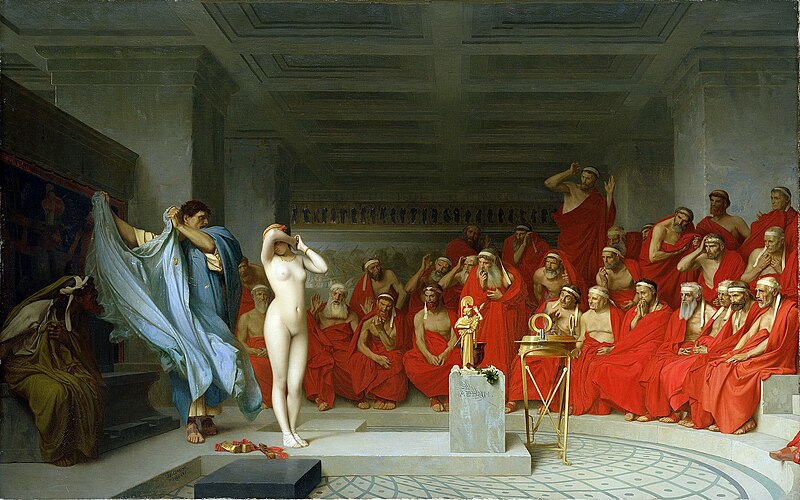
The best known event in Phryne's life is her trial. Athenaeus writes that she was prosecuted for a capital charge of impiety, and defended by the orator Hypereides, who was one of her lovers. When it seemed as if the verdict would be unfavourable, Hypereides removed Phryne's robe and bared her breasts before the judges to arouse their pity. 

File:Jean-Léon Gérôme, Phryne revealed before the Areopagus (1861) - 01.jpg
Jean-Léon Gérôme
Phryne revealed before the Areopagus (1861)
Oil on canvas
80 × 128 cm (31.5 × 50.4 in)
Kunsthalle Hamburg

Phryne Before the Areopagus is an 1861 painting. The subject matter is Phryne, an ancient Greek hetaira (courtesan) who was put on trial for impiety. Phryne was acquitted after her defender Hypereides removed her robe and exposed her naked bosom, "to excite the pity of her judges by the sight of her beauty." More on this painting

Jean-Léon Gérôme (11 May 1824 – 10 January 1904) was a French painter and sculptor in the style now known as academicism. His paintings were so widely reproduced that he was "arguably the world's most famous living artist by 1880." The range of his oeuvre included historical painting, Greek mythology, Orientalism, portraits, and other subjects, bringing the academic painting tradition to an artistic climax. He is considered one of the most important painters from this academic period. He was also a teacher with a long list of students. More on Jean-Léon Gérôme

Her beauty instilled the judges with a superstitious fear, who could not bring themselves to condemn "a prophetess and priestess of Aphrodite" to death. They decided to acquit her out of pity.

File:Jose Frappa - Phryne.jpg
Jose Frappa
Phryne, c. 1904
Oil on canvas
H. 92,0 ; L. 131,0 cm.
Musée d'Orsay

José Frappa (French 1854-1904) is the son of Jean-Claude Frappa and Rose Huguet and the father of film critic and screenwriter, Jean-Jose Frappa.

He exhibited at the Paris Salons from 1876, received an honorable mention in 1880, a third class medal in 1889 and exhibited at the Champ de Mars salon from 1890. He was also, twice, member of the Council of 90 of the Society of French Artists and member of the National Society of Fine Arts.

After taking part in various universal exhibitions, he received on February 4, 1898 the Legion of Honor from the hands of the Minister of Commerce on the occasion of the Brussels International Exhibition of 1897.

José Frappa has made a specialty of small paintings treated with meticulous care, staging perky clergymen, cardinals and choral choir children. More on José Frappa

Due to her beauty, she also inspired much later works:

Franz Von Stuck - Phryne
Franz von Stuck, 1863-1928
Phryne, c.1917/18 
Greek hetaera, 4th C BC., accused of atheism; narrator Hypereides achieves her acquittal by unveiling her body
Oil on paperboard
51 x 32,5cm
Private Collection

Franz Stuck (February 23, 1863 – August 30, 1928) was a German painter, sculptor, engraver, and architect. Born at Tettenweis near Passau, Stuck displayed an affinity for drawing and caricature from an early age. To begin his artistic education he relocated in 1878 to Munich, where he would settle for life. From 1881 to 1885 Stuck attended the Munich Academy.

In 1889 he exhibited his first paintings at the Munich Glass Palace, winning a gold medal for The Guardian of Paradise. In 1892 Stuck co-founded the Munich Secession, and also executed his first sculpture, Athlete. The next year he won further acclaim with the critical and public success of what is now his most famous work, the painting The Sin. Also during 1893, Stuck was awarded a gold medal for painting at the World's Columbian Exposition in Chicago, and was appointed to a royal professorship. In 1895 he began teaching painting at the Munich Academy.
Having attained much fame by this time, Stuck was ennobled on December 9, 1905 and would receive further public honours from around Europe during the remainder of his life. He continued to be well respected among young artists as professor at the Munich Academy, even after his artistic styles became unfashionable. More on Franz von Stuck

File:Phryne seduces the philosopher Xenocrates, Angelica Kauffmann 1794.jpg
Angelica Kauffman, (1741–1807)
Phrine seduces Xenocrates, 1794
Oil on canvas
17 x 18 7/8 in. (43 x 47.5 cm.)
Private collection

Sold for GBP 23,900 in Nov 2002

Xenocrates (c. 396/5 – 314/3 BC) of Chalcedon was a Greek philosopher, mathematician, and leader (scholarch) of the Platonic Academy from 339/8 to 314/3 BC. His teachings followed those of Plato, which he attempted to define more closely, often with mathematical elements. He distinguished three forms of being: the sensible, the intelligible, and a third compounded of the two, to which correspond respectively, sense, intellect and opinion. He considered unity and duality to be gods which rule the universe, and the soul a self-moving number. God pervades all things, and there are daemonical powers, intermediate between the divine and the mortal, which consist in conditions of the soul. He held that mathematical objects and the Platonic Ideas are identical, unlike Plato who distinguished them. In ethics, he taught that virtue produces happiness, but external goods can minister to it and enable it to effect its purpose. More on Xenocrates

Salvator Rosa, (1615 - 1673)
Phryne Tempting Xenocrate
Oil on canvas
128.5 × 96 cm (50 1/2 × 37 3/4 in)
Private collection

Sold for GBP 152,500 in Nov 2015

“Phryne tempting Xenocrates” is a typical work of Rosa’s late Roman period, reflecting the artist’s absorption with Stoic and Cynic philosophy, and ambition to be known as a sober and philosophical painter of cose morali. The incident depicted is described by Diogenes Laertius (IV, 7) and repeated by Valerius Maximus (LIV, III, 3). According to these sources, Phryne made a wager that she could successfully seduce the philosopher Xenocrates, a disciple of Plato known for his personal dignity and self-restraint. One night Phryne went to the house of this virtuous man claiming to seek refuge from pursuers in the street. Out of compassion for her plight, Xenocrates admitted her, and allowed Phryne to share the couch in his room. But all her female charms could not make the philosopher depart from his strict principles. Eventually Phryne gave up and left the house, telling all who inquired that Xenocrates was not a man but a statue. More on this painting

Salvator Rosa, (born June 20, 1615, Arenella, Sicily, Spanish Habsburg domain [now in Italy]—died March 15, 1673, Rome, Papal States [Italy]), was a Italian Baroque painter and etcher of the Neapolitan school, remembered for his wildly romantic or “sublime” landscapes, marine paintings, and battle pictures. He was also an accomplished poet, satirist, actor, and musician.

Rosa studied painting in Naples, coming under the influence of the Spanish painter and engraver José de Ribera. Rosa went to Rome in 1635 to study, but he soon contracted malaria. He returned to Naples, where he painted numerous battle and marine pictures and developed his peculiar style of landscape—picturesquely wild scenes of nature with shepherds, seamen, soldiers, or bandits—the whole infused with a romantic poetic quality.

His reputation as a painter preceded his return to Rome in 1639. Already famous as an artist, he also became a popular comic actor. For some years thereafter the environment of Florence was more comfortable for him than that of Rome. In Florence he enjoyed the patronage of Cardinal Giovanni Carlo de’ Medici. Rosa’s own house became the centre of a literary, musical, and artistic circle called the Accademia dei Percossi; here also Rosa’s flamboyant personality found expression in acting. In 1649 he returned and finally settled in Rome. Rosa, who had regarded his landscapes more as recreation than as serious art, now turned largely to religious and historical painting. In 1660 he began etching and completed a number of successful prints. His satires were posthumously published in 1710. More on Salvator Rosa

Joseph Mallord William Turner, 1775–1851
Phryne Going to the Public Baths as Venus, c. 1838
Oil paint on canvas
1930 x 1651 mm
Tate

Here Turner moves from ancient Rome to Athens, at the same time apparently conflating two classical legends with characteristic freedom. Phryne, a famous courtesan, once celebrated the festival of Poseidon by going naked into the sea at Eleusis near Athens. Her near-contemporary Demosthenes once taunted Aeschynes, his rival as an orator, of being the son of a courtesan (but not of Phryne herself). More on this painting

William Shackleton
Phryne at Eleusis, c. 1907
Oil on canvas
100.5 x 140.5 cm
Touchstones Rochdale

William Shackleton was born in Bradford, and at the early age of nine he had made up his mind to become an artist. His parents encouraged him to pursue his ambition. Shackleton studied at Bradford Technical College before gaining a scholarship to the Royal College of Art in 1893. He studied in Paris and in Italy where he was inspired by Renaissance art. More on this painting

Bronze, 27"x15", 1948
Albert Wein
Phryne Before the Judges, c. 1948
Bronze
27″x15″
Private collection

Bronze, 27″x15″, 1948. Wein modeled Phryne Before the Judges in 1948, presumably while he was in Italy. He was commissioned by Archer Milton Huntington to enlarge the work to a monumental size for installation at Brookgreen Gardens, Murrell’s Inlet, South Carolina in 1950. It took him two years to carve and complete the commission. More on this painting

1
ANTONIO PARREIRAS, (Brazilian, 1860- 1937)
PHRYNE, c. 1909
Oil on canvas
48 1/2 in. x 72 1/2 in.
Private collection

This painting was exhibited at the Salon Societe-Nationale des Beaux-Arts in Paris in 1910

Antônio Diogo da Silva Parreiras (20 January 1860, Niterói – 17 October 1937, Niterói) was a Brazilian painter, designer and illustrator.

In 1882, he enrolled at the Academia Imperial de Belas Artes in Rio de Janeiro, but left two years later to attend the free painting classes being offered by the German immigrant artist Georg Grimm. In 1885, when Grimm left to work in the countryside, Parreiras became an autodidact. A year later, one of his works was purchased by Emperor Pedro II.

This allowed him to resume his formal studies and travel to Europe in 1888, entering the Accademia di Belle Arti di Venezia. Upon his return to Brazil two years later, he participated in the "Exposição Gerais de Belas Artes [pt]". Later that same year, he became a Professor of landscape painting at the Escola Nacional de Belas Artes (ENBA) and, following the example set by Grimm, introduced his students to plein-air painting. Following disagreements with ENBA over changes in the curriculum, he set up his own school called the " Escola do Ar Livre".

He was soon doing much of his work in the forests outside Teresópolis. He also received numerous commissions to paint historical scenes and, after 1899, did decorations for the government in public buildings. From 1906 to 1919, he maintained a second studio in Paris and exhibited at the Salon. He was also named a delegate of the Société Nationale des Beaux-Arts in 1911.

In 1925 he was chosen as Brazil's best artist by the readers of Fon-Fon [pt], a magazine created by art critic Gonzaga Duque. The following year, he published his autobiography and was inducted into the "Academia Fluminense de Letras [pt]". In 1933, he participated in his last exhibitions; the "Jubileu Artístico" in São Paulo and Niteroi. Four years after his death, his former studio became the Museu Antônio Parreiras. More on Antônio Diogo da Silva Parreiras

James Pradier, (1790-1852)
Phryné remettant ses voiles
Sand cast bronze, 1845.
H. 39.8 cm (15 ½ in.)
Louvre Museum

Jean-Jacques (called James) Pradier (1790-1852) was born in Geneva, into a Protestant family who had fled to Switzerland on the Revocation of the Edict of Nantes. Throughout his career he was well supported by orders from Court.

The young Pradier’s education started in Geneva, where Vivant-Denon, then on a mission in the city, the capital of the French Léman region for some time, was so impressed by Pradier’s talent that he decided to make him go to Paris. After being taught by the painter François Gérard (1770-1837), he was a student at the Ecole des Beaux Arts (Fine Arts School) in the studio of the sculptor Frédéric Lemot (1773-1827).

While being a sculptor, he was also a gifted painter. But he soon became one of Lemot’s most brilliant pupils and won the Pris de Rome in 1812. He stayed 5 years in Rome and developed his own style, rather similar to the elegant and graceful statuary of the 18th century. More in Jean-Jacques

Joseph Mallord William Turner, (1775–1851)
Study for a Composition: Phryne c.1804–10
Pen and ink on paper
138 x 300 mm
Tate

Joseph Mallord William Turner, (1775–1851)
Study for a Composition: Phryne c.1802–10
Pen and ink on paper
140 x 302 mm
Tate

Percival Ball, (17 Feb 1845 - 04 Apr 1900)
Phryne before Praxiteles, 1900
Bronze relief
2620.0 x 3440.0 cm
Singer and Sons, Foundry
The facade of the Art Gallery of New South Wales

Percival Ball (17 February 1845 – 4 April 1900) was an English sculptor active in Australia.

He lstudied at the Royal Academy of Arts schools in England winning several gold medals and prizes. Between 1865 and 1882 he exhibited 24 works at Royal Academy exhibitions. Around 1870 Ball travelled to Paris and then to Munich and Rome, where he lived for approximately eight years. His marble sculptures received high praise.

Ball came to Sydney, Australia in 1884, seeking a warmer climate to relieve his asthma and bronchitis. After six months there he moved to Melbourne, occupying a studio at Grosvenor chambers from 1888. In 1898 he was commissioned by the trustees of the national gallery at Sydney to design a panel for the facade of the building. He completed his relief panel Phryne before Praxiteles and then travelled to England to supervise the casting. His architectural sculpture is also at the Victoria and Albert Museum. He died of heart failure due to asthma and bronchitis in England in 1900. More on Percival Ball

Phryne Posing for Praxiteles | by Dovid100
Percival Ball, (17 Feb 1845 - 04 Apr 1900)
Phryne before Praxiteles, 1900
Detail, see above

Phryne (w/c, pastel, pencil with pen and ink on paper) Posters & Prints by English School
English School
Phryne
pastel, pencil with pen and ink on paper
Bridgeman Art Library

Phryne Before the Areopagus
Jean-Baptiste Deshays (French, Colleville 1729–1765 Paris)
Phryne Before the Areopagus, mid-18th century
Pen and brown ink, brown wash, heightened with white, over black chalk
18 11/16 x 23 11/16 in. (47.5 x 60.2)
The Metropolitan Museum of Art

Jean-Baptiste-Henri Deshays or Deshayes (1729 – 10 February 1765) was a French painter of religious and mythological subjects.

Deshays was born in Colleville, near Rouen. His first training was under his father, the minor Rouen painter Jean-Dominique Deshays, he then spent a little time under Jean-Baptiste Descamps at his Ecole Gratuite de Dessin. He spent time in Hyacinthe Collin de Vermont's Paris studio from around 1740 to 1749 and Jean Restout II's from late 1749 to 1751. Both these had been pupils of Jean Jouvenet, and painted in the Grand Style of French history painting, a style Deshays adopted as his own.

Deshays entered the Prix de Rome competition, winning second prize in 1750 with His 1750 Laban Giving his Daughter in Marriage to Jacob won the second prize in the Grand Prix de Rome, and his 1751 Job on the Dung-hill the first prize. Deshays served the compulsory three years training at the Ecole des Eleves Protégés. He then spent 4 years under Charles-Joseph Natoire at the French Academy in Rome, making several copies of works by Raphael, Domenichino, Guercino and the Carracci. On Deshays' return to Paris in 1758, he married Boucher's elder daughter, and a year later became a full academician, though he only exhibited at 4 official Salons. He died in Paris. More on Deshayes


Images are copyright of their respective owners, assignees or others. Some Images may be subject to copyright

I don't own any of these images - credit is always given when due unless it is unknown to me. if I post your images without your permission, please tell me.

I do not sell art, art prints, framed posters or reproductions. Ads are shown only to compensate the hosting expenses.

If you enjoyed this post, please share with friends and family.

Thank you for visiting my blog and also for liking its posts and pages.

Please note that the content of this post primarily consists of articles available from Wikipedia or other free sources online.