Showing posts with label Franz von Stuck. Show all posts

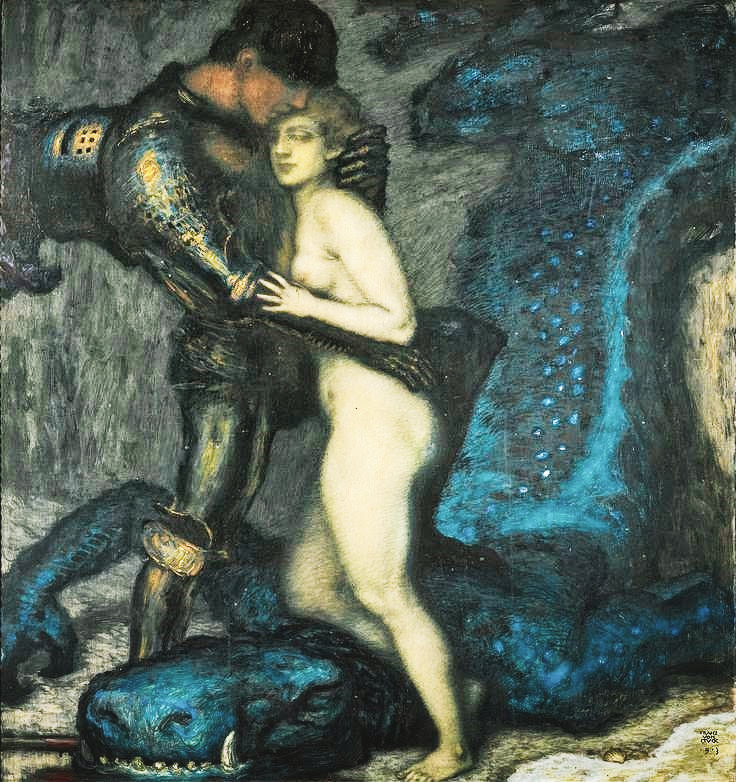
01 Work, RELIGIOUS ART - Franz von Stuck's The Dragon Slayer, With Footnotes - #135

Franz von Stuck, 1863 - 1928, GERMAN
The Dragon Slayer, c. 1913
Oil on panel
135 by 126cm., 53¼ by 49½in
Private collection

Sold for 605,000 GBP in May 2015

The Dragon Slayer is a particularly charged rendition of an age-old theme. Although most of Stuck's paintings depict scenes from the Antique or the Bible, neither the title The Dragon Slayer nor the iconography reveal the exact story behind the present work. Stuck's fascination with Greek legends suggests the subject to be Perseus and Andromeda, although Medusa's head and Perseus's winged shoes are missing. As early as 1900 Stuck’s contemporary, Lovis Corinth (lots 3, 4 & 5), had painted the hero as a medieval knight rather than a Greek half-god, and his Perseus and Andromeda may have been a possible source of inspiration for the present work. Another obvious influence would have been the biblical story of St. George, who kills the dragon to save a virgin. More on Thee Dragon Slayer

Franz Stuck (February 23, 1863 – August 30, 1928) was a German painter, sculptor, engraver, and architect. Born at Tettenweis near Passau, Stuck displayed an affinity for drawing and caricature from an early age. To begin his artistic education he relocated in 1878 to Munich, where he would settle for life. From 1881 to 1885 Stuck attended the Munich Academy.

In 1889 he exhibited his first paintings at the Munich Glass Palace, winning a gold medal for The Guardian of Paradise. In 1892 Stuck co-founded the Munich Secession, and also executed his first sculpture, Athlete. The next year he won further acclaim with the critical and public success of what is now his most famous work, the painting The Sin. Also during 1893, Stuck was awarded a gold medal for painting at the World's Columbian Exposition in Chicago, and was appointed to a royal professorship. In 1895 he began teaching painting at the Munich Academy.
Having attained much fame by this time, Stuck was ennobled on December 9, 1905 and would receive further public honours from around Europe during the remainder of his life. He continued to be well respected among young artists as professor at the Munich Academy, even after his artistic styles became unfashionable. More on Franz von Stuck


Please visit my other blogs: Art CollectorMythologyMarine ArtPortrait of a Lady, The OrientalistArt of the Nude and The Canals of VeniceMiddle East Artists365 Saints365 Days, and Biblical Icons, also visit my Boards on Pinterest and my art stores at  deviantart and Aaroko

Images are copyright of their respective owners, assignees or others. Some Images may be subject to copyright

I don't own any of these images - credit is always given when due unless it is unknown to me. if I post your images without your permission, please tell me.

Ads are shown only to compensate the hosting expenses.

If you enjoyed this post, please share with friends and family.

Thank you for visiting my blog and also for liking its posts and pages.

Please note that the content of this post primarily consists of articles available from Wikipedia or other free sources online.


22 Paintings, RELIGIOUS ART - Paintings from the Bible by the Masters, Franz von Stuck, with footnotes, 21


Franz von Stuck, (1863-1928)
Inferno, c. 1908
128.5 x 209 cm
Oil on canvas

"His painting Inferno rendered an extraordinary panaroma of the damned writhing in eternal torment. A syphilitic whore with a death’s head stands stiffly on the left while a demon readies to suckle at her withered teat. Two muscled figures sit doubled up in agony at the scene’s center. On the right, a venomous serpent coils itself around two damned souls. Stuck used ophidian imagery repeatedly in his paintings and this particular Hydra wildly sibilates as it crushes its victims. Backlit with fiery igneous rock, Stuck focused light on each damned soul so as to detail every facet of their agony. Inferno successfully depicts an arresting scene of chthonian grotesques for its viewers." More

Franz Stuck (February 23, 1863 – August 30, 1928), ennobled as Franz von Stuck in 1906, was a German painter, sculptor, engraver, and architect. Born at Tettenweis near Passau, Stuck displayed an affinity for drawing and caricature from an early age. To begin his artistic education he relocated in 1878 to Munich, where he would settle for life. From 1881 to 1885 Stuck attended the Munich Academy.

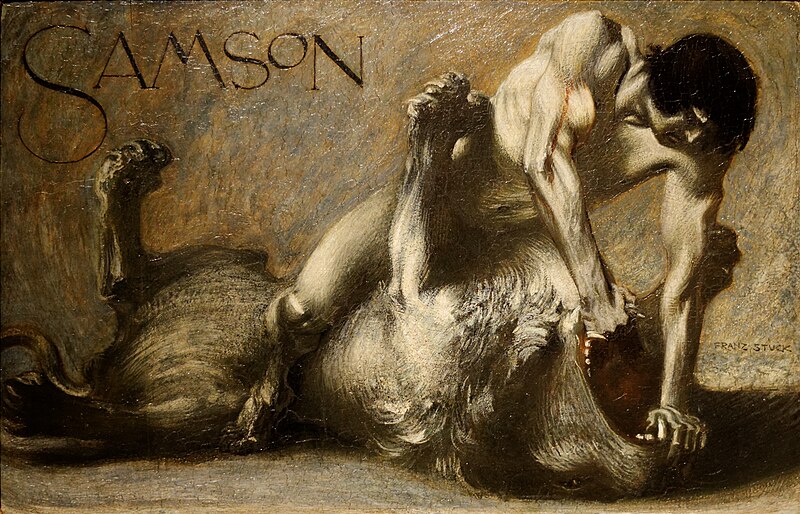
File:Samson Franz von Stuck.jpg
Franz von Stuck (1863–1928)
Samson, c. 1890
Oil on canvas
37 cm (14.57 in.), Width: 56.5 cm (22.24 in.)
 Museum Villa Stuck, Munich

Franz von Stuck's early painting, which titled "Samson" (1890), and which was considered lost since it's last mention in 1924 by Stuck's biographer, the poet OJ Bierbaum; who commented that the image: "One is more inclined to think of one of the labors of Hercules, as to the fact of the Old Testament ." More 

He first became well known by cartoons for Fliegende Blätter, and vignette designs for programmes and book decoration. In 1889 he exhibited his first paintings at the Munich Glass Palace, winning a gold medal for The Guardian of Paradise.

Franz Von Stuck 1863 -1928 |  German Symbolist / Expressionist painter and sculptor
Franz von Stuck
Crucifixion, 1913
Tempera on canvas
190 cm (74.8 in.), Width: 165 cm (64.96 in.) 
Museum der Bildenden Künste - Leipzig

In 1892 Stuck co-founded the Munich Secession, and also executed his first sculpture, Athlete. The next year he won further acclaim with the critical and public success of what is now his most famous work, the painting The Sin. Also during 1893, Stuck was awarded a gold medal for painting at the World's Columbian Exposition in Chicago, and was appointed to a royal professorship. In 1895 he began teaching painting at the Munich Academy.

Franz von Stuck (1863 - 1928)
Crucifixion Christi, c. (1913)
165 x 190 cm (64,8 x 74,7 inches)
Leipzig, Museum

Stuck chose to portray the most dramatic moment of Christ's death, when the sun went dark and the heavens cracked. The scene concentrates entirely on the deathly pale Christ, who is lit in a bright heavenly glow against the dark setting. Apart from Christ and the two murderers, of whom one is lost in the darkness and the other seen from the back and almost invisible, the only others present are John and Mary. More

Franz von Stuck (1863–1928)
Golgotha, c. 1917 
Oil on canvas
Brooklyn Museum - New York, NY (United States)

Stuck devoted several canvases to this subject late in his career, during the difficult years of World War I. Calling on new scholarly theories regarding the Gospel accounts, Stuck departs from tradition and places Christ at eye level with the witnesses to his sufferings. The artist cleverly structures his composition, placing the viewer immediately to the left of the crucified thief in the foreground and to the right of the haloed Virgin Mary, thereby closing a solemn yet intimate circle. Stuck also chooses to show Christ with his feet side by side rather than overlapping—again, referencing nineteenth-century debates about the historical details of this method of execution. More

In 1897 Stuck married an American widow, Mary Lindpainter, and began work designing his own residence and studio, the Villa Stuck. His designs for the villa included everything from layout to interior decorations; for his furniture Stuck received another gold medal at the 1900 Paris World Exposition.

Franz von Stuck (1863–1928)
Pietà, c. 1891
Oil on canvas
Height: 95 cm (37.4 in.), Width: 178.5 cm (70.28 in.)
Städel Museum - Frankfurt (Germany)

Stuck’s big idea is humanity itself, in all its complexity and contradiction, all its passion and pain. In paintings such as Pieta, we bear witness to the Virgin Mary’s grief as we, too, look upon the dead body of Christ, to whom von Stuck often gave his own features in the paintings, thus placing himself in that most passionate and pathetic of roles. More

Having attained much fame by this time, Stuck was ennobled on December 9, 1905 and would receive further public honours from around Europe during the remainder of his life. He continued to be well respected among young artists as professor at the Munich Academy, even after his artistic styles became unfashionable. Notable students of his over the years include Paul Klee, Hans Purrmann, Wassily Kandinsky, Alf Bayrle and Josef Albers.

Franz von Stuck
Lucifer, c. 1891
oil on canvas
National Gallery for Foreign Art (Sofia, Bulgaria)

Stuck’s Lucifer (1890; detail shown above) strikes the viewer not just as an embodiment of evil, but an embodiment of the human element in evil. An early critic wrote of “appalling Lucifer, sitting alone in the nether gloom with incandescent greenish eyes.” Prince Ferdinand of Bulgaria, once owner of Lucifer, told von Stuck that the painter “terrified” his ministers, who made the sign of the cross upon first sight of the fallen archangel—a story von Stuck retold with glee, one presumes.  What makes Lucifer stick in your mind isn’t some reproduction of the glamour of evil, but rather the poignant sense of loss in those glowing green eyes, the envy of the heaven he fell from fueling the fires of the hell he must now fashion. von Stuck could paint both convincing Christs and Satans because he always held onto the common thread of the humanity at the core of such figures. More

Stuck’s masterwork, “Lucifer.” As with many of his portraits, the subject gazes out toward the viewer—but off center and with pale, enraged eyes, the fallen angel is looking through the audience, not at them. Plotting his revenge and cupping his broken wings, this greatest symbol of inversion—once divine, now demonic, once the favorite, now the enemy—sees through the material aspects to the very essence of humanity and how it can be exploited to subvert divine order. Unlike Stuck’s other composite beasts whose hooves are planted firmly on earth, Lucifer has wings that for flight and ascendance, but now form only a dark shell, a reminder of his fall, crumpled by a thin crescent of light descending from above. More

'Temptation', Oil by Franz Von Stuck (1863-1928, Germany):
Franz von Stuck
Die Versuchung (The Temptation)

In the middle of the picture, between Adam and Eve, Stuck positioned the Tree of Knowledge around which a giant snake has curled itself. Eve, who has already been seduced by the snake and sampled the forbidden fruit, is shown timidly offering it to Adam. Torn between accepting or refusing the apple, Adam's leg is simultaneously being enveloped by the devil’s tail. Stuck clearly used the forbidden fruit as a metaphor of the seductive and erotic power of woman. This is reflected not only in the painting’s title but also in Eve’s gesture: while offering him the apple in one hand, she clasps her breast in the other. More

File:Franz-Von-Stuck-adam-and-Eve.jpg:
Franz von Stuck, (1863-1928)
Adam and Eve, ca. 1920-28
98.0 x 93.5 cm
Oil on wood

Here Stuck altered the iconography. The tree is left out entirely. Instead, the devil uses the woman herself as the temptress of man. Rather than the apple, Eve extends the snake’s head, in which the apple is clearly visible between the fangs of its gaping mouth. Both snake and woman conjoin in their attempt to seduce man, just as they do in Stuck’s famous later paintings of Die Sünde (The Sin).

Franz von Stuck, (1863-1928)
Temptation - Adam and Eve
Oil on wood
Mid Rhineland Museum

Franz von Stuck (1863 - 1928)
ADAM UND EVA, 1893
73 x 68,5 x 3,5 cm
Bronze

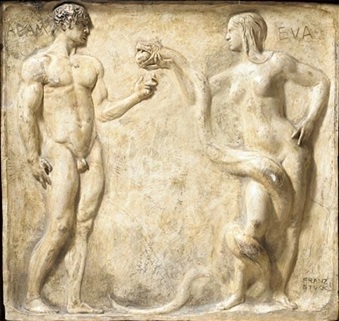
Franz von Stuck (1863 - 1928)
ADAM UND EVA (ADAM AND EVE)
Plaster
70 by 74.5cm., 27½ by 29¼in.


An interesting aspect of this relief, and the bronx above, is the opposing representations of the two nudes. While Adam resembles antique statues from the 5th century BC, Eve is emphatically modern, sensitively modelled from nature and stylized in a way that is typical of von Stuck.

Franz von Stuck died on August 30, 1928 in Munich; his funeral address memorialized him as "the last prince of art of Munich's great days". He is buried in the Munich Waldfriedhof next to his wife Mary.

Franz von Stuck (1863–1928)
The Guardian of Paradise, c. 1889
Oil on canvas
250 cm (98.43 in.), Width: 167 cm (65.75 in.) 
Brooklyn Museum - New York, NY (United States)

In 1889 Stuck exhibited his first paintings at the Munich Glass Palace, winning a gold medal for The Guardian of Paradise.

The lost Paradise, 1897 by Franz Stuck. Symbolism. religious painting:
Franz von Stuck (1863–1928)
The lost Paradise, c. 1897
Oil on canvas
200 x 290 cm
Galerie Neue Meister in Dresden, Germany

 “After he drove the man out, he placed on the east side of the Garden of Eden cherubim and a flaming sword.” (Genesis 3:24)

Franz von Stuck (1863–1928)
The Explusion from Paradise, c. 1890
Oil on canvas
Musée d'Orsay - Paris (France)


In the present painting, the angel is turned into profile, and Adam and Eve are added at the right. The angel’s bent wings are firmly planted on the ground, balancing the slight curve of the two bodies on the right. A vanishing demarcation line indicates the border of Paradise in the center of the painting, reinforcing its symmetrical composition. The dark and light bodies of Adam and Eve repeat the rhythm of the angel’s dark wings and light body. The most innovative element is the scintillating light which creates an unreal magic space. More

Image: Franz von Stuck - Judith
Franz von Stuck, (1863-1928)
Judith, (1924)
83 x 157 cm
Oil on canvas
Schwerin State Museum

Franz von Stuck, (1863-1928)
Judith (1926)
83 x 157 cm
Oil on canvas
Schwerin State Museum

Franz von Stuck, (1863-1928)
Judith and Holofernes, c. 1927
82 × 74 cm
Oil on canvas
Collection Otto Heilmann, Munich, Germany

Modern paintings of this scene often cast Judith nude, as was signalled already by Klimt. Franz Stuck's 1928 Judith has "the deliverer of her people" standing naked and holding a sword besides the couch on which Holofernes, half-covered by blue sheets—where the text portrays her as god-fearing and chaste, "Franz von Stuck's Judith becomes, in dazzling nudity, the epitome of depraved seduction"

The account of the beheading of Holofernes by Judith is given in the Book of Judith, and is the subject of many paintings and sculptures from the Renaissance and Baroque periods. In the story, Judith, a beautiful widow, is able to enter the tent of Holofernes because of his desire for her. Holofernes was an Assyrian general who was about to destroy Judith's home, the city of Bethulia. Overcome with drink, he passes out and is decapitated by Judith; his head is taken away in a basket (often depicted as carried by an elderly female servant). More

Franz von Stuck, (1863-1928)
Salome, c. 1906
45.7 × 24.7 cm
Oil on canvas
Lenbachhaus

Franz von Stuck, (1863-1928)
Salome, 1920
90.2 x 66 cm (35 1/2 x 26 in.)
Oil on canvas

Salome, stepdaughter of Herod II, is depicted in the Bible as a femme fataleâ. Her dance before the King so pleases him that he ultimately agrees to the beheading of John the Baptist. Von Stuck highlights Salome`s seductive and rather sinister”qualities; the tilt of her head and positioning of her body emphasize her long, lean figure as well as the wide expanses of naked skin. Her smile similarly reveals her delight at entertaining her audience, the viewer. This representation is related to a variation of the same subject produced by von Stuck in 1906 (see above). Salome is shown the same pose, but accompanied by a black woman carrying the head of John the Baptist. More

Franz von Stuck - Batsheba, 1912.jpg
Franz von Stuck (1863–1928)
Batsheba, c. 1912
Oil on canvas
95 × 91 cm (37.4 × 35.8 in)
National Museum of Fine Arts in Buenos Aires

According to the Hebrew Bible, "Bat Sheva," , "daughter of the oath"; was the wife of Uriah the Hittite and later of David, king of the United Kingdom of Israel and Judah. She is most known for the Bible story in which she was summoned by King David who had seen her bathing and lusted after her.

Bathsheba was from David's own tribe and the granddaughter of one of David's closest advisors. She was the mother of Solomon, who succeeded David as king, making her the Queen Mother. More

Franz von Stuck (1863–1928)
Susanna and the Elders

Franz von Stuck (1863–1928)
Susanna and the Elders, c. 1904
Oil on canvas

Franz von Stuck (1863–1928)
Susanna and the Elders, c. 1913
Oil on canvas
25 x 63 cm

Franz von Stuck (1863–1928)
Susanna And The Elders, c. 1904
Oil, canvas
98 x 134.5 cm

A fair Hebrew wife named Susanna was falsely accused by lecherous voyeurs. As she bathes in her garden, having sent her attendants away, two lustful elders secretly observe the lovely Susanna. When she makes her way back to her house, they accost her, threatening to claim that she was meeting a young man in the garden unless she agrees to have sex with them.

She refuses to be blackmailed and is arrested and about to be put to death for promiscuity when a young man named Daniel interrupts the proceedings, shouting that the elders should be questioned to prevent the death of an innocent. After being separated, the two men are questioned about details of what they saw, but disagree about the tree under which Susanna supposedly met her lover. In the Greek text, the names of the trees cited by the elders form puns with the sentence given by Daniel. The first says they were under a mastic, and Daniel says that an angel stands ready to cuthim in two. The second says they were under an evergreen oak tree, and Daniel says that an angel stands ready to saw him in two. The great difference in size between a mastic and an oak makes the elders' lie plain to all the observers. The false accusers are put to death, and virtue triumphs. More

stuck, franz von the dragon slayer | figures | sotheby's l15101lot7y6mden:
Franz von Stuck, 1863 - 1928
THE DRAGON SLAYER
Oil on panel
135 by 126cm., 53¼ by 49½in.

The Dragon Slayer is a particularly charged rendition of an age-old theme. Although most of Stuck's paintings depict scenes from the Antique or the Bible, neither the title The Dragon Slayer nor the iconography reveal the exact story behind the present work. Stuck's fascination with Greek legends suggests the subject to be Perseus and Andromeda, although Medusa's head and Perseus's winged shoes are missing. As early as 1900 Stuck’s contemporary, Lovis Corinth (lots 3, 4 & 5), had painted the hero as a medieval knight rather than a Greek half-god, and his Perseus and Andromeda may have been a possible source of inspiration for the present work. Another obvious influence would have been the biblical story of St. George, who kills the dragon to save a virgin. More

Franz von Stuck, 1863 - 1928
Versuchung (Temptation), c. 1918
Mixed media on canvas
37 3/8 x 42 1/2 in
Museum Villa Stuck

Franz von Stuck, 1863 - 1928
Temptation Of St. Anthony
Oil on board
13.00 in. (33.02 cm.) (height) by 15.00 in. (38.10 cm.) (width)

Saint Anthony or Antony (c. 251–356) was a Christian monk from Egypt, revered since his death as a saint. He is known as the Father of All Monks. His feast day is celebrated on January 17 among the Orthodox and Catholic churches and on Tobi 22 in the Egyptian calendar used by the Coptic Church.

The biography of Anthony's life helped to spread the concept of Christian monasticism, particularly in Western Europe via its Latin translations. He is often erroneously considered the first Christian monk. Anthony was, however, the first to go into the wilderness (about ad 270), a geographical move that seems to have contributed to his renown. Accounts of Anthony enduring supernatural temptation during his sojourn in the Eastern Desert of Egypt inspired the often-repeated subject of the temptation of St. Anthony in Western art and literature.

Anthony is appealed to against infectious diseases, particularly skin diseases. In the past, many such afflictions, including ergotism, erysipelas, and shingles, were historically referred to as St. Anthony's fire. More


Please visit my other blogs: Art CollectorMythologyMarine ArtPortrait of a Lady, The OrientalistArt of the Nude and The Canals of VeniceMiddle East Artists365 Saints365 Days, and Biblical Icons, also visit my Boards on Pinterest

Images are copyright of their respective owners, assignees or others. Some Images may be subject to copyright

I don't own any of these images - credit is always given when due unless it is unknown to me. if I post your images without your permission, please tell me.

I do not sell art, art prints, framed posters or reproductions. Ads are shown only to compensate the hosting expenses.

If you enjoyed this post, please share with friends and family.

Thank you for visiting my blog and also for liking its posts and pages.

Please note that the content of this post primarily consists of articles available from Wikipedia or other free sources online.
22 Works, The story of The world's first supermodel, Phryne by Henryk Siemiradzki, Paul Delaroche, Ippolito Buzzi, Angelica Kauffmann, James McNeill Whistler, Jean-Léon Gérôme, Jose Frappa, Franz von Stuck, Salvator Rosa, Joseph Mallord William Turner, and others, with footnotes

Henryk Siemiradzki
Phryne at the Poseidonia in Eleusis, c. 1889
Oil on Canvas
Russian Museum, St. Petersburg, Russia

Phryne at the Festival of Poseidon in Eleusis or Phryne at the Poseidonia in Eleusis is a very large-scale history painting by the Russian-born Polish painter Henryk Siemiradzki, completed in 1889. It is part of the collections of the State Russian Museum in Saint Petersburg. More on this painting

Henryk Hektor Siemiradzki (24 October 1843 – 23 August 1902) was a Polish painter. He spent most of his active creative life in Rome. Best remembered for his monumental academic art. He was particularly known for his depictions of scenes from the ancient Greek-Roman world and the New Testament, owned by many national galleries of Europe.

Many of his paintings depict scenes from antiquity, often the sunlit pastoral scenes or compositions presenting the lives of early Christians. He also painted biblical and historical scenes, landscapes, and portraits. His best-known works include monumental curtains for the Lviv (Lwów) Theatre of Opera and for the Juliusz Słowacki Theatre in Kraków. More on Henryk Hektor Siemiradzki

Phryne's real name was Mnēsarétē ("commemorating virtue"), but owing to her yellowish complexion she was called Phrýnē ("toad"). This was a nickname frequently given to other courtesans and prostitutes as well. The exact dates of her birth and death are unknown, but she was born about 371 BC. In that year Thebes razed Thespiae not long after the battle of Leuctra and expelled its inhabitants.

Paul Delaroche (1797–1856)
The Hémicycle
Oil and wax on wall
H: 16 3/8 x W: 101 5/16 in. (41.6 x 257.3 cm)
The Walters Art Museum

This painting replicates Delaroche's most famous work, a mural in oils and wax (1836-41) in the auditorium of the École des Beaux-Arts in Paris, France's most prestigious art school. Delaroche's pupil, Charles Béranger, is thought to have begun this replica in 1841, but the master completed it following his pupil's death in 1853. It provided a basis for L.-P. Henriquel-Dupont's engraving reproducing the composition. 

Represented are great artists of the past who appear to preside over the awards ceremonies held in the auditorium. Enthroned in the center are the three masters of antiquity-Ictinus the architect, Apelles the painter, and Phidias the sculptor-flanked by personifications of Greek and Gothic art (on the left) and Roman and Renaissance art (on the right). Below, the semi-nude figure of Fame leans forward to distribute laurel wreaths to the recipients of the coveted Grand Prix de Rome, who were entitled to spend 4 to 5 years studying in Rome at the expense of the State. More on this painting

In legislatures, a hemicycle is a semicircular, or horseshoe-shaped, debating chamber (plenary chamber), where deputies (members) sit to discuss and pass legislation. Although originally of Ancient Greek roots, the term and modern design derive from French politics and practice More on hemicycle

Paul Delaroche, in full Hippolyte-Paul Delaroche, (born July 17, 1797, Paris—died Nov. 4, 1859, Paris), painter whose painstakingly realistic historical subjects made him one of the most successful academic artists of mid-19th-century France. Delaroche’s father was an art expert, his uncle was curator of the Cabinet des Estampes, and his brother was the painter Jules-Hippolyte Delaroche. In 1832 he became a professor at the École Nationale Supérieure des Beaux-Arts and was made a member of the institute.
Delaroche’s pictures were painted with a firm, solid, smooth surface, which gave an appearance of the highest finish. Often in developing his compositions he first made wax models of them. He held a course midway between the Classicists and the Romantics. His long series of historical pictures had a great popular success, and the availability of engraved reproductions made his work familiar in thousands of homes. One of the most popular of his scenes was the “Children of Edward” (1830; Louvre, Paris), a depiction of the imprisonment of Edward IV’s sons in the Tower of London. More on Paul Delaroche

Paul Delaroche
Detail; Central portion of "The Hémicycle"
Phryne at the Festival of Poseidon
Oil and wax on wall
École nationale supérieure des Beaux-Arts, Paris

Athenaeus Naucratita, a Greek rhetorician and grammarian, provides many anecdotes about Phryne. He praises her beauty, writing that on the occasion of the festivals of the Eleusinia and Poseidonia she would let down her hair and step naked into the sea. This would have inspired the painter Apelles to create his famous picture of Aphrodite Anadyomene (Rising from the Sea also portrayed at times as Venus Anadyomene). Supposedly the sculptor Praxiteles, who was also her lover, used her as the model for the statue of the Aphrodite of Knidos.


Copy of Praxiteles; restorer: Ippolito Buzzi (Italian, 1562–1634)
Praxiteles of Athens/ The Aphrodite of Knidos
Marble; original elements: torso and thighs; restored elements: head, arms, legs and support (drapery and jug).
Museo nazionale romano di palazzo Altemps

The Aphrodite of Knidos was one of the most famous works of the ancient Greek sculptor Praxiteles of Athens (4th century BC). It and its copies are often referred to as the Venus Pudica ("modest Venus") type, on account of her covering her naked pubis with her right hand. Variants of the Venus Pudica (suggesting an action to cover the breasts) are the Venus de' Medici or the Capitoline Venus.

Praxiteles of Athens, the son of Cephisodotus the Elder, was the most renowned of the Attica sculptors of the 4th century BC. He was the first to sculpt the nude female form in a life-size statue. While no indubitably attributable sculpture by Praxiteles is extant, numerous copies of his works have survived; several authors, including Pliny the Elder, wrote of his works; and coins engraved with silhouettes of his various famous statuary types from the period still exist.

A supposed relationship between Praxiteles and his beautiful model, the Thespian courtesan Phryne, has inspired speculation and interpretation in works of art ranging from painting to comic opera.

Some writers have maintained that there were two sculptors of the name Praxiteles. One was a contemporary of Pheidias, and the other his more celebrated grandson. Though the repetition of the same name in every other generation is common in Greece, there is no certain evidence for either position. More on Praxiteles of Athens

Ippolito Buzzi (or Buzio) (1562–1634) was an Italian sculptor from Viggiù, near Varese, in northernmost Lombardy, a member of a long-established dynasty of painters, sculptors and architects from the town, who passed his mature career in Rome. His personality as a sculptor is somewhat overshadowed by the two kinds of work he is known for: restorations to ancient Roman sculptures, some of them highly improvisatory by modern standards, and sculpture contributed to architectural projects and funeral monuments, where he was one among a team of craftsmen working under the general direction of an architect, like Giacomo della Porta - in projects for Pope Clement VIII, or Flaminio Ponzio - in projects for Pope Paul V - who would provide the designs from which the work was executed, always in consultation with the patron. Buzzi also turned his hand to garden sculpture of a high order, such as caryatids for the Teatro delle Acque in the Villa Aldobrandini, Frascati, works that were in the process of completion from 1603, with water features designed by Orazio Olivieri and Giovanni Guglielmi. Eva-Bettina Krems suggests that Pietro Aldobrandini's secretary, Monsignor Giovanni Battista Agucchi, is a likely candidate for the connection that introduced Buzzi to Cardinal Ludovico Ludovisi. More on Ippolito Buzzi

Praxiteles produced two more statues for her, a statue of Eros which was consecrated in the temple of Thespiae 

Angelica Kauffmann, Swiss, 1741-1807
Praxiteles Giving Phryne his Statue of Cupid, c. 1794
Oil on canvas
43.3 x 48.6 cm (17 1/16 x 19 1/8 inches)
Rhode Island School of Design Museum

This scene depicts the Greek sculptor Praxiteles offering his favorite work, a statue of Cupid, as a gift to the courtesan Phryne. The subject is both tender and original, imagining the artist in a private dialogue with his beautiful mistress. Painted in Rome, it was one of four small paintings with themes of antiquity that were commissioned from Angelica Kauffmann by a British patron. More on this painting

Angelica Kauffmann, in full Maria Anna Catharina Angelica Kauffmann, (born Oct. 30, 1741, Chur, Switz.—died Nov. 5, 1807, Rome, Papal States), painter in the early Neoclassical style who is best known for her decorative wall paintings for residences designed by Robert Adam.

Her early paintings were influenced by the French Rococo works of Henri Gravelot and François Boucher. In 1754 and 1763 she visited Italy, and while in Rome she was influenced by the Neoclassicism of Anton Raphael Mengs.

She was induced by Lady Wentworth, wife of the English ambassador, to accompany her to London in 1766. She was well received and was particularly favoured by the royal family. Sir Joshua Reynolds became a close friend, and most of the numerous portraits and self-portraits done in her English period were influenced by his style of portrait painting. Her name is found among the signatories to the petition for the establishment of the Royal Academy, and in its first catalogue of 1769 she is listed as a member. She was one of only two women founding members. Kauffmann retired to Rome in the early 1780s with her second husband, the Venetian painter Antonio Zucchi.

Kauffmann’s pastoral and mythological compositions portray gods and goddesses. Her paintings are Rococo in tone and approach, though her figures are given Neoclassical poses and draperies. Kauffmann’s portraits of female sitters are among her finest works. More on Angelica Kauffmann

and a statue of Phryne herself which was made of solid gold and consecrated in the temple of Delphi. 

Purple and Gold: Phryne the Superb! - Builder of Temples
James McNeill Whistler (11 July 1834 - 17 July 1903)
Purple and Gold: Phryne the Superb! - Builder of Temples, c. 1898
Oil on canvas
236 x 137 mm (9 1/4" x 5 3/8")
Smithsonian Institution

James Abbott McNeill Whistler RBA (July 10, 1834 – July 17, 1903) was an American painter in oils and watercolor, and printmaker, active during the American Gilded Age and based primarily in the United Kingdom. He eschewed sentimentality and moral allusion in painting and was a leading proponent of the credo "art for art's sake".

His signature for his paintings took the shape of a stylized butterfly possessing a long stinger for a tail.[1] The symbol combined both aspects of his personality: his art is marked by a subtle delicacy, while his public persona was combative. He found a parallel between painting and music, and entitled many of his paintings "arrangements", "harmonies", and "nocturnes", emphasizing the primacy of tonal harmony.[2] His most famous painting, Arrangement in Grey and Black No. 1 (1871), commonly known as Whistler's Mother, is a revered and often parodied portrait of motherhood. Whistler influenced the art world and the broader culture of his time with his aesthetic theories and his friendships with other leading artists and writers. More on James Abbott McNeill Whistler

Athenaeus alleges she was so rich that she offered to fund the rebuilding of the walls of Thebes, which had been destroyed by Alexander the Great in 336 BC, on the condition that the words "Destroyed by Alexander, restored by Phryne the courtesan" be inscribed upon them.

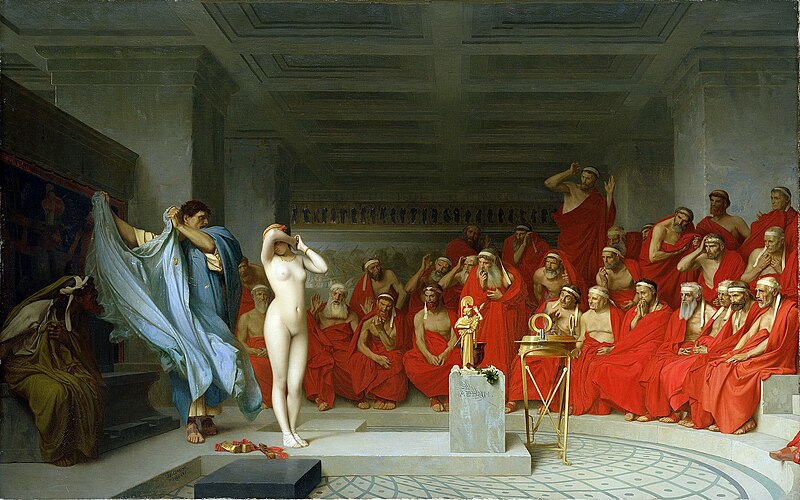
The best known event in Phryne's life is her trial. Athenaeus writes that she was prosecuted for a capital charge of impiety, and defended by the orator Hypereides, who was one of her lovers. When it seemed as if the verdict would be unfavourable, Hypereides removed Phryne's robe and bared her breasts before the judges to arouse their pity. 

File:Jean-Léon Gérôme, Phryne revealed before the Areopagus (1861) - 01.jpg
Jean-Léon Gérôme
Phryne revealed before the Areopagus (1861)
Oil on canvas
80 × 128 cm (31.5 × 50.4 in)
Kunsthalle Hamburg

Phryne Before the Areopagus is an 1861 painting. The subject matter is Phryne, an ancient Greek hetaira (courtesan) who was put on trial for impiety. Phryne was acquitted after her defender Hypereides removed her robe and exposed her naked bosom, "to excite the pity of her judges by the sight of her beauty." More on this painting

Jean-Léon Gérôme (11 May 1824 – 10 January 1904) was a French painter and sculptor in the style now known as academicism. His paintings were so widely reproduced that he was "arguably the world's most famous living artist by 1880." The range of his oeuvre included historical painting, Greek mythology, Orientalism, portraits, and other subjects, bringing the academic painting tradition to an artistic climax. He is considered one of the most important painters from this academic period. He was also a teacher with a long list of students. More on Jean-Léon Gérôme

Her beauty instilled the judges with a superstitious fear, who could not bring themselves to condemn "a prophetess and priestess of Aphrodite" to death. They decided to acquit her out of pity.

File:Jose Frappa - Phryne.jpg
Jose Frappa
Phryne, c. 1904
Oil on canvas
H. 92,0 ; L. 131,0 cm.
Musée d'Orsay

José Frappa (French 1854-1904) is the son of Jean-Claude Frappa and Rose Huguet and the father of film critic and screenwriter, Jean-Jose Frappa.

He exhibited at the Paris Salons from 1876, received an honorable mention in 1880, a third class medal in 1889 and exhibited at the Champ de Mars salon from 1890. He was also, twice, member of the Council of 90 of the Society of French Artists and member of the National Society of Fine Arts.

After taking part in various universal exhibitions, he received on February 4, 1898 the Legion of Honor from the hands of the Minister of Commerce on the occasion of the Brussels International Exhibition of 1897.

José Frappa has made a specialty of small paintings treated with meticulous care, staging perky clergymen, cardinals and choral choir children. More on José Frappa

Due to her beauty, she also inspired much later works:

Franz Von Stuck - Phryne
Franz von Stuck, 1863-1928
Phryne, c.1917/18 
Greek hetaera, 4th C BC., accused of atheism; narrator Hypereides achieves her acquittal by unveiling her body
Oil on paperboard
51 x 32,5cm
Private Collection

Franz Stuck (February 23, 1863 – August 30, 1928) was a German painter, sculptor, engraver, and architect. Born at Tettenweis near Passau, Stuck displayed an affinity for drawing and caricature from an early age. To begin his artistic education he relocated in 1878 to Munich, where he would settle for life. From 1881 to 1885 Stuck attended the Munich Academy.

In 1889 he exhibited his first paintings at the Munich Glass Palace, winning a gold medal for The Guardian of Paradise. In 1892 Stuck co-founded the Munich Secession, and also executed his first sculpture, Athlete. The next year he won further acclaim with the critical and public success of what is now his most famous work, the painting The Sin. Also during 1893, Stuck was awarded a gold medal for painting at the World's Columbian Exposition in Chicago, and was appointed to a royal professorship. In 1895 he began teaching painting at the Munich Academy.
Having attained much fame by this time, Stuck was ennobled on December 9, 1905 and would receive further public honours from around Europe during the remainder of his life. He continued to be well respected among young artists as professor at the Munich Academy, even after his artistic styles became unfashionable. More on Franz von Stuck

File:Phryne seduces the philosopher Xenocrates, Angelica Kauffmann 1794.jpg
Angelica Kauffman, (1741–1807)
Phrine seduces Xenocrates, 1794
Oil on canvas
17 x 18 7/8 in. (43 x 47.5 cm.)
Private collection

Sold for GBP 23,900 in Nov 2002

Xenocrates (c. 396/5 – 314/3 BC) of Chalcedon was a Greek philosopher, mathematician, and leader (scholarch) of the Platonic Academy from 339/8 to 314/3 BC. His teachings followed those of Plato, which he attempted to define more closely, often with mathematical elements. He distinguished three forms of being: the sensible, the intelligible, and a third compounded of the two, to which correspond respectively, sense, intellect and opinion. He considered unity and duality to be gods which rule the universe, and the soul a self-moving number. God pervades all things, and there are daemonical powers, intermediate between the divine and the mortal, which consist in conditions of the soul. He held that mathematical objects and the Platonic Ideas are identical, unlike Plato who distinguished them. In ethics, he taught that virtue produces happiness, but external goods can minister to it and enable it to effect its purpose. More on Xenocrates

Salvator Rosa, (1615 - 1673)
Phryne Tempting Xenocrate
Oil on canvas
128.5 × 96 cm (50 1/2 × 37 3/4 in)
Private collection

Sold for GBP 152,500 in Nov 2015

“Phryne tempting Xenocrates” is a typical work of Rosa’s late Roman period, reflecting the artist’s absorption with Stoic and Cynic philosophy, and ambition to be known as a sober and philosophical painter of cose morali. The incident depicted is described by Diogenes Laertius (IV, 7) and repeated by Valerius Maximus (LIV, III, 3). According to these sources, Phryne made a wager that she could successfully seduce the philosopher Xenocrates, a disciple of Plato known for his personal dignity and self-restraint. One night Phryne went to the house of this virtuous man claiming to seek refuge from pursuers in the street. Out of compassion for her plight, Xenocrates admitted her, and allowed Phryne to share the couch in his room. But all her female charms could not make the philosopher depart from his strict principles. Eventually Phryne gave up and left the house, telling all who inquired that Xenocrates was not a man but a statue. More on this painting

Salvator Rosa, (born June 20, 1615, Arenella, Sicily, Spanish Habsburg domain [now in Italy]—died March 15, 1673, Rome, Papal States [Italy]), was a Italian Baroque painter and etcher of the Neapolitan school, remembered for his wildly romantic or “sublime” landscapes, marine paintings, and battle pictures. He was also an accomplished poet, satirist, actor, and musician.

Rosa studied painting in Naples, coming under the influence of the Spanish painter and engraver José de Ribera. Rosa went to Rome in 1635 to study, but he soon contracted malaria. He returned to Naples, where he painted numerous battle and marine pictures and developed his peculiar style of landscape—picturesquely wild scenes of nature with shepherds, seamen, soldiers, or bandits—the whole infused with a romantic poetic quality.

His reputation as a painter preceded his return to Rome in 1639. Already famous as an artist, he also became a popular comic actor. For some years thereafter the environment of Florence was more comfortable for him than that of Rome. In Florence he enjoyed the patronage of Cardinal Giovanni Carlo de’ Medici. Rosa’s own house became the centre of a literary, musical, and artistic circle called the Accademia dei Percossi; here also Rosa’s flamboyant personality found expression in acting. In 1649 he returned and finally settled in Rome. Rosa, who had regarded his landscapes more as recreation than as serious art, now turned largely to religious and historical painting. In 1660 he began etching and completed a number of successful prints. His satires were posthumously published in 1710. More on Salvator Rosa

Joseph Mallord William Turner, 1775–1851
Phryne Going to the Public Baths as Venus, c. 1838
Oil paint on canvas
1930 x 1651 mm
Tate

Here Turner moves from ancient Rome to Athens, at the same time apparently conflating two classical legends with characteristic freedom. Phryne, a famous courtesan, once celebrated the festival of Poseidon by going naked into the sea at Eleusis near Athens. Her near-contemporary Demosthenes once taunted Aeschynes, his rival as an orator, of being the son of a courtesan (but not of Phryne herself). More on this painting

William Shackleton
Phryne at Eleusis, c. 1907
Oil on canvas
100.5 x 140.5 cm
Touchstones Rochdale

William Shackleton was born in Bradford, and at the early age of nine he had made up his mind to become an artist. His parents encouraged him to pursue his ambition. Shackleton studied at Bradford Technical College before gaining a scholarship to the Royal College of Art in 1893. He studied in Paris and in Italy where he was inspired by Renaissance art. More on this painting

Bronze, 27"x15", 1948
Albert Wein
Phryne Before the Judges, c. 1948
Bronze
27″x15″
Private collection

Bronze, 27″x15″, 1948. Wein modeled Phryne Before the Judges in 1948, presumably while he was in Italy. He was commissioned by Archer Milton Huntington to enlarge the work to a monumental size for installation at Brookgreen Gardens, Murrell’s Inlet, South Carolina in 1950. It took him two years to carve and complete the commission. More on this painting

1
ANTONIO PARREIRAS, (Brazilian, 1860- 1937)
PHRYNE, c. 1909
Oil on canvas
48 1/2 in. x 72 1/2 in.
Private collection

This painting was exhibited at the Salon Societe-Nationale des Beaux-Arts in Paris in 1910

Antônio Diogo da Silva Parreiras (20 January 1860, Niterói – 17 October 1937, Niterói) was a Brazilian painter, designer and illustrator.

In 1882, he enrolled at the Academia Imperial de Belas Artes in Rio de Janeiro, but left two years later to attend the free painting classes being offered by the German immigrant artist Georg Grimm. In 1885, when Grimm left to work in the countryside, Parreiras became an autodidact. A year later, one of his works was purchased by Emperor Pedro II.

This allowed him to resume his formal studies and travel to Europe in 1888, entering the Accademia di Belle Arti di Venezia. Upon his return to Brazil two years later, he participated in the "Exposição Gerais de Belas Artes [pt]". Later that same year, he became a Professor of landscape painting at the Escola Nacional de Belas Artes (ENBA) and, following the example set by Grimm, introduced his students to plein-air painting. Following disagreements with ENBA over changes in the curriculum, he set up his own school called the " Escola do Ar Livre".

He was soon doing much of his work in the forests outside Teresópolis. He also received numerous commissions to paint historical scenes and, after 1899, did decorations for the government in public buildings. From 1906 to 1919, he maintained a second studio in Paris and exhibited at the Salon. He was also named a delegate of the Société Nationale des Beaux-Arts in 1911.

In 1925 he was chosen as Brazil's best artist by the readers of Fon-Fon [pt], a magazine created by art critic Gonzaga Duque. The following year, he published his autobiography and was inducted into the "Academia Fluminense de Letras [pt]". In 1933, he participated in his last exhibitions; the "Jubileu Artístico" in São Paulo and Niteroi. Four years after his death, his former studio became the Museu Antônio Parreiras. More on Antônio Diogo da Silva Parreiras

James Pradier, (1790-1852)
Phryné remettant ses voiles
Sand cast bronze, 1845.
H. 39.8 cm (15 ½ in.)
Louvre Museum

Jean-Jacques (called James) Pradier (1790-1852) was born in Geneva, into a Protestant family who had fled to Switzerland on the Revocation of the Edict of Nantes. Throughout his career he was well supported by orders from Court.

The young Pradier’s education started in Geneva, where Vivant-Denon, then on a mission in the city, the capital of the French Léman region for some time, was so impressed by Pradier’s talent that he decided to make him go to Paris. After being taught by the painter François Gérard (1770-1837), he was a student at the Ecole des Beaux Arts (Fine Arts School) in the studio of the sculptor Frédéric Lemot (1773-1827).

While being a sculptor, he was also a gifted painter. But he soon became one of Lemot’s most brilliant pupils and won the Pris de Rome in 1812. He stayed 5 years in Rome and developed his own style, rather similar to the elegant and graceful statuary of the 18th century. More in Jean-Jacques

Joseph Mallord William Turner, (1775–1851)
Study for a Composition: Phryne c.1804–10
Pen and ink on paper
138 x 300 mm
Tate

Joseph Mallord William Turner, (1775–1851)
Study for a Composition: Phryne c.1802–10
Pen and ink on paper
140 x 302 mm
Tate

Percival Ball, (17 Feb 1845 - 04 Apr 1900)
Phryne before Praxiteles, 1900
Bronze relief
2620.0 x 3440.0 cm
Singer and Sons, Foundry
The facade of the Art Gallery of New South Wales

Percival Ball (17 February 1845 – 4 April 1900) was an English sculptor active in Australia.

He lstudied at the Royal Academy of Arts schools in England winning several gold medals and prizes. Between 1865 and 1882 he exhibited 24 works at Royal Academy exhibitions. Around 1870 Ball travelled to Paris and then to Munich and Rome, where he lived for approximately eight years. His marble sculptures received high praise.

Ball came to Sydney, Australia in 1884, seeking a warmer climate to relieve his asthma and bronchitis. After six months there he moved to Melbourne, occupying a studio at Grosvenor chambers from 1888. In 1898 he was commissioned by the trustees of the national gallery at Sydney to design a panel for the facade of the building. He completed his relief panel Phryne before Praxiteles and then travelled to England to supervise the casting. His architectural sculpture is also at the Victoria and Albert Museum. He died of heart failure due to asthma and bronchitis in England in 1900. More on Percival Ball

Phryne Posing for Praxiteles | by Dovid100
Percival Ball, (17 Feb 1845 - 04 Apr 1900)
Phryne before Praxiteles, 1900
Detail, see above

Phryne (w/c, pastel, pencil with pen and ink on paper) Posters & Prints by English School
English School
Phryne
pastel, pencil with pen and ink on paper
Bridgeman Art Library

Phryne Before the Areopagus
Jean-Baptiste Deshays (French, Colleville 1729–1765 Paris)
Phryne Before the Areopagus, mid-18th century
Pen and brown ink, brown wash, heightened with white, over black chalk
18 11/16 x 23 11/16 in. (47.5 x 60.2)
The Metropolitan Museum of Art

Jean-Baptiste-Henri Deshays or Deshayes (1729 – 10 February 1765) was a French painter of religious and mythological subjects.

Deshays was born in Colleville, near Rouen. His first training was under his father, the minor Rouen painter Jean-Dominique Deshays, he then spent a little time under Jean-Baptiste Descamps at his Ecole Gratuite de Dessin. He spent time in Hyacinthe Collin de Vermont's Paris studio from around 1740 to 1749 and Jean Restout II's from late 1749 to 1751. Both these had been pupils of Jean Jouvenet, and painted in the Grand Style of French history painting, a style Deshays adopted as his own.

Deshays entered the Prix de Rome competition, winning second prize in 1750 with His 1750 Laban Giving his Daughter in Marriage to Jacob won the second prize in the Grand Prix de Rome, and his 1751 Job on the Dung-hill the first prize. Deshays served the compulsory three years training at the Ecole des Eleves Protégés. He then spent 4 years under Charles-Joseph Natoire at the French Academy in Rome, making several copies of works by Raphael, Domenichino, Guercino and the Carracci. On Deshays' return to Paris in 1758, he married Boucher's elder daughter, and a year later became a full academician, though he only exhibited at 4 official Salons. He died in Paris. More on Deshayes


Images are copyright of their respective owners, assignees or others. Some Images may be subject to copyright

I don't own any of these images - credit is always given when due unless it is unknown to me. if I post your images without your permission, please tell me.

I do not sell art, art prints, framed posters or reproductions. Ads are shown only to compensate the hosting expenses.

If you enjoyed this post, please share with friends and family.

Thank you for visiting my blog and also for liking its posts and pages.

Please note that the content of this post primarily consists of articles available from Wikipedia or other free sources online.