Showing posts with label Roberto Manetta. Show all posts

05 Contemporary Interpretations, Olympian deities in classical Greek and Roman religion, with footnotes #3

Odilon Redon, (French, Bordeaux 1840–1916 Paris)
The Chariot of Apollo, c. 1905–16
Oil on canvas
26 x 32 in. (66 x 81.3 cm)
The Metropolitan Museum of Art

About 1900 Redon abandoned his trademark black charcoal drawings and began avidly experimenting with color. He also explored new subjects, including the mythological horses of the sun, driven by Apollo, god of light and poetry; or by Phaethon, the boy who foolishly tried to steer the horses and fell to his death. Redon made over thirty depictions of the motif in oil, pastel, and pencil. In this version he omitted any indication of a ground plane, so that the horses and charioteer appear to race across a boundless sky. More on this painting

Apollo is one of the most important and complex of the Olympian deities in classical Greek and Roman religion, and Greek and Roman mythology. Apollo has been variously recognized as a god of music, truth and prophecy, healing, the sun and light, plague, poetry, and more. Apollo is the son of Zeus and Leto, and has a twin sister, the chaste huntress Artemis.

As the patron of Delphi (Pythian Apollo), Apollo was an oracular god—the prophetic deity of the Delphic Oracle. Medicine and healing are associated with Apollo, whether through the god himself or mediated through his son Asclepius, yet Apollo was also seen as a god who could bring ill-health and deadly plague. Amongst the god's custodial charges, Apollo became associated with dominion over colonists, and as the patron defender of herds and flocks. As the leader of the Muses (Apollon Musegetes) and director of their choir, Apollo functioned as the patron god of music and poetry.

In Hellenistic times, especially during the 3rd century BCE, as Apollo Helios he became identified among Greeks with Helios, Titan god of the sun, and his sister Artemis similarly equated with Selene, Titan goddess of the moon. More on Apollo

Bertrand-Jean Redon better known as Odilon Redon (April 20, 1840 - July 6, 1916) was a Symbolist painter and printmaker, born in Bordeaux, Aquitaine, France. Odilon was a nickname derived from his mother, Odile.

Redon started drawing as a young child, and at the age of 10 he was awarded a drawing prize at school. At age 15, he began formal study in drawing but on the insistence of his father he switched to architecture. His failure to pass the entrance exams at Paris' Ecole des Beaux-Arts ended any plans for a career as an architect, although he would later study there under Jean-Leon Gerome.

He took up sculpture, and Rodolphe Bresdin instructed him in etching and lithography. His artistic career was interrupted in 1870 when he joined the army to serve in the Franco-Prussian War.

At the end of the war, he moved to Paris, working almost exclusively in charcoal and lithography. It would not be until 1878 that his work gained any recognition with Guardian Spirit of the Waters, and he published his first album of lithographs.

In the 1890s, he began to use pastel and oils, which dominated his works for the rest of his life. In 1899, he exhibited with the Nabis at Durand-Ruel's. In 1903 he was awarded the Legion of Honor. His popularity increased when a catalogue of etchings and lithographs was published by Andre Mellerio in 1913 and that same year, he was given the largest single representation at the New York Armory Show.  More on Bertrand-Jean Redon
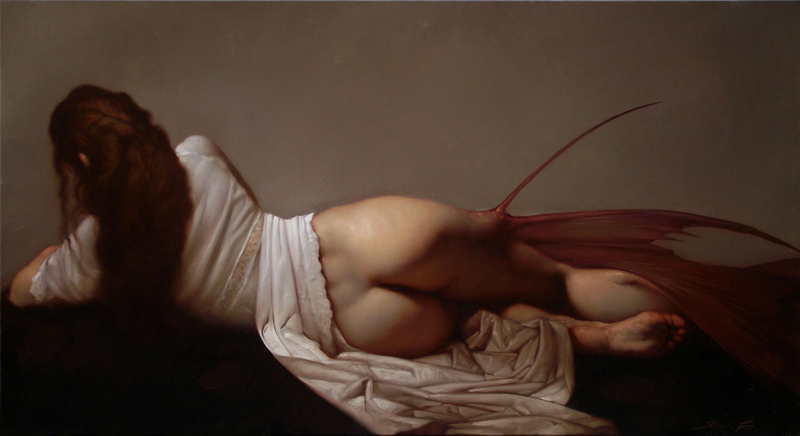
Roberto Ferri, (born 1978) 
Naiade, 2012
Oil on canvas
44 x 80 cm

In Greek mythology, the Naiads are a type of female spirit, or nymph, presiding over fountains, wells, springs, streams, brooks and other bodies of fresh water.

They are distinct from river gods, who embodied rivers, and the very ancient spirits that inhabited the still waters of marshes, ponds and lagoon-lakes, such as pre-Mycenaean Lerna in the Argolis.

Naiads were associated with fresh water, as the Oceanids were with saltwater and the Nereids specifically with the Mediterranean, but because the ancient Greeks thought of the world's waters as all one system, which percolated in from the sea in deep cavernous spaces within the earth, there was some overlap. Arethusa, the nymph of a spring, could make her way through subterranean flows from the Peloponnesus, to surface on the island of Sicily. More on Naiads

Roberto Ferri, (born 1978), see below

Roberto Ferri, (born 1978) 
Nereide, 2012
Oil on canvas
90-x-50-cm

In Greek mythology, the Nereids are sea nymphs. They often accompany Poseidon, the god of the sea, and can be friendly and helpful to sailors, like the Argonauts in their search for the Golden Fleece.

They symbolized everything that is beautiful and kind about the sea. Their melodious voices sang as they danced around their father. They are represented as very beautiful girls, crowned with branches of red coralt. They were part of Poseidon's entourage and carried his trident. More on the Nereids 

Roberto Ferri (born 1978) is an Italian artist and painter from Taranto, Italy, who is deeply inspired by Baroque painters (Caravaggio in particular) and other old masters of Romanticism, the Academy, and Symbolism. 

In 1996, he graduated from the Liceo Artistico Lisippo Taranto, a local art school in his hometown. He began to study painting on his own and moved to Rome in 1999, to increase research on ancient painting, beginning at the end of the 16th century, in particular. In 2006, he graduated with honors from the Academy of Fine Arts in Rome.

His work is represented in important private collections in Rome, Milan, London, Paris, New York, Madrid, Barcelona, Miami, San Antonio (Texas), Qatar, Dublin, Boston, Malta, and the Castle of Menerbes in Provence. His work was featured in the controversial Italian pavilion of the Venice Biennale 2011, and has exhibited at Palazzo Cini, Venice in the Kitsch Biennale 2010.  

Roberto Manetta, Italy
The Nymph of the Woods
Photography
59.1 H x 39.4 W x 15.7 in

A nymph in Greek mythology and in Latin mythology is a minor female nature deity typically associated with a particular location or landform. Different from other goddesses, nymphs are generally regarded as divine spirits who animate nature, and are usually depicted as beautiful, young nubile maidens who love to dance and sing; their amorous freedom sets them apart from the restricted and chaste wives and daughters of the Greek polis.

A dryad is a tree nymph, specifically the nymphs of oak trees. The dryads of ash trees were called the Meliai... More on Nymph of the Woods

Roberto Manetta is a traveling freelance photographer, Film and digital photography, since 1999. "No digital manipulation,only photography My passion comes from nature, adventure stories, fantasy films that have contributed phenomenally to my project ideas and the major part of my photographs. I am always very attentive, in all of my movements, in everything surrounding me. I often dream about adventures, fairy tales and mythological women. I look around at the objects surrounding me, with attention, searching for a link between a nude body more than a face. Geometric lines and original compositions are always at the centre of my attention when I launch upon a new project. I don’t really like the classic approach to nude photography. During the years I tried to maintain in all my productions a quality that re-conducted to classical photography, the one which is created without the need of much digital elaboration" More on Roberto Manetta

Roberto Manetta, Italy
Milky Nymph 
Photography
Size: 29.5 H x 19.7 W x 7.9 in

In Greek mythology, maenads were the female followers of Dionysus and the most significant members of the Thiasus, the god's retinue. Their name literally translates as "raving ones".

As Plato says in the Ion, the god-intoxicated celebrants draw milk and honey from the streams. They strike rocks with the thyrsus, and water gushes forth. They lower the thyrsus to the earth, and a spring of wine bubbles up. If they want milk, they scratch up the ground with their fingers and draw up the milky fluid. Honey trickles down from the thyrsus made of the wood of the ivy, they gird themselves with snakes and give suck to fawns and wolf cubs as if they were infants at the breast. More on the Milky Nymph

Roberto Manetta, Italy, see above


Images are copyright of their respective owners, assignees or others

We do not sell art, art prints, framed posters or reproductions. Ads are shown only to compensate the hosting expenses.


If you enjoyed this post, please share with friends and family.


06 Contemporary Interpretations, Olympian deities in classical Greek and Roman religion, with footnotes #2

Elle Hanley, United States
Venus
Photograph
24 H x 36 W x 0.1 in

The Birth of Venus. In Roman mythology, Venus was the goddess of love, sex, beauty, and fertility. She was the Roman counterpart to the Greek Aphrodite. However, Roman Venus had many abilities beyond the Greek Aphrodite; she was a goddess of victory, fertility, and even prostitution. According to Hesiod's Theogony, Aphrodite was born of the foam from the sea after Saturn (Greek Cronus) castrated his father Uranus (Ouranus) and his blood fell to the sea. This latter explanation appears to be more a popular theory due to the countless artworks depicting Venus rising from the sea in a clam. More The Birth of Venus

Elle Hanley is an american fine art photographer currently living and working in Seattle. her work is creative and varied focusing mainly on capturing beauty and emotion in a still shot of time.

She began photography two years ago as an artistic outlet and it grew into a full fledged devotion. She was drawn in particular to self portraiture for the control it gave over the image outcome and has since grown into a self portrait artist. Elle enjoys the challenges in creating something vintage and timeless from a thoroughly modern process and the contradiction between the two is a strong theme throughout her work.  More on Elle Hanley

Cy Twombly
Leda and the Swan, c. 1962
Oil, pencil, and crayon on canvas
6' 3" x 6' 6 3/4" (190.5 x 200 cm)
The Museum of Modern Art

Leda & the Swan, see below

Rome, Twombly's home since the 1950s, has nurtured his fascination with classical antiquity. In this work he refers to the Roman myth in which Jupiter, lord of the gods, takes the shape of a swan in order to ravish Leda, the beautiful mother of Helen (over whom the Trojan war would be fought). Twombly's version of this old art-historical theme supplies no contrast of feathers and flesh but a fusion of violent energies in furiously thrashing overlays of crayon, pencil, and ruddy paint. A few recognizable signs—hearts, a phallus—fly out from this explosion, in stark contrast to the sober windowlike rectangle near the top of the painting. More on this painting

Edwin Parker "Cy" Twombly Jr. (April 25, 1928 – July 5, 2011) was an American painter, sculptor and photographer. He belonged to the generation of Robert Rauschenberg and Jasper Johns but chose to live in Italy after 1957.

His paintings are predominantly large-scale, freely-scribbled, calligraphic and graffiti-like works on solid fields of mostly gray, tan, or off-white colors. Many of his works are in the permanent collections of most of the museums of modern art around the world

Many of his later paintings and works on paper shifted toward "romantic symbolism", and their titles can be interpreted visually through shapes and forms and words. Twombly often quoted the poets as Stéphane Mallarmé, Rainer Maria Rilke and John Keats, as well as many classical myths and allegories in his works.  Twombly is said to have influenced younger artists such as Jean-Michel Basquiat, Anselm Kiefer, Francesco Clemente, and Julian Schnabel. More om Edwin Parker "Cy" Twombly Jr.

Cathy Hegman
Preflight Icarus
Oil and wax on board
28 x 24 inches
Private collection

Icarus, see below

Cathy Hegman. "My art is my life both literally and physically. I am no longer sure where the paint ends and life begins or vice versa. I am for the most part a figurative painter.  I particularly have a penchant for painting the unknown, the parts of life and painting that simply refuse to be defined.    I paint figures that embody no particular persona, but are comprised of  bits, pieces and facets of those who have in some way marked my journey for either good or bad.  The amalgamated resulting figure is both familiar, strange, and often enigmatic.   The figure for the most part in my work is a two dimensional shape that integrates into and out of the background shapes. It is a pigmented push and pull of visual weight that seems to give the painting life without giving either a portrait or caricature of anyone. I most often prefer my forms to remain faceless, diffused and dimly lit..  I choose to employ loose open ended narratives in my work, I want to leave options for the viewer." Cathy Hegman 2016


Marco Battaglini, Costa Rica
Sex Stop Global Warming
Airbrush, Acrylic and Digital on Canvas
Private collection

Marco Battaglini is an artist based in San Jose, Costa Rica. Through a subtle interplay of multiple realities overlapping in the chronotope, Battaglini evidences the contradictions in mental models about the temporal contrast (chronological), and the cultural and linguistic barriers.

Compositions which at first seem 'logical', immediately reveal temporal and spatial limitations that are disruptive in the interpretation of reality. More on this painting

Costa Rican artist Marco Battaglini uses his artwork to explore the evolution of culture and knowledge. In some works, he combines classical paintings with modern pop-art references and graffiti for a modern renaissance look.  While the imagery appears almost collaged at first glance, looking at the paintings I find subtle details that really add to the ideas behind the pieces, like finding brand names tattooed on the cherubic figures that frequent these scenes. More on Marco Battaglini 


Rafael Roa
The Icarus' s daughter in four pieces, c. 1966
4 pieces of Polaroid 50 × 60 cm
Private collection

Icarus. In Greek mythology, Icarus is the son of the master craftsman Daedalus, the creator of the Labyrinth. Often depicted in art, Icarus and his father attempt to escape from Crete by means of wings that his father constructed from feathers and wax. Icarus' father warns him first of complacency and then of hubris, asking that he fly neither too low nor too high, so the sea's dampness would not clog his wings or the sun's heat melt them. Icarus ignored his father's instructions not to fly too close to the sun; when the wax in his wings melted he tumbled out of the sky and fell into the sea where he drowned. More on Icarus

Rafael Roa is a self-taught photographer and experimental video artist; in the early 80s he co-founded in Madrid the Image Gallery, dedicated to photography.

Since 1988 he works as a photographer and video artist, exhibiting their creations in these disciplines since 2005. He has specialized in fashion, portrait, corporate photography and advertising campaigns and has worked for the best brands and published in media such as Vogue, Elle, El País Semanal, Cosmopolitan, among others.

He has extensive experience as a teacher of university courses and teacher’s training courses in the area of the image. He currently teaches at the school PIC.A. Rafael is an expert in history of photography and video creation, teaches numerous workshops of these subjects in public and private institutions and universities.

Rafael Roa’s work has been awarded with the First Prize Scholarship Workshops of Contemporary Art (Granada, 1986), the Second FotoPres Award in the category of “Sports” (1990) and the Prize of the First Biennial of Contemporary Art Chapingo (Mexico City , 2008). His work is in the permanent collections of the Valencian Institute of Modern Art, the Andalusian Center of Photography (Almería) and the National Center for Contemporary Arts in Moscow (Russia). More om Rafael Roa 

Francesca Woodman
Leda and The Swan 
Private collection


Leda, in Greek legend, usually believed to be the daughter of Thestius, king of Aetolia, and wife of Tyndareus, king of Lacedaemon. She was also believed to have been the mother (by Zeus, who had approached and seduced her in the form of a swan) of the other twin, Pollux, and of Helen, both of whom hatched from eggs. Variant legends gave divine parentage to both the twins and possibly also to Clytemnestra, with all three of them having hatched from the eggs of Leda, while yet other legends say that Leda bore the twins to her mortal husband, Tyndareus. Still other variants say that Leda may have hatched out Helen from an egg laid by the goddess Nemesis, who was similarly approached by Zeus in the form of a swan.The divine swan’s encounter with Leda was a subject depicted by both ancient Greek and Italian Renaissance artists; Leonardo da Vinci undertook a painting (now lost) of the theme, and Correggio’s Leda (c. 1530s) is a well-known treatment of the subject. More Leda and The Swan

Francesca Stern Woodman (April 3, 1958 – January 19, 1981) was an American photographer best known for her black and white pictures featuring either herself or female models. Many of her photographs show young women who are nude, blurred (due to movement and long exposure times), merging with their surroundings, or whose faces are obscured. Her work continues to be the subject of much critical acclaim and attention, years after she died by suicide at the age of 22, in 1981. More Francesca Stern Woodman


Jan Saudek
Roman Charity
Photography
Private collection

Roman Charity is the exemplary story of a woman, Pero, who secretly breastfeeds her father, Cimon, after he is incarcerated and sentenced to death by starvation. She is found out by a jailer, but her act of selflessness impresses officials and wins her father's release.

The story is recorded by the ancient Roman historian Valerius Maximus, and was presented as a great act of filial piety and Roman honour. A painting in the Temple of Pietas depicted the scene. Among Romans, the theme had mythological echoes in Juno's breastfeeding of the adult Hercules, an Etruscan myth. More on Roman Charity

Jan Saudek (born 13 May 1935 in Prague, Czechoslovakia) is a Czech art photographer and painter. Saudek's was a Jew and his family to become a target of the Nazis. Many of his family died in Theresienstadt concentration camp during World War II.

According to Saudeks's biography, he got his first camera, a Kodak Baby Brownie, in 1950. He apprenticed to a photographer and in 1952 started working as a print shop worker, where he worked until 1983. In 1959, he started painting and drawing. After completing his military service, he was inspired in 1963 by the catalogue for Edward Steichen's The Family of Man exhibition, to try to become a serious art photographer. In 1969, he traveled to the United States and was encouraged in his work by curator Hugh Edwards.


Returning to Prague, he was forced to work in a clandestine manner in a cellar, to avoid the attentions of the secret police, as his work turned to themes of personal erotic freedom, and used implicitly political symbols of corruption and innocence. From the late 1970s, he became recognized in the West as the leading Czech photographer. In 1983, the first book of his work was published in the English-speaking world. The same year, he became a freelance photographer as the Czech Communist authorities allowed him to cease working in the print shop, and gave him permission to apply for a permit to work as an artist. More Jan Saudek

Roberto Manetta, Italy
Dancing mermaid
Photography
39.4 H x 27.6 W x 11.8 in

A mermaid is a legendary aquatic creature with the head and upper body of a female human and the tail of a fish. Mermaids appear in the folklore of many cultures worldwide, including the Near East, Europe, Africa and Asia. The first stories appeared in ancient Assyria, in which the goddess Atargatis transformed herself into a mermaid out of shame for accidentally killing her human lover. Mermaids are sometimes associated with perilous events such as floods, storms, shipwrecks and drownings. In other folk traditions (or sometimes within the same tradition), they can be benevolent or beneficent, bestowing boons or falling in love with humans.

Some of the attributes of mermaids may have been influenced by the Sirens of Greek mythology. More on mermaids

Roberto Manetta is a traveling freelance photographer, Film and digital photography, since 1999. "No digital manipulation,only photography My passion comes from nature, adventure stories, fantasy films that have contributed phenomenally to my project ideas and the major part of my photographs. I am always very attentive, in all of my movements, in everything surrounding me. I often dream about adventures, fairy tales and mythological women. I look around at the objects surrounding me, with attention, searching for a link between a nude body more than a face. Geometric lines and original compositions are always at the centre of my attention when I launch upon a new project. I don’t really like the classic approach to nude photography. During the years I tried to maintain in all my productions a quality that re-conducted to classical photography, the one which is created without the need of much digital elaboration" More on Roberto Manetta


Images are copyright of their respective owners, assignees or others

We do not sell art prints, framed posters or reproductions. Ads are shown only to compensate the hosting expenses.

If you enjoyed this post, please share with friends and family.