Showing posts with label Apollo. Show all posts

05 Contemporary Interpretations, Olympian deities in classical Greek and Roman religion, with footnotes #3

Odilon Redon, (French, Bordeaux 1840–1916 Paris)
The Chariot of Apollo, c. 1905–16
Oil on canvas
26 x 32 in. (66 x 81.3 cm)
The Metropolitan Museum of Art

About 1900 Redon abandoned his trademark black charcoal drawings and began avidly experimenting with color. He also explored new subjects, including the mythological horses of the sun, driven by Apollo, god of light and poetry; or by Phaethon, the boy who foolishly tried to steer the horses and fell to his death. Redon made over thirty depictions of the motif in oil, pastel, and pencil. In this version he omitted any indication of a ground plane, so that the horses and charioteer appear to race across a boundless sky. More on this painting

Apollo is one of the most important and complex of the Olympian deities in classical Greek and Roman religion, and Greek and Roman mythology. Apollo has been variously recognized as a god of music, truth and prophecy, healing, the sun and light, plague, poetry, and more. Apollo is the son of Zeus and Leto, and has a twin sister, the chaste huntress Artemis.

As the patron of Delphi (Pythian Apollo), Apollo was an oracular god—the prophetic deity of the Delphic Oracle. Medicine and healing are associated with Apollo, whether through the god himself or mediated through his son Asclepius, yet Apollo was also seen as a god who could bring ill-health and deadly plague. Amongst the god's custodial charges, Apollo became associated with dominion over colonists, and as the patron defender of herds and flocks. As the leader of the Muses (Apollon Musegetes) and director of their choir, Apollo functioned as the patron god of music and poetry.

In Hellenistic times, especially during the 3rd century BCE, as Apollo Helios he became identified among Greeks with Helios, Titan god of the sun, and his sister Artemis similarly equated with Selene, Titan goddess of the moon. More on Apollo

Bertrand-Jean Redon better known as Odilon Redon (April 20, 1840 - July 6, 1916) was a Symbolist painter and printmaker, born in Bordeaux, Aquitaine, France. Odilon was a nickname derived from his mother, Odile.

Redon started drawing as a young child, and at the age of 10 he was awarded a drawing prize at school. At age 15, he began formal study in drawing but on the insistence of his father he switched to architecture. His failure to pass the entrance exams at Paris' Ecole des Beaux-Arts ended any plans for a career as an architect, although he would later study there under Jean-Leon Gerome.

He took up sculpture, and Rodolphe Bresdin instructed him in etching and lithography. His artistic career was interrupted in 1870 when he joined the army to serve in the Franco-Prussian War.

At the end of the war, he moved to Paris, working almost exclusively in charcoal and lithography. It would not be until 1878 that his work gained any recognition with Guardian Spirit of the Waters, and he published his first album of lithographs.

In the 1890s, he began to use pastel and oils, which dominated his works for the rest of his life. In 1899, he exhibited with the Nabis at Durand-Ruel's. In 1903 he was awarded the Legion of Honor. His popularity increased when a catalogue of etchings and lithographs was published by Andre Mellerio in 1913 and that same year, he was given the largest single representation at the New York Armory Show.  More on Bertrand-Jean Redon

Roberto Ferri, (born 1978) 
Naiade, 2012
Oil on canvas
44 x 80 cm

In Greek mythology, the Naiads are a type of female spirit, or nymph, presiding over fountains, wells, springs, streams, brooks and other bodies of fresh water.

They are distinct from river gods, who embodied rivers, and the very ancient spirits that inhabited the still waters of marshes, ponds and lagoon-lakes, such as pre-Mycenaean Lerna in the Argolis.

Naiads were associated with fresh water, as the Oceanids were with saltwater and the Nereids specifically with the Mediterranean, but because the ancient Greeks thought of the world's waters as all one system, which percolated in from the sea in deep cavernous spaces within the earth, there was some overlap. Arethusa, the nymph of a spring, could make her way through subterranean flows from the Peloponnesus, to surface on the island of Sicily. More on Naiads

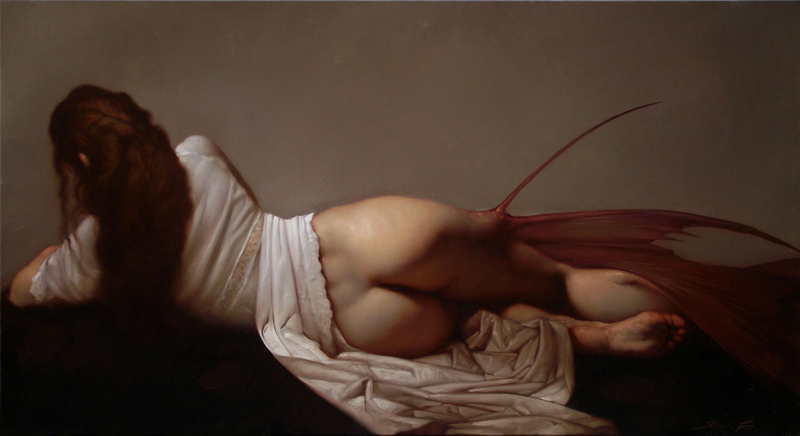
Roberto Ferri, (born 1978), see below

Roberto Ferri, (born 1978) 
Nereide, 2012
Oil on canvas
90-x-50-cm

In Greek mythology, the Nereids are sea nymphs. They often accompany Poseidon, the god of the sea, and can be friendly and helpful to sailors, like the Argonauts in their search for the Golden Fleece.

They symbolized everything that is beautiful and kind about the sea. Their melodious voices sang as they danced around their father. They are represented as very beautiful girls, crowned with branches of red coralt. They were part of Poseidon's entourage and carried his trident. More on the Nereids 

Roberto Ferri (born 1978) is an Italian artist and painter from Taranto, Italy, who is deeply inspired by Baroque painters (Caravaggio in particular) and other old masters of Romanticism, the Academy, and Symbolism. 

In 1996, he graduated from the Liceo Artistico Lisippo Taranto, a local art school in his hometown. He began to study painting on his own and moved to Rome in 1999, to increase research on ancient painting, beginning at the end of the 16th century, in particular. In 2006, he graduated with honors from the Academy of Fine Arts in Rome.

His work is represented in important private collections in Rome, Milan, London, Paris, New York, Madrid, Barcelona, Miami, San Antonio (Texas), Qatar, Dublin, Boston, Malta, and the Castle of Menerbes in Provence. His work was featured in the controversial Italian pavilion of the Venice Biennale 2011, and has exhibited at Palazzo Cini, Venice in the Kitsch Biennale 2010.  

Roberto Manetta, Italy
The Nymph of the Woods
Photography
59.1 H x 39.4 W x 15.7 in

A nymph in Greek mythology and in Latin mythology is a minor female nature deity typically associated with a particular location or landform. Different from other goddesses, nymphs are generally regarded as divine spirits who animate nature, and are usually depicted as beautiful, young nubile maidens who love to dance and sing; their amorous freedom sets them apart from the restricted and chaste wives and daughters of the Greek polis.

A dryad is a tree nymph, specifically the nymphs of oak trees. The dryads of ash trees were called the Meliai... More on Nymph of the Woods

Roberto Manetta is a traveling freelance photographer, Film and digital photography, since 1999. "No digital manipulation,only photography My passion comes from nature, adventure stories, fantasy films that have contributed phenomenally to my project ideas and the major part of my photographs. I am always very attentive, in all of my movements, in everything surrounding me. I often dream about adventures, fairy tales and mythological women. I look around at the objects surrounding me, with attention, searching for a link between a nude body more than a face. Geometric lines and original compositions are always at the centre of my attention when I launch upon a new project. I don’t really like the classic approach to nude photography. During the years I tried to maintain in all my productions a quality that re-conducted to classical photography, the one which is created without the need of much digital elaboration" More on Roberto Manetta

Roberto Manetta, Italy
Milky Nymph 
Photography
Size: 29.5 H x 19.7 W x 7.9 in

In Greek mythology, maenads were the female followers of Dionysus and the most significant members of the Thiasus, the god's retinue. Their name literally translates as "raving ones".

As Plato says in the Ion, the god-intoxicated celebrants draw milk and honey from the streams. They strike rocks with the thyrsus, and water gushes forth. They lower the thyrsus to the earth, and a spring of wine bubbles up. If they want milk, they scratch up the ground with their fingers and draw up the milky fluid. Honey trickles down from the thyrsus made of the wood of the ivy, they gird themselves with snakes and give suck to fawns and wolf cubs as if they were infants at the breast. More on the Milky Nymph

Roberto Manetta, Italy, see above


Images are copyright of their respective owners, assignees or others

We do not sell art, art prints, framed posters or reproductions. Ads are shown only to compensate the hosting expenses.


If you enjoyed this post, please share with friends and family.


13 Olympian deities, Classical Sculpture of Greek and Roman religion, Sculpture, with footnotes, 1

Cart of Dionysus 
Dionysus with maenad on the two panthers drawn wagon with Cupid
Marble Relief
62 x 120 cm

Dionysus  is the god of the grape harvest, winemaking and wine, of ritual madness, fertility, theatre and religious ecstasy in Greek mythology. Wine played an important role in Greek culture with the cult of Dionysus the main religious focus for unrestrained consumption. He may have been worshipped as early as c. 1500–1100 BC by Mycenean Greeks; other traces of the Dionysian-type cult have been found in ancient Minoan Crete. His origins are uncertain, and his cults took many forms; some are described by ancient sources as Thracian, others as Greek. In some cults, he arrives from the east, as an Asiatic foreigner; in others, from Ethiopia in the South. He is a god of epiphany, "the god that comes", and his "foreignness" as an arriving outsider-god may be inherent and essential to his cults. He is a major, popular figure of Greek mythology and religion, becoming increasingly important over time, and is included in some lists of the twelve Olympians. Dionysus was the last god to be accepted into Mt. Olympus. He was the youngest and the only one to have a mortal mother. His festivals were the driving force behind the development of Greek theatre. He is sometimes categorised as a dying-and-rising god. More

Antonio Canova, (1 November 1757 – 13 October 1822)
Medusa
WITH GOLDEN ACCENTS
10"H

In Greek mythology Medusa was a monster, a Gorgon, generally described as a winged human female with a hideous face and living venomous snakes in place of hair. Gazers on her face would turn to stone. She lived and died on an island named Sarpedon, somewhere near Cisthene. The 2nd-century BCE novelist Dionysios Skytobrachion puts her somewhere in Libya, where Herodotus had said the Berbers originated her myth, as part of their religion.

Medusa was beheaded by the hero Perseus, who thereafter used her head, which retained its ability to turn onlookers to stone, as a weapon until he gave it to the goddess Athena to place on her shield. In classical antiquity the image of the head of Medusa appeared in the evil-averting device known as the Gorgoneion. More

Antonio Canova 1 November 1757 – 13 October 1822) was an Italian neoclassical sculptor, famous for his marble sculptures. Often regarded as the greatest of the neoclassical artists,[4] his artwork was inspired by the Baroque and the classical revival, but avoided the melodramatics of the former, and the cold artificiality of the latter. More

Hanno Edelmann, Hamburg 1923 - 2013 
 'Philemon and Baucis' , c. 1980
Bronze with brown patina,
h. 22, 5 cm, 

In Ovid's moralizing fable which stands on the periphery of Greek mythology and Roman mythology, Baucis and Philemon were an old married couple in the region of Tyana, which Ovid places in Phrygia, and the only ones in their town to welcome disguised gods Zeus and Hermes, thus embodying the pious exercise of hospitality, the ritualized guest-friendship termed xenia, or theoxenia when a god was involved. More

Edelmann shows the aged couple Philemon and Baucis as symbol of deep love and attachment till death.

Hanno Edelmann, Hamburg 1923 - 2013 was a painter, a graphic artist and a sculptor He began his apprenticeship as a lithographer, after the war he studied at the Hamburg academy under W. Grimm a. I. Hauptmann, in contrast to contemporary trends he adhered to figurative art, study trips to Spain and Greece enriched his paintings with the glowing colours of the South. Since 1980 he turned his focus towards sculptural design.

A Roman Marble Head of Sarapis, circa 2nd Century A.D.
Based on a cult statue in Alexandria created by Bryaxis in the late 4th Century B.C
Height 28 cm. 11 in.

Serapis is a Graeco-Egyptian god. The cult of Serapis was introduced during the 3rd century BC on the orders of Ptolemy I of Egypt as a means to unify the Greeks and Egyptians in his realm. The cultus of Serapis was spread as a matter of deliberate policy by the Ptolemaic kings, who also built an immense serapeum in Alexandria.

However, there is evidence which implies that the cult of Serapis existed before the Ptolemies came to power in Alexandria – a temple of Sarapis (or Roman Serapis) in Egypt is mentioned in 323. The common assertion that Ptolemy "created" the deity is derived from sources which describe him erecting a statue of Sarapis in Alexandria: this statue enriched the texture of the Sarapis conception by portraying him in both Egyptian and Greek style. Sarapis was a syncretistic deity derived from the worship of the Egyptian Osiris and Apis, and also gained attributes from other deities, such as chthonic powers linked to the Greek Hades and Demeter, and benevolence linked to Dionysus.


Serapis continued to increase in popularity during the Roman period, often replacing Osiris as the consort of Isis in temples outside Egypt. In 389, a Christian mob led by the Patriarch Theophilus of Alexandria destroyed the Alexandrian serapeum, but the cult survived until all forms of pagan religion were suppressed under Theodosius I in 391. More

A Roman Marble Herm Bust of Hermes, circa 2nd Century A.D.
Height 37.5 cm. 14 3/4 in

Hermes is an Olympian god in Greek religion and mythology, the son of Zeus and the Pleiad Maia, and the second youngest of the Olympian gods.

Hermes is considered a god of transitions and boundaries. He is described as quick and cunning, moving freely between the worlds of the mortal and divine. He is also portrayed as an emissary and messenger of the gods; an intercessor between mortals and the divine, and conductor of souls into the afterlife. He has been viewed as the protector and patron of herdsmen, thieves, oratory and wit, literature and poetry, athletics and sports, invention and trade, roads, boundaries and travelers.

In some myths, he is a trickster and outwits other gods for his own satisfaction or for the sake of humankind. His attributes and symbols include the herma, the rooster, the tortoise, purse or pouch, winged sandals, and winged cap. His main symbol is the Greek kerykeion or Latin caduceus, which appears in a form of two snakes wrapped around a winged staff.

In the Roman adaptation of the Greek pantheon Hermes is identified with the Roman god Mercury, who, though inherited from the Etruscans, developed many similar characteristics such as being the patron of commerce. More

A Roman Marble Head of a Boy, probably Hermes, circa late 2nd Century A.D.
Height 19 cm. 7 1/4 in.

Hermes, circa 2nd Century A.D., see above

A Roman Marble Head of a Bearded God, probably Asklepios,
circa late 2nd Century A.D
height 26 cm. 10 1/4 in.

Asclepius was a hero and god of medicine in ancient Greek religion and mythology. Asclepius represents the healing aspect of the medical arts. He was associated with the Roman/Etruscan god Vediovis and the Egyptian Imhotep. He was one of Apollo's sons, sharing with Apollo the epithet Paean ("the Healer"). The rod of Asclepius, a snake-entwined staff, remains a symbol of medicine today. Those physicians and attendants who served this god were known as the Therapeutae of Asclepius. More

A Roman Marble Votive Stele of Asklepios, perhaps Gallo-Roman, 
2nd/3rd Century A.D.
Height 27 cm. 10 1/2 in.

Asklepios, see above

A Roman Marble Figure of Asklepios, circa 3rd Century A.D.
 height 50 cm. 19 11/16 in.
found in the 19th Century at Kyzikos on the Propontis in ancient Mysia

Asklepios, see above

Roman Marble Head of Apollo, circa 2nd Century A.D.
 height 16 cm. 6 5/16 in.
Found in 1916 at Sezze in Lazio

Apollo is one of the most important and complex of the Olympian deities in classical Greek and Roman religion, and Greek and Roman mythology. Apollo has been variously recognized as a god of music, truth and prophecy, healing, the sun and light, plague, poetry, and more. Apollo is the son of Zeus and Leto, and has a twin sister, the chaste huntress Artemis.

As the patron of Delphi (Pythian Apollo), Apollo was an oracular god—the prophetic deity of the Delphic Oracle. Medicine and healing are associated with Apollo, whether through the god himself or mediated through his son Asclepius, yet Apollo was also seen as a god who could bring ill-health and deadly plague. Amongst the god's custodial charges, Apollo became associated with dominion over colonists, and as the patron defender of herds and flocks. As the leader of the Muses (Apollon Musegetes) and director of their choir, Apollo functioned as the patron god of music and poetry. 

In Hellenistic times, especially during the 3rd century BCE, as Apollo Helios he became identified among Greeks with Helios, Titan god of the sun, and his sister Artemis similarly equated with Selene, Titan goddess of the moon. More


A Roman Marble Head of Dionysos, circa 2nd Century A.D.
Height 28 cm. 11 in.
Found at the base of a pedestal in the gardens of the Château de la Mauvoisinière

Dionysus is the god of the grape harvest, winemaking and wine, of ritual madness, fertility, theatre and religious ecstasy in Greek mythology. Alcohol, especially wine, played an important role in Greek culture with Dionysus being an important reason for this life style. His name shows that he may have been worshipped as early as c. 1500–1100 BC by Mycenean Greeks; other traces of the Dionysian-type cult have been found in ancient Minoan Crete. 

In some cults, he arrives from the east, as an Asiatic foreigner; in others, from Ethiopia in the South. He is a god of epiphany, "the god that comes", and his "foreignness" as an arriving outsider-god. Dionysus was the last god to be accepted into Mt. Olympus. He was the youngest and the only one to have a mortal mother.[ His festivals were the driving force behind the development of Greek theatre. Modern scholarship categorises him as a dying-and-rising god.

The earliest cult images of Dionysus show a mature male, bearded and robed. He holds a fennel staff, tipped with a pine-cone and known as a thyrsus. Later images show him as a beardless, sensuous, naked or half-naked androgynous youth: the literature describes him as womanly or "man-womanish". His procession (thiasus) is made up of wild female followers (maenads) and bearded satyrs with erect penises. Some are armed with the thyrsus, some dance or play music. The god himself is drawn in a chariot, usually by exotic beasts such as lions or tigers. This procession is presumed to be the cult model for the human followers of his Dionysian Mysteries. In his Thracian mysteries, he wears the bassaris or fox-skin, symbolizing a new life. Dionysus is represented by city religions as the protector of those who do not belong to conventional society.

Also known as Bacchus, the name adopted by the Romans. His thyrsus is sometimes wound with ivy and dripping with honey. It is a beneficent wand but also a weapon, and can be used to destroy those who oppose his cult and the freedoms he represents. He is also called the liberator, whose wine, music and ecstatic dance frees his followers from self-conscious. His cult is also a "cult of the souls"; his maenads feed the dead through blood-offerings, and he acts as a divine communicant between the living and the dead.

In Greek mythology, he is presented as a son of Zeus and the mortal Semele, thus semi-divine or heroic: and as son of Zeus and Persephone or Demeter, thus both fully divine. Some scholars believe that Dionysus is a syncretism of a local Greek nature deity and a more powerful god from Thrace or Phrygia such as Sabazios or Zalmoxis. More

A Roman Marble Dionysiac Relief, circa A.D. 170-180
28.5 by 71.5 cm. 11 1/4 by 28 1/8 in

From left to right with a satyr ( male companions of Dionysus) resting his foot on a cista mystica (A box or basket used by the ancient Egyptians, Greeks, Etruscans and Romans for various practical and mystical purposes.), an erote (winged god associated with love and sex in Greek mythology) peeking in, Pan (god of the wild, shepherds and flocks) standing behind, a manead ( female followers of Dionysus) playing the double flute, striding Silenus (companion and tutor to the wine god Dionysus) hunched over on a fragmentary staff, a satyr carrying an animal on his shoulders, a maenad holding a tympanon, and a satyr holding a krater; 

A Marble Votive Figure of Kybele, Late Hellenistic or Early Roman Imperial, Circa 1st Century B.C./1st Century A.D.
Height 18 cm. 7 1/8 in.

Enthroned with her feet on a footrest, and holding a bowl in her right hand and formerly a tympanum in her now missing left hand, and wearing a girdled chiton and himation falling from her left shoulder and draped over her lap, her long hair surmounted by a polos, a seated lion to her right.

Cybele is an Anatolian (Asia Minor) mother goddess, and Phrygia's (west central part of  Turkey) only known goddess; probably its state deity. Her Phrygian cult was adopted and adapted by Greek colonists of Asia Minor and spread to mainland Greece and its more distant western colonies around the 6th century BCE.

In Greece, Cybele met with a mixed reception. Some city-states, notably Athens, evoked her as a protector, but her most celebrated Greek rites and processions show her as an essentially foreign, exotic mystery-goddess who arrives in a lion-drawn chariot to the accompaniment of wild music, wine, and a disorderly, ecstatic following. Many of her Greek cults included rites to a divine Phrygian castrate shepherd-consort Attis (god of vegetation), who was probably a Greek invention. In Greece, Cybele is associated with mountains, town and city walls, fertile nature, and wild animals, especially lions.

In Rome, Cybele was known as Magna Mater ("Great Mother"). The Roman State adopted and developed a particular form of her cult after the Sibylline oracle recommended her conscription as a key religious component in Rome's second war against Carthage. Roman mythographers reinvented her as a Trojan goddess, and thus an ancestral goddess of the Roman people by way of the Trojan prince Aeneas. With Rome's eventual hegemony over the Mediterranean world, Romanised forms of Cybele's cults spread throughout the Roman Empire. More

A Roman Marble Figure of Pan Playing the Flute, circa 2nd Century A.D.
Height 43 cm. 17 in.

His face with long unruly beard, smiling mouth preserving the tip of his flute, gnarled brow, and pointed ears, and wearing an animal skin knotted at the waist,

Pan was the god of the wild, hunting and companion of the nymphs. He was depicted as being half human, while having the legs and horns of a goat, just like a faun; his Roman counterpart was Faunus. 

There were no temples attributed to Pan, but he was rather worshipped in natural settings such as caves. It was believed that he often chased nymphs in order to seduce them, but he was always turned down due to his ugly appearance. More

A Roman Marble Figure of Eros with the Attributes of Herakles, 
circa 2nd Century A.D.
Height 90 cm. 35 7/16 in

The statue belongs to a statuary type of Eros. The original is dated to the late Hellenistic period. Other copies prove that the original showed the boy riding on a dolphin. In the present case, the sculptor changed the boy’s seat and added the lion skin, an attribute of Herakles. Depicting Eros as Herakles was not uncommon in Roman times. The attributes of the hero symbolize the power of the god of love.

Eros was the Greek god of love. His Roman counterpart was Cupid[4] ("desire"). Some myths make him a primordial god, while in other myths, he is the son of Aphrodite. He was one of the winged love gods, Erotes. More

A Roman Marble Relief of Mithras Slaying the Bull, 2nd/early 3rd Century A.D.
84.5 by 127.5 cm. 33 1/4 by 50 1/4 in.

Mithras pinning the bull to the ground, pulling its head back, and plunging his knife into its forequarter, the god with head turned back and billowing mantle, flanked by diminutive figures of Cautes on the left holding a downward-turned torch, and of Cautopates on the right holding an upright torch, all wearing Eastern dress, a dog attacking the bull in front and a scorpion and serpent biting at its genitals, a bust of Sol accompanied by a raven in the upper left corner, another of Selene in the right corner.

Mithraism was a mystery religion centred around the god Mithras that was practised in the Roman Empire. The religion was inspired by Persian worship of the god Mithra.

Worshippers of Mithras had a complex system of seven grades of initiation, with ritual meals. Initiates called themselves syndexioi, those "united by the handshake". They met in underground temples which survive in large numbers. The cult appears to have had its centre in Rome.

The Romans regarded the Mithraism as having Persian or Zoroastrian sources. Since the early 1970s the dominant scholarship has noted dissimilarities between Persian Mithra-worship and the Roman Mithraic mysteries. In this context, Mithraism has sometimes been viewed as a rival of early Christianity with similarities such as liberator-saviour, hierarchy of adepts (archbishops, bishops, priests), communal meal and a hard struggle of Good and Evil. More


Images are copyright of their respective owners, assignees or others

Acknowledgement: Sotheby's Auktionshaus Stahl,

15 works - Olympian deities in classical Greek and Roman religion. Know Their Stories

Anthonie van Dyck,
Venus in the Forge of Vulcan
Oil on wood. 32.5 x 21 cm.

Sir Anthony van Dyck (22 March 1599 – 9 December 1641) was a Flemish Baroque artist who became the leading court painter in England, after enjoying great success in Italy and Flanders. He is most famous for his portraits of Charles I of England and his family and court, painted with a relaxed elegance that was to be the dominant influence on English portrait-painting for the next 150 years. He also painted biblical and mythological subjects, displayed outstanding facility as a draughtsman, and was an important innovator in watercolour and etching.

Venus went to her husband Vulcan's forge and asked him to make arms for her son Aeneas. On the right are two Cyclopes who have made the armor under Vulcan's direction. 

Dutch School, 17th Century
An offering to the Goddess Diana
oil on canvas
20 x 34 ¼ in. (50.8 x 87 cm.)

The Dutch School were painters in the Netherlands from the early Renaissance to the Baroque. It includes Early Netherlandish (1400–1500) and Dutch Renaissance (1500–1584) artists active in the northern Low Countries and, later, Dutch Golden Age painting in the United Provinces.

The festival for Diana, (aka Festival of Torches) was celebrated by the ancient Romans either on 13–15 August or on the August Full Moon, in honor of the goddess Diana. This festival was later adopted by Catholics as The Feast of the Assumption.

On this day, worshippers would form a shimmering procession of torches and candles around the dark waters of Lake Nemi, Diana's Mirror, wearing wreaths of flowers. The lights of their candles join the light of the moon, dancing in reflection upon the surface of the water.

Alessandro Allori (Florence 1535-1607)
Laocoön
oil on panel
28 5/8 x 22¼ in. (72.7 x 56.5 cm.)

Alessandro di Cristofano di Lorenzo del Bronzino Allori (Florence, 31 May 1535 – 22 September 1607) was an Italian portrait painter of the late Mannerist Florentine school.

In 1540, after the death of his father, he was brought up and trained in art by a close friend, often referred to as his 'uncle', the mannerist painter Agnolo Bronzino, whose name he sometimes assumed in his pictures. In some ways, Allori is the last of the line of prominent Florentine painters, of generally undiluted Tuscan artistic heritage.

Laocoön is the son of Acoetes, a figure in Greek and Roman mythology and the Epic Cycle. He was a Trojan priest who was attacked, with his two sons, by giant serpents sent by the gods. Though not mentioned by Homer, the story of Laocoön had been the subject of a tragedy, now lost, by Sophocles and was mentioned by other Greek writers, though the events around the attack by the serpents vary considerably. The most famous account of these is now in Virgil's Aeneid where Laocoön was a priest of Poseidon (or Neptune for the Romans), who was killed with both his sons after attempting to expose the ruse of the Trojan Horse by striking it with a spear.

Jan van Noordt (Amsterdam 1620-1676)
Nymphs and a Satyr

oil on canvas
32 5/8 x 26 3/8 in. (83 x 66.9 cm.)

Jan van Noordt lived on the Bloemgracht in Amsterdam in 1674. He was the teacher of the painter Johannes Voorhout and is known for italianate landscapes, portraits, and historical allegories

Roman Alabaster Head of Serapis. Roman Empire, ca. 1st to 2nd century CE. Finely sculpted head of Serapis. Serapis was a Graeco-Egyptian god who first appeared around the time of Alexander the Great. Sculpture is shown with thick, wavy locks framing his face, and a full beard and moustache. Size: 2-7/8" H.

A Hellenistic Marble Torso of Aphrodite, circa 2nd Century B.C.
of the type called Aphrodite Anadyomene, of graceful form standing with her weight on the left leg, her right arm and left forearm formerly raised  to arrange her hair, part of a tress remaining on her right shoulder.
Aphrodite was born from the sea, and after she emerged, wrung the sea foam from her hair and tied it in a bun.
Height 13 in. 33 cm.

A Marble Torso of a Nymph, Roman Imperial, circa 2nd Century A.D.
standing with her legs crossed and right arm raised, the large hand of a satyr(?) pressing the folds of her mantle against her upper back and left shoulder in a mighty embrace, remains of a support against her right buttock.
Height 13 3/4 in. 34.9 cm


Charles Joseph Natoire (attributed to) 
Untitled (Baccanale)
Medium: Oil on Canvas
Size: Approx. 40.6 x 50.8 centimeters 16" x 20" inches
Date: 1780 circa

Charles-Joseph Natoire (3 March 1700 – 23 August 1777) was a French painter in the Rococo manner, a pupil of François Lemoyne and director of the French Academy in Rome, 1751-1775. Considered during his lifetime the equal of François Boucher, he played a prominent role in the artistic life of France.

He is remembered above all for the series of the History of Psyche for Germain Boffrand's oval salon de la Princesse in the Hôtel de Soubise, Paris, and for the tapestry cartoons for the series of the History of Don Quixote, woven at the Beauvais tapestry manufacture, most of which are at the Château de Compiègne.

Old Master German Baroque,  
The Three Graces
Medium: Oil on wood panel
Size: 21" x 26" Approximate
Date: 17th century

The mythological three Graces, daughters of Zeus – identified on some engravings of the statue as, from left to right, Euphrosyne, Aglaea and Thalia - who were said to represent beauty, charm and joy. The Graces presided over banquets and gatherings primarily to entertain and delight the guests of the gods.

1700 Nîmes - 1777 Castel Gandolfo - circle
Venus and Mars in the Smithy of the Volcano
Oil on canvas. Relined. 104 x 129cm.

Venus had two main divine lovers: her husband Vulcan and Mars. There is a myth concerning Venus' and Mars' love affair and how Vulcan cunningly trapped them in bed.

Charles-Joseph Natoire (3 March 1700 – 23 August 1777) was a French painter in the Rococo manner, a pupil of François Lemoyne and director of the French Academy in Rome, 1751-1775. Considered during his lifetime the equal of François Boucher, he played a prominent role in the artistic life of France.

He is remembered above all for the series of the History of Psyche for Germain Boffrand's oval salon de la Princesse in the Hôtel de Soubise, Paris, and for the tapestry cartoons for the series of the History of Don Quixote, woven at the Beauvais tapestry manufacture, most of which are at the Château de Compiègne.

Venus and Mars
1688 Düsseldorf
Oil on wood. Parqueted. 21,5 x 27cm. Inscribed lower left: B Douven

The subject of this painting is an episode from classical literature about the loves of the gods. Mars, the god of war, falls in love with Venus and succeeds in meeting her in the palace of her husband, Vulcan. Douven depicts the moment just before the adulterous couple is caught by Vulcan.

Bartholomeus Frans Douven was a visual artist who was born in 1688. Several works by the artist have been sold at auction, including 'Bathsheba at Her Bath' in 2012. The artist died in 1726.

Attributed to the Caravaggio school
Oil on canvas. 
Size 191 x 154cm.


The Satyr Marsyas finds Athena's flute, which she threw away before due to vanity and he plays on the flute. He presumptuously attributes the divine sounds to his abilities and therefore accepts the artistic competition which the furious Apollo requests. The stake for this competition of the flute against the divine lyre or vielle is that the winner is in charge of the loser. At first Marsyas does well, but he has to give in when he is challenged to sing and at the same time play the flute. More


Trumeau Wall Mirror with Painting ‘Venus and Putti’, 19th C.
Wooden frame, painted and partly with gold
France, 2nd third of the 19th century
Decorative wall mirror with oil painting
Representation of Venus with maid and cherubs
Overall dimensions: c. 216 x 126 cm


This wall mirror is a so-called ‘Trumeau’ mirror. Originally mirrors of this kind were placed between two windows to add light to a room and provide a decorative eye-catcher due to their mostly very ornate design. Often the upper part was taken up by a painting, as is the case here. The present oil painting depicts a scene with Venus attended to by putti before a backdrop of clouds.

Oil on panel
France, around 1800
Verso inscribed ‘Leclerc / peintre aux Gobelins / 1785’
Gold painted wooden frame with leaf frieze
Dimensions, framed: 25.5 x 31 cm

This small-format, idyllic subject was created towards the end of the Rococo in around 1800 by an artist who was active in France. Depicted is a scene with Venus and two putti in a summery landscape. The goddess of love with blue hairband and white gown is accompanied by two putti with wings and the attribute arrow and bow. The artist understood well how to present the mythological scene in a fine brushwork and idyllic effects of light and shadow in the gown of the depicted.