Alessandro di Mariano Filipepi, called Botticelli, and Studio, FLORENCE 1445 - 1510
THE MADONNA AND CHILD WITH SAINT JOHN THE BAPTIST
oil on panel, a tondo
diameter: 34 1/4 in.; 87 cm.
This tondo by Sandro Botticelli likely dates to the second half of the 1480s, when the artist had returned to Florence from Rome. The design for the kneeling Virgin relates to Botticelli’s Madonna Adoring the Sleeping Christ Child in the National Gallery of Scotland, Edinburgh, which also dates to circa 1485 (Below). The heavy, hooded mantle pools in similar folds on the ground and she clasps her hands in the same, quintessentially Botticellian gesture, crooking the little finger of each hand. Unlike the Edinburgh Virgin, however, in the present painting the figure’s mouth is slightly open and there is a delicate shadow between her lips, a characteristic detail that is typical of the artist in this period. He paid careful attention to light, depicting the highlights on the ox’s muzzle and horn with great sensitivity. The veils that cover the Virgin’s head are rendered with similarly meticulous care. The more the layers overlap, the more opaque they become, appearing whiter, an effect accomplished by building up fine layers of pigment in diagonal lines, mimicking the weave of the linen. More THE MADONNA AND CHILD WITH SAINT JOHN THE BAPTIST

Alessandro di Mariano Filipepi, called Botticelli, and Studio, FLORENCE 1445 - 1510
The Virgin Adoring the Sleeping Christ Child, c. 1485
Tempera and gold on canvas
122.00 x 80.30 cm (framed: 188.00 x 107.30 x 21.00 cm)
Scottish National Gallery
Botticelli's composition, inspired by the work of Filippo Lippi (Second Down), is unusual in two respects: canvas paintings were still uncommon at this time and the Christ Child was rarely shown asleep. This variation could be interpreted as a reminder of Christ's death. His future suffering for Mankind may also be symbolised by the detailed plants and fruits. The red strawberries, for example, may refer to Christ's blood. They also complement the beautiful rose bower which forms an 'enclosed garden', a symbol of the Virgin derived from the Old Testament Song of Solomon. The painting was probably designed for a domestic setting. More The Virgin Adoring the Sleeping Christ Child
Alessandro di Mariano Filipepi, called Botticelli, and Studio, FLORENCE 1445 - 1510
The Madonna and Child with Saint John the Baptist
Private collection, formerly with Moretti Gallery, Florence
The above composition overall exists in a number of replicas and copies, each with slight variations, including one formerly with Moretti Gallery, Florence (above). At some point between 1854 and 1921, the Edinburgh painting (above) was cut down on four sides, transforming it from its original tondo into a rectangular format. In both the Edinburgh and London paintings the position of the livestock differs from the present painting; the ass stands to the left of the ox and they appear to be deeper into the background. The pose of the Child is also different. Closest to the top panel in terms of composition is the ex-Moretti tondo. Though depicted without the delicate, translucent veil, the Child is posed in the same manner, with feet together and touching his left hand to his face. Even in the ex-Moretti tondo, however, there are variations in the background landscape and the livestock appear curiously small in comparison to the foreground figures. More The Virgin Adoring the Sleeping Christ Child

Filippo Lippi (1406–1469)
The Adoration in the Forest, c. 1459
Oil on poplar wood
Height: 129.5 cm (51 in). Width: 118.5 cm (46.7 in).
Gemäldegalerie, Berlin
Adoration in the Forest is a painting completed before 1459 by the Carmelite friar, Filippo Lippi, of the Virgin Mary and the newly born Christ Child lying on the ground, in the unusual setting of a steep, dark, wooded wilderness. There are no shepherds, kings, ox, ass – there is no Joseph. "Lippi removes a whole range of narrative details which would have been present in a standard Nativity - he creates a whole set of mysteries, and then preserves them." It was painted for one of the wealthiest men in Renaissance Florence, the banker Cosimo de Medici. In later times it had a turbulent history. Hitler ordered it to be hidden in WW2 and it became part of the story of a mutiny in the U.S. Army - 'the only known case in the whole Second World War of American officers refusing an order.' It is now once again in the Gemäldegalerie, Berlin. More Adoration in the Forest
Fra Filippo Lippi and workshop, 1406; died 1469
Saint Mamas in Prison thrown to the Lions, c. 1455-60
Predella Panel
GroupThe Pistoia Santa Trinità Altarpiece
Egg tempera, tempera grassa and oil on wood
27 x 39.5 cm
The National Gallery, Trafalgar Square, London
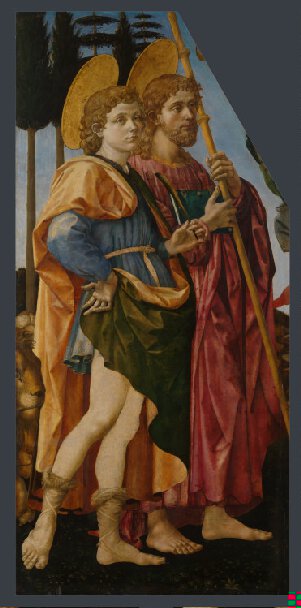
Saint Mammes of Caesarea is a semi-legendary child-martyr of the 3rd century. He was martyred at Caesarea. His parents, Theodotus and Rufina, were also martyred.
Born in prison to parents who had been jailed because they were Christian, Mammes became an orphan when his parents were executed. After his parents' death, Mammes was raised by a rich widow named Ammia, who died when Mammes was 15 years old.
According to legend, Mammes was tortured for his faith by the governor of Caesarea and was then sent before the Roman Emperor Aurelian, who tortured him again. The Mammes legend states that an angel then liberated him and ordered him to hide himself on a mountain near Caesarea.
Jean Cousin the Elder
St Mammes and Duke Alexander
Date 1541
Tapestry
Height: 440 cm (173.2 in). Width: 450 cm (177.2 in).
Louvre Museum
Jean Cousin (1500 – before 1593) see below
Mammes was later thrown to the lions, but managed to make the beasts docile. He preached to animals in the fields, and a lion remained with him as companion. Accompanied by the lion, he visited Duke Alexander, who condemned him to death. He was struck in the stomach with a trident. Bleeding, Mammes dragged himself to a spot near a theater before his soul was carried into heaven by angels. More Saint Mammes
Francesco Pesellino and Fra Filippo Lippi and Workshop
Saints Mamas and James
The Pistoia Santa Trinità Altarpiece, c. 1455-60
Egg tempera, tempera grassa and oil on wood
142 x 64.5 cm
Royal Collection
Fra' Filippo Lippi, O.Carm. (c. 1406 – 8 October 1469), also called Lippo Lippi, was an Italian painter of the Quattrocento (15th century). He was brought up as an unwanted child in the Carmelite friary of the Carmine, where he took his vows in 1421. Unlike the Dominican Fra Angelico, however, Lippi was a reluctant friar and had a scandalous love affair with a nun. The couple was released from their vows and allowed to marry, but Lippi still signed himself "Frater Philippus". His biography is one of the most colourful in Vasari's Lives and has given rise to the picture of a wordly Renaissance artist, rebelling against the discipline of the Church.
From about 1440, however, his style changed direction, becoming more linear and preoccupied with decorative motifs. Lippi is associated with the form of tondi, a format he was among the first to use. Another formal innovation with which Lippi is closely associated is the "sacra conversazione" - his Barbadori Altarpiece is sometimes claimed as the earliest example of the type.
Filippo Lippi was not dedicated to the study of nature firsthand; instead, he depended largely upon painted and sculptured prototypes, and his figures are often inorganic and unanatomical,
Lippi was highly regarded in his day and his influence is seen in the work of numerous artists, most notably Botticelli, who was probably his pupil. Four centuries later he was one of the major sources for the second wave of Pre-Raphaelitism. More Fra' Filippo Lippi, O.Carm
Fra Filippo Lippi and workshop, 1406; died 1469
Saint Jerome and the Lion, c. 1455-60
Predella Panel
The Pistoia Santa Trinità Altarpiece
tEgg tempera, tempera grassa and oil on wood
26.5 x 40 cm
The National Gallery, Trafalgar Square, London
Jerome of Stridonium, who was born around
347AD, and is best known for the legend in which he drew a thorn from a
lion’s paw, and in Michael Pacher’s depiction of the saint (above), we see him
draped in the red robes of a cardinal, stroking the lion. was a priest, confessor,
theologian and historian. He was the son of Eusebius, born at Stridon, a
village near Emona on the border of Dalmatia and Pannonia, then part of
northeastern Italy. He is best known for his translation of most of the Bible into
Latin (the translation that became known as the Vulgate), and his commentaries
on the Gospels. His list of writings is extensive.
The
protégé of Pope Damasus I, who died in December of 384, Jerome was known for
his teachings on Christian moral life, especially to those living in
cosmopolitan centers such as Rome. In many cases, he focused his attention to
the lives of women and identified how a woman devoted to Jesus should live her
life. This focus stemmed from his close patron relationships with several
prominent female ascetics who were members of affluent senatorial families.
He is recognised as a Saint and Doctor of the
Church by the Roman Catholic Church, the Eastern Orthodox Church, the Lutheran
Church, and the Anglican Communion. More Jerome of Stridonium
Jean Cousin the Elder
Eva Prima Pandora, circa 1550
Oil on panel
97.5 × 150 cm (38.4 × 59.1 in)
Louvre Museum
Eve, guilty of original sin as related in the Book of Genesis, is here equated with Pandora who, in Greek mythology, spread all the evils that have afflicted mankind by curiously opening the box entrusted to her by the gods. More
Jean Cousin (1500 – before 1593) was a French painter, sculptor, etcher, engraver, and geometrician. He is known as "Jean Cousin the Elder" to distinguish him from his son Jean Cousin the Younger, also an artist.
Cousin was born at Soucy, near Sens, and began his career in his native town with the study of glass-painting under Jean Hympe and Grassot. At the same time, he studied mathematics and published a successful book on the subject. He also wrote on geometry in his student days. In 1530 Cousin finished the windows for Sens Cathedral, the subject chosen being the "Legend of St. Eutropius". He also painted the windows of many of the noble châteaux in and around the city.
In Paris Cousin continued his career as a glass-painter, and created his best-known work, the windows of the Sainte-Chapelle in Vincennes. He subsequently devoted himself to painting in oil, and has been claimed as the first Frenchman to use that new medium.
He was also an illustrator of books, making many designs for woodcuts and often executed them himself. The "Bible", published in 1596 by Le Clerc, and the Metamorphoses and Epistles of Ovid (1566 and 1571 respectively) contain his most noted work as an illustrator. He also created sculptures. In addition to his early writings on mathematics, he published, in 1560, a treatise on perspective, and, in 1571, a work on portrait-painting. During his life Cousin enjoyed the favour of and worked for four kings of France: Henry II, Francis II, Charles IX, and Henry III.

Attributed to François Chauveau (1613-1676)
John the Baptist Visiting the Infant Christ
Watercolor and gouache on vellum stretched onto panel
Diameter 12 1/2 in. (32.0 cm)
Private Collection
Scenes showing the infants Jesus and John together first became popular in fifteenth-century Tuscany, part of a growing concern for childhood. The subject was given new life in the century to follow thanks to a now lost work by Leonardo, which showed the two children embracing. More
François Chauveau (10 May 1613, Paris – 3 February 1676, Paris) was a French painter and engraver. The second son of the impoverished noble Lubin Chauveau and of Marguerite de Fleurs, he studied in the studio of Laurent de La Hyre and specialised in etching. He married Marguerite Roger on 8 February 1652 and Louis XIV gave him a pension and the title of Graveur du Roi ainsi in 1662. Made a counsellor to the Académie royale de peinture et de sculpture on 14 April 1663, he died in 1676.
Notable for his great culture and imagination, he was one of the four French engravers cited by Charles Perrault in his "Hommes illustres". Chauveau left nearly 1,600 works, including illustrations for works by Mademoiselle de Scudéry, Scarron, Molière, Racine and Boileau. La Fontaine summoned him to illustrate the first six books of his fables. He had many students, including Nicolas Guérard, Jean-Baptiste Broebes and Edward Davies. His children included René, Évrard and Louis Chauveau. More François Chauveau
Netherlandish School, 16th Century
LANDSCAPE WITH CHRIST'S ENTRY INTO JERUSALEM
oil on oak panel
33.7 x 53.5 cm.; 13 1/4 x 21 1/8 in.
Private Collection
The landscape depicts Christ’s triumphal entry into Jerusalem on Palm Sunday, as recounted in all the Gospels. As well as a vivid testament to the energetic fusion of styles and influences that contributed to the development of World Landscape painting in Antwerp in the first half of the sixteenth century, it also contains an unusually accurate early topographic depiction of the city of Jerusalem.
Netherlandish School, 16th Century
LANDSCAPE WITH CHRIST'S ENTRY INTO JERUSALEM
Detail
The painting is likely by at least two different artists, the distant landscape closely resembling those of Herri Met de Bles, to whom the panel has long been attributed, and the figure group deriving from an altarpiece by Jan van Scorel.
Netherlandish School, 16th Century
LANDSCAPE WITH CHRIST'S ENTRY INTO JERUSALEM
Detail
The traditional attribution to the Antwerp painter Herri Met de Bles (c. 1510– after 1550) was no doubt on account of the presence of the owl in the trees on the left hand side of the painting, a device to be found on many of his extant works, and which gave him in Italy the nickname ‘Il Civetta’. More
Roelandt Savery, KORTRIJK 1576 - 1639 UTRECHT
THE TEMPTATION OF SAINT ANTHONY
Oil on beechwood panel
17.5 x 26.7 cm.; 7 x 10 1/2 in
Private Collection
The Temptation of Saint Anthony is an often-repeated subject in history
of art and literature, concerning the supernatural temptation reportedly faced
by Saint Anthony the Great during his sojourn in the Egyptian desert. Anthony's
temptation is first discussed by Athanasius of Alexandria, Anthony's
contemporary, and from then became a popular theme in Western culture. More
Roelandt Savery, KORTRIJK 1576 - 1639 UTRECHT
THE TEMPTATION OF SAINT ANTHONY
Detail
Roelandt Savery, KORTRIJK 1576 - 1639 UTRECHT
THE TEMPTATION OF SAINT ANTHONY
Detail
Roelandt Savery, KORTRIJK 1576 - 1639 UTRECHT
THE TEMPTATION OF SAINT ANTHONY
Detail
The focus of the present panel is firmly upon the saint himself and the assorted diablerie that assail him. He is confronted by a winged demon dressed as a pilgrim, sitting astride a lobster with the head of a dodo, while a trumpet playing demon perches on his shoulder and a grylle with round table-top hat squats beside him. A devil, disguised as a woman in contemporary dress (symbolic of the temptation of lust) lurks in the darkened doorway behind a sleeping pig, the companion and attribute of Saint Anthony. In the foreground cabalistic texts and symbols, including a fountain of blood, blasphemously mock the rosary and crucifix of the saint. More
This work is completely unrecorded, and appears to be one of only two treatments of this subject by Savery. The other, a signed and dated later work of 1617, is today in the collection of the Getty Museum, Los Angeles (Below)
Saint Anthony or Antony (251–356) was a
Christian monk from Egypt, revered since his death as a saint. He is
distinguished from other saints named Anthony by various epithets: Anthony the
Great, Anthony of Egypt, Anthony the Abbot, Anthony of the Desert, Anthony the
Anchorite, and Anthony of Thebes. For his importance among the Desert Fathers
and to all later Christian monasticism, he is also known as the Father of All
Monks. His feast day is celebrated on January 17 among the Orthodox and
Catholic churches and on Tobi 22 in the Egyptian calendar used by the Coptic
Church.
The biography of Anthony's life by Athanasius of
Alexandria helped to spread the concept of Christian monasticism, particularly
in Western Europe via its Latin translations. He is often erroneously
considered the first Christian monk, but as his biography and other sources
make clear, there were many ascetics before him. Anthony was, however, the
first to go into the wilderness, a geographical move that seems to have
contributed to his renown. Accounts of Anthony enduring supernatural temptation
during his sojourn in the Eastern Desert of Egypt inspired the often-repeated
subject of the temptation of St. Anthony in Western art and literature. More Saint Anthony
Roelant Savery (1576–1639)
Landscape with the Temptation of Saint Anthony, c. 1617
Oil on panel
Getty Center
The Getty painting shows the saint praying in the bottom left corner in a rustic hut dwarfed by a magnificent alpine panoramic landscape. The insignificance of the saint in the Getty panel clearly indicate the main focus of that painting is the wider landscape.
Roelant Savery (1576–1639)
Landscape with the Temptation of Saint Anthony, c. 1617
Detail
Roelant Savery (1576 - buried 25 February 1639), was a Flanders-born Dutch Golden Age painter. Like so many other artists, he belonged to an Anabaptist family that fled north from the Spanish-occupied Southern Netherlands when Roelant was about 4 years old and settled in Haarlem around 1585. He was taught painting by his older brother Jacob Savery (c. 1565 – 1603) and Hans Bol.
After his schooling, Savery traveled to Prague around 1604, where he became court painter of the Emperors Rudolf II (1552–1612) and Mathias (1557–1619), who had made their court a center of mannerist art. Between 1606-1608 he traveled to Tyrol to study plants. Gillis d'Hondecoeter became his pupil.
In 1621 Savery bought a large house on the Boterstraat in Utrecht. The house had a large garden with flowers and plants, where a number of fellow painters, like Adam Willaerts were frequent visitors.
In the 1620s he was one of the most successful painters in Utrecht, but later his life got troubled, perhaps because of heavy drinking. Though he would have pupils until the late 1630s, amongst which Allaert van Everdingen and Roelant Roghman, he went bankrupt in 1638 and died in Utrecht half a year later. More Roelant Savery
Italian School, 17th Century
Nativity Scene
Oil on canvas
22 1/2 x 17 in. (57.2 x 43.0 cm)
Private Collection
Francisco de Zurbarán, FUENTE DE CANTOS, BADAJOZ 1598 - 1664 MADRID
THE MYSTIC MARRIAGE OF SAINT CATHERINE OF ALEXANDRIA, circa 1660-62
oil on canvas
47 5/8 by 40 1/2 in.; 121 by 102.7 cm.
Private property
The Virgin and Saint Catherine are both portrayed as classically beautiful young women. According to legend, Catherine was of noble birth and Zurbarán has depicted her richly robed and wearing a brocaded cape. At lower left is her attribute, the broken spiked wheel. Before Saint Catherine's martyrdom, the Emperor Maxentius ordered her to be tortured with an instrument made up of four wheels studded with iron spikes. However, a thunderbolt from heaven destroyed it before she was harmed. The account of her “mystic marriage” is the most often depicted episode from her life. Following her conversion to Christianity she had a vision of the Virgin holding the Christ Child who reached out and placed a ring on her finger, thereby symbolizing her spiritual betrothal to God. More on this painting
Francisco de Zurbarán (baptized November 7, 1598 – August 27, 1664) was a Spanish painter. He is known primarily for his religious paintings depicting monks, nuns, and martyrs, and for his still-lifes. Zurbarán gained the nickname Spanish Caravaggio, owing to the forceful, realistic use of chiaroscuro in which he excelled. More Francisco de Zurbarán
Italian School, 17th Century
Saint Barbara Holding a Chalice and Pointing to Heaven
Charcoal and white chalk on paper
9 x 7 in. (23.1 x 18.0 cm)
Private Collection
Saint Barbara, known in the Eastern Orthodox Church as the Great Martyr Barbara, was an early Christian Greek saint and martyr. Accounts place her in the 3rd century in the Greek city Nicomedia, present-day Turkey or in Heliopolis of Phoenicia, present-day Baalbek, Lebanon. There is no reference to her in the authentic early Christian writings nor in the original recension of Saint Jerome's martyrology. Her name can be traced to the 7th century, and veneration of her was common, especially in the East, from the 9th century
Barbara, the daughter of a rich pagan named Dioscorus, was carefully guarded by her father who kept her locked up in a tower in order to preserve her from the outside world. Having secretly become a Christian, she rejected an offer of marriage that she received through him.
When her father returned a journey, she acknowledged herself to be a Christian; upon this he drew his sword to kill her, but her prayers created an opening in the tower wall and she was miraculously transported to a mountain gorge, where two shepherds watched their flocks. Dioscorus, left in pursuit of his daughter
Dragged before the prefect of the province, Martinianus, who had her cruelly tortured, Barbara held true to her faith. During the night, the dark prison was bathed in light and new miracles occurred. Every morning her wounds were healed. Torches that were to be used to burn her went out as soon as they came near her. Finally she was condemned to death by beheading. Her father himself carried out the death-sentence. However, as punishment for this, he was struck by lightning on the way home and his body was consumed by flame. More Saint Barbara
Images are copyright of their respective owners, assignees or others