Showing posts with label Samson. Show all posts

02 works, RELIGIOUS ART - Photography from the Bible, with footnotes, 3a

Samson and Delilah (1949 film), directed by Cecil B. DeMille
Hedy Lamarr and Victor Mature

Samson and Delilah is a 1949 American romantic biblical drama film produced and directed by Cecil B. DeMille and released by Paramount Pictures. Praised upon release for its Technicolor cinematography, lead performances, costumes, sets, and innovative special effects, the film was a box-office success. Released in December 1949, it was the highest-grossing film of 1950. Of its five Academy Award nominations, the film won two for Best Art Direction and Best Costume Design. More on the film

Samson  is one of the last of the judges of the ancient Israelites mentioned in the Hebrew Bible. According to the biblical account, Samson was given supernatural strength by God in order to combat his enemies and perform heroic feats. Samson had two vulnerabilitieshis attraction to untrustworthy women and his hair, without which he was powerless. These vulnerabilities ultimately proved fatal for him.

Samson eventually fell in love with a woman named Delilah. The Philistines bribed Delilah with 1,100 silver pieces from each of the Philistine leaders, to get her to figure out the secret of Samson's strength and tell them. 

After asking him several times what the secret to his strength is: "Finally he disclosed to her all his heart and said to her: 'A razor has never come upon my head, because I am a Naz′i·rite of God from my mother’s belly. If I did get shaved, my power also would certainly depart from me, and I should indeed grow weak and become like all other men.'" 

She relayed this to the Philistine axis lords, got Samson to fall asleep, and while he was sleeping, had his head shaved. The Philistines then took him captive, put out both his eyes, and made him their slave. 

One day as they are having a great party to worship their false god Dagon, the Philistines bring Samson out so they can make fun of him. By that time, Samson's hair has grown out again. Samson has a young boy lead him to the pillars that hold the building up, prays to Jehovah for strength, takes hold of the pillars, and cries out: "Let my soul die with the Philistines."


There are 3,000 Philistines on the roof of the building alone, and many more inside (the axis lords are all there as well), and when Samson pushes against the pillars, the building falls down and kills all of them, including Samson. More on Samson and Delilah

Movie poster for the original 1949 theatrical release of the film Samson and Delilah


Images are copyright of their respective owners, assignees or others. Some Images may be subject to copyright

I don't own any of these images - credit is always given when due unless it is unknown to me. if I post your images without your permission, please tell me.

I do not sell art, art prints, framed posters or reproductions. Ads are shown only to compensate the hosting expenses.

If you enjoyed this post, please share with friends and family.

Thank you for visiting my blog and also for liking its posts and pages.


02 Works, RELIGIOUS ART - Interpretation of the Bible! With Footnotes - # 43f

Solomon J Solomon, (1860 - 1927)
Samson, c.  1887
Oil on canvas
Height: 2,438 mm (95.98 in). Width: 3,658 mm (144.02 in).
Walker Art Gallery,  Liverpool,  England,

Samson  is one of the last of the judges of the ancient Israelites mentioned in the Hebrew Bible. According to the biblical account, Samson was given supernatural strength by God in order to combat his enemies and perform heroic feats. Samson had two vulnerabilities—his attraction to untrustworthy women and his hair, without which he was powerless. These vulnerabilities ultimately proved fatal for him.

Samson eventually fell in love with a woman named Delilah. The Philistines bribed Delilah with 1,100 silver pieces from each of the Philistine leaders, to get her to figure out the secret of Samson's strength and tell them. 

After asking him several times what the secret to his strength is: "Finally he disclosed to her all his heart and said to her: 'A razor has never come upon my head, because I am a Naz′i·rite of God from my mother’s belly. If I did get shaved, my power also would certainly depart from me, and I should indeed grow weak and become like all other men.'" 

She relayed this to the Philistine axis lords, got Samson to fall asleep, and while he was sleeping, had his head shaved. The Philistines then took him captive, put out both his eyes, and made him their slave. 

One day as they are having a great party to worship their false god Dagon, the Philistines bring Samson out so they can make fun of him. By that time, Samson's hair has grown out again. Samson has a young boy lead him to the pillars that hold the building up, prays to Jehovah for strength, takes hold of the pillars, and cries out: "Let my soul die with the Philistines."

There are 3,000 Philistines on the roof of the building alone, and many more inside (the axis lords are all there as well), and when Samson pushes against the pillars, the building falls down and kills all of them, including Samson. More Samson


Solomon Joseph Solomon, (1860- 1927)
Samson - 1887
Detail

Solomon Joseph Solomon RA (16 September 1860 – 27 July 1927) was a British painter, a founding member of the New English Art Club and member of the Royal Academy. He made an important contribution to the development of camouflage in the First World War, working in particular on tree observation posts and arguing tirelessly for camouflage netting.

Born in London in 1860, Solomon studied at various art schools, sequentially, Heatherley School of Fine Art, the Royal Academy Schools, the Munich Academy, and École des Beaux-Arts (under Alexandre Cabanel). Solomon also studied separately under Rev. S. Singer. He exhibited his first works as early as 1881, and showed at the Royal Academy, the New Gallery, and the Society of British Artists. In 1886, he became one of the founding members of the New English Art Club. In 1896, he became an associate of the Royal Academy, with full membership following in 1906. He joined, and became president of, the Royal Society of British Artists in 1919. More Solomon Joseph Solomon


Images are copyright of their respective owners, assignees or others. Some Images may be subject to copyright

I do not sell art, art prints, framed posters or reproductions. Ads are shown only to compensate the hosting expenses.

If you enjoyed this post, please share with friends and family.

Thank you for visiting my blog and also for liking its posts and pages.

20 Sculptures, scenes from the Bible, by Johann Georg Pinsel, 6

Johann Georg Pinsel 
Abraham’s Sacrifice. c. 1760 
(from a church in the village of Hodovytsya). 
Museum of Sacral Sculpture, Lviv.

According to the Bible, God commands Abraham to offer his son Isaac as a sacrifice. After Isaac is bound to an altar, the angel of God stops Abraham at the last minute, saying "now I know you fear God." At this point, Abraham sees a ram caught in some nearby bushes and sacrifices the ram instead of Isaac.
The event occurred at "the mount of the LORD". The Books of Chronicles identify the location of this event as the hill on which Solomon was said to later build the Temple, now believed to be the Temple Mount in Jerusalem. More

Johann Georg Pinsel (1707-1762) was a Baroque-Rococo sculptor of German or Czech origin active in Red Ruthenia (then in Poland, now Ukraine).
Johann Georg Pinsel 
Samson opening the lion's mouth, c. 1758
Wood, polychrome and gilding
Museum of Sacral Sculpture, Lviv.
As a young man, Samson, the last of the Old Testament Judges of Israel, demonstrated his strength by slaying a lion with his bare hands. The subject’s relationship to the mythological story of Hercules and the Nemean lion and its mingling of classical and biblical iconographical traditions.
Johann Georg Pinsel 
Samson opening the lion's mouth, c. 1758
Wood, polychrome and gilding
Museum of Sacral Sculpture, Lviv.
Detail
Biographical details about him are scarce. He was discovered by J. Bołoz Antoniewicz and appeared in scholarly literature in 1923 in the monograph of Władysław Żyła "Dominican church and monastery in Lviv". His first and second name, some information about his family and approximate date of death were only established in 1993, with the discovery of registers of the Buchach Roman Catholic parish. The place and exact date of his birth remain unknown.
Johann Georg Pinsel 
Saint John the Evangelist, c. 1758 
Wood, polychrome and gilding, 
National Gallery of Art, Lviv
John the Evangelist is traditionally regarded as the author of the Gospel of John and other Johannine literature in the New Testament: the three Epistles of John and the Book of Revelation. More
Pinsel came to the region of Lviv most probably around 1750 and became court artist to Mikołaj Bazyli Potocki. He settled in Buchach and in 1751 married Marianna Majewska, with whom he had two sons. He closely collaborated with the renowned architect Bernard Meretyn His student was Maciej Polejowski.

Johann Georg Pinsel
Grieving Madonna, c. 1758
Wood, polychrome and gilding, 
National Gallery of Art, Lviv

Our Lady of Sorrows, the Sorrowful Mother or Mother of Sorrows, and Our Lady of Piety, Our Lady of the Seven Sorrows or Our Lady of the Seven Dolours are names by which the Blessed Virgin Mary is referred to in relation to sorrows in her life. As Mater Dolorosa, it is also a key subject for Marian art in the Catholic Church.

The Seven Sorrows of Mary are a popular Roman Catholic devotion. In common religious Catholic imagery, the Blessed Virgin Mary is portrayed in a sorrowful and lacrimating affect, with seven daggers piercing her heart, often bleeding. Devotional prayers that consist of meditation began to elaborate on her Seven Sorrows based on the prophecy of Simeon. Common examples of piety under this title are Servite rosary, or the Chaplet of the Seven Sorrows of Our Lady and the Seven Joys of Mary and more recently, "Sorrowful and Immaculate Heart of Mary". More

Johann Georg Pinsel
Grieving Madonna, c. 1758
Detail
Pinsel's works include sculptures and decorations of the Buchach townhall (1750s), the Trinitarian church (1756-1757) and the St. George's Cathedral (headquarters of Greek Catholics) in Lviv, (1759-1761), interiors of the Roman Catholic churches in: Monastyryska (1761), Horodenka (1752-1755) and Hodovytsia (1757-1758), sculptures in the Roman Catholic parish church in Budaniv.
Johann Georg Pinsel
New Testament Avatar, c. 1758
Wood, polychrome and gilding, 
National Gallery of Art, Lviv
Appearances of the "angel of the Lord" are often presented as a visible manifestation to humankind of God or a god. in Genesis the angel of God says, "I am the God of Beth-el"; in Exodus the angel of the Lord appeared to Moses in the flame of fire, and then the Lord says to him: "I am the God of thy father". At times the angel of the Lord speaks in such a way as to assume authority over previous promises. More
His only work that survived intact, in its original spatial arrangement, is the facade of the St. George's Cathedral. His sculptural complexes in the churches in Horodenka and Monastyryska were almost completely destroyed between 1939 and 1989. The figures of the high altar in Hodovytsia have been saved thanks to efforts of the staff of the Lviv Art Gallery
Johann Georg Pinsel
Saint Anna, c. 1761
Wood, polychrome and gilding, 
National Gallery of Art, Lviv

Saint Anne (also known as Ann or Anna) of David's house and line, was the mother of the Virgin Mary and grandmother of Jesus Christ, according to apocryphal Christian and Islamic tradition. Mary's mother is not named in the canonical gospels, nor in the Qur'an. Anne's name and that of her husband Joachim come only from New Testament apocrypha, of which the Protoevangelium of James (written perhaps around 150) seems to be the earliest that mentions them. More

Johann Georg Pinsel
Adoration of an Angel,  c. 1758
Wood, polychrome and gilding, 
Museum of Sacral Sculpture, Lviv

Johann Georg Pinsel
Adoration of an Angel,  c. 1758
Wood, polychrome and gilding, 
Museum of Sacral Sculpture, Lviv
Detail

Johann Georg Pinsel
Prophet Aaron, c. 1760-1761
Wood, polychrome and gilding, 
National Gallery of Art, Lviv

In the Hebrew Bible and the Quran, Aaron was the older brother of Moses and a prophet of God. Unlike Moses, who grew up in the Egyptian royal court, Aaron and his elder sister Miriam remained with their kinsmen in the eastern border-land of Egypt. When Moses first confronted the Egyptian king about the Israelites, Aaron served as his brother's spokesman to Pharaoh. Part of the Law that Moses received from God at Sinai granted Aaron the priesthood for himself and his male descendants, and he became the first High Priest of the Israelites. Various dates for his life have been proposed, ranging from approximately 1600 to 1200 BC. Aaron died before the Israelites crossed the Jordan river and he was buried on Mount Hor. More

Johann Georg Pinsel
Jesus among the Twelve scribes, approx. 1758 
Wood, polychrome and gilding, 
National Gallery of Art, Lviv

Every year Jesus’ parents went to Jerusalem for the Festival of the Passover.  When he was twelve years old, they went up to the festival, according to the custom.  After the festival was over, while his parents were returning home, the boy Jesus stayed behind in Jerusalem, but they were unaware of it.  Thinking he was in their company, they traveled on for a day. Then they began looking for him among their relatives and friends. When they did not find him, they went back to Jerusalem to look for him. After three days they found him in the temple courts, sitting among the teachers, listening to them and asking them questions.  Everyone who heard him was amazed at his understanding and his answers.  When his parents saw him, they were astonished. His mother said to him, “Son, why have you treated us like this? Your father and I have been anxiously searching for you.”

“Why were you searching for me?” he asked. “Didn’t you know I had to be in my Father’s house?” But they did not understand what he was saying to them. More

Johann Georg Pinsel
Jesus among the Twelve scribes", approx. 1758 
Wood, polychrome and gilding, 
National Gallery of Art, Lviv
Detail

Johann Georg Pinsel
Jesus among the Twelve scribes", approx. 1758 
Wood, polychrome and gilding, 
National Gallery of Art, Lviv
Detail

Johann Georg Pinze
Saint Vincent

Saint Vincent of Saragossa was a deacon of the Church of Saragossa. He is the patron saint of Lisbon and Valencia. He was born at Huesca and martyred under the Emperor Diocletian around the year 304. The earliest account of Vincent's martyrdom is in a carmen (lyric poem) written by the poet Prudentius, who wrote a series of lyric poems, Peristephanon ("Crowns of Martyrdom"), on Hispanic and Roman martyrs.

He was born at Huesca, near Saragossa, Spain sometime during the latter part of the 3rd century. Vincent spent most of his life in the city of Saragossa, where he was educated and ordained to the diaconate by Bishop Valerius of Saragossa, who commissioned Vincent to preach throughout the diocese. Because Valerius suffered from a speech impediment, Vincent acted as his spokesman.

When the Roman Emperor Diocletian began persecuting Christians in Spain, both were brought before the Roman governor, Dacian in Valencia. Vincent and his bishop Valerius were confined to the prison of Valencia. Though he was finally offered release if he would consign Scripture to the fire, Vincent refused. Speaking on behalf of his bishop, he informed the judge that they were ready to suffer everything for their faith, and that they could pay no heed either to threats or promises.

His outspoken manner so angered the governor that Vincent was inflicted every sort of torture on him. He was stretched on the rack and his flesh torn with iron hooks. Then his wounds were rubbed with salt and he was burned alive upon a red-hot gridiron. Finally he was cast into prison and laid on a floor scattered with broken pottery, where he died. During his martyrdom he preserved such peace and tranquillity that it astonished his jailer, who repented from his sins and was converted. Vincent's dead body was thrown into the sea in a sack, but was later recovered by the Christians and his veneration immediately spread throughout the Church. The aged bishop Valerius was exiled. More

Johann Georg Pinze
Saint Elizabeth, c.  (1755)

Saint Elizabeth of Hungary, T.O.S.F. ( 7 July 1207 – 17 November 1231), also known as Saint Elizabeth of Thuringia, was a princess of the Kingdom of Hungary, Landgravine of ThuringiaGermany, and a greatly venerated Catholic saint who was an early member of the Third Order of St. Francis, by which she is honored as its patroness. Elizabeth was married at the age of 14, and widowed at 20. After her husband's death she sent her children away and regained her dowry, using the money to build a hospital where she herself served the sick. She became a symbol of Christian charity after her death at the age of 24 and was quickly canonized. More

Johann Georg Pinze
Saint Francis Borgia, 1753

Saint Francis Borgia, S.J., 4th Duke of Gandía, (28 October 1510 – 30 September 1572) was a Grandee of Spain, a Spanish Jesuit, and third Superior General of the Society of Jesus. He was canonized on 20 June 1670 by Pope Clement X. He was born in Duchy of Gandía, Valencia. His father was Juan Borgia, 3rd Duke of Gandía, the son of Giovanni Borgia, the son of Pope Alexander VI (Rodrigo Borgia). 

Although as a child he was very pious and wished to become a monk, his family sent him instead to the court of Charles V, Holy Roman Emperor (who was also King Charles I of Spain), where he was welcomed as a kinsman. He distinguished himself there, accompanying the Emperor on several campaigns.

In September 1529, he married a Portuguese noblewoman in Madrid, Leonor de Castro Mello y Meneses. They had eight children. In 1539, he convoyed the corpse of Isabella of Portugal, Philip II of Spain's mother, to her burial place in Granada. In that same year (1539), he became Viceroy of Catalonia, replacing Fadrique de Portugal y Noroña, though he was only 29.

In 1543 upon the death of his father, Francis became the 4th Duke of Gandía. Francis’ diplomatic abilities came into question when his attempt to arrange a marriage between Prince Philip and the Princess of Portugal failed, thus ending an attempt to bring these two countries together and resulting in his retirement. By then 33 years old he had retired to his native place and devoted himself to religious activities. More

Johann Georg Pinze
St. Joachim, c. 1755

Joachim was the husband of Saint Anne and the father of Mary, the mother of Jesus, according to the Catholic, Orthodox, and Anglican traditions. The story of Joachim and Anne first appears in the apocryphal Gospel of James. Joachim and Anne are not mentioned in the Bible. More

Johann Georg Pinze
Saint Felix with Child (1755)

Felix of Cantalice, (1515-1587) Born to peasant parents in Cantalice, Italy, in the central Italian region of Lazio. Canonized by Pope Clement XI in 1712, he was the first Capuchin friar to be named a saint. Felix entered the newly founded Capuchin friars as a lay brother at the Citta Ducale friary in the municipality of Anticoli Corrado. It is said that he was well noted for his piety. In 1547 he was sent to Rome as quaestor of the Capuchin Friary of St. Bonaventure, where he spent his remaining 40 years begging alms to help in the friars' work of aiding the sick and the poor.

In Rome, Brother Felix became a familiar sight, wandering barefoot through the streets, with a sack slung over his shoulders, knocking on doors to seek donations. He received permission from his superiors to help the needy, especially widows with many children. It is said that his begging sack was as bottomless as his heart. Brother Felix blessed all benefactors and all those he met with a humble “Deo Gratias!” (thanks be to God!). Felix was so successful in his work that during the famine of 1580, the political leader of Rome asked the Capuchins if they would 'lend' Felix to them so he could collect food and provisions for the entire city. The Capuchins agreed and Felix embraced his new task.

The plain-spoken Brother Felix was a good friend of St. Philip Neri and an acquaintance of Charles Borromeo. Felix developed a reputation as a healer. As he got older, his superior ordered him to wear sandals to protect his health. Cardinal Santori had offered to use his influence to have the elderly Felix relieved of the difficult task of questing, but Felix refused. More

Johann Georg Pinze
Saint Tobias, (1755)

Saint Tobias, was one of a group of ten Christian soldiers in the imperial Roman army of Emperor Licinius who were martyred together for refusing to sacrifice to Roman gods. He was burned at the stake c.315 at Sebaste, Armenia

Johann Georg Pinzel
Saint Onuphrius, c. 1761

Saint Onuphrius was one of the Desert Fathers who made a great impression on Eastern spirituality in the third and fourth centuries, around the time that Christianity was emerging as the dominant faith of the Roman Empire. At this time many Christians were inspired to go out into the desert and live in prayer in the harsh environment of extreme heat and cold, with little to eat and drink, surrounded by all sorts of dangerous animals and robbers.[5]

It is uncertain in which century Onuphrius lived; the account of Paphnutius the Ascetic, who encountered him in the Egyptian desert, forms the sole source for our knowledge of the life of Saint Onuphrius. A tradition states that Onuphrius had studied jurisprudence and philosophy before becoming a monk near Thebes and then a hermit.

According to Paphnutius’s account, Paphnutius undertook a pilgrimage to study the hermits’ way of life and to determine whether it was for him. Wandering in the desert for 16 days, on the 17th day, Paphnutius came across a wild figure covered in hair, wearing a loincloth of leaves. Frightened, Paphnutius ran away, up a mountain, but the figure called him back, shouting, “Come down to me, man of God, for I am a man also, dwelling in the desert for the love of God.”

Turning back, Paphnutius talked to the wild figure, who introduced himself as Onuphrius and explained that he had once been a monk at a large monastery in the Thebaid but who had now lived as a hermit for 70 years, enduring extreme thirst, hunger, and discomforts. He said that it was his guardian angel who had brought him to this desolate place. Onuphrius took Paphnutius to his cell, and they spoke until sunset, when bread and water miraculously appeared outside of the hermit's cell.

They spent the night in the prayer, and in the morning Paphnutius discovered that Onuphrius was near death. Paphnutius, distressed, asked the hermit if he should occupy Onuphrius’ cell after the hermit’s death, but Onuphrius told him, "That may not be, thy work is in Egypt with thy brethren." Onuphrius asked Paphnutius for there to be a memorial with incense in Egypt in remembrance of the hermit. He then blessed the traveler and died.

Due to the hard and rocky ground, Paphnutius could not dig a hole for a grave, and therefore covered Onuphrius’ body in a cloak, leaving the hermit’s body in a cleft of the rocks. After the burial, Onuphrius’ cell crumbled, which Paphnutius took to be a sign that he should not stay. More


Acknowledgement: WikipediaIrina Olih
Images are copyright of their respective owners, assignees or others

22 Paintings, RELIGIOUS ART - Paintings from the Bible by the Masters, Franz von Stuck, with footnotes, 21


Franz von Stuck, (1863-1928)
Inferno, c. 1908
128.5 x 209 cm
Oil on canvas

"His painting Inferno rendered an extraordinary panaroma of the damned writhing in eternal torment. A syphilitic whore with a death’s head stands stiffly on the left while a demon readies to suckle at her withered teat. Two muscled figures sit doubled up in agony at the scene’s center. On the right, a venomous serpent coils itself around two damned souls. Stuck used ophidian imagery repeatedly in his paintings and this particular Hydra wildly sibilates as it crushes its victims. Backlit with fiery igneous rock, Stuck focused light on each damned soul so as to detail every facet of their agony. Inferno successfully depicts an arresting scene of chthonian grotesques for its viewers." More

Franz Stuck (February 23, 1863 – August 30, 1928), ennobled as Franz von Stuck in 1906, was a German painter, sculptor, engraver, and architect. Born at Tettenweis near Passau, Stuck displayed an affinity for drawing and caricature from an early age. To begin his artistic education he relocated in 1878 to Munich, where he would settle for life. From 1881 to 1885 Stuck attended the Munich Academy.

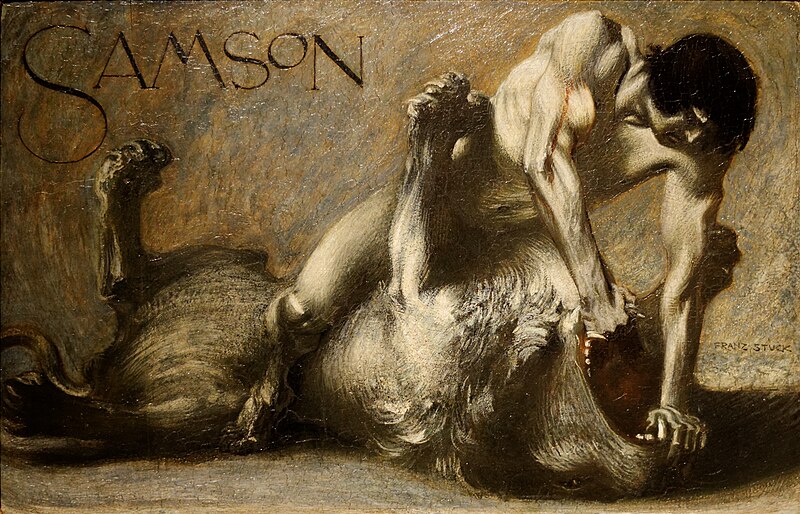
File:Samson Franz von Stuck.jpg
Franz von Stuck (1863–1928)
Samson, c. 1890
Oil on canvas
37 cm (14.57 in.), Width: 56.5 cm (22.24 in.)
 Museum Villa Stuck, Munich

Franz von Stuck's early painting, which titled "Samson" (1890), and which was considered lost since it's last mention in 1924 by Stuck's biographer, the poet OJ Bierbaum; who commented that the image: "One is more inclined to think of one of the labors of Hercules, as to the fact of the Old Testament ." More 

He first became well known by cartoons for Fliegende Blätter, and vignette designs for programmes and book decoration. In 1889 he exhibited his first paintings at the Munich Glass Palace, winning a gold medal for The Guardian of Paradise.

Franz Von Stuck 1863 -1928 |  German Symbolist / Expressionist painter and sculptor
Franz von Stuck
Crucifixion, 1913
Tempera on canvas
190 cm (74.8 in.), Width: 165 cm (64.96 in.) 
Museum der Bildenden Künste - Leipzig

In 1892 Stuck co-founded the Munich Secession, and also executed his first sculpture, Athlete. The next year he won further acclaim with the critical and public success of what is now his most famous work, the painting The Sin. Also during 1893, Stuck was awarded a gold medal for painting at the World's Columbian Exposition in Chicago, and was appointed to a royal professorship. In 1895 he began teaching painting at the Munich Academy.

Franz von Stuck (1863 - 1928)
Crucifixion Christi, c. (1913)
165 x 190 cm (64,8 x 74,7 inches)
Leipzig, Museum

Stuck chose to portray the most dramatic moment of Christ's death, when the sun went dark and the heavens cracked. The scene concentrates entirely on the deathly pale Christ, who is lit in a bright heavenly glow against the dark setting. Apart from Christ and the two murderers, of whom one is lost in the darkness and the other seen from the back and almost invisible, the only others present are John and Mary. More

Franz von Stuck (1863–1928)
Golgotha, c. 1917 
Oil on canvas
Brooklyn Museum - New York, NY (United States)

Stuck devoted several canvases to this subject late in his career, during the difficult years of World War I. Calling on new scholarly theories regarding the Gospel accounts, Stuck departs from tradition and places Christ at eye level with the witnesses to his sufferings. The artist cleverly structures his composition, placing the viewer immediately to the left of the crucified thief in the foreground and to the right of the haloed Virgin Mary, thereby closing a solemn yet intimate circle. Stuck also chooses to show Christ with his feet side by side rather than overlapping—again, referencing nineteenth-century debates about the historical details of this method of execution. More

In 1897 Stuck married an American widow, Mary Lindpainter, and began work designing his own residence and studio, the Villa Stuck. His designs for the villa included everything from layout to interior decorations; for his furniture Stuck received another gold medal at the 1900 Paris World Exposition.

Franz von Stuck (1863–1928)
Pietà, c. 1891
Oil on canvas
Height: 95 cm (37.4 in.), Width: 178.5 cm (70.28 in.)
Städel Museum - Frankfurt (Germany)

Stuck’s big idea is humanity itself, in all its complexity and contradiction, all its passion and pain. In paintings such as Pieta, we bear witness to the Virgin Mary’s grief as we, too, look upon the dead body of Christ, to whom von Stuck often gave his own features in the paintings, thus placing himself in that most passionate and pathetic of roles. More

Having attained much fame by this time, Stuck was ennobled on December 9, 1905 and would receive further public honours from around Europe during the remainder of his life. He continued to be well respected among young artists as professor at the Munich Academy, even after his artistic styles became unfashionable. Notable students of his over the years include Paul Klee, Hans Purrmann, Wassily Kandinsky, Alf Bayrle and Josef Albers.

Franz von Stuck
Lucifer, c. 1891
oil on canvas
National Gallery for Foreign Art (Sofia, Bulgaria)

Stuck’s Lucifer (1890; detail shown above) strikes the viewer not just as an embodiment of evil, but an embodiment of the human element in evil. An early critic wrote of “appalling Lucifer, sitting alone in the nether gloom with incandescent greenish eyes.” Prince Ferdinand of Bulgaria, once owner of Lucifer, told von Stuck that the painter “terrified” his ministers, who made the sign of the cross upon first sight of the fallen archangel—a story von Stuck retold with glee, one presumes.  What makes Lucifer stick in your mind isn’t some reproduction of the glamour of evil, but rather the poignant sense of loss in those glowing green eyes, the envy of the heaven he fell from fueling the fires of the hell he must now fashion. von Stuck could paint both convincing Christs and Satans because he always held onto the common thread of the humanity at the core of such figures. More

Stuck’s masterwork, “Lucifer.” As with many of his portraits, the subject gazes out toward the viewer—but off center and with pale, enraged eyes, the fallen angel is looking through the audience, not at them. Plotting his revenge and cupping his broken wings, this greatest symbol of inversion—once divine, now demonic, once the favorite, now the enemy—sees through the material aspects to the very essence of humanity and how it can be exploited to subvert divine order. Unlike Stuck’s other composite beasts whose hooves are planted firmly on earth, Lucifer has wings that for flight and ascendance, but now form only a dark shell, a reminder of his fall, crumpled by a thin crescent of light descending from above. More

'Temptation', Oil by Franz Von Stuck (1863-1928, Germany):
Franz von Stuck
Die Versuchung (The Temptation)

In the middle of the picture, between Adam and Eve, Stuck positioned the Tree of Knowledge around which a giant snake has curled itself. Eve, who has already been seduced by the snake and sampled the forbidden fruit, is shown timidly offering it to Adam. Torn between accepting or refusing the apple, Adam's leg is simultaneously being enveloped by the devil’s tail. Stuck clearly used the forbidden fruit as a metaphor of the seductive and erotic power of woman. This is reflected not only in the painting’s title but also in Eve’s gesture: while offering him the apple in one hand, she clasps her breast in the other. More

File:Franz-Von-Stuck-adam-and-Eve.jpg:
Franz von Stuck, (1863-1928)
Adam and Eve, ca. 1920-28
98.0 x 93.5 cm
Oil on wood

Here Stuck altered the iconography. The tree is left out entirely. Instead, the devil uses the woman herself as the temptress of man. Rather than the apple, Eve extends the snake’s head, in which the apple is clearly visible between the fangs of its gaping mouth. Both snake and woman conjoin in their attempt to seduce man, just as they do in Stuck’s famous later paintings of Die Sünde (The Sin).

Franz von Stuck, (1863-1928)
Temptation - Adam and Eve
Oil on wood
Mid Rhineland Museum

Franz von Stuck (1863 - 1928)
ADAM UND EVA, 1893
73 x 68,5 x 3,5 cm
Bronze

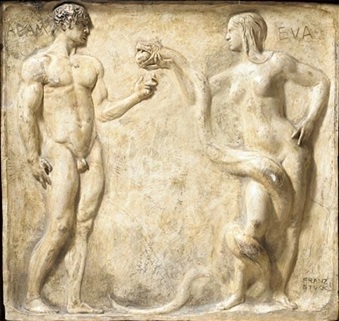
Franz von Stuck (1863 - 1928)
ADAM UND EVA (ADAM AND EVE)
Plaster
70 by 74.5cm., 27½ by 29¼in.


An interesting aspect of this relief, and the bronx above, is the opposing representations of the two nudes. While Adam resembles antique statues from the 5th century BC, Eve is emphatically modern, sensitively modelled from nature and stylized in a way that is typical of von Stuck.

Franz von Stuck died on August 30, 1928 in Munich; his funeral address memorialized him as "the last prince of art of Munich's great days". He is buried in the Munich Waldfriedhof next to his wife Mary.

Franz von Stuck (1863–1928)
The Guardian of Paradise, c. 1889
Oil on canvas
250 cm (98.43 in.), Width: 167 cm (65.75 in.) 
Brooklyn Museum - New York, NY (United States)

In 1889 Stuck exhibited his first paintings at the Munich Glass Palace, winning a gold medal for The Guardian of Paradise.

The lost Paradise, 1897 by Franz Stuck. Symbolism. religious painting:
Franz von Stuck (1863–1928)
The lost Paradise, c. 1897
Oil on canvas
200 x 290 cm
Galerie Neue Meister in Dresden, Germany

 “After he drove the man out, he placed on the east side of the Garden of Eden cherubim and a flaming sword.” (Genesis 3:24)

Franz von Stuck (1863–1928)
The Explusion from Paradise, c. 1890
Oil on canvas
Musée d'Orsay - Paris (France)


In the present painting, the angel is turned into profile, and Adam and Eve are added at the right. The angel’s bent wings are firmly planted on the ground, balancing the slight curve of the two bodies on the right. A vanishing demarcation line indicates the border of Paradise in the center of the painting, reinforcing its symmetrical composition. The dark and light bodies of Adam and Eve repeat the rhythm of the angel’s dark wings and light body. The most innovative element is the scintillating light which creates an unreal magic space. More

Image: Franz von Stuck - Judith
Franz von Stuck, (1863-1928)
Judith, (1924)
83 x 157 cm
Oil on canvas
Schwerin State Museum

Franz von Stuck, (1863-1928)
Judith (1926)
83 x 157 cm
Oil on canvas
Schwerin State Museum

Franz von Stuck, (1863-1928)
Judith and Holofernes, c. 1927
82 × 74 cm
Oil on canvas
Collection Otto Heilmann, Munich, Germany

Modern paintings of this scene often cast Judith nude, as was signalled already by Klimt. Franz Stuck's 1928 Judith has "the deliverer of her people" standing naked and holding a sword besides the couch on which Holofernes, half-covered by blue sheets—where the text portrays her as god-fearing and chaste, "Franz von Stuck's Judith becomes, in dazzling nudity, the epitome of depraved seduction"

The account of the beheading of Holofernes by Judith is given in the Book of Judith, and is the subject of many paintings and sculptures from the Renaissance and Baroque periods. In the story, Judith, a beautiful widow, is able to enter the tent of Holofernes because of his desire for her. Holofernes was an Assyrian general who was about to destroy Judith's home, the city of Bethulia. Overcome with drink, he passes out and is decapitated by Judith; his head is taken away in a basket (often depicted as carried by an elderly female servant). More

Franz von Stuck, (1863-1928)
Salome, c. 1906
45.7 × 24.7 cm
Oil on canvas
Lenbachhaus

Franz von Stuck, (1863-1928)
Salome, 1920
90.2 x 66 cm (35 1/2 x 26 in.)
Oil on canvas

Salome, stepdaughter of Herod II, is depicted in the Bible as a femme fataleâ. Her dance before the King so pleases him that he ultimately agrees to the beheading of John the Baptist. Von Stuck highlights Salome`s seductive and rather sinister”qualities; the tilt of her head and positioning of her body emphasize her long, lean figure as well as the wide expanses of naked skin. Her smile similarly reveals her delight at entertaining her audience, the viewer. This representation is related to a variation of the same subject produced by von Stuck in 1906 (see above). Salome is shown the same pose, but accompanied by a black woman carrying the head of John the Baptist. More

Franz von Stuck - Batsheba, 1912.jpg
Franz von Stuck (1863–1928)
Batsheba, c. 1912
Oil on canvas
95 × 91 cm (37.4 × 35.8 in)
National Museum of Fine Arts in Buenos Aires

According to the Hebrew Bible, "Bat Sheva," , "daughter of the oath"; was the wife of Uriah the Hittite and later of David, king of the United Kingdom of Israel and Judah. She is most known for the Bible story in which she was summoned by King David who had seen her bathing and lusted after her.

Bathsheba was from David's own tribe and the granddaughter of one of David's closest advisors. She was the mother of Solomon, who succeeded David as king, making her the Queen Mother. More

Franz von Stuck (1863–1928)
Susanna and the Elders

Franz von Stuck (1863–1928)
Susanna and the Elders, c. 1904
Oil on canvas

Franz von Stuck (1863–1928)
Susanna and the Elders, c. 1913
Oil on canvas
25 x 63 cm

Franz von Stuck (1863–1928)
Susanna And The Elders, c. 1904
Oil, canvas
98 x 134.5 cm

A fair Hebrew wife named Susanna was falsely accused by lecherous voyeurs. As she bathes in her garden, having sent her attendants away, two lustful elders secretly observe the lovely Susanna. When she makes her way back to her house, they accost her, threatening to claim that she was meeting a young man in the garden unless she agrees to have sex with them.

She refuses to be blackmailed and is arrested and about to be put to death for promiscuity when a young man named Daniel interrupts the proceedings, shouting that the elders should be questioned to prevent the death of an innocent. After being separated, the two men are questioned about details of what they saw, but disagree about the tree under which Susanna supposedly met her lover. In the Greek text, the names of the trees cited by the elders form puns with the sentence given by Daniel. The first says they were under a mastic, and Daniel says that an angel stands ready to cuthim in two. The second says they were under an evergreen oak tree, and Daniel says that an angel stands ready to saw him in two. The great difference in size between a mastic and an oak makes the elders' lie plain to all the observers. The false accusers are put to death, and virtue triumphs. More

stuck, franz von the dragon slayer | figures | sotheby's l15101lot7y6mden:
Franz von Stuck, 1863 - 1928
THE DRAGON SLAYER
Oil on panel
135 by 126cm., 53¼ by 49½in.

The Dragon Slayer is a particularly charged rendition of an age-old theme. Although most of Stuck's paintings depict scenes from the Antique or the Bible, neither the title The Dragon Slayer nor the iconography reveal the exact story behind the present work. Stuck's fascination with Greek legends suggests the subject to be Perseus and Andromeda, although Medusa's head and Perseus's winged shoes are missing. As early as 1900 Stuck’s contemporary, Lovis Corinth (lots 3, 4 & 5), had painted the hero as a medieval knight rather than a Greek half-god, and his Perseus and Andromeda may have been a possible source of inspiration for the present work. Another obvious influence would have been the biblical story of St. George, who kills the dragon to save a virgin. More

Franz von Stuck, 1863 - 1928
Versuchung (Temptation), c. 1918
Mixed media on canvas
37 3/8 x 42 1/2 in
Museum Villa Stuck

Franz von Stuck, 1863 - 1928
Temptation Of St. Anthony
Oil on board
13.00 in. (33.02 cm.) (height) by 15.00 in. (38.10 cm.) (width)

Saint Anthony or Antony (c. 251–356) was a Christian monk from Egypt, revered since his death as a saint. He is known as the Father of All Monks. His feast day is celebrated on January 17 among the Orthodox and Catholic churches and on Tobi 22 in the Egyptian calendar used by the Coptic Church.

The biography of Anthony's life helped to spread the concept of Christian monasticism, particularly in Western Europe via its Latin translations. He is often erroneously considered the first Christian monk. Anthony was, however, the first to go into the wilderness (about ad 270), a geographical move that seems to have contributed to his renown. Accounts of Anthony enduring supernatural temptation during his sojourn in the Eastern Desert of Egypt inspired the often-repeated subject of the temptation of St. Anthony in Western art and literature.

Anthony is appealed to against infectious diseases, particularly skin diseases. In the past, many such afflictions, including ergotism, erysipelas, and shingles, were historically referred to as St. Anthony's fire. More


Please visit my other blogs: Art CollectorMythologyMarine ArtPortrait of a Lady, The OrientalistArt of the Nude and The Canals of VeniceMiddle East Artists365 Saints365 Days, and Biblical Icons, also visit my Boards on Pinterest

Images are copyright of their respective owners, assignees or others. Some Images may be subject to copyright

I don't own any of these images - credit is always given when due unless it is unknown to me. if I post your images without your permission, please tell me.

I do not sell art, art prints, framed posters or reproductions. Ads are shown only to compensate the hosting expenses.

If you enjoyed this post, please share with friends and family.

Thank you for visiting my blog and also for liking its posts and pages.

Please note that the content of this post primarily consists of articles available from Wikipedia or other free sources online.