John William Waterhouse (April 6, 1849 – February 10,
1917) was an English painter known for working in the Pre-Raphaelite
style. He worked several decades after the breakup of the Pre-Raphaelite
Brotherhood, which had seen its heyday in the mid-nineteenth century, leading
to his sobriquet "the modern Pre-Raphaelite". Borrowing stylistic
influences not only from the earlier Pre-Raphaelites but also from his
contemporaries, the Impressionists, his artworks were known for their
depictions of women from both ancient Greek mythology and Arthurian legend.
John William Waterhouse - 1892-1900
Sketch for 'A Mermaid', c. 1892
Oil on canvas
Height: 33.34 cm (13.13 in.), Width: 19.37 cm (7.63 in.)
Born in Italy to English parents who were both
painters, he later moved to London, where he enrolled in the Royal Academy of
Art. He soon began exhibiting at their annual summer exhibitions, focusing on
the creation of large canvas works depicting scenes from the daily life and
mythology of ancient Greece. Later on in his career he came to embrace the
Pre-Raphaelite style of painting despite the fact that it had gone out of
fashion in the British art scene several decades before. More
John William Waterhouse - 1892-1900
Study for The Mermaid, half-length
Black chalk
19.38 X 17.38 in (49.21 X 44.13 cm)
John William Waterhouse - 1892-1900
A Mermaid (Study)
Oil on canvas, circa 1892
14 x 10 in
Kelley Gallery, Pasadena, California, USA
Almost every civilization has believed that life began in the sea and so water has been identified as female and associated with women. In mythology, the treacherousness of water is personified as alluring and irresistible women without souls who lure unwary men to a watery death. They may appear as mermaids, sirens, undines, ladies of the lake, nixies, or water nymphs. More
John William Waterhouse (1849–1917)
Sketch for A Mermaid , c. 1892 and 1895
Oil on canvas
70.5 × 45.2 cm (27.8 × 17.8 in)
John William Waterhouse - 1892-1900
A Mermaid, c. 1901
Oil on canvas
Height: 33.34 cm (13.13 in.), Width: 19.37 cm (7.63 in.)
Waterhouse was known for his depictions of fictional female characters from mythology, literature and fairytales. This mermaid is coming her hair; an iconic image that would make its way into the Disney film as the Little Mermaid.
John William Waterhouse - 1892-1900
The Siren, c. 1900
Oil on canvas
Height: 33.34 cm (13.13 in.), Width: 19.37 cm (7.63 in.)
The painting depicts a siren sitting at the edge of a cliff, lyre in hand, staring down at a shipwrecked sailor floating in water, who in turn is staring up at her. More
"He listened in thrall to the song of the siren, Her voice like a star as it flew through the air. He drowned in her eyes as she called him to follow, And likened the sun to the gold of her hair.
She swept up her arms and held him close to her, Her soft lips caressing the lines on his brow. He could not resist her, a magic had trapped him, And nothing could save him, for she had him now.
She pulled him down with her into the clear water, He gasped as death started the grip on his soul. His life ebbed away as she dragged him still further, And laughed when she saw she'd accomplished her goal." - Charlotte Lester
John William Waterhouse (1849–1917)
Hylas and the Nymphs, c. 1896
Oil on canvas
132.1 × 197.5 cm (52 × 77.8 in)
Manchester Art Gallery
In Greek mythology, Hylas was the son of King Theiodamas of the Dryopians. While Roman sources state that Hylas' father was Hercules and his mother was the nymph Melite, or that his mother was the wife of Theiodamas, whose adulterous affair with Heracles caused the war between him and her husband.
After Heracles killed Theiodamas in battle, he took on Hylas as arms bearer and taught him to be a warrior. He took Hylas with him on the Argo, making him one of the Argonauts. Hylas was kidnapped by nymphs of the spring of Pegae, and vanished without a trace. This upset Heracles greatly, and he searched for him at great length. The ship set sail without them. According to the Latin Argonautica of Valerius Flaccus, he never found Hylas because he had fallen in love with the nymphs and remained "to share their power and their love." More
John William Waterhouse (1849–1917)
STUDY FOR A NYMPH IN HYLAS AND THE NYMPHS
charcoal, white chalk and penci
16.54 X 12.6 in (42 X 32 cm)
A nymph, in Greek mythology and in Latin mythology is a minor female nature deity typically associated with a particular location or landform. Different from other goddesses, nymphs are generally regarded as divine spirits who animate nature, and are usually depicted as beautiful, young maidens who love to dance and sing; their amorous freedom sets them apart from the restricted and chaste wives and daughters of the Greek polis.
John William Waterhouse (1849–1917)
Study for Hylas and the Nyphs ( Detail )
Pencil
20x13,5 cm
They are beloved by many and dwell in mountainous regions and forests by lakes and streams. Although they would never die of old age nor illness, and could give birth to fully immortal children if mated to a god, they themselves were not necessarily immortal, and could be beholden to death in various forms. Charybdis and Scylla were once nymphs. More
John William Waterhouse (1849–1917)
Study for Hylas and the Nyphs ( Detail )
Pencil
John William Waterhouse (1849–1917)
Study for Hylas and the Nyphs
oil on canva
John William Waterhouse (1849–1917)
Study for Hylas and the Nymphs, c. 1896
Oil on canvas
John William Waterhouse (1849–1917)
A Naiad or Hylas with a Nymph, c. 1893
Oil on canvas
John William Waterhouse (1849–1917)
Study for A Naiad or Hylas with a Nymph, c. 1893
Oil on canvas
J.W. Waterhouse
Ulysses and the Sirens, c. 1891
Oil on canvas
100 x 201.7 cm
National Gallery of Victoria, Melbourne, Victoria, Australia
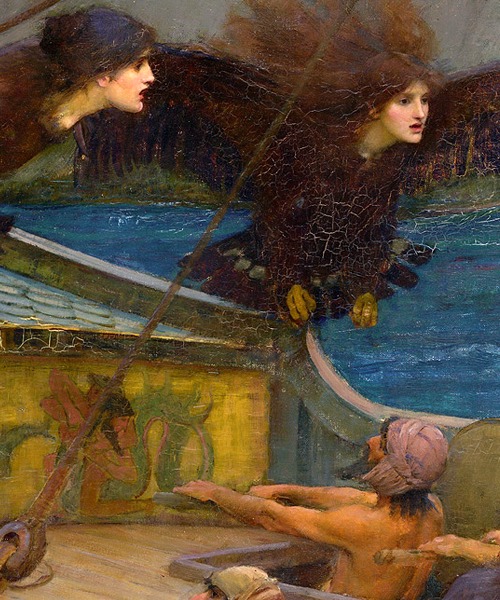
The Greek hero Odysseus (English: Ulysses), forewarned by the sorceress Circe, escaped the danger of the Siren's song by stuffing the ears of his crew with wax so that they were deaf to the Sirens; yet he was able to hear the music and had himself tied to the mast so that he could not steer the ship out of course. More
J.W. Waterhouse
Ulysses and the Sirens, c. 1891
Detail
J.W. Waterhouse
Ulysses and the Sirens, c. 1891
Detail
J.W. Waterhouse
Ulysses and the Sirens, c. 1891
Detail
A siren in Greek mythology was a creature half bird and half woman who lured sailors to destruction by the sweetness of her song. According to Homer there were two Sirens on an island in the western sea between Aeaea and the rocks of Scylla. Later the number was usually increased to three, and they were located on the west coast of Italy, near Naples. They were variously said to be the daughters of the sea god Phorcys or of the river god Achelous. More
The lamia is a siren in Basque mythology. Lamiak live in the river. They are very beautiful, and stay at the shore combing their long hair with a golden comb; they easily charm men. They have duck feet. In coastal areas, some believed that there were itsaslamiak in the sea, who had fish tails - a kind of mermaid.
John William Waterhouse (1849–1917)
Lamia (second version), c. 1909
Oil on canvas
36 × 22.5 in (91.4 × 57.2 cm)
Lamiak help those who give them presents by providing them with help at work; if a farmer left them food at the river shore, they would eat it at night and in exchange would finish a field he had left unploughed. In some places, bridges were believed to have been built by lamiak.
John William Waterhouse (1849–1917)
Vain Lamorna, A Study for Lamia
Oil on canvas
55 × 74 cm (21.7 × 29.1 in)
In some places lamiak had to go away if the bridge they were building at night was left unfinished at cockcrow. People believed that lamiak had left a river if a stone of the bridge was missing. Most lamiak disappeared when men built small churches in the forest.
John William Waterhouse (1849–1917)
Lamia, c. 1905
Oil on canvas
A lamia is at the other side of the rainbow combing her hair. When the sun lights her hair, the rainbow opens. More
John William Waterhouse (1849–1917)
Nymphs Finding the Head of Orpheus, c. 1900
Oil on canvas
99 × 149 cm (39 × 58.7 in)
Orpheus was a legendary musician, poet, and prophet in ancient Greek religion and myth. The major stories about him are centered on his ability to charm all living things and even stones, with his music, his attempt to retrieve his wife, Eurydice, from the underworld, and his death at the hands of those who could not hear his divine music.
John William Waterhouse (1849–1917)
Head of Orpheus - a Sketch
Oil on board
35.50cm high, 26.50cm wide
John William Waterhouse (1849–1917)
Study for Nymphs Finding the Head of Orpheus, c. 1900
oil on canvas
51 × 91 cm (20.1 × 35.8 in)
Northumbria University Gallery
Orpheus took part in this adventure and used his skills to aid his companions, travelling as an Argonaut. Chiron told Jason that without the aid of Orpheus, the Argonauts would never be able to pass the Sirens—the same Sirens encountered by Odysseus in Homer's epic poem the Odyssey.
John William Waterhouse (1849–1917)
Study for Nymphs Finding the Head of Orpheus, c. 1900
Oil on canvas
Orpheus had abstained from the love of women, either because things ended badly for him, or because he had sworn to do so. Yet, many felt a desire to be joined with the poet, and many grieved at rejection.
Feeling spurned by Orpheus, the Ciconian women first threw sticks and stones at him as he played, but his music was so beautiful even the rocks and branches refused to hit him. Enraged, the women tore him to pieces during the frenzy of their Bacchic orgies.
John William Waterhouse (1849–1917)
Study for Nymphs Finding the Head of Orpheus, c. 1900
Oil on canvas
His head and lyre, still singing mournful songs, floated down the swift Hebrus to the Mediterranean shore. There, the winds and waves carried them on to the Lesbos shore, where the inhabitants buried his head and a shrine was built in his honour near Antissa. More
John William Waterhouse (1849–1917)
The Charmer, Brizo, c. 1911
Brizo is known as a charmer, and a soother. In Greek mythology, she is a goddess worshipped at Delos and honored by women as the protector of mariners. Food offerings were set before the goddess in little boats (no fish). Brizo presided over an oracle that was consulted on matters relating to navigation and fishing. Her answers were given in dreams. More
Images are
copyright of their respective owners, assignees or others. Some Images may be
subject to copyright
I don't own any
of these images - credit is always given when due unless it is unknown to me.
if I post your images without your permission, please tell me.
I do not sell
art, art prints, framed posters or reproductions. Ads are shown only to
compensate the hosting expenses.
If you enjoyed
this post, please share with friends and family.
Thank you for
visiting my blog and also for liking its posts and pages.