Showing posts with label William Etty. Show all posts

06 Paintings, Olympian deities, William Etty's Venus, with footnotes # 47

William Etty, RA (British, 1789-1849)
Venus
Oil on board
19.7 x 14.3cm (7 3/4 x 5 5/8in).
Private collection

Sold for £800 in 14, 2021

William Etty, RA (British, 1789-1849)
Venus
Oil on canvas
64.5 x 50.5cm (25 3/8 x 19 7/8in).
Private collection

Sold for £2,550 in September 2022

Venus is the Roman goddess whose functions encompassed love, beauty, desire, sex, fertility, prosperity and victory. In Roman mythology, she was the mother of the Roman people through her son, Aeneas, who survived the fall of Troy and fled to Italy. Julius Caesar claimed her as his ancestor. Venus was central to many religious festivals, and was revered in Roman religion under numerous cult titles.
The Romans adapted the myths and iconography of her Greek counterpart Aphrodite for Roman art and Latin literature. In the later classical tradition of the West, Venus becomes one of the most widely referenced deities of Greco-Roman mythology as the embodiment of love and sexuality. More on Venus

William Etty, RA (British, 1789-1849)
Venus and Cupid
Oil on canvas
70 x 47cm (27 1/2 x 18 1/2in)
Private collection

Sold for £7,650 in September 2022
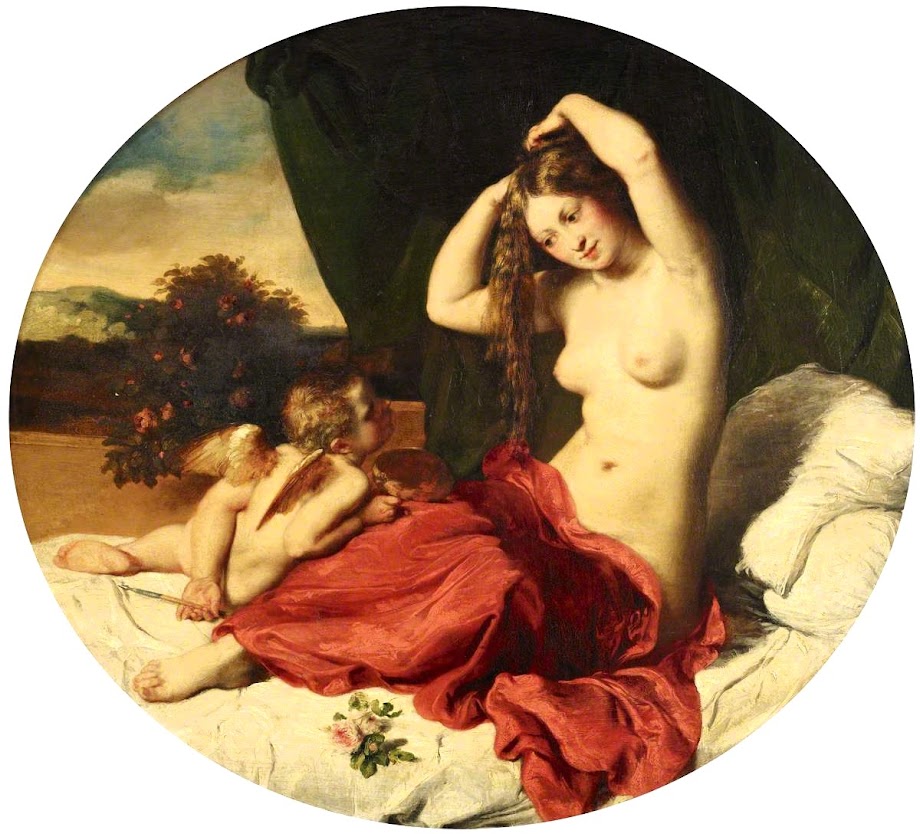
William Etty  (1787–1849)
The Toilet of Venus, between 1807 and 1849
Oil on canvas
height: 66 cm (25.9 in); width: 72.4 cm (28.5 in)
National Trust

This painting is characteristic of Etty, since many of his pictures consist of mythological characters worked up from extremely faithful studies of the female nude, drawn at the Academy Life School. Etty’s justification for painting the female nude so insistently was that he found ‘God’s most glorious work to be Woman’, and ‘that all human beauty had been concentrated in her’. Although there was much contemporary criticism of his work on the grounds of indecency, Etty was not deterred from his self-appointed task.

William Etty was a very unusual Victorian artist in dedicating himself almost exclusively to the depiction of the nude, which he painted in a glowing and sensual manner, reminiscent of Titian and Rubens. From his faithful studies undertaken at the Academy Life School, Etty produced many mythological and religious scenes, which he constantly subjected to the requirements of ideal art. More on this painting
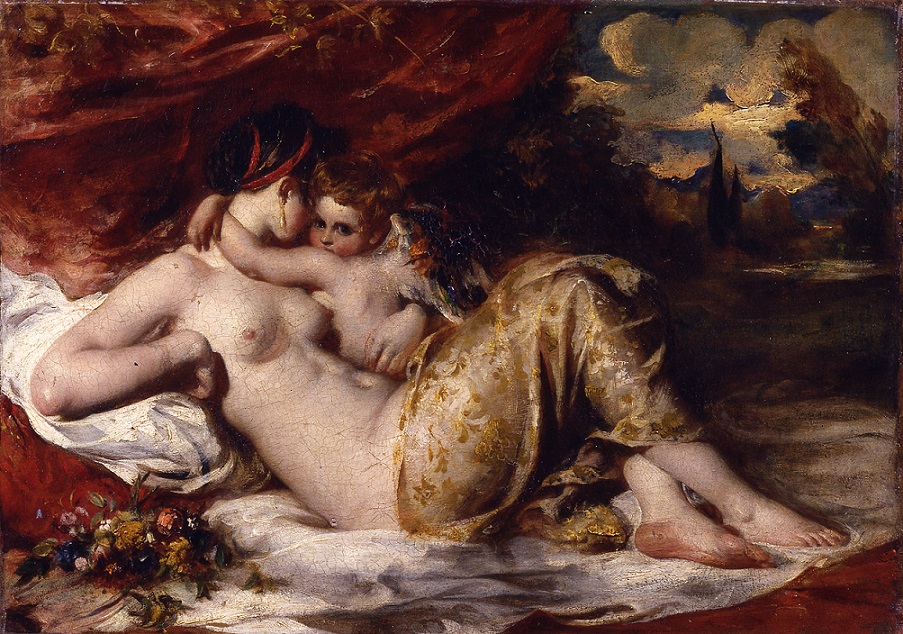
William Etty
Venus and Cupid, c. 1830
York Art Gallery's collection

William Etty  (1787–1849)
Venus of Urbino (after Titian), c. 1823
Oil on canvas
height: 122.3 cm (48.1 in); width: 169 cm (66.5 in)
Royal Scottish Academy

Different tales exist about the origin of Venus and Cupid. Some say that Venus, the goddess of love and beauty, had a love affair with Mars, the god of war. Out of this relationship, Cupid was born. 

Cupid has attributes from both of his parents. Like his mother he is considered to be the god of love, or more precisely, the god of falling in love. He is portrayed as an innocent little child with bow and arrows. He shoots arrows to the heart, and awakening a love that you’re powerless to resist.

Venus and Cupid are often shown in intimate poses, reflecting the unique love between mother and child. More Venus and Love

William Etty RA (10 March 1787 – 13 November 1849) was an English artist best known for his history paintings containing nude figures. He was the first significant British painter of nudes and still lifes. Born in York, he left school at the age of 12 to become an apprentice printer in Hull. He completed his apprenticeship seven years later and moved to London, where in 1807 he joined the Royal Academy Schools. There he studied under Thomas Lawrence and trained by copying works by other artists. Etty earned respect at the Royal Academy of Arts for his ability to paint realistic flesh tones, but had little commercial or critical success in his early years in London. More on William Etty


Please visit my other blogs: Art Collector, Mythology, Marine Art, Portrait of a Lady, The Orientalist, Art of the Nude and The Canals of Venice, Middle East Artists, 365 Saints, 365 Days, and Biblical Icons, also visit my Boards on Pinterest

Images are copyright of their respective owners, assignees or others. Some Images may be subject to copyright

I don't own any of these images - credit is always given when due unless it is unknown to me. if I post your images without your permission, please tell me.

I do not sell art, art prints, framed posters or reproductions. Ads are shown only to compensate the hosting expenses.

If you enjoyed this post, please share with friends and family.

Thank you for visiting my blog and also for liking its posts and pages.

Please note that the content of this post primarily consists of articles available from Wikipedia or other free sources online.


03 Paintings, Olympian deities, King Candaules, with footnotes #38

Jean-Léon Gérôme, (1824–1904)
King Candaules, c. 1859
Oil on canvas
Height: 67 cm (26.3 ″); Width: 100.1 cm (39.4 ″)
Museo de Arte de Ponce

Jean-Léon Gérôme (11 May 1824 – 10 January 1904) was a French painter and sculptor in the style now known as Academicism. The range of his oeuvre included historical painting, Greek mythology, Orientalism, portraits and other subjects, bringing the Academic painting tradition to an artistic climax. He is considered one of the most important painters from this academic period, and in addition to being a painter, he was also a teacher with a long list of students. More on Jean-Léon Gérôme

According to Herodotus, Candaules believed his wife, Nyssia, to be the most beautiful woman on Earth. 
Candaules often told his favourite bodyguard, Gyges, how beautiful the queen was and, thinking Gyges did not believe him, urged Gyges to contrive to see her naked. Gyges initially refused as he did not wish to dishonor the queen. Nevertheless, Candaules was insistent and Gyges had no option but to obey his king. So Gyges hid in Candaules' bedroom and, when the queen entered, watched her undress. As she was getting into bed, he quietly left the room, but the queen saw him and realised what had happened. 

William Etty, (1787–1849)
Candaules, King of Lydia, Shews his Wife by Stealth to Gyges, One of his Ministers, As She Goes to Bed, c. 1830

Oil on canvas
Height: 45.1 cm (17.7 ″); Width: 55.9 cm (22 ″)
Tate Britain
William Etty RA (10 March 1787 – 13 November 1849) was an English artist best known for his history paintings containing nude figures. He was the first significant British painter of nudes and still lifes. Born in York, he left school at the age of 12 to become an apprentice printer in Hull. He completed his apprenticeship seven years later and moved to London, where in 1807 he joined the Royal Academy Schools. There he studied under Thomas Lawrence and trained by copying works by other artists. Etty earned respect at the Royal Academy of Arts for his ability to paint realistic flesh tones, but had little commercial or critical success in his early years in London. More on William Etty

The queen silently swore revenge for her shame. Next day, she summoned Gyges to her chamber. Gyges thought it was a routine request, but she confronted him immediately and presented him with two choices. One was to kill Candaules and seize the throne with Nyssia as his wife. The second was to be executed immediately by her trusted servants.He decided to take the first course of action and assassinate the king. The plan was that he should hide in the royal bedroom as before but this time from the king. After Candaules fell asleep, Gyges crept forward and stabbed him to death.
Giambattista Pittoni,  (1687–1767)
Death of King Candaules, c. 1720
Oil on canvas
Height: 161 cm (63.3 ″); Width: 210 cm (82.6 ″)
Hermitage Museum

Giambattista Pittoni or Giovanni Battista Pittoni (6 June 1687 - 6 November 1767) was a Venetian painter of the late Baroque or Rococo period. He was among the founders of the Academy of Fine Arts of Venice , of which in 1758 he became the second president, succeeding Tiepolo.

Pittoni studied under his uncle Francesco Pittoni, a well-known but undistinguished painter of the Venetian Baroque. 

Pittoni joined the Fraglia of the Venetian Painters, the Venetian guild of painters, in 1716. From, probably, the same year until his death he was a member of the College of Painters, of which he became prior in 1729.  He was elected to the Clementine Academy of Bologna in 1727. In 1750 he was one of the forty-six members of the Veneta Publish Academy of Painting, Sculpture and Architecture, which later became the Academy of Fine Arts of Venice ; from 1758 to 1760 he succeeded Tiepoloas president of the academy, and was elected for a second term in 1763–64. More on Giambattista Pittoni

Gyges married the queen as she had insisted but many Lydians did not at first accept him as their ruler. In order to prevent a civil war, Gyges offered to have his position confirmed or refused by the Delphic Oracle. He agreed that he would restore the throne to the Heracleidae if the Oracle declared against him. The Oracle supported him and his dynasty was established. More on Candaules and Nyssia


Please visit my other blogs: Art Collector, Mythology, Marine Art, Portrait of a Lady, The Orientalist, Art of the Nude and The Canals of Venice, And visit my Boards on Pinterest

Images are copyright of their respective owners, assignees or others. Some Images may be subject to copyright

I don't own any of these images - credit is always given when due unless it is unknown to me. if I post your images without your permission, please tell me.

I do not sell art, art prints, framed posters or reproductions. Ads are shown only to compensate the hosting expenses.

If you enjoyed this post, please share with friends and family.


Thank you for visiting my blog and also for liking its posts and pages.