Showing posts with label Lovis Corinth. Show all posts

01 Painting, CONTEMPORARY & 20th Century Interpretation of the Bible! With Footnotes - 35

Lovis Corinth, (1858–1925)
Susanna and the Elders, c. 1923
Oil on canvas
150,5 x 111 cm
Lower Saxony State Museum 

A fair Hebrew wife named Susanna was falsely accused by lecherous voyeurs. As she bathes in her garden, having sent her attendants away, two lustful elders secretly observe the lovely Susanna. When she makes her way back to her house, they accost her, threatening to claim that she was meeting a young man in the garden unless she agrees to have sex with them.
She refuses to be blackmailed and is arrested and about to be put to death for promiscuity when a young man named Daniel interrupts the proceedings, shouting that the elders should be questioned to prevent the death of an innocent. After being separated, the two men are questioned about details of what they saw, but disagree about the tree under which Susanna supposedly met her lover. In the Greek text, the names of the trees cited by the elders form puns with the sentence given by Daniel. The first says they were under a mastic, and Daniel says that an angel stands ready to cuthim in two. The second says they were under an evergreen oak tree, and Daniel says that an angel stands ready to saw him in two. The great difference in size between a mastic and an oak makes the elders' lie plain to all the observers. The false accusers are put to death, and virtue triumphs. More about Susanna

Lovis Corinth (21 July 1858 – 17 July 1925) was a German artist and writer whose mature work as a painter and printmaker realized a synthesis of impressionism and expressionism.
Corinth studied in Paris and Munich, joined the Berlin Secession group, later succeeding Max Liebermann as the group's president. His early work was naturalistic in approach. Corinth was initially antagonistic towards the expressionist movement, but after a stroke in 1911 his style loosened and took on many expressionistic qualities. His use of color became more vibrant, and he created portraits and landscapes of extraordinary vitality and power. Corinth's subject matter also included nudes and biblical scenes. More on Lovis Corinth


Please visit my other blogs: Art CollectorMythologyMarine ArtPortrait of a Lady, The OrientalistArt of the Nude and The Canals of VeniceMiddle East Artists365 Saints and 365 Days, also visit my Boards on Pinterest

Images are copyright of their respective owners, assignees or others. Some Images may be subject to copyright

I don't own any of these images - credit is always given when due unless it is unknown to me. if I post your images without your permission, please tell me.

I do not sell art, art prints, framed posters or reproductions. Ads are shown only to compensate the hosting expenses.

If you enjoyed this post, please share with friends and family.

Thank you for visiting my blog and also for liking its posts and pages.

Please note that the content of this post primarily consists of articles available from Wikipedia or other free sources online.


25 Works, RELIGIOUS ART - Paintings from the Bible, with footnotes, 6

Circle of Pieter Coecke van Aelst I (Aalst 1502-1550 Brussels) 
The Last Supper 
oil on panel 
59 x 200 cm

Pieter Coecke van Aelst or Pieter Coecke van Aelst the Elder (August 14, 1502 – December 6, 1550) was a Flemish painter, sculptor, architect and a designer of woodcuts, stained glass and tapestries. His principal subjects are Christian religious themes. He worked in Antwerp and Brussels and was court painter to Charles V, Holy Roman Emperor.

His Last Supper was one of the most popular images of the sixteenth century. It was freely inspired by Leonardo da Vinci's Last Supper in Milan and Marcantonio Raimondi's engraving after Raphael's drawing of the same subject. The gestures of the apostles are based on a print by Albrecht Dürer of 1523. There exist about 45 versions of this composition, which were executed with the assistance of workshop assistants. A great number of the versions are dated, and 6 or 7 date to 1528. The Last Supper probably originated as a drawn model, which was then transferred to a panel by means of cartoons. The composition could be ordered in two formats: 50 x 60 cm and 60 x 80 cm. The large format appears to have been the most popular. Small biblical scenes are depicted in the background, heightening the impact of the main theme. Through the window an Antwerp archway we can see the Entry in Jerusalem of Jesus Christ. Depictions of the Fall of Man are visible in the ornamented window. The medals represent the stories of David and Goliath and the Slaying of Cain. The scene with Cain and Abel is taken directly from a print by another popular Renaissance artist, Jan Gossaert. The whole iconography accentuates the Christian occupation with original sin and mankind's salvation through Christ's sacrifice. More

Studio of Adriaen Isenbrant
The Virgin and Child enthroned, attended by angels, before an open window with a hilly river landscape beyond
oil on panel
42.8 x 32.8 cm.

Adriaen Isenbrandt (1480 and 1490 – July 1551) was a Flemish Northern Renaissance painter, who from documentary evidence was clearly a significant artist of his period, but to whom no specific works can be clearly documented. As hypothesised by art historians, he ran a large workshop specializing in religious subjects and devotional paintings, painting conservatively in the tradition of Early Netherlandish painting. He is believed by some to be the anonymous Master of the Seven Sorrows of the Virgin. Other art historians doubt that any works can be reliably attributed to him, and the number of paintings attributed to him by major museums has been in decline for many decades. More


Lovis Corinth 1858 - 1925 GERMAN SUSANNA IM BADE signed Lovis Corinth,  and dated 1890 (lower right) oil on canvas 63 by 44 in. 159 by 111.8 cm:
Lovis Corinth, 1858 - 1925
GERMAN
SUSANNA IM BADE
signed Lovis Corinth,  and dated 1890 (lower right)
oil on canvas
63 by 44 in.
159 by 111.8 cm

In the Book of Daniel, Susanna, a married woman, is spied upon by two lustful elders while bathing. As she returns to her home, they accost her, threatening to claim that she was meeting a young man in the garden unless she succumbs to their advances. She refuses to be blackmailed and is consequently arrested and tried for promiscuity, until Daniel interrupts the proceedings in her defense and reveals the truth about the elders. Since the Renaissance, this narrative has provided inspiration for artists to draw upon and convey themes of innocence and culpability, as well as an occasion to paint a nude figure within the context of a history painting. The subject is portrayed by such masters as Peter Paul Rubens, Anthony van Dyck, Artemisia Gentileschi, Pablo Picasso, Thomas Hart Benton and, in the present work, Lovis Corinth, whose rendering was inspired by Jean-Jacques Henner’s earlier composition, Chaste Susannah (1864, Musée d’Orsay), see below, which Corinth would have known from the collection of the Musée de Luxembourg.

While Henner’s painting was highly criticized at the Salon for the inelegant pose of the model and the thinness of the veil offered by the historical subject (see below), Corinth’s submission nearly thirty years later almost abandons the narrative alibi altogether, including elements such as the curtain and peering heads of the Elders anecdotally. The frank presentation of his model sympathizes with the realist nudes of Gustave Courbet. As Andrea Bärnreuther suggests: “It was Corinth’s objective to free the nude of the conventional formulas that had so long determined and limited its presentation and so to restore life to hollow figures drained of all sensuality” (Lothar Brauner and Andrea Bärnreuther, Lovis Corinth, p. 106).

There are two versions of Corinth’s Susanna of 1890; the present, primary composition, which he exhibited at the Salon of 1891 and untraced until recently, and the second version in the collection of the Folkwang Museum, Essen, Germany. Corinth would return to the subject throughout the subsequent decades in his career, including versions dating from 1897, 1909 and 1923, next, revealing his changing perspective on the narrative and his evolution as an artist. The composition also served as the basis for an etching made in 1920.

Lovis Corinth
Susanna and the Elders, c. 1923
Height: 148 cm (58.27 in.), Width: 108 cm (42.52 in.)
Oil on canvas 
Niedersächsisches Landesmuseum


Jean-Jacques Henner (1829-1905)
Chaste Suzanne, c. 1864
Oil on canvas
H. 185; W. 130 cm
Paris, Musée d'Orsay

The Biblical episode of Suzanne bathing, often treated since the Renaissance, was above all an opportunity for the artist to paint a handsome nude. This aim became clear in Henner's version of the theme of which he sent back to France in the last year of his residence at the Villa Medicis. For this compulsory exercise, supposed to demonstrate the student's progress and skill in execution, he naturally took his inspiration from prestigious examples left by the great masters in the eternal city. The study of Suzanne Bathing by Guerchino (Colonna Gallery) and Titian's Sacred Love and Profane Love supplied the original idea.

His work was severely criticised particularly for the heaviness and lack of nobility in the model's body. Worse still, for the artificiality of the subject which, on the pretext of being a history painting, showed no more than a simple bather. This tendency to get rid of any narrative alibi in painting the nude, treating it as a subject in itself, could be found in the work of many contemporary artists, starting with Courbet.

Henner's Suzanne is nonetheless a vigorously modelled, sturdily built young woman well set off by the drapery. A prelude in a way to a long series of female figures with pearly complexions, delicately detached from twilight landscapes, a motif which Henner treated over and over again. More

Jean-Jacques Henner (15 March 1829 – 23 July 1905) was a French painter, noted for his use of sfumato and chiaroscuro in painting nudes, religious subjects, and portraits. He was born at Bernwiller (Alsace). He began his studies in art as a pupil of Michel-Martin Drolling and François-Édouard Picot. In 1848, he entered the École des Beaux Arts in Paris, and took the Prix de Rome with a painting of Adam and Eve finding the Body of Abel in 1858. In Rome, he was guided by Flandrin, and painted four pictures for the gallery at Colmar among other works.

He first exhibited Bather Asleep at the Salon in 1863 and subsequently contributed Chaste Susanna (1865), now in the Musée d'Orsay. Other noted works include: Byblis turned into a Spring (1867); The Magdalene (1878); Portrait of M. Hayem (1878); Christ Entombed (1879); Saint Jerome (1881); Herodias (1887); A Study (1891); Christ in His Shroud and a Portrait of Carolus-Duran (1896); a Portrait of Mlle Fouquier (1897); and The Dream (1900).

The Levite of the Tribe of Ephraim (1898) was awarded a first-class medal. Among other professional distinctions, Henner also took a Grand Prix for painting at the Paris Exposition Universelle of 1900. He was made Chevalier of the Legion of Honour in 1873, Officer in 1878, and Commander in 1889. In 1889, he succeeded Cabanel in the Institut de France.

Henner died at age 76 in Paris. More

Madonna Litta.tempera and oil on panel, transferred to canvas.42 × 33 cm (16.5 × 13 in). Hermitage Museum
Leonardo da Vinci
Madonna Litta.
tempera and oil on panel, transferred to canvas.
42 × 33 cm (16.5 × 13 in). 
Hermitage Museum

The Madonna Litta is a late 15th-century painting, traditionally attributed to Leonardo da Vinci, in the Hermitage Museum, Saint Petersburg. It depicts the Virgin Mary breastfeeding the Christ child, a devotional subject known as the Madonna lactans. The figures are set in a dark interior with two arched openings, as in Leonardo's earlier Madonna of the Carnation, and a mountainous landscape in aerial perspective can be seen beyond. In his left hand Christ holds a goldfinch, which is symbolic of his future Passion.

Scholarly opinion is divided on the work's attribution, with some believing it to be the work of a pupil of Leonardo such as Giovanni Antonio Boltraffio or Marco d'Oggiono; the Hermitage Museum, however, considers the painting to be an autograph work by Leonardo. The painting takes its name from the House of Litta, a Milanese noble family in whose collection it was for much of the nineteenth century. More

Russian School, possibly 20th century
A pair of Icons
one depicting King David, probably taken from an iconostasis
oil on panel 
76.5 x 33.5cm (30 1/8 x 13 3/16in).

Beverly Whitney Kean (1921-2011) Collection, New York and Scotland. Beverly Whitney Kean was among the first Western tourists to visit the Soviet Union in 1959. On the advice of Alfred Barr, the director of the Museum of Modern Art, New York, she decided to write the book which was to reconstruct the history of arguably Russia's greatest period of artistic patronage. 

Andrea del Sarto (Attributed to)
Holy Family, 1540 Circa
Oil on wood panel
Size: 21" x 26"

Andrea del Sarto (1486–1530) was an Italian painter from Florence, whose career flourished during the High Renaissance and early Mannerism. Though highly regarded during his lifetime as an artist senza errori ("without errors"), his renown was eclipsed after his death by that of his contemporaries, Leonardo da Vinci, Michelangelo, and Raphael.

Andrea del Sarto (1486–1530)
Pietà with Saints, c. 1523 and 1524
Oil on panel
Height: 239 cm (94.1 in). Width: 199 cm (78.3 in).
Pitti Palace 


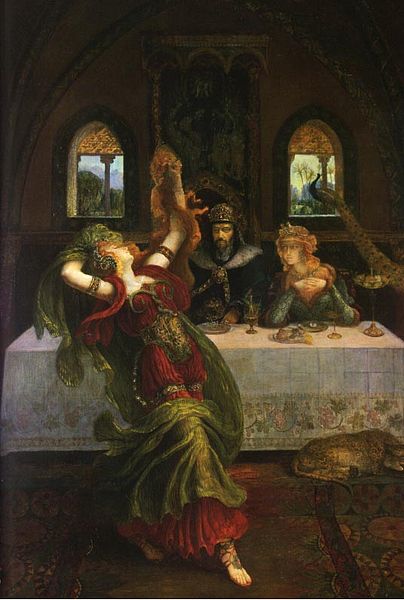
File:PointArmandDanceOftheSevenVeils.jpg
Armand_Point(1861–1932) 
Dance Of the Seven Veils, circa 1890

After removing seven veils as part of an erotic dance and encouraged by her mother Herodias, step-daughter Salome requested that Tetrarch Herod Antipater reward her with John the Baptist's head on a platter. 

The idea that Salome's dance involves "seven veils" originates with Wilde's 1891 play Salomé. Wilde was influenced by earlier French writers who had transformed the image of Salome into an incarnation of female lust. Rachel Shteir writes that, More

Armand Point (23 March 1860 or 23 March 1861 – February 1932 or March 1932) was a French painter, engraver and designer who was associated with the Symbolist movement and was one of the founders of the Salon de la Rose + Croix. Later he formed his own atelier. Sources differ over the details of his birth and death. More

undefined
Theodoor Rombouts
Christ Driving the Money-changers from the Temple
oil on canvas
168 x 238,5 cm
Royal Museum of Fine Arts Antwerp

The cleansing of the Temple narrative tells of Jesus expelling the money changers from the Temple, and occurs in all four canonical gospels of the New Testament.

In this account, Jesus and his disciples travel to Jerusalem for Passover, where Jesus expels the money changers from the Temple, accusing them of turning the Temple into a den of thieves through their commercial activities. In the Gospel of John Jesus refers to the Temple as "my Father’s house", thus, making a claim to being the Son of God.[3]

The narrative occurs near the end of the Synoptic Gospels (at Mark 11:15–19, Matthew 21:12–17, and Luke 19:45–48) and near the start in the Gospel of John (at John 2:13–16). Some scholars believe that these refer to two separate incidents, given that the Gospel of John also includes more than one Passover. More

"Jesus entered the temple, floated out all them that sold and bought in the temple, and threw the tables of the money changers and the seats of pigeons saleswomen. He spoke unto them, It is written, My house shall be called a house of prayer; but ye have made it a den of thieves " More

Theodoor Rombouts (2 July 1597 – 14 September 1637) was a Flemish painter who is mainly known for his Caravaggesque genre scenes depicting lively dramatic gatherings as well as religiously themed works. He is considered to be the primary representative of Flemish Caravaggism.

1
The Money Exchangers
After the painting by Petrus Christus (Flemish circa 1410-1476)
 by noted Limoges enamel artist, J. P. Loup (1867-1948)
Signed J.P. Loup, Limoges
 9 inches x 7.9 inches (23 x 20 cm)

Petrus Christus (1425–1476)
Annonciation, circa 1450
Oil on panel
77.5 × 66.5 cm (30.5 × 26.2 in)
Metropolitan Museum of Art

Petrus Christus (c. 1410/1420 – 1475/1476) was an Early Netherlandish painter active in Bruges from 1444. He was influenced by van Eyck and Rogier van der Weyden and is noted for his innovations with linear perspective and a meticulous technique which seems derived from miniatures and manuscript illumination. Today, some 30 works are confidently attributed to him. The best-known include the 1446 Portrait of a Carthusian and c. 1470 Berlin Portrait of a Young Girl, both are highly innovative in presentation of the figure against detailed, rather than flat, backgrounds.

Christus was an anonymous figure for centuries, his importance not established until the work of modern art historians. Giorgio Vasari barely mentions him in his biographies of painters, written in the Renaissance, and near contemporary records merely list him amongst many others. In the early to mid-nineteenth century, Gustav Waagen and Johann David Passavant were important in establishing Christus's biographical details and in attributing works to him. More

1
P. Bonhaud 
THE VIRGIN, CIRCA 1900
FRENCH LIMOGES 
Enameled plaque
9.75 inches x 8.25 inches (25 x 21 cm)

Girolamo Comi, (Italian, 1507-1581)
The Dance of Salome, c. 1562
23 5/8" h x 16 1/8" h.

Girolamo Comi (1507–1581) was a 16th-century Italian Renaissance painter. Not much is known about Girolamo Comi's life except through his works. He primarily painted religious-themed paintings for church commissions. One work executed by Comi The Madonna with St George is part of the York Museums Trust collection. More

Continental School 
Lot and his daughters, 1600 Circa
Oil on Canvas
104 x 135 centimetres

Eduard (Carl Friedrich E.) Holbein (German, 1807-1875) Ruth and Boaz 54 1/2 x 68in (138 x 172.5cm)
Eduard (Carl Friedrich E.) Holbein (German, 1807-1875)
Ruth and Boaz 
signed and dated 'E. / Holbein / 18[.]0.' (lower right)
oil on canvas
54 1/2 x 68in (138 x 172.5cm)

Eduard Holbein was a history painter and illustrator who lived and worked in Berlin. He studied at the Berlin Academy, where he also taught from 1851. Among his private students were Max Liebermann and Hans von Marées.


Holbein was mostly known for his portraits of the German Emperors in the ceiling medallions of the Neues Museum in Berlin


William Charles Thomas Dobson (German, 1817-1898) The prosperous days of Job 44 x 35in (111.7 x 88.9cm)
William Charles Thomas Dobson (German, 1817-1898)
The prosperous days of Job 
signed with the artist's monogram and dated '1855' (lower left)
oil on canvas
44 x 35in (111.7 x 88.9cm)

William Charles Thomas Dobson was born in Hamburg, Germany, but shortly after his birth his parents moved to Great Britain. As a young man, Dobson practiced drawing during his visits to the British Museum and he was enrolled in the Royal Academy Schools in 1836. He exhibited regularly at the Royal Academy from 1842 and he was noted for his portrayal of uplifting themes and brilliant colors reminiscent of the work of Sir Charles Eastlake. Dobson was elected ARA in 1860 and RA in 1872.

The Bible passage referred to in the painting is Job, 42:12-15 when God rewards Job after all his tribulations. "So the Lord blessed the latter end of Job more than his beginning.." Job is depicted at the center of the composition lifting his hands in thanks to the Lord and is surrounded by his generations

1
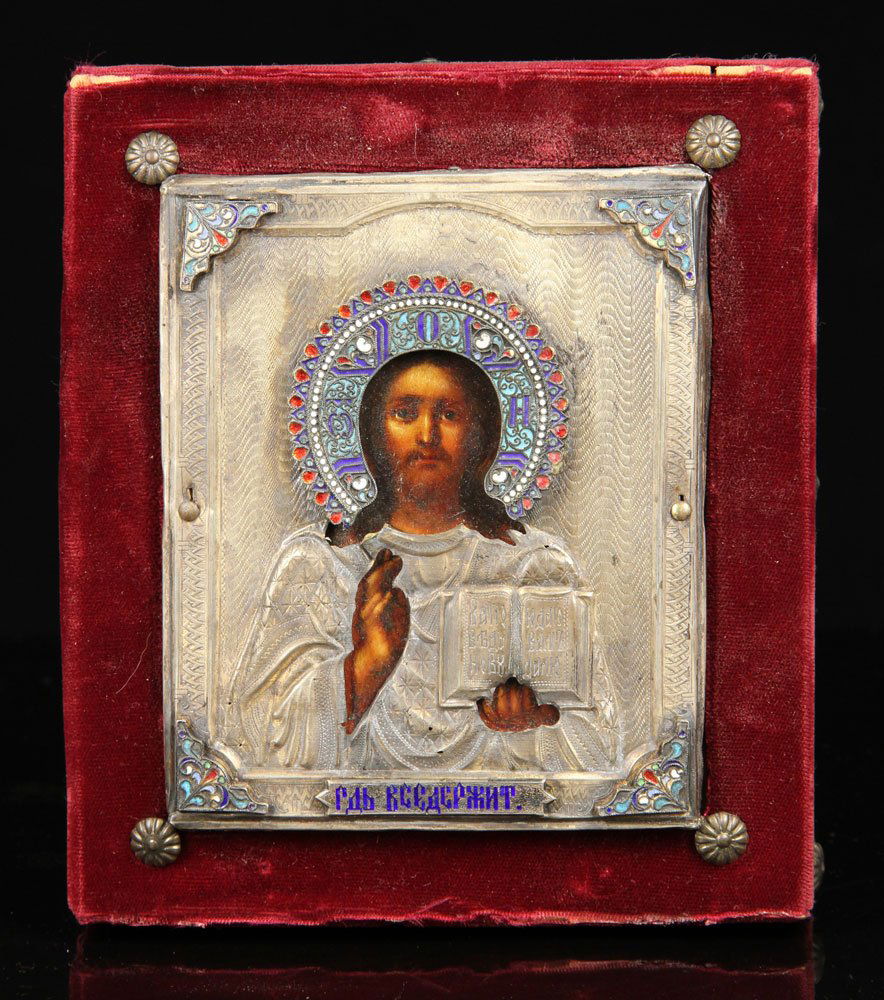
Vasily Semenov (Russian)
Russian Icon of Christ
Silver, with overlaid silver riza and cloissone halo and corners, 
dated 1891, 
13 1/5" h x 11" w. 


Russian Silver-Gilt and Cloisonné Enamel Icon of The Mother of God, Moscow, c.1908-17, painted on wood panel, the engraved oklad with halos in translucent and opaque coloured enamels, 7.1" x 5.7" — 18 x 14.5 cm., maker’s marks (cyrillic) P.T


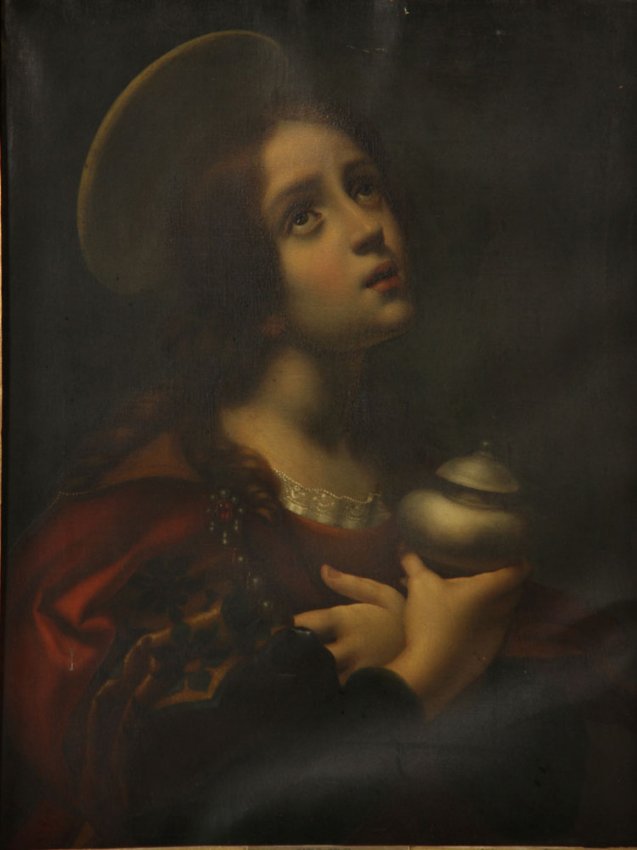
Egisto Manzuoli (Italian, 19th century)
after Carlo Dolci
Penitent Mary Magdalene
Oil on canvas
28" h x 22" w

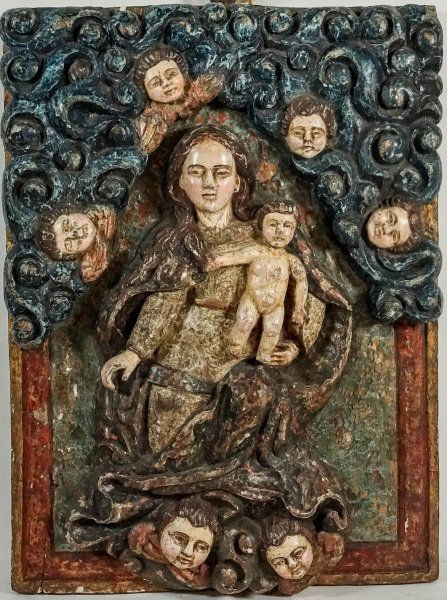
MADONNA & CHILD
18th CENTURY
PERUVIAN CARVING
Height: 24 in. by Width: 18 in.

CIRCA 1700 MEXICAN 
MADONNA & CHILD 
OIL ON CANVAS
Height: 28 & 18 in. by Width: 27 & 15 in.

Acknowledgement: Bonhams

22 Works, RELIGIOUS ART - Paintings from the Bible by the Old Masters! The temptation of St. Anthony of Egypt

Anthony the Great (c. 251 – 356 AD), also known as Saint Anthony of Egypt, Anthony the Abbot, and Father of All Monks, was a Christian saint from Egypt, a prominent leader among the Desert Fathers. His feast day is January 17 in both the Orthodox and Roman Catholic Churches and 22 Tobi according to the calendar of the Coptic Orthodox Church.

Artists: Hyeronimus Bosch, Lovis Corinth, Cornelis Massys, David Ryckaert, Joachim Patinir, David Rijckaert, Marten de Vos, David Teniers, Fra Angelico, Annibale Carracci, Félicien Rops, Paul Delaroche, J. Bosch, Fantin Latour, Sebastiano Ricci, Giovanni Battista Tiepolo, Tintoretto

Annibale Carracci  1597
The Temptation of St Anthony Abbot
Style: Baroque
Genre: religious painting
Technique: oil
Dimensions: 50 x 34 cm

Annibale Carracci (November 3, 1560 – July 15, 1609) was an Italian Baroque painter. He was born in Bologna, and in 1582, Annibale, his brother Agostino and his cousin Ludovico Carracci opened a painters' studio. While the Carraccis laid emphasis on the typically Florentine linear draftsmanship, their interest in the glimmering colours and mistier edges of objects derived from the Venetian painters, which Annibale and Agostino studied during their travels around Italy in 1580–81. This eclecticism was to become the defining trait of the artists of the Baroque Emilian or Bolognese School. More

Anthony is said to have faced a series of supernatural temptations during his pilgrimage to the desert. It is possible these events, like the paintings, are full of rich metaphor or in the case of the animals of the desert, perhaps a vision or dream. Some of the stories included in Saint Anthony's biography are perpetuated now mostly in paintings, where they give an opportunity for artists to depict their more lurid or bizarre interpretations.

The biography of Anthony's life by Athanasius of Alexandria helped to spread the concept of monasticism, particularly in Western Europe through Latin translations. 

Fra Angelico, 
St Anthony Abbot Shunning the Mass of Gold , 1430s. 

Fra Angelico (c. 1395 – February 18, 1455) was an Early Italian Renaissance painter described by Vasari as having "a rare and perfect talent".


In 1982 Pope John Paul II proclaimed his beatification, in recognition of the holiness of his life, thereby making the title of "Blessed" official. Fiesole is sometimes misinterpreted as being part of his formal name, but it was merely the name of the town where he took his vows as a Dominican friar, and was used by contemporaries to separate him from other Fra Giovannis. He is listed in the Roman Martyrology as Beatus Ioannes Faesulanus, cognomento Angelicus—"Blessed Giovanni of Fiesole, known as 'the Angelic'. More

He is often erroneously considered the first monk, but as his biography and other sources make clear, there were many ascetics before him. Anthony was, however, the first known ascetic going into the wilderness (about AD 270–271), a geographical move that seems to have contributed to his renown.

David Teniers the Younger (1610–1690)
The Temptation of Saint Anthony
Second half of 17th century
Oil on oak panel
22 cm (8.7 in). Width: 16 cm (6.3 in)

David Teniers the Younger (15 December 1610 – 25 April 1690) was a Flemish artist born in Antwerp.

Teniers was chosen by the common council of Antwerp to preside over the Guild of Saint Luke in 1644. The Archduke Leopold Wilhelm, who had assumed the government of the Spanish Netherlands employed Teniers as a painter and as keeper of his growing collection of pictures.

Two thousand paintings are thought to have been painted by Teniers. Smith's Catalogue Raisonné gives descriptions of over 900 paintings accepted as original productions of Teniers. Few artists ever worked with greater ease, and some of his smaller pictures, landscapes with figures, have been termed "afternoons", not from their subjects, but from the time spent in producing them.
More


Accounts of Anthony enduring supernatural temptation during his sojourn in the Eastern Desert of Egypt inspired the often-repeated subject of the temptation of St. Anthony in Western art and literature.

Maarten De Vos (1532-1603)
The Temptation Of Saint Anthony c. 1591-4
Antwerpen:Royal Museum of Fine Art (Belgium)

Maarten de Vos was born in 1532 in Antwerp , where he died December 4, 1603, is a Flemish painter of religious subjects, allegorical, historical and portraits.


He traveled in Italy and adopted the Mannerist style popular at the time. De Vos was also strongly influenced by the colors of Venetian painting. Following the iconoclastic destruction in 1566, he was one of the artists largely responsible for redecorating churches of Antwerp with new altarpieces. His nephew Willem de Vos was also a painter.


He is also the founder of the Society of Romanists , which brought together artists, amateurs and humanist who had visited Rome and enjoyed its humanistic culture. More

Anthony is appealed to against infectious diseases, particularly skin diseases. In the past, many such afflictions, including ergotism, erysipelas, and shingles, were historically referred to as St. Anthony's fire.

David Rijckaert III (Antwerp 1612-1661) 

The Temptation of Saint Anthony 

oil on copper 

60.8 x 88.2 cm.
Anthony was born in Coma (or Koma) near Herakleopolis Magna in Lower Egypt in 251 to wealthy landowner parents. When he was about 18 years old, his parents died and left him with the care of his unmarried sister.


David Ryckaert (1612-1661)

The Temptation Of Saint Anthony


Anthony the Great is considered as "Father of Monasticism". A number of Christian ascetics had retired to isolated locations on the outskirts of cities, but none of them started a spontaneous monastic religious movement.

The Temptation of St. Anthony of Egypt
David III Ryckaert

David Rijckaert III, (2 December 1612 (baptized), Antwerp - 11 November 1661, Antwerp) was a Flemish painter known for his contribution to genre painting, in particular through his scenes of merry companies and peasants. He enjoyed the patronage of prominent patrons and was a painter to the court of the governor of the Southern Netherlands.

David Ryckaert was a pupil of his father. He became master of the Guild of Saint Luke in Antwerp in 1636-37 and was the dean of the Guild in 1652-53. He was the teacher of Hans la Croys, Jacob Lafosse II and Erasmus de Bie.

David Ryckaert III worked his entire career in Antwerp. His work was very well received and one of his patrons was Archduke Leopold Wilhelm of Austria, the Governor of the Southern Netherlands from 1647 until 1656.
 More


Shortly thereafter, he decided to follow the words of Jesus, who had said: "If you want to be perfect, go, sell what you have and give to the poor, and you will have treasures in heaven; and come, follow Me". Taking these words quite literally, Anthony gave away some of the family estate to his neighbors, sold the remaining property, donated the funds thus raised to the poor, placed his sister with a group of Christian virgins, a sort of proto-monastery of nuns, and himself became the disciple of a local hermit.


The Temptation of St Anthony"
Cornelis Massiys

oil on Canvas.


Cornelis Massijs (1508, Antwerp – c. 1556, unknown), was a Flemish Renaissance painter, draughtsman and engraver, mainly known for his landscapes and, to a lesser extent, genre scenes and portraits. He is regarded as an important figure in the transition from the fantastic landscapes of Joachim Patinir to the 'pure landscapes' of later Netherlandish landscape painting.


He was the son of leading Antwerp painter Quinten Matsys and the younger brother of Jan, who also became a prominent painter. He trained under his father. He was admitted together with his brother Jan, as a master in the Antwerp Guild of St. Luke in 1531, a year after his father's death. In 1544 the brothers were forced to leave Antwerp because of their religious beliefs. Where Cornelis went and whether he ever returned to Antwerp is unknown. There is speculation that Cornelis travelled to England and later to Germany and Italy, but there is no conclusive proof for this. More


The Therapeutae, pagan ascetic hermits and loosely organized cenobitic communities described by the Hellenized Jewish philosopher Philo of Alexandria in the first century, were long established in the harsh environments by Lake Mareotis close to Alexandria, and in other less-accessible regions.


The Temptation of Saint Anthony - 1897

Lovis Corinth

Lovis Corinth (21 July 1858 – 17 July 1925) was a German painter and printmaker whose mature work realized a synthesis of impressionism and expressionism.


Corinth studied in Paris and Munich, joined the Berlin Secession group, later became the group's president. His early work was naturalistic in approach. Corinth was initially antagonistic towards the expressionist movement, but after a stroke in 1911 his style loosened and took on many expressionistic qualities. His use of color became more vibrant, and he created portraits and landscapes of extraordinary vitality and power. Corinth's subject matter also included nudes and biblical scenes.


Corinth was born Franz Heinrich Louis on 21 July 1858 in Tapiau, in Prussia. The son of a tanner, he displayed a talent for drawing as a child, and in 1876 he went to study painting in the academy of Königsberg. In 1880 he attended the Academy of Fine Art in Munich. There he was influenced by Courbet and the Barbizon school, through their interpretation by the Munich artists Wilhelm Leibl and Wilhelm Trübner. Louis then traveled to Antwerp and then Paris where he studied under William-Adolphe Bouguereau at the Académie Julian. He returned to Königsberg in 1888 when he adopted the name "Lovis Corinth". More

Philo noted that "this class of persons may be met with in many places, for both Greece and barbarian countries want to enjoy whatever is perfectly good.

J. Bosch - circa 1536-1600
The temptation of St Anthony
oil on oak panel
Height: 68.7 cm (27 in). Width: 86.7 cm (34.1 in)

Hyeronimus Bosch

Temptation of St Anthony, c.1500

Oil on Board

131.5 x 119 cm (52 x 47 in) 

Museo National de Arte Antiga, Lisbon

The kneeling figure of St Anthony being tormented by devils. These include a man with a thistle for a head, and a fish that is half gondola. Bizarre and singular as such images seem to us, many would have been familiar to Bosch's contemporaries because they relate to Flemish proverbs and religious terminology. What is so extraordinary is that these imaginary creatures are painted with utter conviction, as though they truly existed. He has invested each bizarre or outlandish creation with the same obvious realism as the naturalistic animal and human elements. His nightmarish images seem to possess an inexplicable surrealistic power. More

Hieronymus Bosch (c. 1450 – 9 August 1516) was an Early Netherlandish painter. His work is known for its fantastic imagery, detailed landscapes and illustrations of moral and religious concepts and narratives. Within his lifetime his work was collected in the Netherlands, Austria, and Spain, and widely copied, especially his macabre and nightmarish depictions of hell.

Little is known of Bosch's life, though there are some records. He spent most of it in the town of 's-Hertogenbosch. His pessimistic and fantastical style cast a wide influence on northern art of the 16th century, with Pieter Bruegel the Elder his best known follower. His paintings have been difficult to translate from a modern point of view; attempts to associate instances of modern sexual imagery with fringe sects or the occult have largely failed. Today he is seen as a hugely individualistic painter with deep insight into man's desires and deepest fears. His most acclaimed works consist of a few triptych altarpieces, the most outstanding of which is the Garden of Earthly Delights. More

Saint Anthony decided to follow this tradition and headed out into the alkaline Nitrian Desert region (which became the location of the noted monasteries of Nitria, Kellia and Scetis), about 95 km (59 mi) west of Alexandria, on the edge of the Western Desert. Here he remained for some 13 years.


Matthias Grünewald, 
Inner right wing of the Isenheim Altarpiece
 depicting the Temptation of St. Anthony, 1512-1516 
Distress of the hermit by the demons
oil on panel


Matthias Grünewald spent most of his life in the town of 's-Hertogenbosch, where he was born. His pessimistic and fantastical style cast a wide influence on northern art of the 16th century. Today he is seen as a hugely individualistic painter with deep insight into man's desires and deepest fears. More


Anthony is notable for being one of the first ascetics to attempt living in the desert proper, completely cut off from civilization. His anchoretic lifestyle was remarkably harsher than that of his predecessors. Yet the title of Father of monasticism is merited as he was the inspiration for the coming of hundreds of men and women into the depths of the desert, who were then loosely organized into small communities, especially by his disciple, Macarius.


Temptation of Saint Anthony

Joachim Patinir, ca. 1515-24


A sitting Antonius, with a red book and a rosary in his left hand. Rostrate a demon trying to distract him. His short hook-staff in front of him on the ground. As a European background landscape with chapel and havnestad large church.

Joachim Patinir, (c. 1480 – 5 October 1524), was a Flemish Northern Renaissance history and landscape painter from the area of modern Wallonia.

Originally from Dinant or Bouvignes in present-day Belgium, Wallonia, Patinir became registered as a member of Antwerp's painters’ guild, Guild of Saint Luke, in 1515, where he spent the rest of his life. He may have studied with Gerard David at Bruges, who had been registered as a guild member in the same year as Patinir. In 1511, Patinir is believed to have travelled to Genoa with David and Adrien Ysenbrandt.

In 1521, Patinir’s friend Albrecht Dürer attended his second wedding and painted his portrait. Dürer called Patinir "a good painter of landscapes", thus creating a neologism translated later into the French. Many of his works are unusually large for Netherlandish panel paintings of the time.
More


According to Athanasius, the devil fought St. Anthony by afflicting him with boredom, laziness, and the phantoms of women, which he overcame by the power of prayer, providing a theme for Christian art. After that, he moved to a tomb, where he resided and closed the door on himself, depending on some local villagers who brought him food. 

The Temptation of St. Anthony 1878

Felicien Rops

When the devil perceived his ascetic life and his intense worship, he was envious and beat him mercilessly, leaving him unconscious. When his friends from the local village came to visit him and found him in this condition, they carried him to a church.

After he recovered, he made a second effort and went back into the desert to a farther mountain by the Nile called Pispir, now Der el Memun, opposite Arsinoe. There he lived strictly enclosed in an old abandoned Roman fort for some twenty years.

Temptation of St Anthony
Felicien Rops

Félicien Rops (7 July 1833 – 23 August 1898) was a Belgian artist, known primarily as a printmaker in etching and aquatint. 


Rops was born in Namur, the only son of Sophie Maubile and Nicholas Rops, who was a textile manufacturer. After his first artistic training at a local academy, he relocated to Brussels at the age of twenty and briefly attended the University of Brussels. He subsequently attended the Académie de Saint-Luc and began creating satirical lithographs which were published in the student magazine Le Crocodile. These and the lithographs he contributed until 1862 to the magazine Uylenspiegel brought him early fame as a caricaturist.


He produced a number of etchings as illustrations for books by Charles de Coster. In 1862 he went to Paris where he met the etchers Félix Bracquemond and Jules Ferdinand Jacquemart. His activity as a lithographer ceased about 1865, and he became a restless experimenter with etching techniques. More

According to Athanasius, the devil again resumed his war against Saint Anthony, only this time the phantoms were in the form of wild beasts, wolves, lions, snakes and scorpions. They appeared as if they were about to attack him or cut him into pieces. But the saint would laugh at them scornfully and say, "If any of you have any authority over me, only one would have been sufficient to fight me." At his saying this, they disappeared as though in smoke. 

Paul Delaroche

The temptation of St. Anthony c.1832

20 x 16 cm

This tiny painting – just 20 x 16 cm – transmits a powerful message. It depicts Saint Anthony Abbot, also known as Saint Anthony of Egypt, overcoming temptation. Beautiful naked women vie for his attention whilst he raises his arms and eyes heavenward. More


Paul Delaroche (17 July 1797 – 4 November 1856), was a French painter. He was trained by Antoine-Jean, Baron Gros, who was painting life-size historical subjects and had many students.


The first Delaroche picture exhibited was the large Jehosheba saving Joash (1822). This exhibition led to his acquaintance with Théodore Géricault and Eugène Delacroix, with whom he formed the core of a large group of Parisian historical painters. He visited Italy in 1838 and 1843, when his father-in-law, Horace Vernet, was director of the French Academy in Rome. In 1845, he was elected into the National Academy of Design, New York, as an Honorary Academician.


He was born, worked, and died in Paris. His studio was in the rue Mazarin. His subjects were painted with a firm, solid, smooth surface, which gave an appearance of the highest finish. This texture was the manner of the day. Among his students were British landscape artist Henry Mark Anthony, British history painters Edward Armitage and Charles Lucy, and American painter/photographer Alfred L. Boisseau (1823–1901). More

This is attributed as a victory granted by God. While in the fort he only communicated with the outside world by a crevice through which food would be passed and he would say a few words. Saint Anthony would prepare a quantity of bread that would sustain him for six months. He did not allow anyone to enter his cell; whoever came to him stood outside and listened to his advice.

Then one day he emerged from the fort with the help of villagers to break down the door. By this time most had expected him to have wasted away, or to have gone insane in his solitary confinement. Instead, he emerged healthy, serene and enlightened. Everyone was amazed that he had been through these trials and emerged spiritually rejuvenated. He was hailed as a hero and from this time forth the legend of Anthony began to spread and grow.

Fantin Latour 

The Temptation of St Anthony

Oil on canvas
Height: 635 mm (25 in). Width: 835 mm (32.87 in).

Henri Fantin-Latour (14 January 1836 – 25 August 1904) was a French painter and lithographer best known for his flower paintings and group portraits of Parisian artists and writers. He was born Ignace Henri Jean Théodore Fantin-Latour in Grenoble, Isère. As a youth, he received drawing lessons from his father, who was an artist. In 1850 he entered the Ecole de Dessin, where he studied with Lecoq de Boisbaudran. After studying at the École des Beaux-Arts in Paris from 1854, he devoted much time to copying the works of the old masters in the Musée du Louvre. Although Fantin-Latour befriended several of the young artists who would later be associated with Impressionism, including Whistler and Manet, Fantin's own work remained conservative in style.


Whistler brought attention to Fantin in England, where his still-lifes sold so well that they were "practically unknown in France during his lifetime". In addition to his realistic paintings, Fantin-Latour created imaginative lithographs inspired by the music of some of the great classical composers. More

Anthony went to the Fayyum and confirmed the brethren there in the Christian faith, then returned to his old Roman fort. In 311, Anthony wished to become a martyr and went to Alexandria. He visited those who were imprisoned for the sake of Christ and comforted them.

When the Governor saw that he was confessing his Christianity publicly, not caring what might happen to him, he ordered him not to show up in the city. However, the Saint did not heed his threats. He faced him and argued with him in order that he might arouse his anger so that he might be tortured and martyred, but it did not happen.


Giovanni Battista Tiepolo
Temptations of St Anthony
Oil on Canvas
40 x 47 cm
Gallery: Pinacoteca di Brera, Milan, Italy

Giovanni Battista Tiepolo (March 5, 1696 – March 27, 1770), was an Italian painter and printmaker from the Republic of Venice. He was prolific, and worked not only in Italy, but also in Germany and Spain.


Successful from the beginning of his career, he has been described as "the greatest decorative painter of eighteenth-century Europe, as well as its most able craftsman. More

He left Alexandria to return to the old Roman fort upon the end of the persecutions. Here, many came to visit him and to hear his teachings. He saw that these visits kept him away from his worship. As a result, he went further into the Eastern Desert of Egypt. He travelled to the inner wilderness for three days, until he found a spring of water and some palm trees, and then he chose to settle there. Disciples soon started to come to him to seek spiritual teaching. A trickle became a flood, and soon they numbered in the hundreds. On this spot now stands the monastery of Saint Anthony the Great.

Jacopo Comin - Tintoretto

The Temptation of St Anthony c.1577

Oil on Canvas

282 x 165 cm

Gallery: San Trovaso, Venice

Tintoretto (October, 1518[1] – May 31, 1594) was an Italian painter and a notable exponent of the Renaissance school. For his phenomenal energy in painting he was termed Il Furioso. His work is characterized by its muscular figures, dramatic gestures, and bold use of perspective in the Mannerist style, while maintaining color and light typical of the Venetian School. More

There, he anticipated the rule of Benedict of Nursia who lived about 200 years later; "pray and work", by engaging himself and his disciple or disciples in manual labor. Anthony himself cultivated a garden and wove mats of rushes. He and his disciples were regularly sought out for words of enlightenment. These statements were later collected into the book of Sayings of the Desert Fathers. Anthony himself is said to have spoken to those of a spiritual disposition personally, leaving the task of addressing the more worldly visitors to Macarius. On occasions, he would go to the monastery on the outskirts of the desert by the Nile to visit the brethren, then return to his inner monastery.

Sebastiano Ricci - BELLUNO 1659 - 1734 VENICE

THE TEMPTATION OF SAINT ANTHONY

oil on canvas

25 by 38 3/4  in.; 63.5 by 98.5 cm

Sebastiano Ricci (1 August 1659 – 15 May 1734) was an Italian painter of the late Baroque school of Venice. He was born in Belluno. In 1671, he was apprenticed to Federico Cervelli of Venice. In 1678, a youthful indiscretion led to an unwanted pregnancy, and ultimately to a greater scandal, when Ricci was accused of attempting to poison the young woman to avoid marriage. He was imprisoned, and released only after the intervention of a nobleman. He married the pregnant mother in 1691, although this was a stormy union.


Following his release he moved to Bologna. His painting style there was apparently influenced by Giovanni Gioseffo dal Sole. 


In 1688, Ricci abandoned his wife and daughter, and fled from Bologna to Turin with the daughter of the painter Giovanni Peruzzini. He was again imprisoned, and nearly executed, but was eventually freed by the intercession of the Duke of Parma. In 1692, he was commissioned to copy the Coronation of Charlemagne by Raphael in Vatican City, on behalf of Louis XIV, a task he finished only by 1694. The death of the Duke Ranuccio in December, 1694, who was also his protector, forced Ricci to abandon Rome for Milan. On 22 June 1697, the Count Giacomo Durini hired him to paint in the Cathedral of Monza.


In 1698, he returned to the Venetian republic for a decade. By 24 August 1700, he had frescoed the chapel of the Santissimo Sacramento in the church of Santa Giustina of Padua. More 

The backstory of one of the surviving epistles, directed to Constantine I, recounts how the fame of Saint Anthony spread abroad and reached Emperor Constantine. The Emperor wrote to him offering praise and requesting prayers. The brethren were pleased with the Emperor's letter, but Anthony did not pay any attention to it, and he said to them, "The books of God, the King of Kings and the Lord of Lords, commands us every day, but we do not heed what they tell us, and we turn our backs on them." Under the persistence of the brethren who told him "Emperor Constantine loves the church", he accepted to write him a letter blessing him, and praying for the peace and safety of the empire and the church.

POL DEHERT
The temptation of St. Anthony 

According to Athanasius, Saint Anthony heard a voice telling him "Go out and see." He went out and saw an angel who wore a girdle with a cross, one resembling the holy Eskiem (Tonsure or Schema), and on his head was a head cover (Kolansowa). He was sitting while braiding palm leaves, then he stood up to pray, and again he sat to weave. A voice came to him saying, "Anthony, do this and you will rest." Henceforth, he started to wear this tunic that he saw, and began to weave palm leaves, and never was bored again.

Salvador Dali

The Temptation of St. Anthony 1946

oil on canvas

89.7 x 119.5 cm

Musée Royaux des Beaux-Arts, Brussels, Belgium

When Saint Anthony felt that the day of his departure had approached, he instructed his disciples to bury his body in an unmarked, secret grave.


Acknowledgment: Wikipedia