Showing posts with label Pieter Coecke van Aelst. Show all posts

01 Work, RELIGIOUS ART - Interpretation of the bible, Pieter Coecke van Aelst's Adoration of the Magi. With Footnotes - 146

Circle of Pieter Coecke van Aelst (Aelst 1502-1550 Brussels)
The Adoration of the Magi 
Oil on panel
67.6 x 55.6cm (26 5/8 x 21 7/8in)
Private collection

Numerous repetitions of the present work exist with the primary version being the central panel of a triptych listed by Georges Marlier as by the 'Master of the Musée de L'Assistance Publique', named after the institution in Brussels where it is housed

The Adoration of the Magi (anglicized from the Matthean Vulgate Latin section title: A Magis adoratur) is the name traditionally given to the subject in the Nativity of Jesus in art in which the three Magi, represented as kings, especially in the West, having found Jesus by following a star, lay before him gifts of gold, frankincense, and myrrh, and worship him. The Adoration of the Magi

Pieter Coecke van Aelst or Pieter Coecke van Aelst the Elder (Aalst, 14 August 1502 – Brussels, 6 December 1550) was a Flemish painter, sculptor, architect, author and designer of woodcuts, stained glass and tapestries. His principal subjects were Christian religious themes. He worked in Antwerp and Brussels and was appointed court painter to Charles V, Holy Roman Emperor.

Coecke van Aelst was a polyglot. He published translations of Ancient Roman and modern Italian architectural treatises into Flemish, French and German. These publications played a crucial role in spreading Renaissance ideas to the Low Countries. They contributed to the transition in Northern Europe from the late Gothic style then prevalent towards a modern 'antique-oriented' architecture. More on Pieter Coecke van Aelst


Please visit my other blogs: Art CollectorMythologyMarine ArtPortrait of a Lady, The OrientalistArt of the Nude and The Canals of VeniceMiddle East Artists365 Saints and 365 Days, also visit my Boards on Pinterest

Images are copyright of their respective owners, assignees or others. Some Images may be subject to copyright

I don't own any of these images - credit is always given when due unless it is unknown to me. if I post your images without your permission, please tell me.

I do not sell art, art prints, framed posters or reproductions. Ads are shown only to compensate the hosting expenses.

If you enjoyed this post, please share with friends and family.

Thank you for visiting my blog and also for liking its posts and pages.

Please note that the content of this post primarily consists of articles available from Wikipedia or other free sources online.

01 Works, RELIGIOUS ART - Interpretation of the bible, With Footnotes - 131

Attributed to Pieter Coecke van Aelst, (Aelst 1502–1550 Brussels) 
Saint Jerome
Oil on panel
74 x 55 cm
Private collection

Jerome (c.  347 – 30 September 420) was a priest, confessor, theologian and historian. He was the son of Eusebius, born at Stridon, a village near Emona on the border of Dalmatia and Pannonia, then part of northeastern Italy. He is best known for his translation of most of the Bible into Latin (the translation that became known as the Vulgate), and his commentaries on the Gospels. His list of writings is extensive.
The protégé of Pope Damasus I, who died in December of 384, Jerome was known for his teachings on Christian moral life, especially to those living in cosmopolitan centers such as Rome. In many cases, he focused his attention to the lives of women and identified how a woman devoted to Jesus should live her life. This focus stemmed from his close patron relationships with several prominent female ascetics who were members of affluent senatorial families.

He is recognised as a Saint and Doctor of the Church by the Roman Catholic Church, the Eastern Orthodox Church, the Lutheran Church, and the Anglican Communion. His feast day is 30 September. More on Jerome

Pieter Coecke van Aelst or Pieter Coecke van Aelst the Elder (Aalst, 14 August 1502 – Brussels, 6 December 1550) was a Flemish painter, sculptor, architect, author and designer of woodcuts, stained glass and tapestries. His principal subjects were Christian religious themes. He worked in Antwerp and Brussels and was appointed court painter to Charles V, Holy Roman Emperor.

Coecke van Aelst was a polyglot. He published translations of Ancient Roman and modern Italian architectural treatises into Flemish, French and German. These publications played a crucial role in spreading Renaissance ideas to the Low Countries. They contributed to the transition in Northern Europe from the late Gothic style then prevalent towards a modern 'antique-oriented' architecture. More on Pieter Coecke van Aelst


Please visit my other blogs: Art CollectorMythologyMarine ArtPortrait of a Lady, The OrientalistArt of the Nude and The Canals of VeniceAnd visit my Boards on Pinterest

Images are copyright of their respective owners, assignees or others. Some Images may be subject to copyright

I don't own any of these images - credit is always given when due unless it is unknown to me. if I post your images without your permission, please tell me.

I do not sell art, art prints, framed posters or reproductions. Ads are shown only to compensate the hosting expenses.

If you enjoyed this post, please share with friends and family.

Thank you for visiting my blog and also for liking its posts and pages.

                                                       
Please note that the content of this post primarily consists of articles available from Wikipedia or other free sources online.

8 Paintings, RELIGIOUS ART - Interpretations of the Bible! by The Old Masters, With Footnotes # 54

Alfred-Pierre Agache, 1843 - 1915, FRENCH
L'ANNONCIATION, c. 1891
Oil on canvas
55 7/8 by 41 1/2 in., 141.9 by 105.4 cm
Private Collection

The Annunciation referred to as the Annunciation to the Blessed Virgin Mary, the Annunciation of Our Lady, or the Annunciation of the Lord, is the Christian celebration of the announcement by the angel Gabriel to the Virgin Mary that she would conceive and become the mother of Jesus, the Son of God, marking his Incarnation. Gabriel told Mary to name her son Yehoshua , meaning "YHWH is salvation".

According to Luke 1:26, the Annunciation occurred "in the sixth month" of Elizabeth's pregnancy. Many Christians observe this event with the Feast of the Annunciation on 25 March, an approximation of the northern vernal equinox nine full months before Christmas, the ceremonial birthday of Jesus. In England, this came to be known as Lady Day. It marked the new year until 1752. The 2nd-century writer Irenaeus of Lyon regarded the conception of Jesus as 25 March coinciding with the Passion. More The Annunciation

Alfred-Pierre Agache, 1843 - 1915, FRENCH
L'ANNONCIATION, c. 1891
Detail

Alfred-Pierre Joseph Agache (29 August 1843 – 15 September 1915), also known simply as Alfred Agache, was a French academic painter. Little is known of Agache's life. He was born in Lille, France, and exhibited his work frequently in Paris until his death. He seems to have specialized in portraits and large-scale allegorical paintings. He was a member of the Société des Artistes Français, and won a third-class medal in 1885 for his work. He may have been friends with American painter James Abbott McNeill Whistler and French writer Auguste Angellier; the latter dedicated a book to him around 1893.

Two of his pieces, "Vanity" and "The Annunciation", were shown at the World's Columbian Exposition in Chicago, 1893. He was awarded the Légion d'honneur. He died in Lille in 1915. More on Alfred-Pierre Joseph Agache

Alfred-Pierre Agache, 1843 - 1915, FRENCH
L'ANNONCIATION, c. 1891
Detail


Michel-François Dandré-Bardon, AIX-EN-PROVENCE 1700 - 1783 PARIS
THE DEAD CHRIST LYING BY THE CROSS
Signed and dated lower right D'André / 1724
Oil on canvas
30,5 x 57 cm ; 12 by 22 1/2  in
Private Collection

Michel François André-Bardon (22 May 1700 – 13 April 1785) was a French history painter and etcher. He was born in Aix-en-Provence, France. He signed his name Dandré-Bardon, or D. Bardon, because his uncle, Louis Bardon, made him his heir on condition that he continued the name of Bardon; but his real name was André, as the registers of the church of St. Madeleine testify. Michel François was destined by his parents for jurisprudence, and studied at Paris.

In 1719, he began to design during his leisure hours under the direction of Jean-Baptiste van Loo, and studied painting with J. F. de Troy. His progress was so rapid, that he obtained, in 1725, the second prize at the Royal Academy. He went afterwards to Rome, and after being there six years he returned to France, through Venice, where he stayed six months.

He went to Paris, where he displayed his talents, not only as a painter and etcher, but also as a poet and writer. In 1735, he became a member of the Academy; in 1752 professor; afterwards secretary; and finally teacher of historical painting. He was also the founder of the Académie des Beaux-Arts at Marseilles. He designed with great facility, and was a perfect master in representing the nude. More on Michel François André-Bardon

Jacques Blanchard, PARIS 1600 - 1638
MADONNA WITH CHILD
Oil on canvas
82,5 x 69 cm ; 32 1/2  by 27 in
Private Collection

Jacques Blanchard (1600–1638), also known as Jacques Blanchart, was a French baroque painter who was born in Paris. He was raised and taught by his uncle, the painter Nicolas Bollery (fr) (ca. 1560–1630). Jacques’s brother and son, Jean-Baptiste Blanchard (painter) (fr) (after 1602–1665) and Gabriel Blanchard (1630–1704), respectively were also painters.

Blanchard moved to Rome in 1624. He also worked in Venice and Turin where he was commissioned to paint by the Duke of Savoy. He returned to Paris in 1628 from which year most of his paintings are dated. He developed a style unique in France at the time and reminiscent of both Titian and Tintoretto. More on Blanchard

Ignace-Henri-Jean-Théodore Fantin Latour, GRENOBLE 1836 - BURÉ 1904
SAINT CATHERINE'S MYSTICAL MARRIAGE
Oil on canvas
47 x 46 cm ; 18 1/2 by 18 1/2 in.
Private Collection

The Mystic Marriage of Saint Catherine covers two different subjects in Christian art arising from visions received by either Saint Catherine of Alexandria or Saint Catherine of Siena (1347–1380), in which these virgin saints went through a mystical marriage wedding ceremony with Christ, in the presence of the Virgin Mary, consecrating themselves and their virginity to him.

The Catholic Encyclopaedia notes that such a wedding ceremony "is but the accompaniment and symbol of a purely spiritual grace", and that "as a wife should share in the life of her husband, and as Christ suffered for the redemption of mankind, the mystical spouse enters into a more intimate participation in His sufferings."  Catherine of Alexandria was martyred, while Catherine of Siena received the stigmata.

Both Saint Catherines are frequent subjects in Christian art; the scene usually includes one of the Saint Catherines and either the infant Jesus held by his mother or an adult Jesus. Very rarely both saints are shown in a double ceremony (as above). Saint Catherine of Alexandria is invariably dressed as a princess in rich clothes, often with a crown, and normally with loose long blonde hair and carrying a martyr's palm, sometimes with her attribute of a wheel; Saint Catherine of Siena is shown as a Dominican nun in white with a black over-robe open at the front, so it is usually easy to tell which saint is depicted. More Saint Catherine

Henri Fantin-Latour (14 January 1836 – 25 August 1904) was a French painter and lithographer best known for his flower paintings and group portraits of Parisian artists and writers.  He was born Ignace Henri Jean Théodore Fantin-Latour in Grenoble, Isère. As a youth, he received drawing lessons from his father, who was an artist. In 1850 he entered the Ecole de Dessin. After studying at the École des Beaux-Arts in Paris from 1854, he devoted much time to copying the works of the old masters in the Musée du Louvre. Although Fantin-Latour befriended several of the young artists who would later be associated with Impressionism, including Whistler and Manet, Fantin's own work remained conservative in style.

Whistler brought attention to Fantin in England, where his still-lifes sold so well that they were "practically unknown in France during his lifetime". In addition to his realistic paintings, Fantin-Latour created imaginative lithographs inspired by the music of some of the great classical composers.

In 1875, Henri Fantin-Latour married a fellow painter, Victoria Dubourg, after which he spent his summers on the country estate of his wife's family at Buré, Orne in Lower Normandy, where he died on 25 August 1904. More on Henri Fantin-Latour 

JOSÉ DE ALCÍBAR, (1751-1803)
Asunción de la Virgen, c. 1779
Oil on copper
15 by 11 in.; 38 by 28 cm
Private Collection

The Assumption of Mary into Heaven, often shortened to the Assumption and also known as the Falling Asleep of the Blessed Virgin Mary, according to the beliefs of the Catholic Church, Eastern Orthodoxy, Oriental Orthodoxy, and parts of Anglicanism, was the bodily taking up of the Virgin Mary into Heaven at the end of her earthly life. More on The Assumption of Mary

Alcíbar, José de (Mexico City, 1730-1803). Mexican painter. One of the most active and representative artists of the pictorial scene of Mexico City during the second half of the eighteenth century. His commissions were numerous, especially religious paintings for various churches and portraits of pre-eminent figures of Mexican society, with a personal style not unrelated to the artistic processes that developed in the metropolis. It is worth remembering that in the eighteenth century Mexico City lived a moment of special cultural importance, also in the artistic aspect, with the foundation of the Royal Academy of Fine Arts of San Carlos in 1784, of which Alcíbar was one of its founding members and the one that participated actively until his death. Despite the relative successes of his teachings, The Academy represented the arrival in Mexico of painters trained and active in Madrid. The two portraits preserved in the Prado Museum are characteristic of a part of the production of Alcíbar, the portraiture, and show the pretension of elegance and ostentation of its brushes. More José de Alcibar


Attributed to Pieter Pourbus, GOUDA VERS, 1523 - 1584 BRUGES
THE INCREDULITY OF SAINT THOMAS
Oil on panel
154 x 99 cm ; 60 1/2  by 39 in
Private Collection

A doubting Thomas is a skeptic who refuses to believe without direct personal experience—a reference to the Apostle Thomas, who refused to believe that the resurrected Jesus had appeared to the ten other apostles, until he could see and feel the wounds received by Jesus on the cross.

In art, the episode (formally called the Incredulity of Thomas) has been frequently depicted since at least the 5th century, with its depiction reflecting a range of theological interpretations. More doubting Thomas

Pieter Jansz. Pourbus (Gouda, around 1523 – Bruges, 30 January 1584) was a Dutch Flemish Renaissance painter, sculptor, draftsman and cartographer. He was born in Gouda but moved to Bruges at a young age. Though he painted many good works in Bruges, his best work was in the Sint Janskerk in Gouda, the History of Saint Hubertus. Besides painting, he was also a surveyor and engineer. He was known primarily for his religious and portrait painting and worked mainly in Bruges, where he had settled before 1543, when he became a member of the Bruges Guild of Saint Luke. His pupils were his son, Frans Pourbus the Elder, Antonius Claeissens, and his grandson Frans Pourbus the younger. He died in Bruges.

Pourbus' early work was a mix of the traditional Flemish style of the early sixteenth century and Italianate influences brought north by his peers such as Frans Floris. He later began to adapt Italian influence more and more, thus his later works can be considered early Flemish mannerism, which still contained some idioms of the traditional northern style. He never traveled to Italy and instead looked to his peers for stylistic influence. The Groeningemuseum in Bruges displays many of his works. The Museum Het Catharina Gasthuis in Gouda possesses a few of his works. The Sint Janskerk and the Church of Our Lady, Bruges have some of his art. More on Pieter Pourbus

Workshop of Pieter Coecke van Aelst
MADONNA WITH CHILD
Oil on panel
41,5 x 30,5 cm ; 16 1/4  by 11 3/4  in
Private Collection

Pieter Coecke van Aelst or Pieter Coecke van Aelst the Elder (Aalst, 14 August 1502 – Brussels, 6 December 1550) was a Flemish painter, sculptor, architect, author and designer of woodcuts, stained glass and tapestries. His principal subjects were Christian religious themes. He worked in Antwerp and Brussels and was appointed court painter to Charles V, Holy Roman Emperor.

Coecke van Aelst was a polyglot. He published translations of Ancient Roman and modern Italian architectural treatises into Flemish, French and German. These publications played a crucial role in spreading Renaissance ideas to the Low Countries. They contributed to the transition in Northern Europe from the late Gothic style then prevalent towards a modern 'antique-oriented' architecture. More on Pieter Coecke van Aelst

Henry Varnum Poor
Mother and Child, 1924
Oil on canvas
598x547 mm; 23 1/2x21 1/2 inches
Private Collection

Henry Varnum Poor (September 30, 1887 – December 8, 1970) was an American architect, painter, sculptor, muralist, and potter. He was a grandnephew of the Henry Varnum Poor who was a founder of the predecessor firm to Standard & Poor's. Poor attended Stanford University, studied painting at the Slade School in London and under painter Walter Sickert, then attended the Académie Julian in Paris. He returned to the United States in 1911 and taught art at Stanford University before moving to San Francisco to teach at the San Francisco Art Association. Following military service in World War I, he settled in Rockland County, New York, and focused on ceramics.

In the late 1920s, Poor gained recognition as a painter and eventually turned to murals; he was commissioned to paint twelve murals in the U.S. Department of Justice and the mural Conservation of American Wild Life in the Department of the Interior during the 1930s. During World War II he was head of the War Art Unit of the Corps of Engineers. He served on the U.S. Commission of Fine Arts from 1944 to 1945. In 1946 Poor was one of the founders of the Skowhegan School of Painting and Sculpture and taught at Columbia University. Poor was a member of the American Academy of Arts and Letters and was a resident fellow in visual arts at the American Academy in Rome from 1950 to 1951.

Self-taught as an architect. He was also a potter, with ceramics in the permanent collections of the Art Institute of Chicago and the Metropolitan Museum of Art, and ceramics designed for Radio City Music Hall. He also has works in the collections of the Whitney Museum and the Phillips Collection. Poor's papers are in the Archives of American Art at the Smithsonian.

He died on December 8, 1970 in New City, New York. More on Henry Varnum Poor


Acknowledgement: Conde de Salvatierra, Sotheby's and others

Images are copyright of their respective owners, assignees or others

We do not sell art prints, framed posters or reproductions. Ads are shown only to compensate the hosting expenses.

25 Works, RELIGIOUS ART - Paintings from the Bible, with footnotes, 6

Circle of Pieter Coecke van Aelst I (Aalst 1502-1550 Brussels) 
The Last Supper 
oil on panel 
59 x 200 cm

Pieter Coecke van Aelst or Pieter Coecke van Aelst the Elder (August 14, 1502 – December 6, 1550) was a Flemish painter, sculptor, architect and a designer of woodcuts, stained glass and tapestries. His principal subjects are Christian religious themes. He worked in Antwerp and Brussels and was court painter to Charles V, Holy Roman Emperor.

His Last Supper was one of the most popular images of the sixteenth century. It was freely inspired by Leonardo da Vinci's Last Supper in Milan and Marcantonio Raimondi's engraving after Raphael's drawing of the same subject. The gestures of the apostles are based on a print by Albrecht Dürer of 1523. There exist about 45 versions of this composition, which were executed with the assistance of workshop assistants. A great number of the versions are dated, and 6 or 7 date to 1528. The Last Supper probably originated as a drawn model, which was then transferred to a panel by means of cartoons. The composition could be ordered in two formats: 50 x 60 cm and 60 x 80 cm. The large format appears to have been the most popular. Small biblical scenes are depicted in the background, heightening the impact of the main theme. Through the window an Antwerp archway we can see the Entry in Jerusalem of Jesus Christ. Depictions of the Fall of Man are visible in the ornamented window. The medals represent the stories of David and Goliath and the Slaying of Cain. The scene with Cain and Abel is taken directly from a print by another popular Renaissance artist, Jan Gossaert. The whole iconography accentuates the Christian occupation with original sin and mankind's salvation through Christ's sacrifice. More

Studio of Adriaen Isenbrant
The Virgin and Child enthroned, attended by angels, before an open window with a hilly river landscape beyond
oil on panel
42.8 x 32.8 cm.

Adriaen Isenbrandt (1480 and 1490 – July 1551) was a Flemish Northern Renaissance painter, who from documentary evidence was clearly a significant artist of his period, but to whom no specific works can be clearly documented. As hypothesised by art historians, he ran a large workshop specializing in religious subjects and devotional paintings, painting conservatively in the tradition of Early Netherlandish painting. He is believed by some to be the anonymous Master of the Seven Sorrows of the Virgin. Other art historians doubt that any works can be reliably attributed to him, and the number of paintings attributed to him by major museums has been in decline for many decades. More


Lovis Corinth 1858 - 1925 GERMAN SUSANNA IM BADE signed Lovis Corinth,  and dated 1890 (lower right) oil on canvas 63 by 44 in. 159 by 111.8 cm:
Lovis Corinth, 1858 - 1925
GERMAN
SUSANNA IM BADE
signed Lovis Corinth,  and dated 1890 (lower right)
oil on canvas
63 by 44 in.
159 by 111.8 cm

In the Book of Daniel, Susanna, a married woman, is spied upon by two lustful elders while bathing. As she returns to her home, they accost her, threatening to claim that she was meeting a young man in the garden unless she succumbs to their advances. She refuses to be blackmailed and is consequently arrested and tried for promiscuity, until Daniel interrupts the proceedings in her defense and reveals the truth about the elders. Since the Renaissance, this narrative has provided inspiration for artists to draw upon and convey themes of innocence and culpability, as well as an occasion to paint a nude figure within the context of a history painting. The subject is portrayed by such masters as Peter Paul Rubens, Anthony van Dyck, Artemisia Gentileschi, Pablo Picasso, Thomas Hart Benton and, in the present work, Lovis Corinth, whose rendering was inspired by Jean-Jacques Henner’s earlier composition, Chaste Susannah (1864, Musée d’Orsay), see below, which Corinth would have known from the collection of the Musée de Luxembourg.

While Henner’s painting was highly criticized at the Salon for the inelegant pose of the model and the thinness of the veil offered by the historical subject (see below), Corinth’s submission nearly thirty years later almost abandons the narrative alibi altogether, including elements such as the curtain and peering heads of the Elders anecdotally. The frank presentation of his model sympathizes with the realist nudes of Gustave Courbet. As Andrea Bärnreuther suggests: “It was Corinth’s objective to free the nude of the conventional formulas that had so long determined and limited its presentation and so to restore life to hollow figures drained of all sensuality” (Lothar Brauner and Andrea Bärnreuther, Lovis Corinth, p. 106).

There are two versions of Corinth’s Susanna of 1890; the present, primary composition, which he exhibited at the Salon of 1891 and untraced until recently, and the second version in the collection of the Folkwang Museum, Essen, Germany. Corinth would return to the subject throughout the subsequent decades in his career, including versions dating from 1897, 1909 and 1923, next, revealing his changing perspective on the narrative and his evolution as an artist. The composition also served as the basis for an etching made in 1920.

Lovis Corinth
Susanna and the Elders, c. 1923
Height: 148 cm (58.27 in.), Width: 108 cm (42.52 in.)
Oil on canvas 
Niedersächsisches Landesmuseum


Jean-Jacques Henner (1829-1905)
Chaste Suzanne, c. 1864
Oil on canvas
H. 185; W. 130 cm
Paris, Musée d'Orsay

The Biblical episode of Suzanne bathing, often treated since the Renaissance, was above all an opportunity for the artist to paint a handsome nude. This aim became clear in Henner's version of the theme of which he sent back to France in the last year of his residence at the Villa Medicis. For this compulsory exercise, supposed to demonstrate the student's progress and skill in execution, he naturally took his inspiration from prestigious examples left by the great masters in the eternal city. The study of Suzanne Bathing by Guerchino (Colonna Gallery) and Titian's Sacred Love and Profane Love supplied the original idea.

His work was severely criticised particularly for the heaviness and lack of nobility in the model's body. Worse still, for the artificiality of the subject which, on the pretext of being a history painting, showed no more than a simple bather. This tendency to get rid of any narrative alibi in painting the nude, treating it as a subject in itself, could be found in the work of many contemporary artists, starting with Courbet.

Henner's Suzanne is nonetheless a vigorously modelled, sturdily built young woman well set off by the drapery. A prelude in a way to a long series of female figures with pearly complexions, delicately detached from twilight landscapes, a motif which Henner treated over and over again. More

Jean-Jacques Henner (15 March 1829 – 23 July 1905) was a French painter, noted for his use of sfumato and chiaroscuro in painting nudes, religious subjects, and portraits. He was born at Bernwiller (Alsace). He began his studies in art as a pupil of Michel-Martin Drolling and François-Édouard Picot. In 1848, he entered the École des Beaux Arts in Paris, and took the Prix de Rome with a painting of Adam and Eve finding the Body of Abel in 1858. In Rome, he was guided by Flandrin, and painted four pictures for the gallery at Colmar among other works.

He first exhibited Bather Asleep at the Salon in 1863 and subsequently contributed Chaste Susanna (1865), now in the Musée d'Orsay. Other noted works include: Byblis turned into a Spring (1867); The Magdalene (1878); Portrait of M. Hayem (1878); Christ Entombed (1879); Saint Jerome (1881); Herodias (1887); A Study (1891); Christ in His Shroud and a Portrait of Carolus-Duran (1896); a Portrait of Mlle Fouquier (1897); and The Dream (1900).

The Levite of the Tribe of Ephraim (1898) was awarded a first-class medal. Among other professional distinctions, Henner also took a Grand Prix for painting at the Paris Exposition Universelle of 1900. He was made Chevalier of the Legion of Honour in 1873, Officer in 1878, and Commander in 1889. In 1889, he succeeded Cabanel in the Institut de France.

Henner died at age 76 in Paris. More

Madonna Litta.tempera and oil on panel, transferred to canvas.42 × 33 cm (16.5 × 13 in). Hermitage Museum
Leonardo da Vinci
Madonna Litta.
tempera and oil on panel, transferred to canvas.
42 × 33 cm (16.5 × 13 in). 
Hermitage Museum

The Madonna Litta is a late 15th-century painting, traditionally attributed to Leonardo da Vinci, in the Hermitage Museum, Saint Petersburg. It depicts the Virgin Mary breastfeeding the Christ child, a devotional subject known as the Madonna lactans. The figures are set in a dark interior with two arched openings, as in Leonardo's earlier Madonna of the Carnation, and a mountainous landscape in aerial perspective can be seen beyond. In his left hand Christ holds a goldfinch, which is symbolic of his future Passion.

Scholarly opinion is divided on the work's attribution, with some believing it to be the work of a pupil of Leonardo such as Giovanni Antonio Boltraffio or Marco d'Oggiono; the Hermitage Museum, however, considers the painting to be an autograph work by Leonardo. The painting takes its name from the House of Litta, a Milanese noble family in whose collection it was for much of the nineteenth century. More

Russian School, possibly 20th century
A pair of Icons
one depicting King David, probably taken from an iconostasis
oil on panel 
76.5 x 33.5cm (30 1/8 x 13 3/16in).

Beverly Whitney Kean (1921-2011) Collection, New York and Scotland. Beverly Whitney Kean was among the first Western tourists to visit the Soviet Union in 1959. On the advice of Alfred Barr, the director of the Museum of Modern Art, New York, she decided to write the book which was to reconstruct the history of arguably Russia's greatest period of artistic patronage. 

Andrea del Sarto (Attributed to)
Holy Family, 1540 Circa
Oil on wood panel
Size: 21" x 26"

Andrea del Sarto (1486–1530) was an Italian painter from Florence, whose career flourished during the High Renaissance and early Mannerism. Though highly regarded during his lifetime as an artist senza errori ("without errors"), his renown was eclipsed after his death by that of his contemporaries, Leonardo da Vinci, Michelangelo, and Raphael.

Andrea del Sarto (1486–1530)
Pietà with Saints, c. 1523 and 1524
Oil on panel
Height: 239 cm (94.1 in). Width: 199 cm (78.3 in).
Pitti Palace 


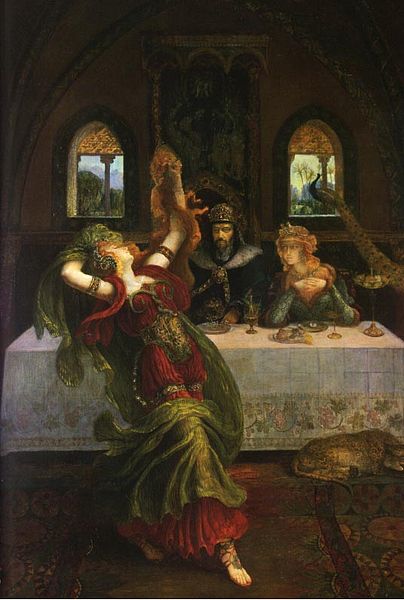
File:PointArmandDanceOftheSevenVeils.jpg
Armand_Point(1861–1932) 
Dance Of the Seven Veils, circa 1890

After removing seven veils as part of an erotic dance and encouraged by her mother Herodias, step-daughter Salome requested that Tetrarch Herod Antipater reward her with John the Baptist's head on a platter. 

The idea that Salome's dance involves "seven veils" originates with Wilde's 1891 play Salomé. Wilde was influenced by earlier French writers who had transformed the image of Salome into an incarnation of female lust. Rachel Shteir writes that, More

Armand Point (23 March 1860 or 23 March 1861 – February 1932 or March 1932) was a French painter, engraver and designer who was associated with the Symbolist movement and was one of the founders of the Salon de la Rose + Croix. Later he formed his own atelier. Sources differ over the details of his birth and death. More

undefined
Theodoor Rombouts
Christ Driving the Money-changers from the Temple
oil on canvas
168 x 238,5 cm
Royal Museum of Fine Arts Antwerp

The cleansing of the Temple narrative tells of Jesus expelling the money changers from the Temple, and occurs in all four canonical gospels of the New Testament.

In this account, Jesus and his disciples travel to Jerusalem for Passover, where Jesus expels the money changers from the Temple, accusing them of turning the Temple into a den of thieves through their commercial activities. In the Gospel of John Jesus refers to the Temple as "my Father’s house", thus, making a claim to being the Son of God.[3]

The narrative occurs near the end of the Synoptic Gospels (at Mark 11:15–19, Matthew 21:12–17, and Luke 19:45–48) and near the start in the Gospel of John (at John 2:13–16). Some scholars believe that these refer to two separate incidents, given that the Gospel of John also includes more than one Passover. More

"Jesus entered the temple, floated out all them that sold and bought in the temple, and threw the tables of the money changers and the seats of pigeons saleswomen. He spoke unto them, It is written, My house shall be called a house of prayer; but ye have made it a den of thieves " More

Theodoor Rombouts (2 July 1597 – 14 September 1637) was a Flemish painter who is mainly known for his Caravaggesque genre scenes depicting lively dramatic gatherings as well as religiously themed works. He is considered to be the primary representative of Flemish Caravaggism.

1
The Money Exchangers
After the painting by Petrus Christus (Flemish circa 1410-1476)
 by noted Limoges enamel artist, J. P. Loup (1867-1948)
Signed J.P. Loup, Limoges
 9 inches x 7.9 inches (23 x 20 cm)

Petrus Christus (1425–1476)
Annonciation, circa 1450
Oil on panel
77.5 × 66.5 cm (30.5 × 26.2 in)
Metropolitan Museum of Art

Petrus Christus (c. 1410/1420 – 1475/1476) was an Early Netherlandish painter active in Bruges from 1444. He was influenced by van Eyck and Rogier van der Weyden and is noted for his innovations with linear perspective and a meticulous technique which seems derived from miniatures and manuscript illumination. Today, some 30 works are confidently attributed to him. The best-known include the 1446 Portrait of a Carthusian and c. 1470 Berlin Portrait of a Young Girl, both are highly innovative in presentation of the figure against detailed, rather than flat, backgrounds.

Christus was an anonymous figure for centuries, his importance not established until the work of modern art historians. Giorgio Vasari barely mentions him in his biographies of painters, written in the Renaissance, and near contemporary records merely list him amongst many others. In the early to mid-nineteenth century, Gustav Waagen and Johann David Passavant were important in establishing Christus's biographical details and in attributing works to him. More

1
P. Bonhaud 
THE VIRGIN, CIRCA 1900
FRENCH LIMOGES 
Enameled plaque
9.75 inches x 8.25 inches (25 x 21 cm)

Girolamo Comi, (Italian, 1507-1581)
The Dance of Salome, c. 1562
23 5/8" h x 16 1/8" h.

Girolamo Comi (1507–1581) was a 16th-century Italian Renaissance painter. Not much is known about Girolamo Comi's life except through his works. He primarily painted religious-themed paintings for church commissions. One work executed by Comi The Madonna with St George is part of the York Museums Trust collection. More

Continental School 
Lot and his daughters, 1600 Circa
Oil on Canvas
104 x 135 centimetres

Eduard (Carl Friedrich E.) Holbein (German, 1807-1875) Ruth and Boaz 54 1/2 x 68in (138 x 172.5cm)
Eduard (Carl Friedrich E.) Holbein (German, 1807-1875)
Ruth and Boaz 
signed and dated 'E. / Holbein / 18[.]0.' (lower right)
oil on canvas
54 1/2 x 68in (138 x 172.5cm)

Eduard Holbein was a history painter and illustrator who lived and worked in Berlin. He studied at the Berlin Academy, where he also taught from 1851. Among his private students were Max Liebermann and Hans von Marées.


Holbein was mostly known for his portraits of the German Emperors in the ceiling medallions of the Neues Museum in Berlin


William Charles Thomas Dobson (German, 1817-1898) The prosperous days of Job 44 x 35in (111.7 x 88.9cm)
William Charles Thomas Dobson (German, 1817-1898)
The prosperous days of Job 
signed with the artist's monogram and dated '1855' (lower left)
oil on canvas
44 x 35in (111.7 x 88.9cm)

William Charles Thomas Dobson was born in Hamburg, Germany, but shortly after his birth his parents moved to Great Britain. As a young man, Dobson practiced drawing during his visits to the British Museum and he was enrolled in the Royal Academy Schools in 1836. He exhibited regularly at the Royal Academy from 1842 and he was noted for his portrayal of uplifting themes and brilliant colors reminiscent of the work of Sir Charles Eastlake. Dobson was elected ARA in 1860 and RA in 1872.

The Bible passage referred to in the painting is Job, 42:12-15 when God rewards Job after all his tribulations. "So the Lord blessed the latter end of Job more than his beginning.." Job is depicted at the center of the composition lifting his hands in thanks to the Lord and is surrounded by his generations

1
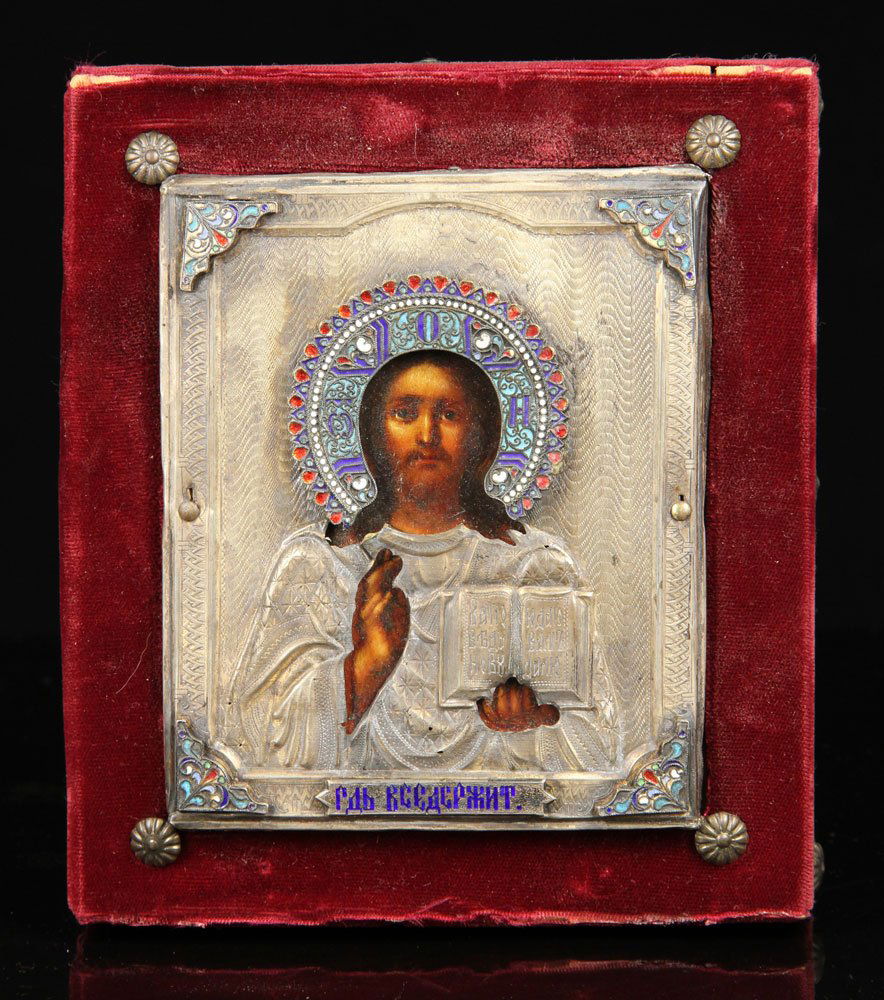
Vasily Semenov (Russian)
Russian Icon of Christ
Silver, with overlaid silver riza and cloissone halo and corners, 
dated 1891, 
13 1/5" h x 11" w. 


Russian Silver-Gilt and Cloisonné Enamel Icon of The Mother of God, Moscow, c.1908-17, painted on wood panel, the engraved oklad with halos in translucent and opaque coloured enamels, 7.1" x 5.7" — 18 x 14.5 cm., maker’s marks (cyrillic) P.T


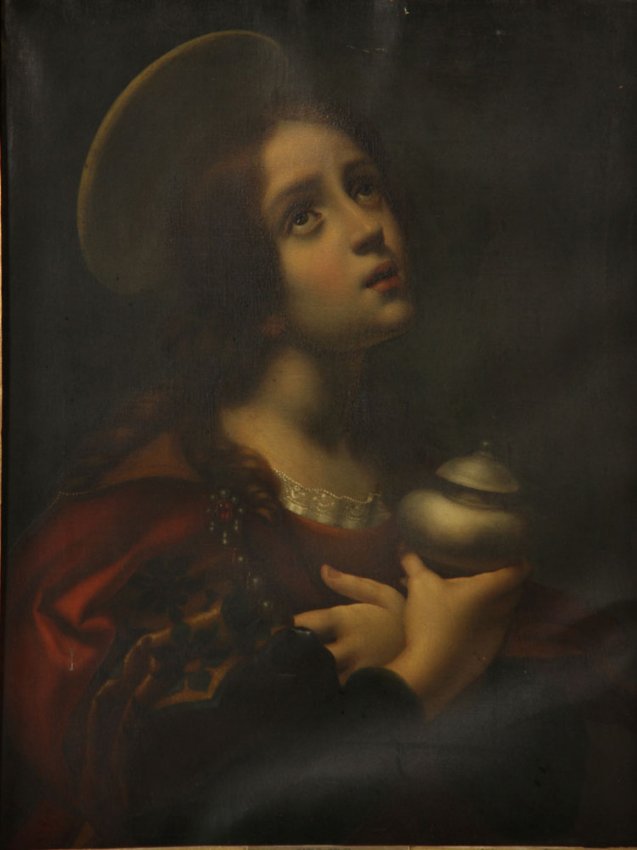
Egisto Manzuoli (Italian, 19th century)
after Carlo Dolci
Penitent Mary Magdalene
Oil on canvas
28" h x 22" w

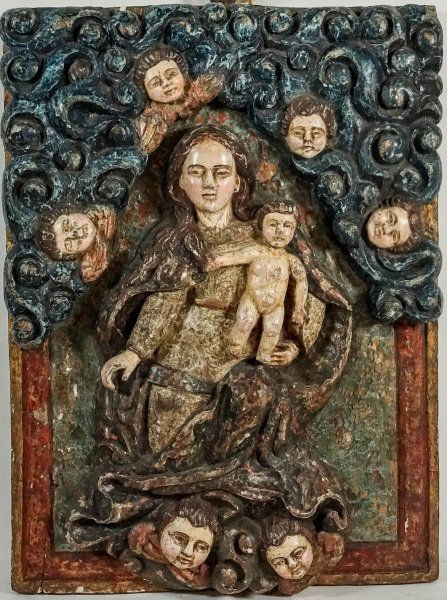
MADONNA & CHILD
18th CENTURY
PERUVIAN CARVING
Height: 24 in. by Width: 18 in.

CIRCA 1700 MEXICAN 
MADONNA & CHILD 
OIL ON CANVAS
Height: 28 & 18 in. by Width: 27 & 15 in.

Acknowledgement: Bonhams