Showing posts with label Andrea del Sarto. Show all posts

01 Works, RELIGIOUS ART - Interpretation of the Bible! by the Old Masters, With Footnotes - 93

R PAOLETTI (ITALIAN 19TH CENTURY) AFTER ANDREA DEL SARTO 
Madonna and Child 
Oil on canvas 
110 x 78cm
Private Collection

The Madonna and Child or The Virgin and Child is often the name of a work of art which shows the Virgin Mary and the Child Jesus. The word Madonna means "My Lady" in Italian. Artworks of the Christ Child and his mother Mary are part of the Roman Catholic tradition in many parts of the world including Italy, Spain, Portugal, France, South America and the Philippines. Paintings known as icons are also an important tradition of the Orthodox Church and often show the Mary and the Christ Child. They are found particularly in Eastern Europe, Russia, Egypt, the Middle East and India. More on The Madonna and Child

Andrea del Sarto (1486–1530) was an Italian painter from Florence, whose career flourished during the High Renaissance and early Mannerism. Though highly regarded during his lifetime as an artist senza errori ("without errors"), his renown was eclipsed after his death by that of his contemporaries, Leonardo da Vinci, Michelangelo and Raphael.

By 1494 Andrea was apprenticed to a goldsmith, and then to a woodcarver and painter named Gian Barile, with whom he remained until 1498. According to his late biographer Vasari, he then apprenticed to Piero di Cosimo, and later with Raffaellino del Garbo.


Andrea and an older friend Franciabigio decided to open a joint studio at a lodging together in the Piazza del Grano. By the time the partnership was dissolved, Sarto's style bore the stamp of individuality. According to the Encyclopædia Britannica, it "is marked throughout his career by an interest, exceptional among Florentines, in effects of colour and atmosphere and by sophisticated informality and natural expression of emotion." More on Andrea del Sarto


Images are copyright of their respective owners, assignees or others

We do not sell art, art prints, framed posters or reproductions. Ads are shown only to compensate the hosting expenses.

If you enjoyed this post, please share with friends and family.

14 Paintings, scenes from the Bible, by The Old Masters, with footnotes # 27

FLORENTINE school in 1530, workshop of Andrea Del Sarto 
The Virgin and Child with St. John the Baptist 
Oil on Poplar pane
72 x 56cm - 28 3/8 x 22 1/16 IN . 
Private Collection

Andrea del Sarto (1486–1530) was an Italian painter from Florence, whose career flourished during the High Renaissance and early Mannerism. Though highly regarded during his lifetime as an artist senza errori ("without errors"), his renown was eclipsed after his death by that of his contemporaries, Leonardo da Vinci, Michelangelo and Raphael. More

Lucas Cranach the Elder (c. 1472 – 16 October 1553) 
Christ in Limbo (Christ Freeing Souls from Hell), c. 1530
Private Collection

The story of Christ's descent into Limbo to rescue the souls of the righteous who lived before his time enjoyed a special place in the European popular imagination. This vision of Hell, its eternal darkness broken by Christ's dazzling entry, is exceptionally vivid.

Lucas Cranach the Elder (c. 1472 – 16 October 1553) was a German Renaissance painter and printmaker in woodcut and engraving. He was court painter to the Electors of Saxony for most of his career, and is known for his portraits, both of German princes and those of the leaders of the Protestant Reformation, whose cause he embraced with enthusiasm, becoming a close friend of Martin Luther. He also painted religious subjects, first in the Catholic tradition, and later trying to find new ways of conveying Lutheran religious concerns in art. He continued throughout his career to paint nude subjects drawn from mythology and religion. He had a large workshop and many works exist in different versions; his son Lucas Cranach the Younger, and others, continued to create versions of his father's works for decades after his death. Lucas Cranach the Elder has been considered the most successful German artist of his time. More

Unknown German artist
St. Martin of Tours and St. Nicholas of Bari, ca. 1450
Tempera on wood
Art Gallery of South Australia, Victoria

Saint Martin of Tours, (born ad 316, Sabaria, Pannonia [now Szombathely, Hung.]—died Nov. 8, 397, Candes, Gaul [France]. Of pagan parentage, Martin chose Christianity at the age of 10. As a youth he was forced into the Roman army, but later he petitioned the Roman emperor Julian the Apostate to be released from the army because “I am Christ’s soldier: I am not allowed to fight.” He was imprisoned but was soon discharged.

On leaving the Roman army, Martin settled at Poitiers, under the guidance of Bishop Hilary. He became a missionary in the provinces of Pannonia and Illyricum (now in the Balkan Peninsula), where he opposed Arianism, a heresy that denied the divinity of Christ. Forced out of Illyricum by the Arians, Martin went to Italy. In 360 he rejoined Hilary at Poitiers. Martin then founded a community of hermits at Ligugé, the first monastery in Gaul. In 371 he was made bishop of Tours, and outside that city he founded another monastery, Marmoutier, to which he withdrew whenever possible.

As bishop, Martin made Marmoutier a great monastic complex to which European ascetics were attracted and from which apostles spread Christianity throughout Gaul. He himself was an active missionary in Touraine and in the country districts where Christianity was as yet barely known. In 384/385 he took part in a conflict at the imperial court in Trier, Fr., to which the Roman emperor Magnus Maximus had summoned Bishop Priscillian of Ávila, Spain, and his followers. Martin protested to Maximus against the killing of heretics (Priscillian), and against civil interference in ecclesiastical matters. Priscillian was nevertheless executed, and Martin’s continued involvement with the case caused him to fall into disfavour with the Spanish bishops. During his lifetime, Martin acquired a reputation as a miracle worker, and he was one of the first nonmartyrs to be publicly venerated as a saint. More

Saint Nicholas (15 March 270 – 6 December 343), also called Nikolaos of Myra, was a historic 4th-century Christian saint and Greek Bishop of Myra, in Asia Minor. Because of the many miracles attributed to his intercession, he is also known as Nikolaos the Wonderworker. His reputation evolved among the faithful, as was common for early Christian saints, and his legendary habit of secret gift-giving gave rise to the traditional model of Santa Claus through Sinterklaas.

The historical Saint Nicholas, as known from strict history: He was born at Patara, Lycia in Asia Minor. In his youth he made a pilgrimage to Egypt and the Palestine area. Shortly after his return he became Bishop of Myra and was later cast into prison during the persecution of Diocletian. He was released after the accession of Constantine and was present at the Council of Nicaea. 

He was buried in his church at Myra, and by the 6th century his shrine there had become well-known. In 1087 Italian sailors or merchants stole his alleged remains from Myra and took them to Bari, Italy; this removal greatly increased the saint’s popularity in Europe, and Bari became one of the most crowded of all pilgrimage centres. Nicholas’s relics remain enshrined in the 11th-century basilica of San Nicola at Bari. More

Aimé Nicolas Morot, (1850–1913)
The Good Samaritan, c. 1880
Oil on canvas
268.5 × 198 cm (105.7 × 78 in)
Petit Palais, Paris

The parable of the Good Samaritan is a didactic story told by Jesus in Luke 10:25–37. It is about a traveler who is stripped of clothing, beaten, and left half dead alongside the road. First a priest and then a Levite comes by, but both avoid the man. Finally, a Samaritan comes by. Samaritans and Jews generally despised each other, but the Samaritan helps the injured man. Jesus is telling the parable in response to the question from a lawyer, "And who is my neighbour?" whom that should be loved. Jesus answers his question in who is his neighbour, but also tells him to love his neighbour. 

The parable has inspired painting, sculpture, satire, poetry, and film. The colloquial phrase "good Samaritan", meaning someone who helps a stranger, derives from this parable, and many hospitals and charitable organizations are named after the Good Samaritan. More

Aimé Nicolas Morot (1850–1913) was a French painter and sculptor in the Academic Art style. He was born in Nancy, where at age 12 he started his studies in drawing, painting and gravure printing at l'Ecole Municipal de Dessin et de Peinture de Nancy. He continued his study in Nancy until the late 1860s and subsequently attended the atelier of Alexandre Cabanel at the École Nationale Supérieure des Beaux-Arts in Paris, but could not study in the noisy environment of Cabanel's atelier and left after having received two corrections by Cabanel. In the next two years he continued his studies independently. Despite his lack of attendance at the École, he won the Grand Prix de Rome in 1873 with his first submission, the Babylonian, which is currently in the collection of the École des Beaux-Arts in Paris (below).

Aimé Nicolas Morot (1850–1913)
La captivité des juifs à Babylone, 1873
Paris, Ecole Nationale Supérieure des Beaux-Arts


The fellowship allowed him to travel to Italy and become a resident of the Villa Medici, where the French Academy in Rome was housed. Morot rarely set foot in his atelier in the Villa Medici, but produced paintings in a regular fashion anyway. His first submission to the Salon de Paris awarded him a third-class medal for the painting Spring in 1876. In 1877 He was awarded a second-class medal for Médée, a first-class medal in 1879...

He returned to Paris in 1880, where he met painter Jean-Léon Gérôme and married his daughter Suzanne Mélanie Gérôme (1867-1941). His daughter Denise Morot was born in the late 1890s. Suzanne Morot modelled for paintings in 1897 and, together with her daughter, in 1904.

In 1900, he won a grand prix of the l'Exposition Universelle (Paris Exhibition) and in the same year became professor at the École Nationale Supérieure des Beaux-Arts in Paris. In 1910, Morot ordered construction of Maison dite Ker Arlette in Dinard, a coastal village in North-east Brittany. He lived there until his death on 12 August 1913. More

Gierymski Maksymilian 
RETURN OF A SERVANT, 1868
oil, canvas
59 x 88.5cm
Private Collection


Matthew 24:46 Who then is the faithful and wise servant, whom the master has put in charge of his household, to give the others their food at the proper time? 46 Blessed is that servant whose master returns and finds him doing his job. 

Maksymilian Gierymski (1846 in Warsaw – 1874 in Reichenhall, Bavaria) was a Polish painter, specializing mainly in watercolours. He was the older brother of painter Aleksander Gierymski.

As a seventeen-year-old boy, he participated in the January Uprising. He was educated at the Warsaw Drawing School initially, but then received a government scholarship in 1867 and went to study at the Academy of Fine Arts in Munich. He became one of the leading painters of the Munich realistic school. Initially best known for this battle paintings, he also created many landscape paintings, especially of southern Poland, which he visited several times.


Completely successful in western Europe, he did not gain approval nor popularity in Poland of the 19th century, although he sent paintings to exhibitions in Warsaw regularly from 1868 on. He did however win awards at exhibitions in Munich (1869) and in Berlin (1872). More


After Bartolomé Esteban Murillo (December 1617  – April 3, 1682) 
St. John the Baptist in a landscape 
30 x 23cm - 11 x 9 13/16 1/16 IN. 
Private Collection

Bartolomé Esteban Murillo (born late December 1617, baptized January 1, 1618 – April 3, 1682) was a Spanish Baroque painter. Although he is best known for his religious works, Murillo also produced a considerable number of paintings of contemporary women and children. His lively, realist portraits of flower girls, street urchins, and beggars constitute an extensive and appealing record of the everyday life of his times. More

After Guido Reni (Bologna 1575-Bologna 1642)
The Virgin Sewing
Oil on Copper 
26 x 20cm - 10 1/4 x 7 7/8 IN.
Private Collection

Seated to right in a chamber, three child angels behind, bent over parcel of material with needle in right hand. 

Guido Reni (4 November 1575 – 18 August 1642) was an Italian painter of high-Baroque style. Born in Bologna into a family of musicians, Guido Reni was the son of Daniele Reni and Ginevra de’ Pozzi. As a child of nine, he was apprenticed under the Bolognese studio of Denis Calvaert. When Reni was about twenty years old he migrated to the rising rival studio, named Accademia degli Incamminati (Academy of the "newly embarked", or progressives), led by Lodovico Carracci. He went on to form the nucleus of a prolific and successful school of Bolognese painters who followed Annibale Carracci to Rome. Like many other Bolognese painters, Reni's painting was thematic and eclectic in style. More

After Guido Reni (Bologna 1575-Bologna 1642)
The Virgin Sewing
Oil on canvas (transferred from panel)
27.5 x 21
Hunterian Museum & Art Gallery

When this work was bought in 1771, it was catalogued as by da Pesaro (Simone Cantarini 1612-1648). In fact it is a version of an early work by Guido Reni. Eighteenth-century knowledge was sometimes sufficient to establish the 'school' from which the work came, but not the precise identity of the painter. In the middle of the eighteenth century Reni's first painting of this subject on copper, dating from 1606, was in the French Royal Collection. In that painting the Virgin has a red dress, and is accompanied by only three angels. Concluding that his painting was of lesser quality, it mistakenly assigned it to Cantarini, Reni's pupil. This painting corresponds in its details of a white dress and four accompanying angels to Reni's second version of the Virgin Sewing also painted on copper, which passed from Mazarin's to the French Royal Collection. The high quality of the present painting, and the type of pigments used suggest that it is a contemporary studio replica of La couseuse. More

Anatoly (Anatoli) Zverev, 1931-1986
George on Horseback
oil on board
19 5/8 x 27 1/2 (50 x 70 cm)
Private Collection

Saint George (circa 275/281 – 23 April 303 AD) was a soldier in the Roman army who later became venerated as a Christian martyr. His parents were Christians of Greek background; his father Gerontius was a Roman army official from Cappadocia and his mother Polychronia was from Lydda, Syria Palaestina. Saint George became an officer in the Roman army in the Guard of Diocletian, who ordered his death for failing to recant his Christian faith.

In the fully developed Western version of the Saint George Legend, a dragon, or crocodile, makes its nest at the spring that provides water for the city of "Silene" (perhaps modern Cyrene in Libya or the city of Lydda in Palistine, depending on the source). Consequently, the citizens have to dislodge the dragon from its nest for a time, to collect water. To do so, each day they offer the dragon at first a sheep, and if no sheep can be found, then a maiden is the best substitute for one. The victim is chosen by drawing lots. One day, this happens to be the princess. The monarch begs for her life to be spared, but to no avail. She is offered to the dragon, but then Saint George appears on his travels. He faces the dragon, protects himself with the sign of the Cross, slays the dragon, and rescues the princess. The citizens abandon their ancestral paganism and convert to Christianity. Mor

Anatoly (Anatoli) Zverev (November 3, 1931 Moscow –December 9, 1986 Moscow) was a Russian artist, a member of the non-conformist movement and a founder of Russian Expressionism in the 1960s. He spent all of his life in Moscow.

He did not have a solo show in Russia until shortly before his death in 1986 and his work was exhibited in small, underground galleries. Throughout his career he was harassed and persecuted by the Soviet authorities especially as his international success grew.

His style of tachisme can be compared with the work of the American Abstract Expressionist painter Jackson Pollock. His work was based on deep philosophical convictions, particularly the idea of momentalism, that everything is in constant change. His intention was to render direct sensations, and he worked at great speed. More
A 17th century Indo-Portuguese oratory with table
 The Passion of Christ 
Carved, polychrome and gilt teak oratory  representing floral motifs and IHS insignia 
Tilting doors painted with eight angles holding symbols of the Passion of Christ 
Interior with four solomonic columns green and gilt ground 
Base with drawer 
162x82x40 cm
Private Collection

Jan van Scorel (1495–1552) 
Mary Magdalene, circa 1530
Oil on oak panel
Height: 66.3 cm (26.1 in). Width: 76 cm (29.9 in).
Rijksmuseum Amsterdam

Mary Magdalene is traditionally depicted with a vessel of ointment,. The anointing of Jesus is one of the relatively few events reported by each of the four Gospels, although the details differ in the accounts. All report the anointing of Jesus with expensive perfume by a woman, who pours over Jesus the contents of an alabastron jar of "nard" (or spikenard), a very expensive perfume. The anointing angers some of the onlookers because the perfume could have been sold for a year's wages—which the Gospel of Mark enumerates as 300 denarii—and the money given to the poor. Matthew's gospel states that the "disciples were indignant" and John's states that it was Judas who was most offended. John adds that he was bothered because he (Judas) was a thief and desired the money for himself. Jesus is described as justifying the action of the woman by stating that the poor will always exist, and can be helped whenever desired. More

Jan van Scorel (1495 – 6 December 1562) was a Dutch painter, who played a leading role in introducing aspects of Italian Renaissance painting into Dutch and Flemish Renaissance painting. Van Scorel was one of the early painters of the Romanist style who had spent a number of years in Italy, where he thoroughly absorbed the Italian style of painting. His trip to Italy coincided with the brief reign of the only Dutch pope in history, Adrian VI in 1522-23. The pope made him a court painter and superintendent of his collection of antiquities. His stay in Italy lasted from 1518 to 1524. He also visited Nuremberg, Venice and Jerusalem. Venetian art had an important impact on the development of his style.

He differed from most Romanists in that he was a native of the northern Netherlands and not of Flanders and that he remained most of his life in the northern Netherlands. He settled permanently in Utrecht in 1530 and established a large workshop on the Italian model. The workshop mainly produced altarpieces, many of which were destroyed in the Reformation iconoclasm in the years just after his death. He also held clerical appointments. This did not stop him from having a long-time relationship with a mistress who may have modelled for some of his female figure. More

Eduard Karl Franz von Gebhardt, 1838-1925 Dusseldorf
Christ
Oil / paper / wood
33.8x41.2cm
Private Collection

Franz Karl Eduard von Gebhardt (1838–1925) was a Baltic German historical painter. He was born in Järva-Jaani, Estonia, the son of a Protestant clergyman, and studied first at the Academy of St. Petersburg (1855–58). In 1860 he became the pupil of Wilhelm Sohn at Düsseldorf, where he permanently settled, and became professor at the academy in 1873.

There is a religious tone defining many of his most highly regarded paintings. Their chief characteristic is their deep and powerful yet varied expression of religious feeling. In the former Cistercian monastery at Lokkum may be seen six mural paintings: "Scenes from the Life of Christ". Mural paintings of similar subjects may be found at the Friedenskirche, Düsseldorf.

Gebhardt also painted many excellent portraits, and was awarded gold medals at Berlin, Dresden, Munich, Vienna, and Paris; and was elected a member of the academies of Antwerp, Berlin, Brussels, Munich, and Vienna. He died in 1925. More

Wilhelm Claudius, 1854 Altona-1942 Dresden
Reading monk
oil / cardboard
52x42cm
Private Collection

Wilhelm Ludwig Heinrich Claudius (1854-1942) at first attended the drawing school in Hamburg.  After that he studied at the Academy of Art in Dresden from 1871-74.  He also successfully worked as an illustrator. 

Around 1900 he rather focused on his painting and became a member of the Dresden artist circle called Goppelner Gruppe.  He further participated in the exhibitions of the Dresden Secession.  In 1903 he was appointed professor and in 1909 was honored with the Gold Medal of the Munich art exhibition. More


Acknowledgment: Henry's Auktionshaus AG
Images are copyright of their respective owners, assignees or others

18 Works, RELIGIOUS ART - Paintings from the Bible, with footnotes, 9

Attributed to Altichiero (news 1369-1384), Altarpiece Boi, third quarter of the fourteenth century, tempera on panel:
Attributed to Altichiero (1369-1384)
Altarpiece Boi
third quarter of the fourteenth century
tempera on panel 


Caravaggio (1571–1610)
Mary Magdalen in Ecstasy, c. 1606
Oil on canvas
106.5 × 91 cm (41.9 × 35.8 in)
Private collection, Rome


An old story has it that Mary Magdalene ended up in the south of France after Jesus had died. She lived in a cave, where she sought penitence for her sins. She also underwent mystical experiences, including meetings with God.

Traditional depictions would show angels carrying Mary into the clouds. Caravaggio chose to show the event as an intense inner experience, almost erotic. More


Madonna of the Harpies is a 1517 painting by Andrea del Sarto, considered his major contribution to High Renaissance art. It is a depiction of the Virgin Mary and child on a pedestal, flanked by angels and two saints (Saint Bonaventure or Francis, and John the Evangelist). Originally completed in 1517 for the convent of San Francesco dei Macci, the altarpiece now resides in the Uffizi. The figures have a Leonardo-like aura, with a pyramid shaped composition. More

Andrea del Sarto 1486–1530) was an Italian painter from Florence, whose career flourished during the High Renaissance and early Mannerism. Though highly regarded during his lifetime as an artist senza errori ("without errors"), his renown was eclipsed after his death by that of his contemporaries, Leonardo da Vinci, Michelangelo, and Raphael. More

 Andrea Mantegna
Adoration of the three kings,  - circa 1461
Tempera on canvas 
Height: 76 cm (29.92 in.), Width: 77 cm (30.31 in.)
Galleria degli Uffizi  (Italy - Florence)


Andrea Mantegna (c. 1431 – September 13, 1506) was an Italian painter, a student of Roman archeology, and son-in-law of Jacopo Bellini. Like other artists of the time, Mantegna experimented with perspective, e.g., by lowering the horizon in order to create a sense of greater monumentality. His flinty, metallic landscapes and somewhat stony figures give evidence of a fundamentally sculptural approach to painting. He also led a workshop that was the leading producer of prints in Venice before 1500.

Antonio da Correggio (1490–1534)
The Adoration of the Child, between 1518 and 1520
Oil on canvas
Height: 81 cm (31.9 in). Width: 67 cm (26.4 in).
Uffizi Gallery


The Adoration of the Child  was donated by Francesco I Gonzaga, duke of Mantua, to Cosimo II de' Medici of Tuscany in 1617. The Medici exhibited it in the Uffizi Tribune, where it remained until 1634. The original commission of the painting is however unknown, although some identify it with that mentioned by late Renaissance art biographer Giorgio Vasari and which had been brought to Reggio Emilia from Genoa by Luca Pallavicino.

The dating of the work is based on stylistic elements: the 1524-1526 dates derives from similarities with the Deposition and the Martyrdom of Four Saints. Copies of the painting were executed by Johan Zoffany and Giovan Battista Stefaneschi. More

In 1675 the work was in the collection of Cardinal Leopoldo de' Medici, but perhaps came to Florence before then. The brilliant colors exalt the soffused softness of the skin tones and the natural facial expressions. This is the smallest painting we have by Correggio. It could have been a Mantuan commission considering that the courtly and musical culture of the d'Este family could have influenced the planning of this cultured hymn to divine music. More

Antonio Allegri da Correggio (August 1489 – March 5, 1534), was the foremost painter of the Parma school of the Italian Renaissance, who was responsible for some of the most vigorous and sensuous works of the 16th century. In his use of dynamic composition, illusionistic perspective and dramatic foreshortening, Correggio prefigured the Rococo art of the 18th century. He was born in Correggio, Italy. It is often assumed that he had his first artistic education from his father's brother, the painter Lorenzo Allegri.

In 1503-5 he was apprenticed to Francesco Bianchi Ferrara in Modena, where he probably became familiar with the classicism of artists like Lorenzo Costa and Francesco Francia, evidence of which can be found in his first works. After a trip to Mantua in 1506, he returned to Correggio, where he stayed until 1510. To this period is assigned the Adoration of the Child with St. Elizabeth and John (see below), which shows clear influences from Costa and Mantegna. In 1514 he probably finished three tondos for the entrance of the church of Sant'Andrea in Mantua, and then returned to Correggio, where, as an independent and increasingly renowned artist, he signed a contract for the Madonna altarpiece in the local monastery of St. Francis (now in the Dresden Gemäldegalerie). More

Correggio 007.jpg
Antonio da Correggio (1490–1534)
Birth of Christ, with St. Elizabeth and John the Baptist and sleeping Josef., circa 1515
Oil on panel
77 × 99 cm (30.3 × 39 in)
Brera 's picture gallery

Bartolomeo MANFREDI
The Tribute to Caesar
Oil on canvas
130 x 191 cm
Galleria degli Uffizi, Firenze

Cosimo II acquired many paintings by Bartolomeo Manfredi who was one of the painters responsible for popularizing the genre scenes inspired by Caravaggio. Thanks to Cosimo II and his brother, Cardinal Carlo, the owner of this painting and the Christ Among the Doctors, the greatest number of works by this artist are found in Florentine collections. There were six before two were destroyed by the bombing in 1993. In this extreme phase of his work, the black background swallows up the minute figures with their large, dark eyes. Attributed to Caravaggio until 1924, The Tribute to Caesar was exhibited in the Tribune of the Uffizi from 1753. More

Early biographers of Bartolomeo Manfredi (Mancini, Baglione, Bellori, Sandrart) inform us that this close follower of Caravaggio emulated his maestro so perfectly that he was often confused with him. Indeed, this work was attributed to Caravaggio right up until the last century, when the first correct attributions to Manfredi (Voss and Longhi) removed some paintings from the corpus of genre scenes which had revolved around the name of Caravaggio. More

Bartolomeo Manfredi (baptised 25 August 1582 – 12 December 1622) was an Italian painter, a leading member of the Caravaggisti (followers of Michelangelo Merisi da Caravaggio) of the early 17th century. Manfredi was born in Ostiano, near Cremona. He may have been a pupil of Caravaggio in Rome: at his famous libel trial in 1603 Caravaggio mentioned that a certain Bartolomeo, accused of distributing scurrilous poems attacking Caravaggio's detested rival Baglione, had been a servant of his. Certainly the Bartolomeo Manfredi known to art history was a close follower of Caravaggio's innovatory style, with its enhanced chiaroscuro and insistence on naturalism, with a gift for story-telling through expression and body-language.

Manfredi was a successful artist, able to keep his own servant before he was thirty years old. He built his career around easel paintings for private clients, and never pursued the public commissions upon which wider reputations were built, but his works were widely collected in the 17th century and he was considered Caravaggio's equal or even superior. His Mars Chastising Cupid offers a tantalising hint at a lost Caravaggio: the master promised a painting on this theme to Mancini, but another of Caravaggio's patrons, Cardinal Francesco Maria Del Monte, had taken it, and Mancini therefore commissioned Manfredi to paint another for him, which Mancini considered Manfredi's best work.

Manfredi died in Rome in 1622. Gerard Seghers (or Segers; 1589–1651) was one of his pupils More

Fra Angelico (about 1395-1455)
Coronation of the Virgin, c. 1434-1435
Tempera on wood
112 × 114 cm (44.1 × 44.9 in)
Uffizi Gallery

The Coronation of the Virgin is a painting of the Coronation of the Virgin by the Italian early Renaissance painter Fra Angelico, executed around 1432. It is now in the Uffizi Gallery of Florence. The artist executed another Coronation of the Virgin (c. 1434-1435), now in the Louvre in Paris (see below).

The work is mentioned as by Fra Angelico in a manuscript of the Biblioteca Nazionale di Firenze, and Giorgio Vasari writes that it was located in the church of Sant'Egidio at Florence. Two panels of the predella which once was part of the work are known: they portray the Marriage and the Funeral of the Virgin, and are currently exhibited in the museum of San Marco, Florence. More

Fra Angelico (1395] – 1455) was an Early Italian Renaissance painter described as having "a rare and perfect talent".

In 1982 Pope John Paul II proclaimed his beatification, in recognition of the holiness of his life, thereby making the title of "Blessed" official. Fiesole is sometimes misinterpreted as being part of his formal name, but it was merely the name of the town where he took his vows as a Dominican friar, and was used by contemporaries to separate him from other Fra Giovannis. He is listed in the Roman Martyrology as Beatus Ioannes Faesulanus, cognomento Angelicus—"Blessed Giovanni of Fiesole, known as 'the Angelic' ".

Vasari wrote of Fra Angelico: "But it is impossible to bestow too much praise on this holy father, who was so humble and modest in all that he did and said and whose pictures were painted with such facility and piety" More

File:Fra Angelico 078.jpg
Fra Angelico (circa 1395–1455)
The Coronation of the Virgin, between circa 1430 and circa 1435
Tempera on panel
213 × 211 cm (83.9 × 83.1 in)
Louvre Museum

Master of the Legend of St. Ursula ACTIVE IN BRUGES 1470 - 1500 HEAD OF CHRIST oil and gold on oak panel 43 by 33 cm.; 17 by 13 in.:
Master of the Legend of St. Ursula
ACTIVE IN BRUGES 1470 - 1500
HEAD OF CHRIST
oil and gold on oak panel
43 by 33 cm.; 17 by 13 in.

The thirteenth-century author of the fictitious account of the life of Christ ascribed to the Roman Publius Lentulus describes the Redeemer as 'having a reverend countenance which they that look upon may love and fear', and this direct but poignant image, painted towards the end of the fifteenth-century was surely intended to invoke the forgiving and human Saviour of mankind rather than the stern judge of the Last Judgment. Images such as this were intended for private devotion, and were no doubt linked to the rise in personal piety that occurred in the Netherlands in the fourteenth and fifteenth centuries.

The Master of the Legend of St. Ursula (1436 – 1505) was a Flemish painter active in the fifteenth century. His name is derived from a polyptych depicting scenes from the life of Saint Ursula painted for the convent of the Black Sisters of Bruges. More

The Master of 1456 ACTIVE IN COLOGNE DURING THE 1450S THE MARTYRDOM OF SAINT URSULA AND THE ELEVEN THOUSAND VIRGINS OF COLOGNE oil on oak panel 127.5 by 108.5 cm.; 50 1/4  by 42 3/4  in.:
The Master of 1456
ACTIVE IN COLOGNE DURING THE 1450S
THE MARTYRDOM OF SAINT URSULA AND THE ELEVEN THOUSAND VIRGINS OF COLOGNE
oil on oak panel
127.5 by 108.5 cm.; 50 1/4  by 42 3/4  in.

Saint Ursula (Latin for 'little female bear') is a Romano-British Christian saint. Her feast day in the pre-1970 General Roman Calendar is October 21. Because of the lack of definite information about the anonymous group of holy virgins who on some uncertain date were killed at Cologne, their commemoration was omitted from the General Roman Calendar when it was revised in 1969, but they have been kept in the Roman Martyrology.


Her legend, probably not historical, is that she was a princess who, at the request of her father King Dionotus of Dumnonia in south-west Britain, set sail to join her future husband, the pagan governor Conan Meriadoc of Armorica, along with 11,000 virginal handmaidens. After a miraculous storm brought them over the sea in a single day to a Gaulish port, Ursula declared that before her marriage she would undertake a pan-European pilgrimage. She headed for Rome with her followers and persuaded the Pope, Cyriacus (unknown in the pontifical records, though from late 384 there was a Pope Siricius), and Sulpicius, bishop of Ravenna, to join them. After setting out for Cologne, which was being besieged by Huns, all the virgins were beheaded in a massacre. The Huns' leader shot Ursula dead, in about 383 (the date varies). More

The Master of 1456 owes his name to the series of twenty-four panels detailing, in thirty episodes, the life of Saint Ursula in the Basilica of Saint Ursula, Cologne. The last panel, depicting the saint’s Martyrdom, is dated 1456.


Workshop of Cornelis Engelbrechtsz. LEIDEN 1460/65 - 1527 CHRIST AND THE WOMAN TAKEN IN ADULTERY oil on oak panel 47 by 36.7 cm.; 18 1/2  by 14 1/2  in.:
Workshop of Cornelis Engelbrechtsz.
LEIDEN 1460/65 - 1527
CHRIST AND THE WOMAN TAKEN IN ADULTERY
oil on oak panel
47 by 36.7 cm.; 18 1/2  by 14 1/2  in.

Infra-red imaging Conducted by Art Analysis Research reveals detailed underdrawing in chalk throughout, seemingly in two stages, since some is done with a thicker heavier chalk (see fig. 1).4  Tree-ring analysis conducted by Ian Tyers reveals that the panel comprises two planks of Baltic oak from the same tree, likely plausible use from circa 1507 to circa 153.

Jesus and the woman taken in adultery — known as Pericope Adulterae  — is a famous passage (pericope) from verses 7:53-8:11 of the Gospel of John. The passage describes a confrontation between Jesus and the scribes and Pharisees over whether a woman, caught in an act of adultery, ought to be stoned as per the Law of Moses. Jesus shames the crowd into dispersing, and averts the execution.

Although in line with many stories in the Gospels and probably primitive, certain critics argue that it was "certainly not part of the original text of St John's Gospel." On the other hand, the Council of Trent, held between 1545 and 1563, declared that the Latin Vulgate (which contains the passage) was authentic and authoritative.


The parable, and its messages of suspension of judgment when one is not blameless and tempering justice with mercy, have endured in Christian thought. Both "let him who is without sin, cast the first stone" and "go, and sin no more" have found their way into common usage. 

Cornelis Engebrechtsz., also known as Cornelis Engelbrechtsz. (c.1462–1527) was an early Dutch painter. He was born and died in Leiden, and is considered the first important painter from that city. Engebrechtsz. taught a number of other Leiden painters, including Lucas van Leyden, Aertgen van Leyden and Engebrechtsz.' own sons Cornelis, Lucas, and Pieter Cornelisz. Kunst. Lucas van Leyden is considered his most important pupil, eclipsing Engebrechtsz. in popularity.

Work by Engebrechtsz. is in the collection of the Rijksmuseum Amsterdam, the Kunsthistorisches Museum in Vienna, the J. Paul Getty Museum in Los Angeles, the Alte Pinakothek in Munich and the Metropolitan Museum of Art in New York, among others. More

The Master of the Dreux-Budé Triptych, probably André d’Ypres | lot | Sotheby's:
The Master of the Dreux-Budé Triptych, probably André d’Ypres
ACTIVE AMIENS 1425/6 – MONS 1450
THE LEFT WING OF THE DREUX BUDÉ TRIPTYCH: THE BETRAYAL AND ARREST OF CHRIST, WITH THE DONOR DREUX BUDÉ AND HIS SON JEAN PRESENTED BY SAINT CHRISTOPHER
oil on oak panel
48.7 by 30.5 cm.; 19 1/8  by 12 in.

This is the left wing of a small triptych commissioned in Paris at the end of the 1440s or around 1450 by Dreux Budé, who is here portrayed kneeling with his son. The central panel of the Crucifixion is in the J. Paul Getty Museum, Los Angeles, and the right wing, depicting the Resurrection and including the sitter’s wife Jeanne Peschard and her daughters presented by Saint Catherine, is in the Musée Fabre at Montpellier.1 The three panels were re-united for the first time in the Chicago exhibition, and the triptych is reproduced here in its original form.

André d'Ypres, died in Mons (Hainaut) in 1450, was a painter and illuminator of the fifteenth century, a native of Amiens, born in Flanders and moved to Paris. Most art historians agree to see in him the Master of Dreux Bude.


Jan Gossaert, called Mabuse MAUBEUGE (?) CIRCA 1478 - 1532 ANTWERP (?) THE VIRGIN AND CHILD oil on oak panel 38.9 by 26.6 cm.; 15 3/8  by 10 1/2  in.:
Jan Gossaert (c. 1478 – 1 October 1532)
THE VIRGIN AND CHILD
oil on oak panel
38.9 by 26.6 cm.; 15 3/8  by 10 1/2  in.

Jan Gossaert (c. 1478 – 1 October 1532) was a Flemish painter also known as Jan Mabuse (the name he adopted from his birthplace. Little is known of his early life. One of his earliest biographers, Karel van Mander, claimed he was from a small town in Artois or Henegouwen (County of Hainaut) called Maubeuge or Maubuse. Other scholars have determined he was the son of a bookbinder who received his training at Maubeuge Abbey, while the RKD mentions there is evidence to support a claim that he was born in Duurstede Castle. He is registered in the Antwerp Guild of Saint Luke in 1503] From 1508-9 he traveled to Rome and in 1509-17 he is registered in Middelburg. According to Van Mander he was one of the first Flemish artists to bring back the Italian manner of painting with lots of nudity in historical allegories. From 1517-24 he is registered at Duurstede Castle where according to the RKD, he had Jan van Scorel as pupil. From 1524 onwards he returned to Middelburg as court painter to Adolf of Burgundy.

He was a contemporary of Lucas van Leyden, and was influenced by artists who came before him, such as Rogier van der Weyden, the great master of Tournai and Brussels, and like him, his compositions were usually framed in architectural backgrounds. More

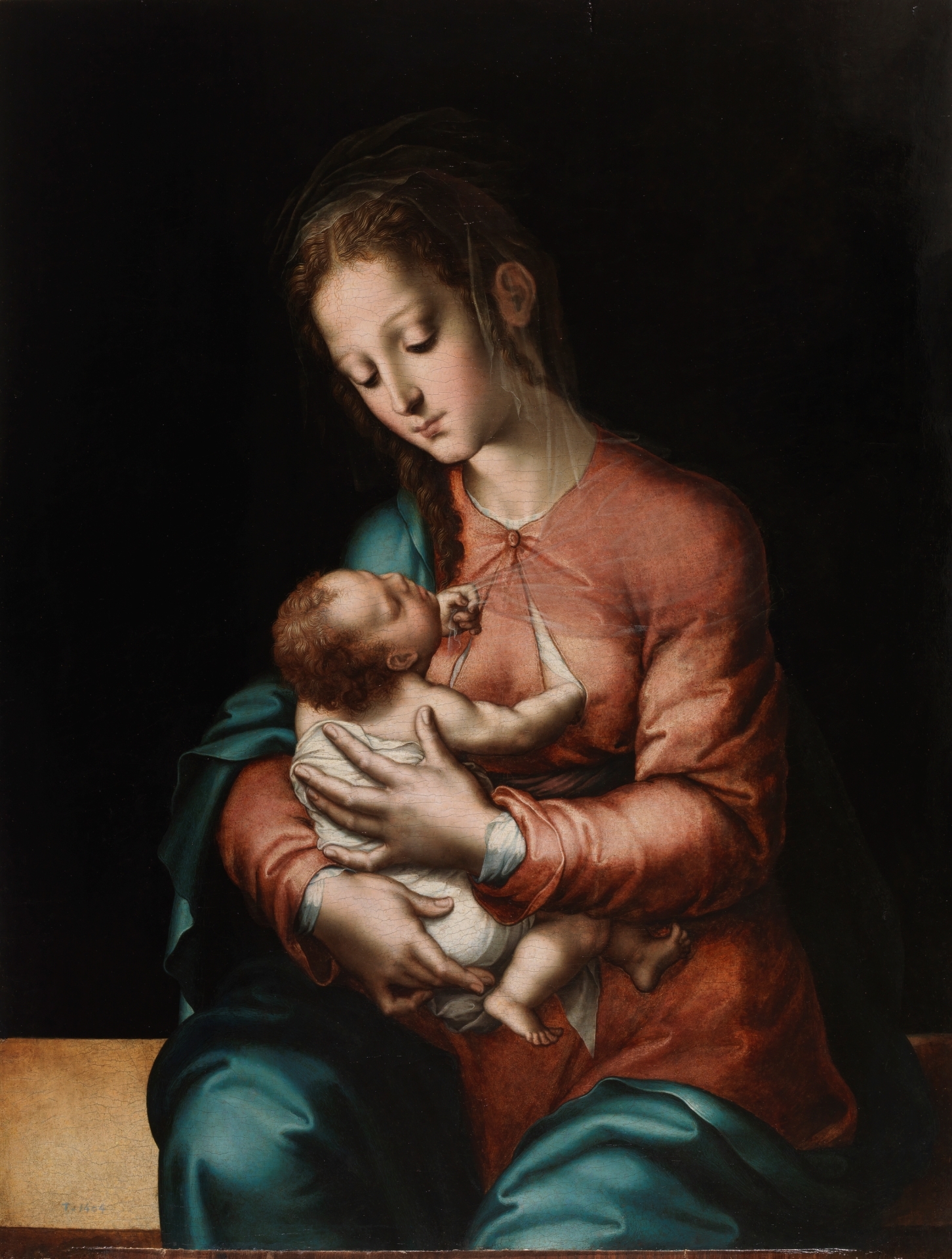
Luis de Morales (1509–1586)
Madonna and Child, circa 1565
Oil on canvas
84 × 64 cm (33.1 × 25.2 in)
Prado Museum 

Luis de Morales BADAJOZ (?) CIRCA 1520 - 1586 (?) BADAJOZ THE VIRGIN AND CHILD WITH THE INFANT ST. JOHN THE BAPTIST oil on panel, in a tabernacle frame 43 by 25.5 cm.; 17 by 10 in.:
Luis de Morales
BADAJOZ CIRCA 1520 - 1586 BADAJOZ
THE VIRGIN AND CHILD WITH THE INFANT ST. JOHN THE BAPTIST
oil on panel, in a tabernacle frame
43 by 25.5 cm.; 17 by 10 in.

Luis de Morales (1512 - 9 May 1586) was a Spanish painter born in Badajoz, Extremadura. Known as "El Divino", most of his work was of religious subjects, including many representations of the Madonna and Child and the Passion.

Influenced, especially in his early work, by Raphael Sanzio and the Lombard school (fr) school of Leonardo, he was called by his contemporaries "The Divine Morales", because of his skill and the shocking realism of his paintings, and because of the spirituality transmitted by all his work.

His work has been divided by critics into two periods, an early stage under the influence of Florentine artists such as Michelangelo and a more intense, more anatomically correct later period similar to German and Flemish renaissance painters. More

Upper Rhenish School, circa 1480 ECCE HOMO inscribed upper centre: pylatus, ecce homo; elsewhere on banderoles: crucifige eum; tolle tolle crucifige eum; crucifige eu; and on the border of the robe lower left: EVOT III  tempera on softwood panel, in an old carved and gilt wood tabernacle frame 49.4 by 34.2 cm.; 19 1/2  by 13 1/2  in.:
Upper Rhenish School, circa 1480
ECCE HOMO
Tempera on softwood panel, in an old carved and gilt wood tabernacle frame
49.4 by 34.2 cm.; 19 1/2  by 13 1/2  in.

Ecce homo ("behold the man") are the Latin words used by Pontius Pilate in the Vulgate translation of John 19:5, when he presents a scourged Jesus Christ, bound and crowned with thorns, to a hostile crowd shortly before his Crucifixion. More

Michele Tosini, called Michele di Ridolfo del Ghirlandaio
FLORENCE 1503 - 1577
THE HOLY FAMILY WITH ST ELIZABETH AND THE YOUNG ST JOHN THE BAPTIST
oil on poplar panel
98.5 by 76.2 cm.; 38 3/4  by 30 in

Elisabeth was the mother of John the Baptist and the wife of Zechariah, according to the Gospel of Luke.

Michele Tosini (1503–1577) was an Italian painter of the Renaissance and Mannerist period, who worked in Florence. Tosini began painting in the early 16th-century Florentine style of Fra Bartolommeo and Andrea del Sarto. His acceptance of Mannerism was slow, but by the 1540s the influence of Francesco Salviati and Agnolo Bronzino was visible in his work. After 1556, Tosini served as an assistant to Giorgio Vasari in the decoration of the Salone dei Cinquecento in the Palazzo Vecchio in Florence. Through Vasari's example, Tosini adopted a vocabulary derived from the work of Michelangelo and painted some of his best-known works in this manner. He executed several important commissions late in his career: the fresco decoration of three city gates of Florence (1560s), the altar in the chapel at the Villa Caserotta (1561), near San Casciano Val di Pesa, and the paintings on the sides and back of the tabernacle of the high altar of Santa Maria della Quercia (1570), Viterbo. According to Vasari, Tosini headed a large workshop that executed numerous altarpieces and paintings. He was also a notable portraitist. Tosini was a mentor to Bernardino Poccetti. More

Sebastiano Ricci
BELLUNO 1659 - 1734 VENICE
THE HOLY FAMILY WITH THE INFANT SAINT JOHN THE BAPTIST IN A LANDSCAPE
oil on canvas, in a fine English carved and gilt wood frame
61 by 81.6 cm.; 24 by 32 1/8  in

Sebastiano Ricci (1 August 1659 – 15 May 1734) was an Italian painter of the late Baroque school of Venice. About the same age as Piazzetta, and an elder contemporary of Tiepolo, he represents a late version of the vigorous and luminous Cortonesque style of grand manner fresco painting. More

Hermann Stenner
Bearing of the Cross I
Dimensions:  9.72 X 11.81 in (24.7 X 30 cm)
Medium:  Oil on paper
Creation Date:  1913

Hermann Stenner (12. March 1891 in Bielefeld;  5. December 1914 on the Eastern Front in Iłowa) was a German painter and graphic artist. Stenner is one of the outstanding artists of the early 20th century, although due to his early death in World War I he only had a short creative period of five years. During this time the young artist created an extensive oeuvre: Approximately 280 paintings and well over 1,500 works on paper are known. After impressionist beginnings around 1909 Stenner painting from 1911 has become increasingly more expressive with hard contours and bright colors. This turning to expressionism came under the influence of Kandinsky, from 1912-13 but especially by his teacher Adolf Hölzel. More


Acknowledgement: Old Master & British Paintings