Attributed to Altichiero (1369-1384)
Altarpiece Boi
third quarter of the fourteenth century
tempera on panel

Caravaggio (1571–1610)
Mary Magdalen in Ecstasy, c. 1606
Oil on canvas
106.5 × 91 cm (41.9 × 35.8 in)
Private collection, Rome
An old story has it that Mary Magdalene ended up in the south of France after Jesus had died. She lived in a cave, where she sought penitence for her sins. She also underwent mystical experiences, including meetings with God.
Traditional depictions would show angels carrying Mary into the clouds. Caravaggio chose to show the event as an intense inner experience, almost erotic. More

Madonna of the Harpies is a 1517 painting by Andrea del Sarto, considered his major contribution to High Renaissance art. It is a depiction of the Virgin Mary and child on a pedestal, flanked by angels and two saints (Saint Bonaventure or Francis, and John the Evangelist). Originally completed in 1517 for the convent of San Francesco dei Macci, the altarpiece now resides in the Uffizi. The figures have a Leonardo-like aura, with a pyramid shaped composition. More
Andrea del Sarto 1486–1530) was an Italian painter from Florence, whose career flourished during the High Renaissance and early Mannerism. Though highly regarded during his lifetime as an artist senza errori ("without errors"), his renown was eclipsed after his death by that of his contemporaries, Leonardo da Vinci, Michelangelo, and Raphael. More

Adoration of the three kings, - circa 1461
Tempera on canvas
Height: 76 cm (29.92 in.), Width: 77 cm (30.31 in.)
Galleria degli Uffizi (Italy - Florence)
Andrea Mantegna (c. 1431 – September 13, 1506) was an Italian painter, a student of Roman archeology, and son-in-law of Jacopo Bellini. Like other artists of the time, Mantegna experimented with perspective, e.g., by lowering the horizon in order to create a sense of greater monumentality. His flinty, metallic landscapes and somewhat stony figures give evidence of a fundamentally sculptural approach to painting. He also led a workshop that was the leading producer of prints in Venice before 1500.

The Adoration of the Child, between 1518 and 1520
Oil on canvas
Height: 81 cm (31.9 in). Width: 67 cm (26.4 in).
Uffizi Gallery
The Adoration of the Child was donated by Francesco I Gonzaga, duke of Mantua, to Cosimo II de' Medici of Tuscany in 1617. The Medici exhibited it in the Uffizi Tribune, where it remained until 1634. The original commission of the painting is however unknown, although some identify it with that mentioned by late Renaissance art biographer Giorgio Vasari and which had been brought to Reggio Emilia from Genoa by Luca Pallavicino.
The dating of the work is based on stylistic elements: the 1524-1526 dates derives from similarities with the Deposition and the Martyrdom of Four Saints. Copies of the painting were executed by Johan Zoffany and Giovan Battista Stefaneschi. More
In 1675 the work was in the collection of Cardinal Leopoldo de' Medici, but perhaps came to Florence before then. The brilliant colors exalt the soffused softness of the skin tones and the natural facial expressions. This is the smallest painting we have by Correggio. It could have been a Mantuan commission considering that the courtly and musical culture of the d'Este family could have influenced the planning of this cultured hymn to divine music. More
Antonio Allegri da Correggio (August 1489 – March 5, 1534), was the foremost painter of the Parma school of the Italian Renaissance, who was responsible for some of the most vigorous and sensuous works of the 16th century. In his use of dynamic composition, illusionistic perspective and dramatic foreshortening, Correggio prefigured the Rococo art of the 18th century. He was born in Correggio, Italy. It is often assumed that he had his first artistic education from his father's brother, the painter Lorenzo Allegri.
In 1503-5 he was apprenticed to Francesco Bianchi Ferrara in Modena, where he probably became familiar with the classicism of artists like Lorenzo Costa and Francesco Francia, evidence of which can be found in his first works. After a trip to Mantua in 1506, he returned to Correggio, where he stayed until 1510. To this period is assigned the Adoration of the Child with St. Elizabeth and John (see below), which shows clear influences from Costa and Mantegna. In 1514 he probably finished three tondos for the entrance of the church of Sant'Andrea in Mantua, and then returned to Correggio, where, as an independent and increasingly renowned artist, he signed a contract for the Madonna altarpiece in the local monastery of St. Francis (now in the Dresden Gemäldegalerie). More

Birth of Christ, with St. Elizabeth and John the Baptist and sleeping Josef., circa 1515
Oil on panel
77 × 99 cm (30.3 × 39 in)
Brera 's picture gallery

The Tribute to Caesar
Oil on canvas
130 x 191 cm
Galleria degli Uffizi, Firenze
Cosimo II acquired many paintings by Bartolomeo Manfredi who was one of the painters responsible for popularizing the genre scenes inspired by Caravaggio. Thanks to Cosimo II and his brother, Cardinal Carlo, the owner of this painting and the Christ Among the Doctors, the greatest number of works by this artist are found in Florentine collections. There were six before two were destroyed by the bombing in 1993. In this extreme phase of his work, the black background swallows up the minute figures with their large, dark eyes. Attributed to Caravaggio until 1924, The Tribute to Caesar was exhibited in the Tribune of the Uffizi from 1753. More
Early biographers of Bartolomeo Manfredi (Mancini, Baglione, Bellori, Sandrart) inform us that this close follower of Caravaggio emulated his maestro so perfectly that he was often confused with him. Indeed, this work was attributed to Caravaggio right up until the last century, when the first correct attributions to Manfredi (Voss and Longhi) removed some paintings from the corpus of genre scenes which had revolved around the name of Caravaggio. More
Bartolomeo Manfredi (baptised 25 August 1582 – 12 December 1622) was an Italian painter, a leading member of the Caravaggisti (followers of Michelangelo Merisi da Caravaggio) of the early 17th century. Manfredi was born in Ostiano, near Cremona. He may have been a pupil of Caravaggio in Rome: at his famous libel trial in 1603 Caravaggio mentioned that a certain Bartolomeo, accused of distributing scurrilous poems attacking Caravaggio's detested rival Baglione, had been a servant of his. Certainly the Bartolomeo Manfredi known to art history was a close follower of Caravaggio's innovatory style, with its enhanced chiaroscuro and insistence on naturalism, with a gift for story-telling through expression and body-language.
Manfredi was a successful artist, able to keep his own servant before he was thirty years old. He built his career around easel paintings for private clients, and never pursued the public commissions upon which wider reputations were built, but his works were widely collected in the 17th century and he was considered Caravaggio's equal or even superior. His Mars Chastising Cupid offers a tantalising hint at a lost Caravaggio: the master promised a painting on this theme to Mancini, but another of Caravaggio's patrons, Cardinal Francesco Maria Del Monte, had taken it, and Mancini therefore commissioned Manfredi to paint another for him, which Mancini considered Manfredi's best work.
Manfredi died in Rome in 1622. Gerard Seghers (or Segers; 1589–1651) was one of his pupils More

Coronation of the Virgin, c. 1434-1435
Tempera on wood
112 × 114 cm (44.1 × 44.9 in)
Uffizi Gallery
The Coronation of the Virgin is a painting of the Coronation of the Virgin by the Italian early Renaissance painter Fra Angelico, executed around 1432. It is now in the Uffizi Gallery of Florence. The artist executed another Coronation of the Virgin (c. 1434-1435), now in the Louvre in Paris (see below).
The work is mentioned as by Fra Angelico in a manuscript of the Biblioteca Nazionale di Firenze, and Giorgio Vasari writes that it was located in the church of Sant'Egidio at Florence. Two panels of the predella which once was part of the work are known: they portray the Marriage and the Funeral of the Virgin, and are currently exhibited in the museum of San Marco, Florence. More
Fra Angelico (1395] – 1455) was an Early Italian Renaissance painter described as having "a rare and perfect talent".
In 1982 Pope John Paul II proclaimed his beatification, in recognition of the holiness of his life, thereby making the title of "Blessed" official. Fiesole is sometimes misinterpreted as being part of his formal name, but it was merely the name of the town where he took his vows as a Dominican friar, and was used by contemporaries to separate him from other Fra Giovannis. He is listed in the Roman Martyrology as Beatus Ioannes Faesulanus, cognomento Angelicus—"Blessed Giovanni of Fiesole, known as 'the Angelic' ".
Vasari wrote of Fra Angelico: "But it is impossible to bestow too much praise on this holy father, who was so humble and modest in all that he did and said and whose pictures were painted with such facility and piety" More

The Coronation of the Virgin, between circa 1430 and circa 1435
Tempera on panel
213 × 211 cm (83.9 × 83.1 in)
Louvre Museum

Master of the Legend of St. Ursula
ACTIVE IN BRUGES 1470 - 1500
HEAD OF CHRIST
oil and gold on oak panel
43 by 33 cm.; 17 by 13 in.
The thirteenth-century author of the fictitious account of the life of Christ ascribed to the Roman Publius Lentulus describes the Redeemer as 'having a reverend countenance which they that look upon may love and fear', and this direct but poignant image, painted towards the end of the fifteenth-century was surely intended to invoke the forgiving and human Saviour of mankind rather than the stern judge of the Last Judgment. Images such as this were intended for private devotion, and were no doubt linked to the rise in personal piety that occurred in the Netherlands in the fourteenth and fifteenth centuries.

The Master of 1456
ACTIVE IN COLOGNE DURING THE 1450S
THE MARTYRDOM OF SAINT URSULA AND THE ELEVEN THOUSAND VIRGINS OF COLOGNE
oil on oak panel
127.5 by 108.5 cm.; 50 1/4 by 42 3/4 in.
Saint Ursula (Latin for 'little female bear') is a Romano-British Christian saint. Her feast day in the pre-1970 General Roman Calendar is October 21. Because of the lack of definite information about the anonymous group of holy virgins who on some uncertain date were killed at Cologne, their commemoration was omitted from the General Roman Calendar when it was revised in 1969, but they have been kept in the Roman Martyrology.
Her legend, probably not historical, is that she was a princess who, at the request of her father King Dionotus of Dumnonia in south-west Britain, set sail to join her future husband, the pagan governor Conan Meriadoc of Armorica, along with 11,000 virginal handmaidens. After a miraculous storm brought them over the sea in a single day to a Gaulish port, Ursula declared that before her marriage she would undertake a pan-European pilgrimage. She headed for Rome with her followers and persuaded the Pope, Cyriacus (unknown in the pontifical records, though from late 384 there was a Pope Siricius), and Sulpicius, bishop of Ravenna, to join them. After setting out for Cologne, which was being besieged by Huns, all the virgins were beheaded in a massacre. The Huns' leader shot Ursula dead, in about 383 (the date varies). More
The Master of 1456 owes his name to the series of twenty-four panels detailing, in thirty episodes, the life of Saint Ursula in the Basilica of Saint Ursula, Cologne. The last panel, depicting the saint’s Martyrdom, is dated 1456.

Workshop of Cornelis Engelbrechtsz.
LEIDEN 1460/65 - 1527
CHRIST AND THE WOMAN TAKEN IN ADULTERY
oil on oak panel
47 by 36.7 cm.; 18 1/2 by 14 1/2 in.
Infra-red imaging Conducted by Art Analysis Research reveals detailed underdrawing in chalk throughout, seemingly in two stages, since some is done with a thicker heavier chalk (see fig. 1).4 Tree-ring analysis conducted by Ian Tyers reveals that the panel comprises two planks of Baltic oak from the same tree, likely plausible use from circa 1507 to circa 153.
Jesus and the woman taken in adultery — known as Pericope Adulterae — is a famous passage (pericope) from verses 7:53-8:11 of the Gospel of John. The passage describes a confrontation between Jesus and the scribes and Pharisees over whether a woman, caught in an act of adultery, ought to be stoned as per the Law of Moses. Jesus shames the crowd into dispersing, and averts the execution.
Although in line with many stories in the Gospels and probably primitive, certain critics argue that it was "certainly not part of the original text of St John's Gospel." On the other hand, the Council of Trent, held between 1545 and 1563, declared that the Latin Vulgate (which contains the passage) was authentic and authoritative.
The parable, and its messages of suspension of judgment when one is not blameless and tempering justice with mercy, have endured in Christian thought. Both "let him who is without sin, cast the first stone" and "go, and sin no more" have found their way into common usage.
Cornelis Engebrechtsz., also known as Cornelis Engelbrechtsz. (c.1462–1527) was an early Dutch painter. He was born and died in Leiden, and is considered the first important painter from that city. Engebrechtsz. taught a number of other Leiden painters, including Lucas van Leyden, Aertgen van Leyden and Engebrechtsz.' own sons Cornelis, Lucas, and Pieter Cornelisz. Kunst. Lucas van Leyden is considered his most important pupil, eclipsing Engebrechtsz. in popularity.
Work by Engebrechtsz. is in the collection of the Rijksmuseum Amsterdam, the Kunsthistorisches Museum in Vienna, the J. Paul Getty Museum in Los Angeles, the Alte Pinakothek in Munich and the Metropolitan Museum of Art in New York, among others. More

The Master of the Dreux-Budé Triptych, probably André d’Ypres
ACTIVE AMIENS 1425/6 – MONS 1450
THE LEFT WING OF THE DREUX BUDÉ TRIPTYCH: THE BETRAYAL AND ARREST OF CHRIST, WITH THE DONOR DREUX BUDÉ AND HIS SON JEAN PRESENTED BY SAINT CHRISTOPHER
oil on oak panel
48.7 by 30.5 cm.; 19 1/8 by 12 in.
This is the left wing of a small triptych commissioned in Paris at the end of the 1440s or around 1450 by Dreux Budé, who is here portrayed kneeling with his son. The central panel of the Crucifixion is in the J. Paul Getty Museum, Los Angeles, and the right wing, depicting the Resurrection and including the sitter’s wife Jeanne Peschard and her daughters presented by Saint Catherine, is in the Musée Fabre at Montpellier.1 The three panels were re-united for the first time in the Chicago exhibition, and the triptych is reproduced here in its original form.
André d'Ypres, died in Mons (Hainaut) in 1450, was a painter and illuminator of the fifteenth century, a native of Amiens, born in Flanders and moved to Paris. Most art historians agree to see in him the Master of Dreux Bude.

Jan Gossaert (c. 1478 – 1 October 1532)
THE VIRGIN AND CHILD
oil on oak panel
38.9 by 26.6 cm.; 15 3/8 by 10 1/2 in.
Jan Gossaert (c. 1478 – 1 October 1532) was a Flemish painter also known as Jan Mabuse (the name he adopted from his birthplace. Little is known of his early life. One of his earliest biographers, Karel van Mander, claimed he was from a small town in Artois or Henegouwen (County of Hainaut) called Maubeuge or Maubuse. Other scholars have determined he was the son of a bookbinder who received his training at Maubeuge Abbey, while the RKD mentions there is evidence to support a claim that he was born in Duurstede Castle. He is registered in the Antwerp Guild of Saint Luke in 1503] From 1508-9 he traveled to Rome and in 1509-17 he is registered in Middelburg. According to Van Mander he was one of the first Flemish artists to bring back the Italian manner of painting with lots of nudity in historical allegories. From 1517-24 he is registered at Duurstede Castle where according to the RKD, he had Jan van Scorel as pupil. From 1524 onwards he returned to Middelburg as court painter to Adolf of Burgundy.
He was a contemporary of Lucas van Leyden, and was influenced by artists who came before him, such as Rogier van der Weyden, the great master of Tournai and Brussels, and like him, his compositions were usually framed in architectural backgrounds. More
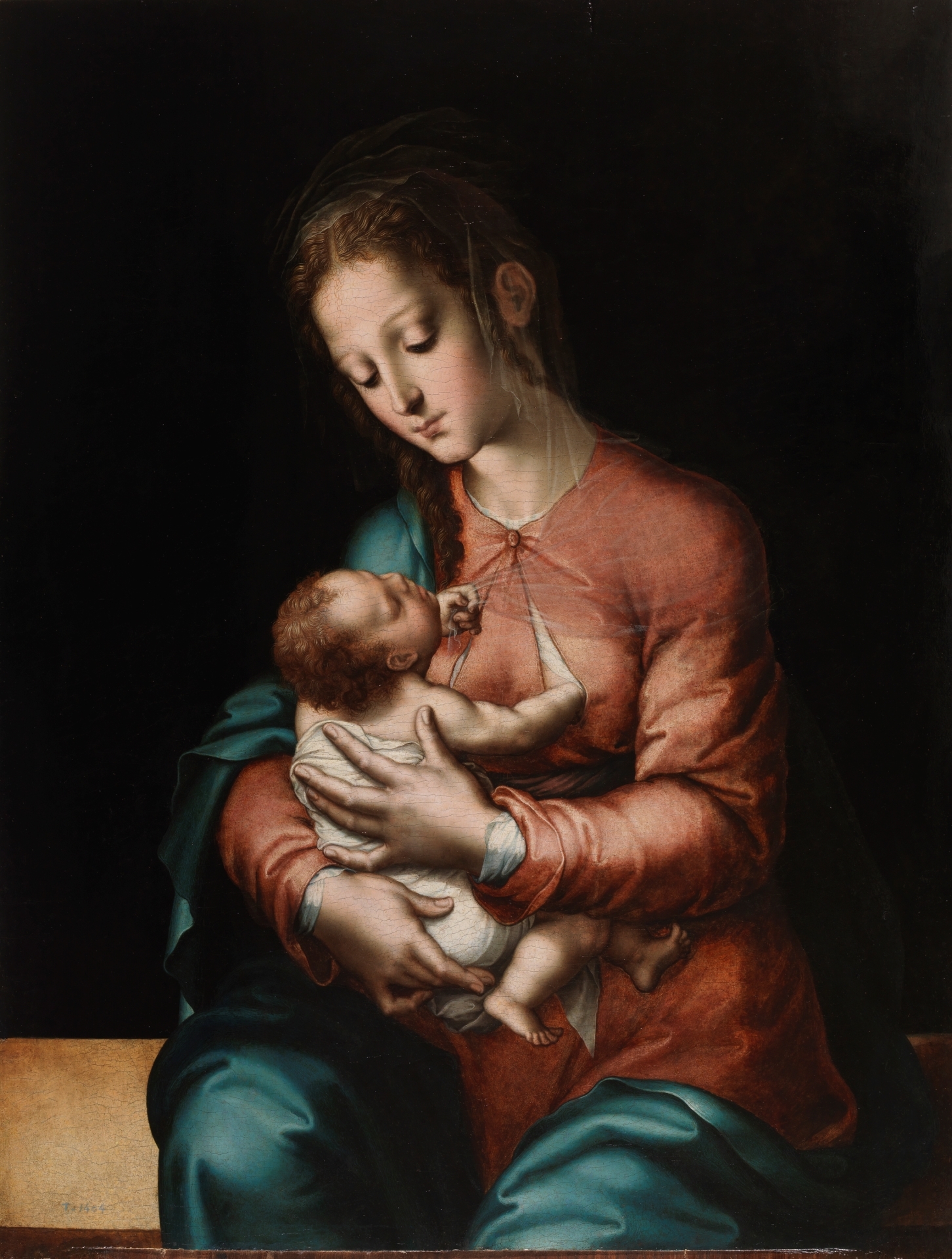
Luis de Morales (1509–1586)
Madonna and Child, circa 1565
Oil on canvas
84 × 64 cm (33.1 × 25.2 in)
Prado Museum

Luis de Morales
BADAJOZ CIRCA 1520 - 1586 BADAJOZ
THE VIRGIN AND CHILD WITH THE INFANT ST. JOHN THE BAPTIST
oil on panel, in a tabernacle frame
43 by 25.5 cm.; 17 by 10 in.
Luis de Morales (1512 - 9 May 1586) was a Spanish painter born in Badajoz, Extremadura. Known as "El Divino", most of his work was of religious subjects, including many representations of the Madonna and Child and the Passion.
Influenced, especially in his early work, by Raphael Sanzio and the Lombard school (fr) school of Leonardo, he was called by his contemporaries "The Divine Morales", because of his skill and the shocking realism of his paintings, and because of the spirituality transmitted by all his work.
His work has been divided by critics into two periods, an early stage under the influence of Florentine artists such as Michelangelo and a more intense, more anatomically correct later period similar to German and Flemish renaissance painters. More

Upper Rhenish School, circa 1480
ECCE HOMO
Tempera on softwood panel, in an old carved and gilt wood tabernacle frame
49.4 by 34.2 cm.; 19 1/2 by 13 1/2 in.
Ecce homo ("behold the man") are the Latin words used by Pontius Pilate in the Vulgate translation of John 19:5, when he presents a scourged Jesus Christ, bound and crowned with thorns, to a hostile crowd shortly before his Crucifixion. More

Michele Tosini, called Michele di Ridolfo del Ghirlandaio
FLORENCE 1503 - 1577
THE HOLY FAMILY WITH ST ELIZABETH AND THE YOUNG ST JOHN THE BAPTIST
oil on poplar panel
98.5 by 76.2 cm.; 38 3/4 by 30 in
Michele Tosini (1503–1577) was an Italian painter of the Renaissance and Mannerist period, who worked in Florence. Tosini began painting in the early 16th-century Florentine style of Fra Bartolommeo and Andrea del Sarto. His acceptance of Mannerism was slow, but by the 1540s the influence of Francesco Salviati and Agnolo Bronzino was visible in his work. After 1556, Tosini served as an assistant to Giorgio Vasari in the decoration of the Salone dei Cinquecento in the Palazzo Vecchio in Florence. Through Vasari's example, Tosini adopted a vocabulary derived from the work of Michelangelo and painted some of his best-known works in this manner. He executed several important commissions late in his career: the fresco decoration of three city gates of Florence (1560s), the altar in the chapel at the Villa Caserotta (1561), near San Casciano Val di Pesa, and the paintings on the sides and back of the tabernacle of the high altar of Santa Maria della Quercia (1570), Viterbo. According to Vasari, Tosini headed a large workshop that executed numerous altarpieces and paintings. He was also a notable portraitist. Tosini was a mentor to Bernardino Poccetti. More

Sebastiano Ricci
BELLUNO 1659 - 1734 VENICE
THE HOLY FAMILY WITH THE INFANT SAINT JOHN THE BAPTIST IN A LANDSCAPE
oil on canvas, in a fine English carved and gilt wood frame
61 by 81.6 cm.; 24 by 32 1/8 in

Hermann Stenner
Bearing of the Cross I
Dimensions: 9.72 X 11.81 in (24.7 X 30 cm)
Medium: Oil on paper
Creation Date: 1913
Hermann Stenner (12. March 1891 in Bielefeld; 5. December 1914 on the Eastern Front in Iłowa) was a German painter and graphic artist. Stenner is one of the outstanding artists of the early 20th century, although due to his early death in World War I he only had a short creative period of five years. During this time the young artist created an extensive oeuvre: Approximately 280 paintings and well over 1,500 works on paper are known. After impressionist beginnings around 1909 Stenner painting from 1911 has become increasingly more expressive with hard contours and bright colors. This turning to expressionism came under the influence of Kandinsky, from 1912-13 but especially by his teacher Adolf Hölzel. More
Acknowledgement: Old Master & British Paintings,