Showing posts with label Murillo. Show all posts

14 Paintings, scenes from the Bible, by The Old Masters, with footnotes # 34

Nicolas Poussin
Santa Francesca Romana, c. 1657
Oil on canvas
Musée du Louvre  (France - Paris) 

Frances of Rome, Obl.S.B., (Italian: Santa Francesca Romana) (1384 – March 9, 1440) is an Italian saint who was a wife, mother, mystic, organizer of charitable services and a Benedictine oblate who founded a religious community of oblates, who share a common life without religious vows.

Frances was born in 1384 in Rome to a wealthy and aristocratic couple, and christened at the Church of St. Agnes on the famed Piazza Navona. When she was about the age of twelve, her parents forced her to marry Lorenzo Ponziani, commander of the papal troops of Rome and member of an extremely wealthy family. Although the marriage had been arranged, it was a happy one, lasting for forty years.

Frances visited the poor and took care of the sick, inspiring other wealthy women of the city to do the same. Soon after her marriage, Frances fell seriously ill. Her husband called a man in who dabbled in magic, but Frances drove him away, and later recounted to Vannozza that St. Alexis had appeared to her and cured her.

Giovanni Battista Gaulli (1639–1709) 
Frances of Rome giving alms, c. 1675
Oil on canvas
Getty museum, Los Angeles

Giovanni Battista Gaulli (8 May 1639 – 2 April 1709), also known as Baciccio, was an Italian artist working in the High Baroque and early Rococo periods. He is best known for his grand illusionistic vault frescos in the Church of the Gesù in Rome, Italy. His work was influenced by Gian Lorenzo Bernini.

Gaulli was born in Genoa, and initially apprenticed with Luciano Borzone. In mid-17th century. Gaulli's Genoa was a cosmopolitan Italian artistic center open to both commercial and artistic enterprises from north European countries. Gaulli's earliest influences would have come from an eclectic mix of these foreign painters and other local artists whose warm palette Gaulli adopted. In the 1660s, he experimented with the cooler palette and linear style of Bolognese classicism.

He first introduced him to Gianlorenzo Bernini in Rome, who promoted him. He found patrons among the Genoese, and was accepted into the Roman artists' guild, where he was to later hold several offices. The next year, he received his first public commission for an altarpiece, in the church of San Rocco, Rome. He received many private commissions for mythological and religious works.

At his height, Gaulli was one of Rome's most esteemed portrait painters. Gaulli died in Rome, shortly after 26 March 1709, probably 2 April. More

Giovanni Battista Gaulli (1639–1709) 
An Apostle
Oil on canvas
74 by 60.5 cm.; 29 1/8 by 23 3/4 in.
Private Collection

When her mother-in-law died, Frances became mistress of the household. During a time of flood and famine, she turned part of the family's country estate into a hospital, and distributed food and clothing to the poor. 

During a period of forced exile, much of Lorenzo's property and possessions were destroyed. In the course of one occupation of Rome by Neapolitan forces in the early part of the century, he was wounded so severely that he never fully recovered. Frances nursed him throughout the rest of his life.

Frances experienced other sorrows in the course of her marriage with Lorenzo Ponziani. They lost two children to the plague. Chaos ruled the city in that period of neglect by the pope and the ongoing warfare between him and the various forces competing for power on the Italian peninsula devastated the city. The city of Rome was largely in ruins. Frances again opened her home as a hospital and drove her wagon through the countryside to collect wood for fire and herbs for medicine. It is said she had the gift of healing, and more than sixty cases were attested to during the canonization proceedings.

Giovanni Antonio Galli, called Spadarino (1585 - 1652)
Santa Francesca Romana con l’angelo, c. 1600s
Oil on canvas

Italian painter, Giovanni Antonio Galli, called Spadarino (1585 - 1652). He was the son of a swordsmith or frabbricante di spade, earning him the moniker, "Spadarino", or roughly "Little Sword". His family were from Florence. He was recorded alongside Bartolomeo Manfredi, Jusepe de Ribera, Cecco del Caravaggio and Carlo Saraceni as one of the closest of Caravaggio's followers c. 1620.

He is documented in 1603 as "painter in the Palazzo San Marco, in the house of Cardinal Dolfin" and was still serving the Cardinal in 1620. The few other documents that relate to him attest to his presence in Rome in 1597, 1617, 1620, 1638, 1645 and 1651.

His works are of concentrated simplicity, remote from the violence of Caravaggio and characterized rather by the tender relationship between the figures and the softness and delicacy of the shadows. More

On August 15, 1425, the feast of the Assumption of Mary, she founded the Olivetan Oblates of Mary, a confraternity of pious women. In March 1433, she founded a monastery at Tor de' Specchi, near the Campidoglio, in order to allow for a common life by those members of the confraternity. This monastery remains the only house of the Institute. The community later became known simply as the Oblates of St. Frances of Rome.

Frances herself remained in her own home, nursing her husband for the last seven years of his life from wounds he had received in battle. When he died in 1436, she moved into the monastery and became the superior. She died in 1440 and was buried in Santa Maria Nova. More

Michelangelo Caravaggio
St. Jerome writing, c. 1607
Oil on canvas
Height: 117 cm (46.1 in). Width: 157 cm (61.8 in).
St. John's Co-Cathedral


Jerome (c.  347 – 30 September 420) was a priest, confessor, theologian and historian. He was the son of Eusebius, born at Stridon, a village near Emona on the border of Dalmatia and Pannonia, then part of northeastern Italy. He is best known for his translation of most of the Bible into Latin (the translation that became known as the Vulgate), and his commentaries on the Gospels. His list of writings is extensive.
The protégé of Pope Damasus I, who died in December of 384, Jerome was known for his teachings on Christian moral life, especially to those living in cosmopolitan centers such as Rome. In many cases, he focused his attention to the lives of women and identified how a woman devoted to Jesus should live her life. This focus stemmed from his close patron relationships with several prominent female ascetics who were members of affluent senatorial families.
He is recognised as a Saint and Doctor of the Church by the Roman Catholic Church, the Eastern Orthodox Church, the Lutheran Church, and the Anglican Communion.[6] His feast day is 30 September. More

Michelangelo Merisi da Caravaggio (29 September 1571 in Caravaggio – 18 July 1610) was an Italian painter active in Rome, Naples, Malta, and Sicily between 1592 and 1610. His paintings, which combine a realistic observation of the human state, both physical and emotional, with a dramatic use of lighting, had a formative influence on Baroque painting.
Caravaggio trained as a painter in Milan under Simone Peterzano who had himself trained under Titian. In his twenties Caravaggio moved to Rome where there was a demand for paintings to fill the many huge new churches and palazzos being built at the time. It was also a period when the Church was searching for a stylistic alternative to Mannerism in religious art that was tasked to counter the threat of Protestantism. Caravaggio's innovation was a radical naturalism that combined close physical observation with a dramatic, even theatrical, use of chiaroscuro which came to be known as tenebrism (the shift from light to dark with little intermediate value).

He gained attention in the art scene of Rome in 1600 with the success of his first public commissions, the Martyrdom of Saint Matthew and Calling of Saint Matthew. Thereafter he never lacked commissions or patrons, yet he handled his success poorly. He was jailed on several occasions, vandalized his own apartment, and ultimately had a death sentence pronounced against him by the Pope after killing a young man, possibly unintentionally, on May 29, 1606. He fled from Rome with a price on his head. He was involved in a brawl in Malta in 1608, and another in Naples in 1609, possibly a deliberate attempt on his life by unidentified enemies. This encounter left him severely injured. A year later, at the age of 38, he died under mysterious circumstances in Porto Ercole in Tuscany, reportedly from a fever while on his way to Rome to receive a pardon.

Famous while he lived, Caravaggio was forgotten almost immediately after his death, and it was only in the 20th century that his importance to the development of Western art was rediscovered. More


Roman School, circa 1700
The Madonna and Child with the Infant Saint John the Baptist 
Oil on copper
21.2 x 16.2cm (8 3/8 x 6 3/8in)
Private Collection

Lucas Cranach the Elder (1472–1553)
Virgin and Child adored by the infant St John, circa 1512
Oil and tempera on lime
75.9 × 59.4 cm (29.9 × 23.4 in)
Private Collection

Lucas Cranach the Elder (c. 1472 – 16 October 1553) was a German Renaissance painter and printmaker in woodcut and engraving. He was court painter to the Electors of Saxony for most of his career, and is known for his portraits, both of German princes and those of the leaders of the Protestant Reformation, whose cause he embraced with enthusiasm, becoming a close friend of Martin Luther. He also painted religious subjects, first in the Catholic tradition, and later trying to find new ways of conveying Lutheran religious concerns in art. He continued throughout his career to paint nude subjects drawn from mythology and religion. He had a large workshop and many works exist in different versions; his son Lucas Cranach the Younger, and others, continued to create versions of his father's works for decades after his death. Lucas Cranach the Elder has been considered the most successful German artist of his time. More

North Italian School, late 16th Century, after Tiziano Vecelli, called Titian
Saint Peter Martyr 
Oil on canvas
245.5 x 150.5cm (96 5/8 x 59 1/4in).
Private Collection

Saint Peter of Verona O.P. (1206 – April 6, 1252), also known as Saint Peter Martyr, was a 13th-century Italian Catholic priest. He was a Dominican friar and a celebrated preacher. He served as Inquisitor in Lombardy, was killed by an assassin, and was canonized as a Catholic saint 11 months after his death, making this the fastest canonization in history.

He was born in the city of Verona into a family perhaps sympathetic to the Cathar heresy. Peter went to a Catholic school, and later to the University of Bologna, where he is said to have maintained his orthodoxy and at the age of fifteen, met Saint Dominic. Peter joined the Order of the Friars Preachers (Dominicans) and became a celebrated preacher throughout northern and central Italy.

From the 1230s on, Peter preached against heresy, and especially Catharism, which had many adherents in thirteenth-century Northern Italy. Because of this, a group of Milanese Cathars conspired to kill him. They hired an assassin, one Carino of Balsamo. Carino's accomplice was Manfredo Clitoro of Giussano. On April 6, 1252, when Peter was returning from Como to Milan, the two assassins followed Peter to a lonely spot near Barlassina, and there killed him and mortally wounded his companion, a fellow friar named Dominic.

Carino struck Peter's head with an axe and then attacked Domenico. Peter rose to his knees, and recited the first article of the Symbol of the Apostles (the Apostle's Creed). Offering his blood as a sacrifice to God, according to legend, he dipped his fingers in it and wrote on the ground: "Credo in Unum Deum", the first words of the Nicene Creed. The blow that killed him cut off the top of his head, but the testimony given at the inquest into his death confirms that he began reciting the Creed when he was attacked.

Dominic was carried to Meda, where he died five days afterwards. More

Tiziano Vecelli or Tiziano Vecellio, or Titian (1488/1490 – 27 August 1576), was an Italian painter, the most important member of the 16th-century Venetian school. He was born in Pieve di Cadore, near Belluno (in Veneto, Republic of Venice). During his lifetime he was often called da Cadore, taken from the place of his birth.

Recognized by his contemporaries as "The Sun Amidst Small Stars", Titian was one of the most versatile of Italian painters, equally adept with portraits, landscape backgrounds, and mythological and religious subjects. His painting methods, particularly in the application and use of color, would exercise a profound influence not only on painters of the Italian Renaissance, but on future generations of Western art.

During the course of his long life, Titian's artistic manner changed drastically but he retained a lifelong interest in color. Although his mature works may not contain the vivid, luminous tints of his early pieces, their loose brushwork and subtlety of tone are without precedent in the history of Western painting. More

CARAVAGESQUE SCHOOL
THE ADORATION OF THE SHEPERDS, CIRCA 1640
Oil on canvas
180 x 125 cm ; 70 7/8  by 49 1/4  in
Private Collection

The Adoration of the Shepherds, in the Nativity of Jesus in art, is a scene in which shepherds are near witnesses to the birth of Jesus in Bethlehem, arriving soon after the actual birth. It is often combined in art with the Adoration of the Magi, in which case it is typically just referred to by the latter title. The Annunciation to the Shepherds, when they are summoned by an angel to the scene, is a distinct subject.

The Adoration of the Shepherds is based on the account in the Luke 2, not reported by any other Canonical Gospel, which states that an angel appeared to a group of shepherds, saying that Christ had been born in Bethlehem, followed by a crowd of angels saying Glory to God in the highest, peace on earth to men of good will. This Annunciation to the shepherds forms a distinct subject in Christian art and is sometimes included in a Nativity scene as a peripheral feature (even though it occurs prior to the adoration itself), as in the 1485 scene by Domenico Ghirlandaio, where it can be seen in the upper left corner. Ghirlandaio also shows a procession of Magi about to arrive with their gifts. More

The Caravaggisti (or the "Caravagesques") were stylistic followers of the 16th-century Italian Baroque painter Caravaggio. His influence on the new Baroque style that eventually emerged from Mannerism was profound. Caravaggio never established a workshop as most other painters did, and thus had no school to spread his techniques. Nor did he ever set out his underlying philosophical approach to art, the psychological realism which can only be deduced from his surviving work. But it can be seen directly or indirectly in the work of Rubens, Jusepe de Ribera, Bernini, and Rembrandt. Famous while he lived, Caravaggio himself was forgotten almost immediately after his death. Many of his paintings were reascribed to his followers, such as The Taking of Christ, which was attributed to Honthorst until 1990. It was only in the 20th century that his importance to the development of Western art was rediscovered. In the 1920s Roberto Longhi once more placed him in the European tradition: "Ribera, Vermeer, La Tour and Rembrandt could never have existed without him. And the art of Delacroix, Courbet and Manet would have been utterly different". The influential Bernard Berenson stated: "With the exception of Michelangelo, no other Italian painter exercised so great an influence." More


Jacob de Wet (I) (fl. 1632–1675)
German: Parable of the Workers in the Vineyard, 2 Third 17C.
Color on panel
50 × 75.5 cm (19.7 × 29.7 in)
Museum of Fine Arts (Budapest)

The Parable of the Workers in the Vineyard (also called the Parable of the Laborers in the Vineyard or the Parable of the Generous Employer) is a parable of Jesus which appears in the Gospel of Matthew in the New Testament.

In Matthew Matt 20:1–16, Jesus says that any "laborer" who accepts the invitation to the work in the vineyard (said by Jesus to represent the Kingdom of Heaven), no matter how late in the day, will receive an equal reward with those who have been faithful the longest. More

For the kingdom of heaven is like unto a man that is an householder, which went out early in the morning to hire labourers into his vineyard. And when he had agreed with the labourers for a penny a day, he sent them into his vineyard. And he went out about the third hour, and saw others standing idle in the marketplace, And said unto them; Go ye also into the vineyard, and whatsoever is right I will give you. And they went their way. Again he went out about the sixth and ninth hour, and did likewise. And about the eleventh hour he went out, and found others standing idle, and saith unto them, Why stand ye here all the day idle? They say unto him, Because no man hath hired us. He saith unto them, Go ye also into the vineyard; and whatsoever is right, that shall ye receive. So when evening was come, the lord of the vineyard saith unto his steward, Call the labourers, and give them their hire, beginning from the last unto the first. 

Rembrandt Harmenszoon van Rijn (15 July 1606 – 4 October 1669)
The Parable of the Laborers in the Vineyard. 1637
Oil on panel
The Hermitage, St. Petersburg, Russia

Rembrandt Harmenszoon van Rijn (15 July 1606 – 4 October 1669) was a Dutch painter and etcher. He is generally considered one of the greatest painters and printmakers in European art and the most important in Dutch history. His contributions to art came in a period of great wealth and cultural achievement that historians call the Dutch Golden Age when Dutch Golden Age painting, although in many ways antithetical to the Baroque style that dominated Europe, was extremely prolific and innovative, and gave rise to important new genres in painting.
In his paintings and prints he exhibited knowledge of classical iconography, which he molded to fit the requirements of his own experience; thus, the depiction of a biblical scene was informed by Rembrandt's knowledge of the specific text, his assimilation of classical composition, and his observations of Amsterdam's Jewish population. Because of his empathy for the human condition, he has been called "one of the great prophets of civilization. More


And when they came that were hired about the eleventh hour, they received every man a penny. But when the first came, they supposed that they should have received more; and they likewise received every man a penny. And when they had received it, they murmured against the goodman of the house, Saying, These last have wrought but one hour, and thou hast made them equal unto us, which have borne the burden and heat of the day. But he answered one of them, and said, Friend, I do thee no wrong: didst not thou agree with me for a penny? Take that thine is, and go thy way: I will give unto this last, even as unto thee. Is it not lawful for me to do what I will with mine own? Is thine eye evil, because I am good? So the last shall be first, and the first last: for many be called, but few chosen... — Matthew 20:1–16, King James Version

Jacob Willemszoon de Wet or Jacob Willemsz. de Wet the Elder (c. 1610 – between 1675 and 1691) was a Dutch Golden Age painter, whose works were largely influenced by Rembrandt. De Wet was born and died in Haarlem. Little is known of his early life. Houbraken mentions him in passing as an art dealer of Haarlem in his biographical sketch of Philips Wouwerman, referring to him as Jan de Wet. 

De Wet left a notebook that mentions a total of 34 pupils, most famously Paulus Potter. Other notable pupils were Job Adriaensz Berckheyde, Adriaen Jansz Kraen, Johann Philip Lemke, Jan Vermeer van Haarlem I (not to be confused with Vermeer of Delft), Jacob de Wet II, and Kort Withold. He became a member of the Haarlem Guild of St. Luke in 1632. Judging from the number of pupils, and the difficulties his son Jacob II had with launching an independent career, it seems that De Wet had a large and successful practise in Haarlem. His son Jacob II was the only one of 5 children who also became a painter. More


Master of the Prodigal Son (active Antwerp, mid 16th Century)
The Story of Tobias 
oil on panel
86.2 x 120.8cm (33 15/16 x 47 9/16in)
Private Collection

A short story possibly dating from Persian times is the book of Tobit, named after the father of its hero. From the fragments of the book discovered at Qumrān, scholars now know that the original form of the name was Tobi. Tobit was from the Hebrew tribe of Naphtali and lived as an exile in Nineveh; his son was Tobias. Obeying the tenets of Jewish piety, Tobit buried the corpses of his fellow Israelites who had been executed. One day, when he buried a dead man, the warm dung of sparrows fell in his eyes and blinded him. His family subsequently suffered from poverty, but then Tobit remembered that he had once left a deposit of silver at Rages (today Teheran) in Media. He sent his son Tobias along with a companion, who was in reality the angel Raphael under the guise of an Israelite, to retrieve the deposit. During the journey, while Tobias was washing in the Tigris, a fish threatened to devour his foot. Upon instructions from Raphael, Tobias caught the fish and removed its gall, heart, and liver, since it was believed that the smoke from the heart and liver had the power to exorcise demons and that ointment made from the gall would cure blindness. On the way he stopped at Ecbatana (in Persia), where Raguel, a member of Tobias’ family, lived. His daughter Sarah had been married seven times, but the men had been slain by the demon Asmodeus on the wedding night, before they had lain with her. On the counsel of Raphael, Tobias asked to marry Raguel’s daughter, and on the wedding night Tobias put Asmodeus to flight through the stench of the burning liver and heart of the fish. Raphael went to Rages and returned with the deposit. When he returned with his young wife and Raphael to Nineveh, Tobias restored his father’s sight by applying the gall of the fish to his eyes. Raphael then disclosed that he was one of God’s seven angels and ascended into heaven. More


The Master of the Prodigal Son. Named after the large altarpiece now in the Kunsthistorisches Museum in Vienna which depicts the Parable of the Prodigal Son, the Master of the present work comes very close in style to both Pieter Coecke van Aelst (1502-50) and Frans Floris (1517-1570). This stylistic affinity suggests that the artist was active in Antwerp during the second quarter of the 16th Century. The master often treated subjects from the Old Testament. More

He was born in Antwerp and is considered to have run a workshop there with several pupils. His name is derived from a painting in Vienna. He is known for landscapes and religious works, and possibly travelled to Rome. Though a monogram of "LK" was discovered in one of his paintings, to conclude that this person was the Leonart Kroes mentioned as teacher in Karel van Mander's biography of Gillis van Coninxloo is incorrect. More


Francesco Solimena (Canale di Serino 1657-1747 Barra di Napoli)
Saints Tecla, Archelaa and Susanna being taken to their martyrdom 
Oil on canvas
51.6 x 62.5cm (20 5/16 x 24 5/8in)
Private Collection

St. Archelais, St. Thecla and St. Susanna (d. 293) were Christian virgins of the Romagna region of Italy. During the persecution by Diocletian in the third century, these holy virgins dressed themselves in men’s clothing, cut their hair and went to the Italian province of Campagna. Settling in a remote area, they continued to pursue an ascetical life of fasting and prayer. They received the gift of healing from God, treated the local inhabitants, and converted many pagans to Christ.

When the governor of the district heard of these healings, he had the holy women brought to Salerno. He threatened St. Archelais with torture and death if she did not offer sacrifice to idols. With firm hope in the Lord, the saint refused and denounced the folly of worshipping soulless statues. The governor ordered the saint to be torn apart by hungry lions, but the beasts meekly lay at her feet. In a rage, the governor ordered the lions to be killed, and locked the holy virgins in prison.

In the morning, having suspended St. Archelais from a tree, the torturers began to rake her with iron utensils and pour hot tar on the wounds. The saint prayed even more loudly, and suddenly a light shone over her and a voice was heard, “Fear not, for I am with you.”

St. Archelais was defended by the power of God. When they wanted to crush her with an immense stone, an angel pushed it to the other side, and it crushed the torturers instead. A judge ordered the soldiers to behead the holy virgins, but the soldiers did not dare to put their hands upon the saints. Sts. Archelais, Thekla and Susanna then said to the soldiers, “If you do not fulfill the command, you shall have no respect from us.” Thus, the holy martyrs were beheaded in 293. More

F. Solimena. Ss. Archelais, Thecla and Susanna 
Church of San Giorgio (Salerno)


Francesco Solimena (October 4, 1657 – April 3, 1747) was a prolific Italian painter of the Baroque era, one of an established family of painters and draughtsmen. He received early training from his father, Angelo Solimena, with whom he executed a Paradise for the cathedral of Nocera and a Vision of St. Cyril of Alexandria for the church of San Domenico at Solofra.

He settled in Naples in 1674, there he worked in the studio of Francesco di Maria and later Giacomo del Po. He apparently had taken the clerical orders, but was patronized early on, and encouraged to become an artist by Cardinal Vincenzo Orsini (later Pope Benedict XIII). By the 1680s, he had independent fresco commissions, and his active studio came to dominate Neapolitan painting from the 1690s through the first four decades of the 18th century. He modeled his art—for he was a highly conventional painter—after the Roman Baroque masters. Solimena painted many frescoes in Naples, altarpieces, celebrations of weddings and courtly occasions, mythological subjects, characteristically chosen for their theatrical drama, and portraits. His settings are suggested with a few details—steps, archways, balustrades, columns—concentrating attention on figures and their draperies, caught in pools and shafts of light. Art historians take pleasure in identifying the models he imitated or adapted in his compositions. His numerous preparatory drawings often mix media, combining pen-and-ink, chalk and watercolor washes. More

AFTER BARTOLOME ESTEBAN MURILLO (Spanish, 1617-1682) 
Virgin and Child 
Oil on canvas 
157 x 107cm 
Private Collection

Bartolomé Esteban Murillo (born late December 1617, baptized January 1, 1618 – April 3, 1682) was a Spanish Baroque painter. Although he is best known for his religious works, Murillo also produced a considerable number of paintings of contemporary women and children. These lively, realist portraits of flower girls, street urchins, and beggars constitute an extensive and appealing record of the everyday life of his times. More

Francesco Rizzo da Santacroce (active Venice, 1507-circa 1545)
The Holy Family with a female martyr saint 
oil on panel
68.8 x 98.2cm (27 1/16 x 38 11/16in).
Private Collection

The angular treatment of the drapery in the present work, along with the dramatic tonality of the sky suggest this is a typical, late work by Francesco Rizzo da Santacroce. A further characteristic of this Holy Family with a female martyr Saint is the underdrawing which is visible throughout. This peculiarity is seen in works by the artist such as his Holy Family with Saint Simon. In his article, This may simply be the result of the way the artist put together his pigments. The underdrawing is itself notable for its lack of hatching which may suggest that the artist regularly used cartoons to repeat his compositions, as his teacher Francesco di Simone da Santacroce (Santa Croce circa 1470-1508 Venice) had done before him. More

Francesco Rizzo da Santacroce, also known as simply Francesco da Santacroce or Francesco di Bernardo de' Vecchi Da Santa Croce (active 1507 – 1545) was an Italian painter of the Renaissance period, active mainly in Bergamo and Venice. He initially trained with Francesco di Simone da Santacroce, an ultimately inherited this master's studio. He was later a pupil or influenced by Giovanni Bellini or Vittore Carpaccio. He was born in the Sestiere of Santa Croce in Venice, or his family came from the hamlet of Santa Croce in Bergamo.

In 1507, he painted an Altarpiece depicting St Peter for the parish church of Lerina. By 1519, he was working in Venice, where he painted for San Cristoforo, the church of the Dominicans in the Zattere, San Francesco della Vigna (Last Supper), and Santa Maria degli Angeli, Murano (Virgin and St Jerome and Jermiah moved to San Pietro). He also painted an altarpiece for the parish church of Chirignago.

Girolamo and Pietro Paolo Rizzo were also painters and part of the same family. More


Acknowledgement: Bonhams

Images are copyright of their respective owners, assignees or others

29 Works, RELIGIOUS ART - Paintings and Stories from the Bible, with footnotes #7

Religious art is a visual representation of religious ideologies and their relationship with humans. Sacred art directly relates to religious art in the sense that its purpose is for worship and religious practices. According to one set of definitions, artworks that are inspired by religion but are not considered traditionally sacred remain under the umbrella term of religious art, but not sacred art. More on Religious art

Bartolomé Esteban Murillo (1617  – 1682)
La Colosal (Immaculate Conception), c. 1652
436 x 297 cm
Oil on Canvas
Seville Museum of Fine Arts

In this painting Murillo establishes a new iconographic prototype with representations of great dynamic force and movement. The Immaculate Conception, also known as "La Colosal", is an early work by Murillo painted around 1650, which was in the convent of San Francisco in Seville. The scene shown here is monumental in nature and full of movement, as can be seen in the swirling cloth, the white tunic and blue mantle, and the accompaniment of the angels playing around the image of the Virgin. 

The style of the early works of Murillo continues the models of Zurbarán, using strict Tenebrist naturalism and the cloud-filled skies suffused with golden light. More on this painting

Bartolomé Esteban Murillo (1617  – 1682)  was a Spanish Baroque painter. Although he is best known for his religious works, Murillo also produced a considerable number of paintings of contemporary women and children. His lively, realist portraits of flower girls, street urchins, and beggars constitute an extensive and appealing record of the everyday life of his times. More on Bartolomé Esteban Murillo

Lawrence Alma-Tadema (1836–1912)
The finding of Moses, c. 1904
oil on canvas
137.5 × 213.4 cm (54.1 × 84 in)
Private collection

The Finding of Moses is a 1904 painting by the Anglo-Dutch artist Sir Lawrence Alma-Tadema. It was one his last major works before his death in 1912, but quickly fell out of favour; according to rumour, it was sold in the 1960s for its frame. After appreciation of Victorian painting was renewed towards the end of the 20h century, it was described in an auction catalogue in 1995 as "the undisputed masterpiece of [Alma-Tadema's] last decade, as well as a late (perhaps the final?) flowering of the nineteenth-century's love-affair with Egypt". It was sold at auction in 2010 for nearly US$36 million.

The painting was commissioned by Sir John Aird, 1st Baronet for 5,000 guineas, plus expenses. Aird's civil engineering business, John Aird & Co., was responsible for building the first Aswan Dam. Aird invited Alma-Tadema to visit Egypt for the opening of the dam in December 1902, and commissioned him to paint a suitable subject to add to Aird's large collection of academic paintings by the likes of Frederic Leighton, Edward Poynter, and John William Waterhouse, including Alma-Tadema's 1888 work The Roses of Heliogabalus. The commission allowed Alma-Tadema to revisit Egyptian themes from his works in the 1860s.

The work is a Biblical scene based on chapter 2, verse 6 of the Book of Exodus, in which Pharaoh's daughter comes to wash in the River Nile, and finds the infant Moses abandoned in an ark in the reeds. The painting depicts the scene after the infant has been discovered, showing a procession travelling back to the daughter's abode in Memphis, the capital of the Old Kingdom of Egypt. More on this painting

Sir Lawrence Alma-Tadema,  (born January 8, 1836, Dronrijp, Netherlands—died June 25, 1912, Wiesbaden, Germany), Dutch-born painter of scenes from everyday life in the ancient world whose work was immensely popular in its time.

Alma-Tadema, the son of a Dutch notary, studied art at the Antwerp Academy (1852–58) under the Belgian historical painter Hendrik Leys, assisting the painter in 1859 with frescoes for the Stadhuis (town hall) in Antwerp. During a visit to Italy in 1863, Alma-Tadema became interested in Greek and Roman antiquity and Egyptian archaeology, and afterward he depicted imagery almost exclusively from those sources. Moving to England, he became a naturalized British subject in 1873 and was elected a member of the Royal Academy in 1879. He was knighted in 1899.

Alma-Tadema excelled at the accurate re-creation of ancient architecture and costumes and the precise depiction of textures of marble, bronze, and silk. His expert rendering of settings provides a backdrop for anecdotal scenes set in the ancient world. Alma-Tadema’s wife, Laura Epps, was also a painter. More on Sir Lawrence Alma-Tadema

Follower of Frans Francken the Younger | lot | Sotheby's:
Follower of Frans Francken the Younger
THE FEAST IN THE HOUSE OF SIMON
Oil on oak panel
43 by 49.3 cm.; 16 7/8  by 19 3/8  in.
Private collection

Feast in the House of Simon the Pharisee, also known as Christ in the Home of Simon the Pharisee. The painting depicts an incident from Luke 7 where Jesus visits Simon the Pharisee, and has his feet anointed by a "sinful woman". Jesus proceeds to tell the Parable of the Two Debtors.

Frans Francken the Younger, see below

FRENCH MASTER, 17th/18th century 
Moses Banishes the Shepherds from the Fountain and Waters the Sheep of Jethro's Daughters. 
Oil on canvas. Laid down on wood. 
75 x 102 cm.

The Bible, Exodus, Chapters:
.16 ¶ Now the priest of Midian had seven daughters: and they came and drew water, and filled the troughs to water their father's flock. 
 17  And the shepherds came and drove them away: but Moses stood up and helped them, and watered their flock. 
.18  And when they came to Reuel their father, he said, How is it that ye are come so soon to day? 
 19  And they said, An Egyptian delivered us out of the hand of the shepherds, and also drew water enough for us, and watered the flock. 
 20  And he said unto his daughters, And where is he? why is it that ye have left the man? call him, that he may eat bread. 

 FRANCKEN, FRANS II, Antwerp 1581 - 1642 - workshop 
Solomon's Idolatry. 
Oil on wood. 57,5 x 84,5cm.
Private collection

Estimated for €25,000 EUR - €30,000 EUR in Nov 2015

This is a depiction of King Solomon, who prays to a gold idol on a pedestal on his knees and swinging a censer. He is surrounded by women representing his second vice which is the polygamy. In the bible this vice is mentioned on the very spot with his idolatry. (1 Kings 11, 1-13) 

The present painting goes back to a painting by Franks Francken II (see below). depicting the same subject in the Musée of Beaux-Arts in Clermont-Ferrand dated 1630-1635. 

Frans Francken the Younger (Antwerp, 1581 – Antwerp, 6 May 1642) was a Flemish painter and the best-known member of the large Francken family of artists. He played an important role in the development of Flemish art in the first half of the 17th century through his innovations in genre painting and introduction of new subject matter. More on Frans Francken the Younger

Frans Francken II (Flemish Baroque Era Painter, 1581-1642)
The Idolatry of Solomon, c. 1622
Oil on panel
77 x 109 cm (30 3/8 x 43 in.)
The Getty Museum, Los Angeles, CA, USA

Wearing a silk robe with an ermine lining, King Solomon kneels and makes an offering to a pagan idol. One of his wives appears to instruct him, while several other concubines, lavishly dressed, stand behind. A group of men in elaborate headpieces and rich finery watch Solomon and the women from the left with displeasure, as if they know that Solomon's idol worship will eventually destroy his kingdom. The Temple of Jerusalem, which was erected under the king's reign, is under construction in the background.

Solomon was known for his proverbial wisdom and great wealth. In his later years, he was increasingly drawn to the pagan cults, which were thought to have been introduced into Israel by the women who came from neighboring kingdoms to join his large harem.

This subject was popular in Protestant countries in the 1600s because it reflected Protestant disapproval of the Catholic Church's use of religious imagery, a practice that Protestants viewed as idolatrous. More on this painting

SOGLIANI, GIOVANNI ANTONIO - Florence 1492 - 1544
Madonna and the Child and John the Baptist as a boy.
Oil on wood. 
74,5 x 56cm.
Private collection

Sold for €9,500 EUR November 2015

Giovanni Antonio Sogliani (1492–1544) was an Italian painter of the Renaissance, active mainly in Florence. Giovanni had apprenticed with Lorenzo di Credi for two decades. He painted a Martyrdom of St Acasio for the Church of San Lorenzo in Florence. Vasari claims that Sogliani was influenced by Fra Bartolomeo in this painting. He painted a St Martin for the Orsanmichele. He painted an altarpiece of St Brigitta now in the Museo di San Marco. He also painted a number of works for the Cathedral of Pisa, a commission that had previously been requested from Perino del Vaga. This included three canvases for the "Sacrifice of Abel, "Sacrifice of Cain, and Sacrifice of Noah completed by 15 May 1533. On 23 March 1536, he was commissioned an altarpiece of the Virgin with child and Saints.

He painted an Allegory of the Immaculate Conception now in the Accademia di Belli Arti in Florence. Among his pupils are Sigismondo Foschi and Zanobi di Poggino. More on Giovanni Antonio Sogliani

SEGHERS, GERARD, Antwerp 1591 - 1651 - circle 
Mary and the Child. 
Oil on canvas
125 x 92,5cm
Private collection

Estimated for €10,000 EUR - €12,000 EUR in Nov 2015

Gerard Seghers (Antwerp, 1591 – Antwerp, 18 March 1651) was a Flemish painter, art collector and art dealer. As a painter of history and genre paintings, he was in his youth one of the leading representatives of the Flemish Caravaggisti movement. More on Gerard Seghers

GERMAN MASTER 1st half of the 19th century 
Young Female Vintner in front of a Broad Campagna Landscape. 
Oil on canvas
133 x 98cm.
Private collection

STEENWYCK, HENDRICK VAN II. , 1580 - 1649 Leyden 
Salome with the Head of John the Baptist. 
Oil on wood. 
41 x 62cm. 
Private collection

Sold for  €6,000 EUR in Nov 2015


Hendrik van Steenwijck II (c.1580–1649) was a Baroque painter mostly of architectural interiors and biblical scenes and still lifes.

Van Steenwijck was born in Antwerp. His father, the Dutch painter Hendrik van Steenwijck I, one of the originators of the interiors genre, moved the family to Frankfurt am Main in 1585, where he trained his son. At his father's death in 1603, Van Steenwijck the Younger took over the studio in Frankfurt, but from 1604 until 1615 he was primarily active in Antwerp, where he collaborated with early Flemish Baroque painters such as Frans Francken I and Jan Brueghel the Elder. Van Steenwijck is best known for the numerous imaginary interiors that were based on the Cathedral of Our Lady, Antwerp. These had an immediate influence on paintings by Pieter Neeffs I. After settling in London by 1615, he painted backgrounds for Anthony van Dyck and Daniel Mytens the Elder. Van Steenwijck moved to The Hague around 1638, where he was a painter at the court, and to Leiden around 1642. His wife, Susanna van Steenwijk was also an architectural painter. Van Steenwijck died in Leiden or The Hague. More on Hendrik van Steenwijck II

FLORIS, FRANS, Antwerp 1516 - 1570 
St. Jerome
Oil on wood. 39 x 28,5cm.
Private collection

Estimated for €4,000 - €5,000 in Nov 2015

Saint Jerome (c.  347 – 30 September 420) was a Catholic priest, confessor, theologian and historian, who also became a Doctor of the Church. He was born at Stridon, in northeastern Italy. He is best known for his translation of most of the Bible into Latin, and his commentaries on the Gospels. His list of writings is extensive. The protégé of Pope Damasus I, who died in December of 384, Jerome was known for his teachings on Christian moral life, especially to those living in cosmopolitan centers such as Rome. In many cases, he focused his attention to the lives of women and identified how a woman devoted to Jesus Christ should live her life. This focus stemmed from his close patron relationships with several prominent female ascetics who were members of affluent senatorial families.

He is recognised as a saint by the Roman Catholic Church, the Eastern Orthodox Church, the Lutheran Church, and the Church of England (Anglican Communion). His feast day is 30 September. More on Saint Jerome

Frans Floris, Frans Floris the Elder or Frans Floris de Vriendt (1517 – 1 October 1570) was a Flemish painter mainly known for his historical paintings and portraits. He was a leading figure in the movement in Northern Renaissance painting referred to as Romanism. The Romanists had typically travelled to Italy to study the works of leading Italian High Renaissance artists such as Michelangelo, Raphael and their followers. Their art assimilated these Italian influences into the Northern painting tradition More

 PIETERS, PIETER, 1540 Antwerp - 1603 Amsterdam - circle 
Allegoric Female from Matthew, chapter 10: 16
"Therefore be as shrewd as snakes and as innocent as doves"
Oil on oak
103 x 76,5cm
Private collection

Sold for €6,000 EUR in Nov 2015

LISAERT, PIETER, Antwerp 1595 - 1629 - attributed 
Jephta Sees His Daughter 
Oil on wood
 49 x 64cm
Private collection

Estimated for  €19,000 EUR - €20,000 EUR in Nov 2015

Old Testament, Judges 11: 29 Now the Spirit of the LORD came upon Jephthah, so that he passed through Gilead and Manasseh; then he passed through Mizpah of Gilead, and from Mizpah of Gilead he went on to the sons of Ammon. 30 Jephthah made a vow to the LORD and said, "If You will indeed give the sons of Ammon into my hand, 31 then it shall be that whatever comes out of the doors of my house to meet me when I return in peace from the sons of Ammon, it shall be the LORD'S, and I will offer it up as a burnt offering."…

Pieter Lisaert ( Antwerp , 1574-1630) was a Flemish painter, specializing in historical, religious and allegorical painting matter.

A member of a family of artists and art dealers, his paintings, which are observed archaic features a mannerism, reveals influences of Frans Francken the Elder .


The little known Pieter Lisaert works. He hrepeated several times the parable of the foolish virgins and wise virgins ( Matthew 25: 1-13 ) (see below). More on Pieter Lisaert

File:Pieter Lisaert IV - De gelijkenis van de wijze en dwaze maagden.jpg
Pieter Lisaert III (1574 - circa 1630)
The Parable of the Wise and Foolish Virgins
Medium oil on panel
73.4 × 104.8 cm (28.9 × 41.3 in)
Museo del Prado, Madrid

The Parable of the Ten Virgins, also known as the Parable of the Wise and Foolish Virgins, is one of the well known parables of Jesus. It appears in two versions one in the Canonical gospels of the New Testament and one in the Epistula Apostolorum. According to the Gospel of Matthew 25:1-13, the five virgins who are prepared for the bridegroom's arrival are rewarded, while the five who are not prepared are disowned. The parable has a clear eschatological theme: be prepared for the Day of Judgment. It was one of the most popular parables in the Middle Ages, with enormous influence on Gothic art, sculpture and the architecture of German and French cathedrals. More on The Parable of the Wise and Foolish Virgins

By Giovanni Battista Tiepolo, c.1735-9. National Gallery, London:
Giovanni Battista Tiepolo (1696–1770
Pope St Clement Adoring the Trinity, c. 1737 and 1738
Oil on canvas
Height: 488 cm (192.1 in). Width: 256 cm (100.8 in).
Alte Pinakothek, München, Germany

The painting shows Pope Clement I at prayer, in an ecclesiastical architectural setting which cannot be identified more closely, before a vision of the Holy Trinity. The lively facial expressions suggest a conversation between Clement and God the Father, which is further dramatized by the strong chiaroscuro contrasts. In an allusion to the particular connection between the donor and his famous patron saint, Tiepolo lends the portrait of the Pope a private character: the tiara and crosier, symbols of his power, have been laid aside and placed in the keeping of a putto.More on this painting

Pope Clement I (died 99), also known as Saint Clement of Rome, is listed Bishop of Rome, holding office from 88 to his death in 99. He is considered to be the first Apostolic Father of the Church.

Clement was consecrated by Saint Peter, and he is known to have been a leading member of the church in Rome in the late 1st century. Early church lists place him as the second or third bishop of Rome after Saint Peter.

Clement asserted the authority of the presbyters as rulers of the church on the ground that the Apostles had appointed such. In the legendary Clementine Literature, Clement is the intermediary through whom the apostles teach the church. According to tradition, Clement was imprisoned under the Emperor Trajan; during this time he is recorded to have led a ministry among fellow prisoners. Thereafter he was executed by being tied to an anchor and thrown into the sea.

Clement is recognized as a saint in many Christian churches and is considered a patron saint of mariners. More on Pope Clement I

Giovanni Battista Tiepolo (March 5, 1696 – March 27, 1770), also known as Gianbattista or Giambattista Tiepolo, was an Italian painter and printmaker from the Republic of Venice. He was prolific, and worked not only in Italy, but also in Germany and Spain.

Giovan Battista Tiepolo, together with Giambattista Pittoni, Canaletto, Giovan Battista Piazzetta, Giuseppe Maria Crespi and Francesco Guardi forms the traditional great Old Masters of that period.

Successful from the beginning of his career, he has been described by Michael Levey as "the greatest decorative painter of eighteenth-century Europe, as well as its most able craftsman. More

Francesco di Gentile da Fabriano (1460-1500)
Virgin and Child with a Pomegranate, c. 1497
Oil on Canvas
18.8 x 25.2" (47.8 x 64.1 cm)
Philadelphia Museum of Art, USA

Gentile da Fabriano, (born c. 1370, Fabriano, Papal States [Italy]—died 1427, Rome), foremost painter of central Italy at the beginning of the 15th century, whose few surviving works are among the finest examples of the International Gothic style.

An early signed work by Gentile has stylistic affinities with Lombard painting and suggests that he was trained in the Lombard school. In 1409 Gentile was commissioned to decorate the Doges’ Palace in Venice with historical frescoes, which were later completed by Il Pisanello. His final important cycle of frescoes was begun in Rome in the Church of St. John Lateran shortly before his death. As with the frescoes in Venice, they were completed by Il Pisanello (now destroyed).

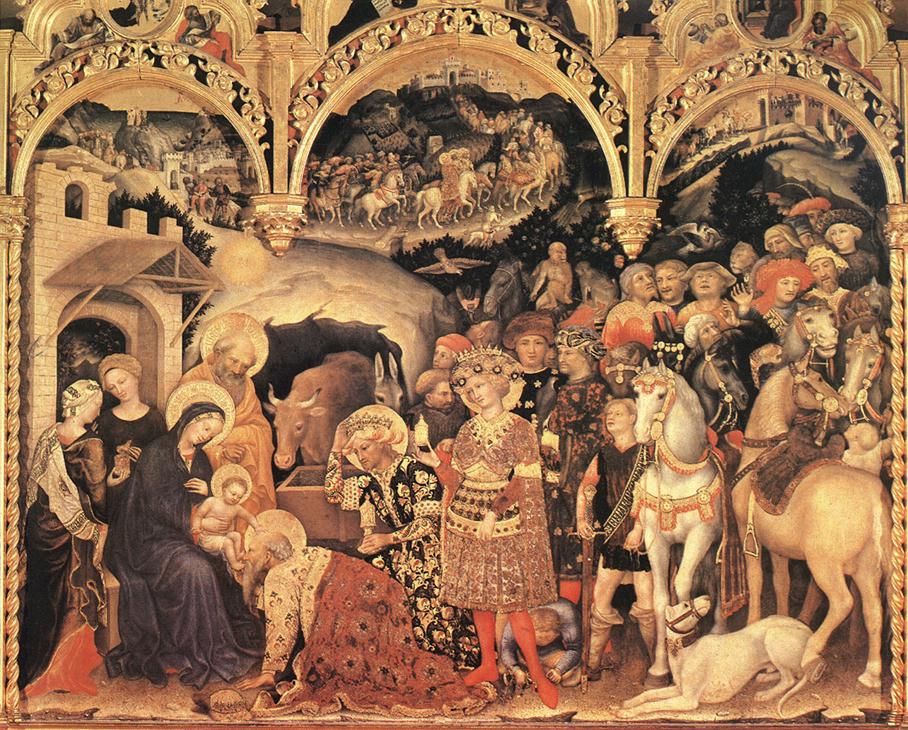
His surviving masterpiece, the Adoration of the Magi, c. 1423 (see below) for the Church of Santa Trinità, in Florence. Its graceful figures are clothed in velvets and rich brocades, and the Magi are attended by Oriental retainers, who look after such exotic animals as lions and camels. Its delicate linearity and vibrant colours enhance the effect of rich exoticism. Gentile also produced a number of Madonnas, such as the altarpiece known as the Quaratesi Polyptych c. 1425, which show the Mother and Child, regally clad, sitting on the ground in a garden. More on Gentile da Fabriano

Gentile da Fabriano Adoration.jpg
Gentile da Fabriano (1370–1427)
The Adoration of the Magi, c.1423
Medium tempera on panel
Height: 300 cm (118.1 in). Width: 282 cm (111 in).
Uffizi Gallery,  Firenze, Italy

Botticelli, madonna della melagrana 01.jpg
Sandro Botticelli (1445–1510)
Madonna of the Pomegranate (Madonna della Melagrana), circa 1487
Tempera on panel
diameter 143,5 cm
Galleria degli Uffizi, Florence

The Madonna of the Pomegranate (Madonna della Melagrana) is a painting by the Italian Renaissance master Sandro Botticelli, circa 1487. It is housed in the Uffizi Gallery of Florence, Italy.

Several copies of the work exist, currently held at the Berlin State Museums, the Wernher Collection in London and the Aynard Collection at Lyon. More

The elements of this image contain many symbolic items. Each figure wears a sad expression as if their mind is somewhere else thinking of Christ’s death. The seed of the pomegranate the infant is holding signifies that Christ will receive resurrection through rebirth just as the seed will cause the birth of a new plant. The angel in front is holding lilies and roses which are both symbols of the Virgin. That same angel is wearing sashes with the words AVE GRAZIA PLENA which mean “Hail [Mary] full of grace.” More on Madonna of the Pomegranate

Alessandro di Mariano di Vanni Filipepi, known as Sandro Botticelli (Italian: [ˈsandro bottiˈtʃɛlli]; c. 1445[1] – May 17, 1510), was an Italian painter of the Early Renaissance. He belonged to the Florentine School under the patronage of Lorenzo de' Medici, a movement that Giorgio Vasari would characterize less than a hundred years later in his Vita of Botticelli as a "golden age". Botticelli's posthumous reputation suffered until the late 19th century; since then, his work has been seen to represent the linear grace of Early Renaissance painting.

Among Botticelli's best-known works are The Birth of Venus and Primavera. More on Sandro Botticelli

Lorenzo di Credi, Florentine, c. 1457/1459 - 1536
Madonna and Child with a Pomegranate, c. 1475/1480
oil on poplar panel
16.5 x 13.4 cm (6 1/2 x 5 1/4 in.)
National Gallery of Art, Washington, United States

The Madonna and Christ Child appear in a window, and the child is standing on the balustrade below it. She is holding a pomegranate that has been cut open out to him, and the boy has taken some of it, for he is showing Mary red pearls of fruit that he is holding in his clumsy child's hand. Mary appears melancholy, as if she knows about the future Passion of her son, symbolized by the pomegranate.

This is one of the first Florentine panel paintings known today to have been produced with a paint medium containing oil for colour pigments. This technique first appeared in northern painting in the first half of the 15th century and rapidly spread there. Italian developed the technique later. The panel is very small by Italian standards, yet not at all an unusual format in Flemish painting. The Christ Child as well, with his fat, tummy overlong torso and skinny little arms, refutes the widespread generally more rounded Florentine type of depiction.

This Madonna is modeled after one by Leonardo; in fact, the painting was formerly thought to be an early work by Leonardo. More on this painting

Lorenzo di Credi (c. 1459 – January 12, 1537) was an Italian Renaissance painter and sculptor. He first influenced Leonardo da Vinci and then was greatly influenced by him. Born in Florence, he started to work in Andrea del Verrocchio's workshop. After the death of his master, he inherited the direction of the workshop. For Pistoia Cathedral he completed the painting of the Madonna Enthroned between John the Baptist and St. Donatus which had been partially painted by his master, Verrocchio, but was left unfinished when Verrocchio went to Venice.

Lorenzo's mature works are influenced by Fra Bartolomeo, Perugino and the young Raphael.

In recent times, one of di Credi's works gained attention when scholars pointed out a resemblance between the face of Mona Lisa by Leonardo da Vinci and the face of Caterina Sforza in a portrait by him. Caterina Sforza was the Lady of Forlì and Imola in Romagna, later prisoner of Cesare Borgia. The portrait, known also as La dama dei gelsomini, is now in the Pinacoteca of Forlì. More on Lorenzo di Credi

Italian (Florentine) School
Madonna and Child with a Pomegranate, c.1525
Oil on panel
102 x 83 cm
National Trust, Manvers, Rotherham, UK

The large split pomegranate on the plinth, with its hard case and a multitude of blood-red seeds, refers to Christ’s resurrection and unity of faith. Its presence became popular in fifteenth-century Florentine painting. Its symbolism of immortality or regeneration is related to the mythological story of Proserpine, daughter of the corn-goddess Ceres, who was abducted to the Underworld by Pluto. But, after she had eaten some pomegranate seeds, he allowed her to return to earth in springtime, so plants blossomed. In Jerusalem the pillars of Temple of Solomon (a biblical King prefiguring Christ) and the robes of its High Priest were decorated with pomegranates. They are mentioned in Solomon’s Song of Songs and became a metaphor of the Virgin’s chastity. Here the Virgin and Child stand in a classical building and she holds a book, possibly alluding to the Roman Missal 1472, which contains a reference to the feast day of her presentation at the temple. More on this painting

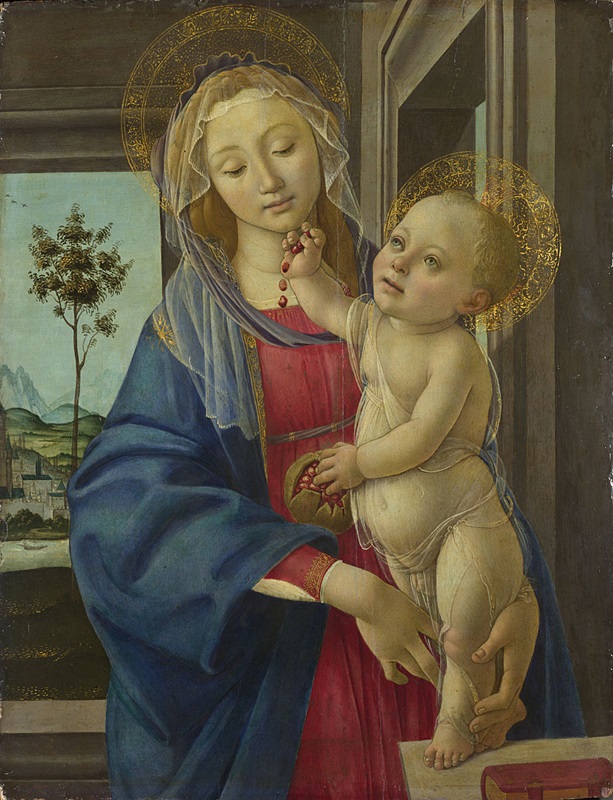
The Virgin and Child with a Pomegranate
Workshop of Sandro Botticelli, probably about 1480-1500
Tempera on wood
Dimensions67.9 x 52.7 cm
The National Gallery

The Virgin Mary stands with her infant son, Christ, in the corner of a large but sparsely decorated room. He is balanced on a small table, the only piece of furniture, but is dangerously close to its edge; a closed book further restricts the space available to him. The Virgin uses both hands to support his left leg as he leans forward. His translucent robe hardly provides protection.

Seeds of a pomegranate trickle out of Christ’s raised hand, evoking the beads of a rosary, the devotional aid often used for prayer. This resemblance may be intentional, as the painting is likely to have been made for private worship. The workshop of the Florentine painter Sandro Botticelli specialised in the production of such paintings, which frequently decorated people’s homes. More on this painting

The Virgin and Child with two Angels or The Virgin with a Pomegranate, 1426
Guido di Pietro, known as Fra Angelico (Mugello, 1390 – Rome, 1455)
Tempera on panel, 83 x 59 cm
Museo Nacional del Prado. Acquired in 2016 (with the collaboration of the Fundación Amigos del Museo del Prado)

The Virgin of the Pomegranate takes its name from the pomegranate held by the Virgin and which attracts the attention of the Christ Child, who touches it. In this context the fruit has a double meaning: in the Virgin’s hands it refers to her chastity, while by touching it the Christ Child prefigures his own death and resurrection. This iconography was widely used in 15th-century Florence where it interested artists such as Sandro Botticelli and Leonardo da Vinci.

The Virgin of the Pomegranate is a remarkable work painted at one of the key moments in the history of European art, in early 15th-century Florence, by one of its most important artists: Guido di Pietro (Mugello, 1390 – Rome, 1455), better known as the Beato Angelico or Fra Angelico. This panel is also one of the very few masterpieces of this period to remain in private hands, given that since Quattrocento Italian painting first began to attract the attention of critics and art lovers in the early 19th century, it became a coveted field for museums and collectors. In the present day the most important works by Masaccio, Masolino and Fra Angelico are housed in the leading European and American museums. This fact, in addition to the painting’s fine state of conservation, makes The Virgin of the Pomegranate exceptionally important.

The Virgin of the Pomegranate is one of a series of Virgin and Child compositions that Fra Angelico painted in the 1420s and which reveal his increasing mastery of anatomy, light and space. This group also includes The Virgin of Humility in the Museo Thyssen. More on The Virgin of the Pomegranate

Fra Angelico (c. 1395 – February 18, 1455) see below

The Annunciation, 1425 – 1426
Guido di Pietro, known as Fra Angelico (Mugello, 1390 – Rome, 1455)
Tempera on panel, 194 x 194 cm
Museo Nacional del Prado

This altarpiece was painted for the monastery of Santo Domenico in Fiesole, near Florence. The central panel shows the Archangel Gabriel’s Annunciation to Mary under a portico. On the left, Adam and Eve are being expelled from Paradise. The damnation and salvation of Humanity. The predella has scenes from the life of the Virgin; Mary’s Birth, Her Wedding with Saint Joseph, Mary’s Visit to her cousin Saint Elisabeth, the Birth of the Christ Child, the Presentation of Jesus in the Temple and the Dormition of the Virgin with Christ receiving her soul. Fra Angelico, also known as Blessed Angelico, dedicated his work exclusively to religious subjects as he understood art to be an aspect of religious devotion. He was particularly meticulous in the details and qualities of Nature and of the objects and persons depicted. In his style, Fra Angelico merged the late Gothic Italian style with the new language of the Renaissance. An example of this is the architecture’s spatial depth, which, while in keeping with Brunelleschi’s recommendation to occupy the center of a square and unadorned stage, nevertheless shows some of the errors present in Angelico’s early works. More on this painting

Fra Angelico (c. 1395 – February 18, 1455) see below

Guido di Pietro, known as Fra Angelico (Mugello, 1390 – Rome, 1455)
The Funeral of Saint Anthony Abbot, c.1426-1430
Tempera on poplar wood, 29.2 x 19.5 cm
(Donation of Carlos Fitz-Stuart y Martínez de Irujo, 19th Duke of Alba de Tormes, to the Museo del Prado)

This scene is from the predella of an altarpiece dedicated to Saint Anthony Abbot, the founder of the eremitic movement. Its technical and formal characteristics suggest a dating close to that of The Virgin with the Pomegranate. Like that work, it was acquired in Florence in 1817 by Carlos Miguel Fitz-James Stuart y Silva, 14th Duke of Alba de Tormes. More on this painting

Saint Anthony, c. 251–356, was a Christian monk from Egypt, revered since his death as a saint. He is distinguished from other saints named Anthony by various epithets: Anthony the Great, Anthony of Egypt, Anthony the Abbot, Anthony of the Desert, Anthony the Anchorite, and Anthony of Thebes. For his importance among the Desert Fathers and to all later monasticism, he is also known as the Father of All Monks. His feast day is celebrated on January 17 among the Orthodox and Catholic churches and on Tobi 22 in the Egyptian calendar used by the Coptic Church.

The biography of Anthony's life by Athanasius of Alexandria helped to spread the concept of monasticism, particularly in Western Europe via its Latin translations. He is often erroneously considered the first monk, but as his biography and other sources make clear, there were many ascetics before him. Anthony was, however, the first known ascetic going into the wilderness (about ad 270), a geographical move that seems to have contributed to his renown. Accounts of Anthony enduring supernatural temptation during his sojourn in the Eastern Desert of Egypt inspired the often-repeated subject of the temptation of St. Anthony in Western art and literature.

Anthony is appealed to against infectious diseases, particularly skin diseases. In the past, many such afflictions, including ergotism, erysipelas, and shingles, were historically referred to as St. Anthony's fire. More on Saint Anthony

Fra Angelico (c. 1395 – February 18, 1455) was an Early Italian Renaissance painter described by Vasari in his Lives of the Artists as having "a rare and perfect talent".

He was known to contemporaries as Fra Giovanni da Fiesole (Brother John of Fiesole, the "Angelic friar").

In 1982 Pope John Paul II proclaimed his beatification, in recognition of the holiness of his life, thereby making the title of "Blessed" official. Fiesole is sometimes misinterpreted as being part of his formal name, but it was merely the name of the town where he took his vows as a Dominican friar, and was used by contemporaries to separate him from other Fra Giovannis. He is listed in the Roman Martyrology as Beatus Ioannes Faesulanus, cognomento Angelicus—"Blessed Giovanni of Fiesole, known as 'the Angelic' ".

Vasari wrote of Fra Angelico that "it is impossible to bestow too much praise on this holy father, who was so humble and modest in all that he did and said and whose pictures were painted with such facility and piety." More on Fra Angelico

Battista Dossi FERRARA (?) 1490/5 - 1548 FERRARA THE FLIGHT INTO EGYPT oil on poplar panel 66.1 by 87.3 cm.; 26 by 34 3/8  in.:
Battista Dossi, FERRARA 1490/5 - 1548 FERRARA
THE FLIGHT INTO EGYPT
oil on poplar panel
66.1 by 87.3 cm.; 26 by 34 3/8  in.
University of Miami, Lowe Art Museum

The Flight into Egypt is representative of a new genre of painting, the cabinet picture, which originated in the early sixteenth century. Small-scale easel paintings such as this were produced for private consumption and therefore were not constrained by conventional expectations in regard to content. In The Flight into Egypt, the biblical event is illustrated in a novel fashion that conveys the familial intimacy of the Holy Family. Whereas in earlier Italian art Joseph is always shown on foot leading the mule on which Mary and the Christ Child ride, here he rides his own mule and carries the sleeping Christ Child in a wooden cradle. Joseph turns in the saddle to face Mary and points vigorously to the trail, whereas she appears to be forewarning him that a closed gateway lies directly in their path. Like Garofalo, Dosso and his younger brother, Battista, worked chiefly in Ferrara for the Este court. Painted after Battista’s return from Rome, where he worked in Raphael’s shop from 1517-1520, The Flight into Egypt is one of many collaborative undertakings by the two painters. More on this painting

The composition is known in three versions. One was in the Samuel H. Kress Foundation, and was given as a gift to the Lowe Art Museum at the University of Miami, Florida.1 Marginally smaller, and also on panel, the Kress painting is comparable to the present work down to the smallest details. The third version was formerly in the collection of Fritz von Harck (1855-1917), at Schloß Seußlitz, Dresden.2 The Harck painting differs from the other two in the construction of the right-hand side of the composition, where it depicts a small weir under the bridge before the Holy Family, and omits the posts delineating the edge of the path. The distance is also different, the Harck version shows a distant island, with a walled city at its shores, then another island in the middle distance upon which is another group of buildings, including a rotunda and a square tower, and a third spit of land with small figures and foliage only. The present picture, and the Kress version, depict a distant landscape sweeping from green fields, to coastal cities, to high rocky mountains and distant rolling hills. More on this painting

The flight into Egypt is a biblical event described in the Gospel of Matthew (Matthew 2:13-23), in which Joseph fled to Egypt with st. Mary and infant son Jesus after a visit by Magi because they learn that King Herod intends to kill the infants of that area. The episode is frequently shown in art, as the final episode of the Nativity of Jesus in art, and was a common component in cycles of the Life of the Virgin as well as the Life of Christ. More

Battista Dossi (ca. 1490–1548), also known as Battista de Luteri, was an Italian painter who belonged to the Ferrara School of Painting. He spent nearly his entire career in service of the Court of Ferrara, where he worked with his older brother Dosso Dossi (c. 1489-1542). It is believed that Battista worked in the Rome studio of Raphael from 1517 to 1520. Battista’s students include Camillo Filippi (c. 1500-1574). More on Battista Dossi

DUYTS, JAN DE , Antwerp 1629 - 1676 
The Mystic Wedding of Saint Catherine
Oil on canvas
108 x 100cm
Private collection

Estimated for €20,000 - €25,000 in Nov. 2015

The Mystical Marriage of Saint Catherine (or "Mystic") covers two different subjects in Christian art arising from visions received by either Saint Catherine of Alexandria or Saint Catherine of Siena (1347–1380), in which these virgin saints went through a mystical marriage wedding ceremony with Christ, in the presence of the Virgin Mary, consecrating themselves and their virginity to him.

The Catholic Encyclopaedia notes that such a wedding ceremony "is but the accompaniment and symbol of a purely spiritual grace", and that "as a wife should share in the life of her husband, and as Christ suffered for the redemption of mankind, the mystical spouse enters into a more intimate participation in His sufferings." Catherine of Alexandria was martyred, while Catherine of Siena received the stigmata. More on The Mystical Marriage of Saint Catherine

Jan De Duyts was a Dutch visual artist who was born in 1629. The artist died in 1676.

He apprentice between 18 September 1641 and 18 September 1642 in the Guild of St. Luke's, Antwerp , master between 18 September 1647 and 18 September 1648 (Rombouts/Van Lerius 1872/1961)

Attributed to CIARAMPONI, PASQUALE, 1734 Treia (Marche) - 1792 Treia (Marche) - 
Erminia and Vafrin find the Wounded Tancredi
Oil on canvas
121 x 158cm
Private collection

Estimated for €18,000 EUR - €20,000 EUR  in Nov 2015

This painting illustrates an episode taken from the epic poem "Jerusalem Delivered" by Torquato Tasso (Canto 19, line 809-912). The subject of this epic poem is the conquest of Jerusalem by the Christians. The Christian warrior, Tancredi, is heavily wounded by the cruel Saracen, Argante, and is lying in front of Jerusalem's walls. Argante, who is killed in action, can be seen in the background. Tancredi is found by his squire, Vafrin, who is dressed up like a Saracen, and princess Erminia, who is secretly in love with Tancredi. Erminia bents down over Tancredi and is deeply upset. 

Jerusalem Delivered  is an epic poem by the Italian poet Torquato Tasso first published in 1581, which tells a largely mythified version of the First Crusade in which Christian knights, led by Godfrey of Bouillon, battle Muslims in order to take Jerusalem. One of the most characteristic literary devices in Tasso's poem is the emotional conundrum endured by characters torn between their heart and their duty; the depiction of love at odds with martial valour or honor is a central source of lyrical passion in the poem.

Tasso's choice of subject matter, an actual historic conflict between Christians and Muslims (albeit with fantastical elements added), had a historical grounding, and created compositional implications  that are lacking in other Renaissance epics. Like other works of the period which portray conflicts between Christians and Muslims, this subject matter had a topical resonance to readers of the period, as the Ottoman Empire was advancing through Eastern Europe.

The poem, which in detail bears almost no resemblance to the actual history or cultural setting of the Crusades, tells of the initial disunity and setbacks of the Christians and their ultimate success in taking Jerusalem in 1099. Much of the poem is concerned with romantic sub-plots involving entirely fictional characters, except for Tancredi. The three main female characters begin as Muslims, have romantic entanglements with Christian knights, and are eventually converted to Christianity. They are all women of action: two of them fight in battles, and the third is a sorceress. There are many magical elements, and the Saracen side often act as though they were classical pagans. The most famous episodes, and those most often dramatised and painted, includes the Princess Erminia (or "Hermine") of Antioch. 

Princess Erminia (or "Hermine") of Antioch, also falls in love with Tancredi and betrays her people to help him, but she grows jealous when she learns that Tancredi loves Clorinda. One night she steals Clorinda's armor and leaves the city, in an attempt to find Tancredi, but she is attacked by Christian soldiers (who mistake her for Clorinda) and she flees into the forest, where she is cared for by a family of shepherds.

Later in the poem we find her again in the company of Armida's ladies, but Erminia abandons her Muslim people and goes over to the Christian side. When Tancredi is dangerously wounded in combat, she heals him, cutting off her hair to bind his wounds. More on More on Jerusalem Delivered

Pasquale Ciaramponi (20 May 1734 – 27 October 1792) was an Italian painter active in the Marche region in a late-Baroque style.

He was born in Treia, in the province of Macerata. He trained initially under Pompeo Batoni. He then moved to Rome, where he entered the studio of Gaetano Lapis. He returned to Treia and the Marche, where he painted portraits and sacred subjects. More on Pasquale Ciaramponi

MARR, CARL VON, 1858 Milwaukee - 1936 Munich 
The Walk of Children to Bethlehem. 
Oil on cardboard
63 x 63cm
Private collection

Sold for €18,000 €13,000 EUR  in Nov 2015

Carl von Marr (February 14, 1858 – July 10, 1936) was an American-born German painter. He was born at Milwaukee, Wisconsin. He was a pupil of Henry Vianden in Milwaukee, of Martin Schauß in Weimar, of Karl Gussow in Berlin, and subsequently of Otto Seitz at the Academy of Fine Arts Munich.

Marr became a professor at the Academy of Fine Arts in Munich in 1893, and in 1895 a member of the Berlin Academy of Arts. In 1917, Marr was appointed a privy councilor to the Bavarian government. He was forced to flee to Switzerland during the Bavarian Council Republic, which put a price on his head because of this political connection. In 1919, Marr became the director of the Royal Academy in Munich, where he continued to work until his retirement in 1923. Marr died on 10 July 1936 and is buried at the Solln Cemetery in Munich. More on Carl von Marr


Please visit my other blogs: Art CollectorMythologyMarine ArtPortrait of a Lady, The OrientalistArt of the Nude and The Canals of VeniceMiddle East Artists365 Saints365 Days, and Biblical Icons, also visit my Boards on Pinterest

Images are copyright of their respective owners, assignees or others. Some Images may be subject to copyright

I don't own any of these images - credit is always given when due unless it is unknown to me. if I post your images without your permission, please tell me.

I do not sell art, art prints, framed posters or reproductions. Ads are shown only to compensate the hosting expenses.

If you enjoyed this post, please share with friends and family.

Thank you for visiting my blog and also for liking its posts and pages.

Please note that the content of this post primarily consists of articles available from Wikipedia or other free sources online.