01 Work, RELIGIOUS ART - Interpretation the bible, Edouard Kasparides' The penitent Mary Magdalene in the cave, with Footnotes - 127

Edouard Kasparides, (1858-1926 Austrian)
Detail; The penitent Mary Magdalene in the cave, c. 1890
Oil on canvas
45.5" H x 67" W
Private collection

Edouard Kasparides, (1858-1926 Austrian)
The penitent Mary Magdalene in the cave, c. 1890
Oil on canvas
45.5" H x 67" W
Private collection

The penitent Mary Magdalene was a sinner, perhaps a courtesan, Mary Magdalen was a witness of Christ who renounced the pleasures of the flesh for a life of penance and contemplation. Penitent Magdalene or Penitent Magdalen refers to a post-biblical period in the life of Mary Magdalene, according to medieval legend. 

According to the tenets of the 17th–century Catholic church, Mary Magdalene was an example of the repentant sinner and consequently a symbol of the Sacrament of Penance. According to legend, Mary led a dissolute life until her sister Martha persuaded her to listen to Jesus Christ. She became one of Christ's most devoted followers and he absolved her of her former sins. More on The Penitent Magdalen

The sacrament of Penance had important significance in Counter-Reformation spirituality, and artists frequently portrayed penitent saints as exemplars of religious fervor. Such works were meant to inspire a greater devotion. On the other hand, the popularity of The Magdalene as a subject is also associated with her implied sexuality. Her passive gaze and partially naked body appealed to male viewers, for whom such paintings offered a moralizing context through which to engage with the sensuality of the female form. The Penitent Magdalene

Eduard Kasparides  (Krönau 1858 - 1926 Bad Gleichenberg) was born in Moravia in the eastern part of the Czech Repubic. In 1876 he moved to Vienna to study at the Academy of Fine Arts. His teachers were Christian Griepenkerl and Josef Mathias von Trenkwald.  In 1884 he finished his studies and moved to Munich one year later, he came back to Vienna in 1886. He made several study trips during his career and traveled through Italy, Germany, Sweden and Russia.

At the begin of his career Eduard Kasparides painted mainly conversation pieces and historical paintings with religious motives. But from 1899 he found his individual style and focussed on impressionistic evening-landscapes with a strong atmospheric effect. He became a member of the Vienna Künstlerhaus in 1894 and was a co-founder of the artist group Hagenbund in 1900.

Eduard Kasparides was awarded several times, he got the Baron Königswarter-Künstlerpreis in 1899, the Mention honorable at the world exhibition in Paris in 1900 and the Kleine Goldene Staatsmedaille in Vienna, the Erzherzog Carl Ludwig Medaille in 1908, the Drasche Preis in 1911 and the Große Goldene Staatsmedaille in 1912. Eduard Kasparides died in 1926 in Styria. More on Eduard Kasparides


Please visit my other blogs: Art CollectorMythologyMarine ArtPortrait of a Lady, The OrientalistArt of the Nude and The Canals of VeniceMiddle East Artists365 Saints and 365 Days, also visit my Boards on Pinterest

Images are copyright of their respective owners, assignees or others. Some Images may be subject to copyright

I don't own any of these images - credit is always given when due unless it is unknown to me. if I post your images without your permission, please tell me.

I do not sell art, art prints, framed posters or reproductions. Ads are shown only to compensate the hosting expenses.

If you enjoyed this post, please share with friends and family.

Thank you for visiting my blog and also for liking its posts and pages.

Please note that the content of this post primarily consists of articles available from Wikipedia or other free sources online.

01 Work, CONTEMPORARY Interpretation of the Bible! Jean Jansem's Lot and his two daughters, with Footnotes - 44

Jean Jansem, (1920-2013)
Loth et ses filles/ Lot and his two daughters, c. 1999
Oil on canvas
51 3/16 x 63 3/4 in
Private collection

Lot and his two daughters, Genesis 19:30-38,  left Zoar and settled in the mountains, for he was afraid to stay in Zoar. He and his two daughters lived in a cave. 31 One day the older daughter said to the younger, “Our father is old, and there is no man around here to give us children—as is the custom all over the earth. 32 Let’s get our father to drink wine and then sleep with him and preserve our family line through our father.”

That night they got their father to drink wine, and the older daughter went in and slept with him. He was not aware of it when she lay down or when she got up.

The next day the older daughter said to the younger, “Last night I slept with my father. Let’s get him to drink wine again tonight, and you go in and sleep with him so we can preserve our family line through our father.” So they got their father to drink wine that night also, and the younger daughter went in and slept with him. Again he was not aware of it when she lay down or when she got up.

So both of Lot’s daughters became pregnant by their father. The older daughter had a son, and she named him Moab; he is the father of the Moabites of today. The younger daughter also had a son, and she named him Ben-Ammi; he is the father of the Ammonites of today. More Lot and his two daughters

Hovhannes "Jean" Semerdjian (9 March 1920 – 27 August 2013), also known as Jean Jansem, was a French-Armenian painter. Jansem's artworks are internationally known, and are part of museum collections throughout France, Japan and the United States. A Foreign member of the National Academy of Sciences of Armenia (2002).
He was awarded the Ordre des Arts et des Lettres in 1953 and by the Knight of the French Legion of Honour in 2003. The President of Armenia awarded Jansem a Medal of Honor for his “reinforcement of Armenian-French cultural ties.” 
Hovhannes Semerdjian was born in 1920 in Bursa, Turkey. In 1922, his family fled to Greece. He spent his childhood in Thessaloniki. They arrived to Issy-les-Moulineaux suburb of Paris, France in 1931 when he was 11 and that is when he begin to paint. The first professional schools for Jansem became free academies of Montparnasse (1934-1936). He studied in the Ecole des Arts Decoratifs. Jansem also studied at the Sabatie studio for a year. Early paintings by Jansem were mainly to national issues. He had individual exhibitions in Paris, New York, Chicago, London, Tokyo, Rome, Brussels, Lausanne, Beirut etc. Hovhannes Semerdjian was elected the President of the Young Artists' Saloon in 1956.
Jansem’s primary sources of inspiration were Goya and Brueghel. His mother and his children were the main heroes in his earlier works. Jansem was characterized as a miserablist, an artist of unfortunate people.
Jansem died on 27 August 2013, aged 93, outside Paris. More on Jean Jansem


Please visit my other blogs: Art CollectorMythologyMarine ArtPortrait of a Lady, The OrientalistArt of the Nude and The Canals of VeniceMiddle East Artists365 Saints and 365 Days, also visit my Boards on Pinterest

Images are copyright of their respective owners, assignees or others. Some Images may be subject to copyright

I don't own any of these images - credit is always given when due unless it is unknown to me. if I post your images without your permission, please tell me.

I do not sell art, art prints, framed posters or reproductions. Ads are shown only to compensate the hosting expenses.

If you enjoyed this post, please share with friends and family.

Thank you for visiting my blog and also for liking its posts and pages.

Please note that the content of this post primarily consists of articles available from Wikipedia or other free sources online.


01 Work , RELIGIOUS ART, Charles Burton Barber's The lamb with the lion - with footnotes #196

Charles Burton Barber, ROI (British, 1845-1894)
The lamb with the lion, c. 1873
oil on canvas
71 x 91.5cm (27 15/16 x 36in)
Private collection

An unusual subject for the artist, in the present painting, Barber has used his skills as an animal painter to produce a work brimming with religious symbolism. Used in Christianity to represent the Messianic Age, the lion is seen to symbolise Christ's resurrection, while the lamb stands for Christ's sacrifice. The symbols are also used to represent a time of peace; the work makes an interesting comparison with William Strutt's 1896 work Peace which draws inspiration from Isaiah, and depicts a child surrounded by a group of animals, among which a lion stands next to a lamb. More on this painting

Charles Burton Barber (1845–1894), was a British painter who attained great success with his paintings of children and their pets.

Barber was born in Great Yarmouth in Norfolk, and studied from the age of 18 at the Royal Academy, London - receiving a silver medal for drawing in 1864, and first exhibiting there in 1866.

During his lifetime Barber was regarded as one of Britain's finest animal painters and received commissions from Queen Victoria to do paintings of her with grandchildren and dogs, and also the Prince of Wales (later Edward VII) and his pets. A number of his portraits are in the Royal Collection. He exhibited at the Royal Academy from 1866 to 1893. In 1883 he was elected a member of the Royal Institute of Oil Painters.

Barber received his final commission in 1894 to paint Queen Victoria, with her grandchildren, in her pony-carriage. He died in London soon afterwards. More on Charles Burton Barber


Please visit my other blogs: Art CollectorMythologyMarine ArtPortrait of a Lady, The OrientalistArt of the Nude and The Canals of VeniceMiddle East Artists365 Saints and 365 Days, also visit my Boards on Pinterest

Images are copyright of their respective owners, assignees or others. Some Images may be subject to copyright

I don't own any of these images - credit is always given when due unless it is unknown to me. if I post your images without your permission, please tell me.

I do not sell art, art prints, framed posters or reproductions. Ads are shown only to compensate the hosting expenses.

If you enjoyed this post, please share with friends and family.

Thank you for visiting my blog and also for liking its posts and pages.

Please note that the content of this post primarily consists of articles available from Wikipedia or other free sources online.


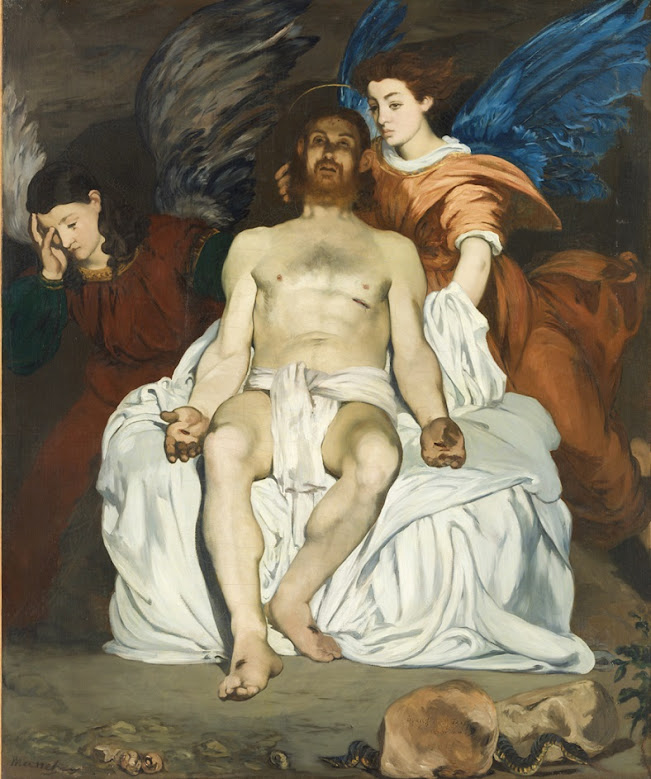
01 Work , RELIGIOUS ART, Edouard Manet's The Dead Christ with Angels - with footnotes #195

Edouard Manet (French, Paris 1832–1883 Paris)
The Dead Christ with Angels, c. 1864
Oil on canvas
70 5/8 x 59 in. (179.4 x 149.9 cm)
The Metropolitan Museum of Art

Manet identified the source for this painting, the first of several religious scenes, in the inscription on the rock: the Gospel according to Saint John. However, in the passage cited, Christ’s tomb is empty except for two angels. After Manet sent the canvas to the 1864 Salon, he realized that he had made an even greater departure from the text, depicting Christ’s wound on the wrong side. Despite Charles Baudelaire’s warning that he would "give the malicious something to laugh at," the artist did not correct his mistake. Indeed, critics denounced the picture, particularly the realism of Christ’s cadaverous body. More on this painting

Édouard Manet (23 January 1832 – 30 April 1883) was a French painter. He was one of the first 19th-century artists to paint modern life, and a pivotal figure in the transition from Realism to Impressionism.
 
His early masterworks, The Luncheon on the Grass (Le déjeuner sur l'herbe) and Olympia, both 1863, caused great controversy and served as rallying points for the young painters who would create Impressionism. Today, these are considered watershed paintings that mark the genesis of modern art. More on Édouard Manet


Please visit my other blogs: Art CollectorMythologyMarine ArtPortrait of a Lady, The OrientalistArt of the Nude and The Canals of VeniceMiddle East Artists365 Saints and 365 Days, also visit my Boards on Pinterest

Images are copyright of their respective owners, assignees or others. Some Images may be subject to copyright

I don't own any of these images - credit is always given when due unless it is unknown to me. if I post your images without your permission, please tell me.

I do not sell art, art prints, framed posters or reproductions. Ads are shown only to compensate the hosting expenses.

If you enjoyed this post, please share with friends and family.

Thank you for visiting my blog and also for liking its posts and pages.

Please note that the content of this post primarily consists of articles available from Wikipedia or other free sources online.