Showing posts with label El Greco. Show all posts

19 Works, RELIGIOUS ART - Paintings from the Bible by the Old Masters, 4

Follower of The Master of Karlsruhe Passion (active South Germany, 1450) The Kiss of Judas 22cm diameter (8 11/16in)  (unframed)
Follower of The Master of Karlsruhe Passion (active South Germany, 1450)
The Kiss of Judas
oil on panel, tondo 
22cm diameter (8 11/16in)

Follower of Pieter Coecke van Aelst (Aelst 1502-1550 Brussels) The Holy Family with an angel
Follower of Pieter Coecke van Aelst (Aelst 1502-1550 Brussels)
The Holy Family with an angel 
oil on panel, shaped top
72 x 49.8cm (28 3/8 x 19 5/8in).

Circle of Frans Francken the Younger (Antwerp 1581-1642) The Crucifixion
Circle of Frans Francken the Younger (Antwerp 1581-1642)
The Crucifixion 
oil on copper
27 x 20.2cm (10 5/8 x 7 15/16in)

Follower of Gillis  Mostaert the Elder (Hulst 1528-1598 Antwerp) The Crucifixion
Follower of Gillis Mostaert the Elder (Hulst 1528-1598 Antwerp)
The Crucifixion
oil on panel 
29.2 x 22.2cm (11 1/2 x 8 3/4in).

Jacob Willemsz. de Wet I (Haarlem circa 1610-1675) The Presentation of the Virgin at the Temple
Jacob Willemsz. de Wet I (Haarlem circa 1610-1675)
The Presentation of the Virgin at the Temple 
oil on canvas
66.2 x 84.4cm (26 1/16 x 33 1/4in).

Circle of Jacques de Stella (Lyons 1596-1657 Paris) The Rest on the Flight into Egypt
Circle of Jacques de Stella (Lyons 1596-1657 Paris)
The Rest on the Flight into Egypt 
oil on panel
30.4 x 36.5cm (11 15/16 x 14 3/8in).

After Paolo Caliari, called Paolo Veronese, circa 1800 The Feast in the house of Simon the Pharisee
After Paolo Caliari, called Paolo Veronese, circa 1800
The Feast in the house of Simon the Pharisee 
oil on canvas
73.3 x 139.6cm (28 7/8 x 54 15/16in)

After Guido Reni, 17th Century Susannah and the Elders
After Guido Reni, 17th Century
Susannah and the Elders 
oil on canvas
73.5 x 93.2cm (28 15/16 x 36 11/16in).

Circle of Pedro Machuca (Toledo circa 1490-1550 Grenada) Christ with Saint John the Baptist
Circle of Pedro Machuca (Toledo circa 1490-1550 Grenada)
Christ with Saint John the Baptist 
oil on panel
52.7 x 65.5cm (20 3/4 x 25 13/16in).

Follower of Domenikos Theotokopoulos, called El Greco (Candia 1541-1614 Toledo) The Agony in the Garden unframed
Follower of Domenikos Theotokopoulos, called El Greco (Candia 1541-1614 Toledo)
The Agony in the Garden 
oil on panel
31.6 x 61.2cm (12 7/16 x 24 1/8in).

Follower of Adam van Noort the Elder (Antwerp 1562-1641) The Miracle of the Loaves and Fishes
Follower of Adam van Noort the Elder (Antwerp 1562-1641)
The Miracle of the Loaves and Fishes 
oil on panel
42.8 x 53.6cm (16 7/8 x 21 1/8in).

Follower of Jacob de Backer (Antwerp circa 1555-1585) The Garden of Eden
Follower of Jacob de Backer (Antwerp circa 1555-1585)
The Garden of Eden 
oil on panel
98 x 126cm (38 9/16 x 49 5/8in).

Circle of Antonio Busca (Milan 1625-1686) Christ healing the Infirm Woman
Circle of Antonio Busca (Milan 1625-1686)
Christ healing the Infirm Woman 
oil on canvas
90.1 x 133.1cm (35 1/2 x 52 3/8in).

Circle of Nicolo Bambini (Venice 1651-1736)
Lot and his Daughters 
oil on canvas, unlined
120 x 166cm (47 1/4 x 65 3/8in).

Circle of Nicolo Bambini (Venice 1651-1736)
Rebecca and Eliezer at the well 
oil on canvas, unlined
117.2 x 165.2cm (46 1/8 x 65 1/16in).

Venetian School, 18th Century The Adoration of the Magi
Venetian School, 18th Century
The Adoration of the Magi 
oil on canvas, unlined
89.7 x 111.5cm (35 5/16 x 43 7/8in).

Circle of Jacob van Oost I (Bruges 1601-1671) The Madonna and Child unframed
Circle of Jacob van Oost I (Bruges 1601-1671)
The Madonna and Child 
oil on canvas
122 x 89cm (48 1/16 x 35 1/16in)

Follower of Joos van Cleve (Cleve circa 1485-circa 1540 Antwerp) The Madonna and Child
Follower of Joos van Cleve (Cleve circa 1485-circa 1540 Antwerp)
The Madonna and Child
oil on panel 
27.6 x 22.6cm (10 7/8 x 8 7/8in).

Manner of Sano di Pietro, 19th Century The Madonna and Child
Manner of Sano di Pietro, 19th Century
The Madonna and Child 
oil on gold-ground panel
46.2 x 36cm (18 3/16 x 14 3/16in).


Acknowledgment: Bonhams

13 Drawings - RELIGIOUS ART - Drawings from the Bible by the Old Masters! 1

Artists: Giorgio Vasari, Carlo Maratta, Gioacchino Martorana, Paolo Caliari/Veronese, Ventura di Archangelo Salimbeni, Luca Cambiasi/Cangiagio, Guido Reni, Francesco Solimena, Doménikos Theotokopoulos, Francisco Rizi, Domenico Campagnola, Giovanni Francesco Barbieri, Lazzaro Baldi

Giorgio Vasari (1511-1574)
The Coronation of the Virgin
Pen and brown ink
7 x 23 cm. (2 3/4 x 9 in)

Giorgio Vasari (30 July 1511 – 27 June 1574) was an Italian painter, architect, writer and historian, most famous for his "Lives of the Most Excellent Painters, Sculptors, and Architects", considered the ideological foundation of art-historical writing.

Often called "the first art historian", Vasari invented the genre of the encyclopedia of artistic biographies, which was first published in 1550. He was the first to use the term "Renaissance" (rinascita) in print, and he was responsible for our use of the term Gothic Art, though he only used the word Goth which he associated with the "barbaric" German style.  The book was partly rewritten and enlarged in 1568, with the addition of woodcut portraits of artists (some conjectural).

The work has a consistent and notorious bias in favour of Florentines and tends to attribute to them all the developments in Renaissance art... More

Circle of Carlo Maratta (1625-1713)
Study of Christ Child, with left arm outstretched grasping an apple, supported by the hand of another
Black chalk on laid paper 
24 x 17.5 cm. (9 1/2 x 6 7/8 in)

Carlo Maratta or Maratti (13 May 1625 – 15 December 1713) was an Italian painter, active mostly in Rome, and known principally for his classicizing paintings executed in a Late Baroque Classical manner. Although he is part of the classical tradition stemming from Raphael, he was not exempt from the influence of Baroque painting and particularly in his use of colour.

Circle of Gioacchino Martorana (c.1735-1779)
David La unta va da Samueli
Samuel anointing David, who kneels surrounded by figures
Pen and brown ink, with grey wash, over graphite
left 17 x 14 cm. (6 3/4 x 5 1/2 in)

Gioacchino Martorana ( Palermo , 1735 - 1779 ) was a painter Italian .
Son of the painter Pietro, from whom he received his the first art lessons. In 1749 he went to Rome for an apprenticeship from "the Conca", directed by Vasi, a disciple of his father.

Then Martorana was a student of Benefial, which was an Academic of San Luca, again thanks to recommendations of Vasi, whose daughter Caterina he married. In 1759 he returned to Rome to remain there until the early sixties. From 1764 he was active in the capital island Palero where he had art work commissions for churches and aristocratic palace. More

Follower of Paolo Veronese (1528-1588)
Adoration of the Shepherds, with St Jerome.
Pen and black ink, brown wash, heightened with white, on paper support laid onto canvas 
Bears inscription P Veronese
41 x 26.5 cm. (16 x 10 1/2 in)

Saint Jerome ( c.  347 – 30 September 420) was an Illyrian Latin Christian priest, confessor, theologian and historian, who also became a Doctor of the Church. He was the son of Eusebius, born at Stridon, a village on the border of Dalmatia and Pannonia. He is best known for his translation of most of the Bible into Latin, and his commentaries on the Gospels. His list of writings is extensive. Known as the “protégé” of Pope Damasus I, who died in December of 384, Jerome became well known for outlining the type of lifestyle that was acceptable for Christians living in cosmopolitan centers like Rome. In many cases, he focused his attention to the lives of women and identified how a woman devoted to Jesus Christ should live her life. This concentration stemmed from his close patron relationships with several prominent female ascetics who were members of affluent Roman “senatorial families”. More

Paolo Caliari/Veronese (1528 – 19 April 1588) was an Italian Renaissance painter based in Venice, most famous for large historical paintings of both religious and mythological subjects. With Titian, who was at least a generation older, and Tintoretto, ten years older, he was one of the "great trio that dominated Venetian painting of the cinquecento" or 16th-century late Renaissance.

He has always been appreciated for "the chromatic brilliance of his palette, the splendor and sensibility of his brushwork, the aristocratic elegance of his figures, and the magnificence of his spectacle", but his work has been felt "not to permit expression of the profound, the human, or the sublime", and of the "great trio" he has often been the least appreciated by modern criticism. More

Follower of Ventura Salimbeni (1568-1613)
The Marriage of the Virgin
Black chalk, touches of brown wash, on laid paper, with ruled border Inscribed West in black ink by a later hand
19.5 x 14 cm. (7 3/4 x 5 1/2 in) 
The present composition directly relates to an etching of the same subject by Salimbeni, printed circa 1590

The Marriage of the Virgin is the subject in Christian art depicting the marriage of the Virgin Mary and Saint Joseph. The marriage is not mentioned in the canonical Gospels but is covered in several apocryphal sources, and later redactions, notably the 14th century compilation the Golden Legend. Unlike many other scenes in Life of the Virgin cycles (like the Nativity of Mary and Presentation of Mary), it is not a feast in the church calendar. More

Ventura di Archangelo Salimbeni (also later called Bevilacqua; 20 January 1568 – 1613) was an Italian Mannerist painter and printmaker and among the last representatives of a style influenced by the earlier Sienese School of Quattrocento-Renaissance.He was born in Siena. and studied painting, under his father, Arcangelo Salimbeni.

He moved to Rome in 1588 to work, together with others, on the fresco painting of the Vatican Library under pope Sixtus V.

He got a commission for paintings in the Roman Jesuit Church of the Gesù and the Basilica di Santa Maria Maggiore. These paintings show the influence of the Mannerist Cavalier D'Arpino and Andrea Lillio.

Salimbeni returned to Siena in 1595. He was influenced by Federico Barocci as can be seen in the draperies, highlighted with abrupt changes of light and flickering surfaces, of his painting "Birth of a Virgin" in the San Domenico church in Ferrara (1607–1608).

He is known for detailed preparatory drawings, most of which are now in the Uffizi in Florence. At around 1600, he began painting the "Life of St Hyacinth" for the Sienese church of Santo Spirito. He continued to create paintings for churches throughout Italy, including Florence. At the Basilica della Santissima Annunziata di Firenze, he frescoed lunettes (1605–1608) illustrating events in the history of the Servite Order. In the Duomo di San Salvatore, he executed a magnificent John the Baptist.

Around 1600, he got an assignment in Assisi for a fresco of the "Resurrection of Christ" and the "Dying Saint Clare is visited by the pope" in the vault of chapel of San Massimo in the Basilica of Santa Maria degli Angeli.

At the same time he was painting the "Vision of Gregory the Great" and the "Punishment of David" in the Basilica of San Pietro in Perugia. He invested with the Order of the Golden Spur, a very selective papal order. 

His last work of art was the oil painting the "Marriage of the Virgin" for the Seminario Diocesano in Foligno in 1613. More

Luca Cambiaso (1527-1585)
St Mark with an open book, and lion at his side
Pen and brown ink, with brown wash, over touches of black chalk, on laid paper 
37 x 27.5 cm. (14 1/2 x 10 3/4 in)

About this work: A large and dramatic drawing that captures both the pace and distinctive draughtsmanship of Cambiaso. The scale and controlled handling of the ink is reminiscent of Cambiaso's Hercules shooting his bow (Ercole tirando il suo arco), 1544-50. The inclusion of the bed of clouds that St Jerome sits upon in the present composition, and which engulfs the lower right corner of the work. The drawing was possibly one of several preliminary studies that Cambiaso would have executed before reaching the final design, which includes two lions, amongst other differences. 


Luca Cambiasi/Cangiagio (18 November 1527 – 6 September 1585) was an Italian painter and draftsman, familiarly known as Lucchetto da Genova. He was born at Moneglia, the Republic of Genoa, the son of a painter named Giovanni Cambiasi.

Cambiasi was precocious, and painting at the age of fifteen. In 1544, at the age of seventeen, he was involved in the decoration of the Palazzo Doria, now the Prefettura. He aided in the vault decoration of the church of San Matteo. 

The 1911 Britannica states that Cambiasi by his thirties began to decline in skill, though not at once in reputation, owing to the vexations brought upon him by a passion which he conceived for his sister-in-law. His wife having died, and the sister-in-law had taken charge of his house and children, he failed to procure a papal dispensation for marrying her.

In 1583 he accepted an invitation from Philip II, the principal reason for traveling to Spain was that he hoped royal influence would gain favor with the Vatican for his marriage plans, but this failed. 

His son Orazio Cambiasi became a painter. More

Circle of Guido Reni (1575-1642) 
St Mary Magdalene looking upwards, with cross and putti behind
Pen and brownish black ink, over red chalk, incised for transfer, with ruled border 
13.5 x 10.5 cm. (5 1/4 x 4 1/8 in)

Guido Reni (4 November 1575 – 18 August 1642) was an Italian painter of high-Baroque style. Born in Bologna into a family of musicians, At the age of nine, he was apprenticed under the Bolognese studio of Denis Calvaert. He may also have trained with a painter by the name of Ferrantini. When Reni was about twenty years old, he migrated to the rising rival studio, named Accademia degli Incamminati (Academy of the "newly embarked", or progressives), led by Lodovico Carracci. He went on to form the nucleus of a prolific and successful school of Bolognese painters who followed Annibale Carracci to Rome. Like many other Bolognese painters, Reni's painting was thematic and eclectic in style. More

Francesco Solimena (1657-1747)
Study for Fall of the Rebel Angels d.1747
Black chalk, on thick laid paper Bears old pen and brown ink 
25.5 x 19 cm. (10 x 7 1/2 in)

The composition of the present drawing relates to several known paintings by Francesco Solimena. The recumbent figure also appears as a type that Solimena employed in a number of commissions.

The Book of Revelation describes a "war in heaven" between angels led by the archangel Michael versus those led by "Satan", who is defeated and thrown down to the earth. Revelation's "war in heaven" has been compared to the idea of fallen angels, and possible parallels have been proposed in the Hebrew Bible and Dead Sea Scrolls. More

Francesco Solimena (October 4, 1657 – April 3, 1747) was a prolific Italian painter of the Baroque era, one of an established family of painters and draughtsmen. He was born in Canale di Serino, near Avellino.

He received early training from his father, Angelo Solimena. He settled in Naples in 1674, there he worked in the studio of Francesco di Maria and later Giacomo del Po. He apparently had taken the clerical orders, but was patronized early on, and encouraged to become an artist by Cardinal Vincenzo Orsini (later Pope Benedict XIII). By the 1680s, he had independent fresco commissions, and his active studio came to dominate Neapolitan painting from the 1690s through the first four decades of the 18th century. He was a highly conventional painter—after the Roman Baroque masters, whose technique of warm brownish shadowing Solimena emulated. Solimena painted many frescoes in Naples, altarpieces, celebrations of weddings and courtly occasions, mythological subjects, characteristically chosen for their theatrical drama, and portraits. His numerous preparatory drawings often mix media, combining pen-and-ink, chalk and watercolor washes. More

Attributed to Doménikos Theotokopoulos, called El Greco
CANDÍA, CRETE 1541 – 1614 TOLEDO
PIETÀ
Pen and brown ink and different shades of brown wash, over traces of black chalk
244 by 167 mm

The Pietà (Italian) is a subject in Christian art depicting the Virgin Mary cradling the dead body of Jesus, most often found in sculpture. As such, it is a particular form of the Lamentation of Christ, a scene from the Passion of Christ found in cycles of the Life of Christ. When Christ and the Virgin are surrounded by other figures from the New Testament, the subject is strictly called a Lamentation in English, although Pietà is often used for this as well, and is the normal term in Italian. More

El Greco, born Doménikos Theotokópoulos (1541 – 7 April 1614), was a painter, sculptor and architect of the Spanish Renaissance. "El Greco" ("The Greek") was a nickname, a reference to his Greek origin, and the artist normally signed his paintings with his full birth name in Greek letter.

El Greco was born in Crete, which was at that time part of the Republic of Venice, and the center of Post-Byzantine art. He became a master and at age 26 travelled to Venice.] In 1570 he moved to Romes. During his stay in Italy, El Greco enriched his style with elements of Mannerism and of the Venetian Renaissance. In 1577, he moved to Toledo, Spain, where he lived and worked until his death.

El Greco's dramatic and expressionistic style was met with puzzlement by his contemporaries but found appreciation in the 20th century.] He is best known for tortuously elongated figures and often fantastic or phantasmagorical pigmentation, marrying Byzantine traditions with those of Western painting. More

Francisco Rizi - MADRID 1608 - 1685 ESCORIAL
THE MARTYRDOM OF ST. ANDREW
Pen and brown ink with red-brown wash, squared for transfer in black chalk, arched top
596 by 297 mm

Andrew the Apostle, also known as Saint Andrew, was a Christian Apostle and the brother of Saint Peter.

Arms thrown wide, Saint Andrew implores the heavens above while soldiers tie him to a cross in the shape of an X. His executioner, the Roman governor Egeas, watches from a classical porch above, and confusion reigns as soldiers try to push back the surging crowd.

Francisco Rizi (1608–1685) was a Spanish painter born at Madrid. Rizi was first trained by Vincencio Carducho. He became painter to Philip IV in 1656, and held the office under Charles II, who added to it the deputy-keepership of the royal keys. A few years prior, he was appointed painter to the Cathedral of Toledo. Rizi died at El Escorial. More

Domenico Campagnola - PADUA 1484 - 1550 (?)
THE FLAGELLATION
Pen and brown ink over black chalk
220 by 378 mm

The Flagellation of Christ, sometimes known as Christ at the Column or the Scourging at the Pillar, is a scene from the Passion of Christ very frequently shown in Christian art, in cycles of the Passion or the larger subject of the Life of Christ. It is the fourth station of the modern alternate Stations of the Cross, and a Sorrowful Mystery of the Rosary. The column to which Christ is normally tied, and the rope, scourge, whip or birch are elements in the Arma Christi. The Basilica di Santa Prassede in Rome, claimed to possess the original column. More

Domenico Campagnola (c. 1500 – 1564) was an Italian painter and printmaker in engraving and woodcut of the Venetian Renaissance. Born in Venice, he was the pupil of his father, the leading engraver and painter Giulio Campagnola. He was presumably trained initially by his father, and may also have been a pupil of Titian. Much of his early painting may be of landscape backgrounds in Titians. In his lifetime he was a successful painter, mostly in Padua (Giulio's home town), where he was based from the early 1520s onwards. Mostly he painted on walls, including decorative schemes, but portraits and landscapes are also attributed to him. His works as a painter are not highly regarded by modern art historians though some landscapes are of high quality. More
Giovanni Francesco Barbieri, called il Guercino
CENTO 1591 - 1666 BOLOGNA
A FEMALE NUDE LOOKING TO THE RIGHT, HALF LENGTH, RESTING HER RIGHT ARM ON A CUSHION - Joseph and Potiphar’s Wife
Red chalk
247 by 220 mm

Potiphar is a person known only from the Book of Genesis's account of Joseph. Potiphar is the captain of the palace guard and is referred to without name in the Quran. Joseph, sold into slavery by his brothers, is taken to Egypt where he is sold to Potiphar as a household slave. Potiphar makes Joseph the head of his household, but Potiphar's wife, who is not named in the Bible or in Christian tradition, is furious at Joseph for resisting her attempts to seduce him, and falsely accuses him of attempted rape. Potiphar casts Joseph into prison, from where he later comes to the notice of Pharaoh through his ability to interpret the dreams of other prisoners. More

Giovanni Francesco Barbieri (February 8, 1591 – December 22, 1666), best known as Guercino, was an Italian Baroque painter and draftsman from the region of Emilia, and active in Rome and Bologna. The vigorous naturalism of his early manner is in contrast to the classical equilibrium of his later works. His many drawings are noted for their luminosity and lively style. More

Lazzaro Baldi - PISTOIA 1624 - 1703 ROME
THE ANNUNCIATION TO JOACHIM AND ANNA
Point of the brush and black and brown wash heightened with white, with some indentations, on grey prepared paper;
a cut-out and made up pentimento for the entire figure of Joachim
304 by 219 mm

By tradition Joachim and Anne are considered to be the names of the parents of Mary, the Mother of God. We have no historical evidence, however, of any elements of their lives, including their names. Any stories about Mary's father and mother come to us through legend and tradition. More

Lazzaro Baldi (c. 1624 – 30 March 1703) was an Italian painter of the Baroque period, active mainly in Rome. He was born in Pistoia and died in Rome. He moved to Rome to form part of the large studio directed by Pietro da Cortona, where Baldi became adept at fresco technique. He painted a David and Goliath for Alexander VII in the Palazzo Quirinale, as well as frescoes (1658) for the church of San Giovanni in Oleo and a San Giovanni in Patmos(1660–1665) for San Giovanni in Laterano... More


RELIGIOUS ART - Drawings from the Bible by the Old Masters! El Greco, PIETÀ

Attributed to Doménikos Theotokopoulos, called El Greco
CANDÍA, CRETE 1541 – 1614 TOLEDO
PIETÀ
Pen and brown ink and different shades of brown wash, over traces of black chalk
244 by 167 mm

This drawing, with its highly individual technique, was published in 2007 by Nicholas Turner in a ground-breaking article, where he argued that this drawing and a number of others by the same very distinctive hand are all the work of El Greco, and should be added to the very small corpus of just five universally accepted sheets, which provide the starting point for our understanding of his draughtsmanship. Turner’s thesis has been met with varying degrees of acceptance, but his arguments are in many respects highly persuasive, and the proposed attribution should be taken very seriously.  If, as seems entirely possible, this drawing is indeed by El Greco, it is a sheet of considerable significance. More

The Pietà is a subject in Christian art depicting the Virgin Mary cradling the dead body of Jesus, most often found in sculpture. As such, it is a particular form of the Lamentation of Christ, a scene from the Passion of Christ found in cycles of the Life of Christ. When Christ and the Virgin are surrounded by other figures from the New Testament, the subject is strictly called a Lamentation in English, although Pietà is often used for this as well, and is the normal term in Italian. More
El Greco, born Doménikos Theotokópoulos (1541 – 7 April 1614), was a painter, sculptor and architect of the Spanish Renaissance. El Greco was born in Crete, which was at that time part of the Republic of Venice, and the center of Post-Byzantine art. He trained and became a master within that tradition before traveling at age 26 to Venice, as other Greek artists had done. In 1570 he moved to Rome, where he opened a workshop and executed a series of works. During his stay in Italy, El Greco enriched his style with elements of Mannerism and of the Venetian Renaissance. In 1577, he moved to Toledo, Spain, where he lived and worked until his death. In Toledo, El Greco received several major commissions and produced his best-known paintings. More

19 Works - RELIGIOUS ART BY THE OLD MASTER PAINTERS - Stories from the Bible

Alvise Vivarini, El Greco, Hieronymous Bosch, Jacob van Amsterdam, José Antolínez, Pietro della Vecchia, Quentin Metsys, Saint Barbara, Saint Bartholomew, Saint Maurice, Saint Irene, Saint Sebastian, Mariotto Albertinell,  John the Baptist, Jacopo Tintoretto, Tommaso, Antoniazzo Romano, Francesco Solimena, Noli me tangere, Giandomenico Tiepolo, Bartolomé Esteban Murillo, Francisco de Zurbarán, Alvise Vivarini, Jacob Cornelisz, Quentin Metsys...

Neapolitan School, 17th Century
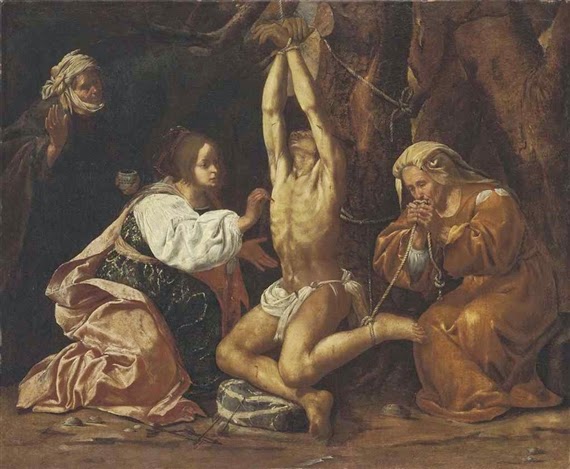
Saint Irene healing Saint Sebastian
oil on canvas
40¾ x 49½ in. (103.5 x 125.7 cm.)

School of Naples, included artists mainly originating from the pre-unification duchies, provinces, or kingdoms, mostly under Aragonese, Habsburg, or Bourbon rulers, which had Naples as the capital. 

Sebastian, a Roman soldier turned Christian, was stripped and shot with arrows for shielding Christian martyrs in defiance of the Emperor.  Sebastian's triumph over his affliction led him to become the saint who was invoked against dangers like the plague. He is often portrayed in paintings from Naples, such as this one, that were painted after the city's terrible plague of 1656.

Irene of Rome was the widow of the martyr St. Castulus. After the death of her husband, she continued to be active in the Christian community in Rome. According to legend, when Saint Sebastian was discovered to be a Christian, in 286, he was handed over to the Mauretanian archers, who tied him to a tree and pierced him with arrows.[5]

However, Irene came to bury the body and found that he was not quite dead. Irene took him to her lodgings and nursed him back to health. Irene is venerated by Christians for her virtuous care in attending the injured.

Mariotto Albertinelli (Florence 1474-1515)
The Madonna and Child with Saint John the Baptist
oil on panel
19 ½ x 12 ¼ in. (49.5 x 31.1 cm.)

Mariotto di Bigio di Bindo Albertinelli (October 13, 1474 – November 5, 1515) was a High Renaissance Italian painter of the Florentine school, closely involved with Fra Bartolomeo and influenced by Raphael.

Born in Florence. As a 12-year-old boy, he became a pupil of Cosimo Rosselli, and a fellow-pupil with Fra Bartolomeo with whom he formed such an intimate brotherly rapport that in 1494 the two started their own studio in Florence. Vasari's opinion was that Mariotto was not so well grounded in drawing as Bartolomeo, and he tells that, to improve his hand he had taken to drawing the antiquities in the Medici garden, where he was encouraged by Madonna Alfonsina, the mother of Lorenzo de' Medici.

Circle of Jacopo Tintoretto (Venice 1519-1594)
The Trinity with the Virgin and two donors
oil on pine panel
25 7/8 x 34¼ in. (65.7 x 87.1 cm.)

Alvise Vivarini, El Greco, Hieronymous Bosch, Jacob van Amsterdam, José Antolínez, Pietro della Vecchia, Quentin Metsys, Saint Barbara, Saint Bartholomew, Saint Maurice, Saint Irene healing Saint Sebastian, Mariotto Albertinell,  John the Baptist, Jacopo Tintoretto, Tommaso, Antoniazzo Romano,, late September or early October, 1518[1] – May 31, 1594) was an Italian painter and a notable exponent of the Renaissance school. For his phenomenal energy in painting he was termed Il Furioso. His work is characterized by its muscular figures, dramatic gestures, and bold use of perspective in the Mannerist style, while maintaining color and light typical of the Venetian School. 

Tommaso (active Florence late 15th and early 16th centuries)
The Holy Family with the Infant Saint John the Baptist
tempera on panel
34 ¼ in. (87 cm.) diameter

Circle of Antoniazzo Romano (Rome before 1452-1508/12)
The Madonna and Child
tempera and gold on panel
25¼ x 16½ in. (64.1 x 41.9 cm.)

Antoniazzo Romano, born Antonio di Benedetto Aquilo degli Aquili (c. 1430 – c. 1510) was an Italian Early Renaissance painter, the leading figure of the Roman school during the 15th century.

Francesco Solimena (Canale di Serino 1657-1747 Barra)
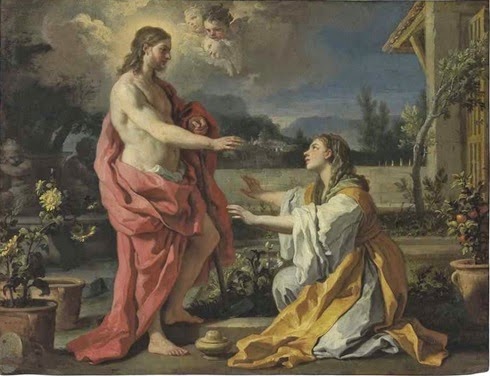
Noli me tangere
oil on copper, unframed
13 ¾ x 18 in. (35 x 45.7 cm.)

Francesco Solimena (October 4, 1657 – April 3, 1747) was a prolific Italian painter of the Baroque era, one of an established family of painters and draughtsmen.

Noli me tangere, meaning "touch me not" or "don't tread on me", is the Latin version of words spoken, according to John 20:17, by Jesus to Mary Magdalene when she recognized him after his resurrection.

Giandomenico Tiepolo (Venice 1727-1804)
Christ and the barren fig tree
oil on canvas
33 x 75 in. (83.3 x 190.5 cm.)

Giovanni Domenico Tiepolo (August 30, 1727 – March 3, 1804) was an Italian painter and printmaker in etching. He was the son of artist Giovanni Battista Tiepolo and elder brother of Lorenzo Baldissera Tiepolo.

Domenico was born in Venice, studied under his father, and by the age of 13 was the chief assistant to him. He was one of the many assistants, including Lorenzo, who transferred the designs of his father (executed in the 'oil sketch' invented by the same). By the age of 20, he was producing his own work for commissioners.

Christ and the barren fig treeParable of the barren fig tree, "He spoke also of this parable; A certain man had a fig tree planted in his vineyard; and he came and sought fruit thereon, and found none. Then said he unto the dresser of his vineyard, Behold, these three years I come seeking fruit on this fig tree, and find none: cut it down; why cumbereth it the ground? And he answering said unto him, Lord, let it alone this year also, till I shall dig about it, and dung it: And if it bear fruit, well: and if not, then after that thou shalt cut it down." In this parable, the owner is generally regarded as representing God, who had a fig tree (tree of knowledge) planted in his vineyard (the garden of Eden) and came seeking fruit. The gardener (vinedresser) is God and the vine is Jesus (tree of Life). Fig trees were often planted in vineyards.

The fig tree was a common symbol for Israel, and may also have that meaning here,[1] or the tree in the parable may refer to the religious leadership. In either case, the parable reflects Jesus offering his hearers one last chance for repentance. 

José Antolínez (Madrid 1635-1675)
The Baptism of Christ
oil on canvas
65 ½ x 43 1/8in. (166.5 x 109.5 cm.

José Antolínez ( Madrid , 1635-1675), Spanish Baroque painter , was one of the most original artists of the Madrid school full Baroque . His painting, preserved in relatively abundant amount, despite his untimely death, spanned many different genres, both religious and secular, of which he always took a personal standpoint and a rich sense of color, who took both Tiziano as Rubens and Van Dyck , applied with a technique of light and vibrant brushwork with which it will get done fortunate interpreter of the atmosphere Velázquez .

Circle of Bartolomé Esteban Murillo (Seville 1618-1682)
Saint Joseph and the Christ Child
oil on canvas, unframed
65 7/8 x 41 in. (167.3 x 104.1 cm.)
Bartolomé Esteban Murillo (born late December 1617, baptized January 1, 1618 – April 3, 1682) was a Spanish Baroque painter. Although he is best known for his religious works, Murillo also produced a considerable number of paintings of contemporary women and children. These lively, realist portraits of flower girls, street urchins, and beggars constitute an extensive and appealing record of the everyday life of his times.

Joseph is a figure in the Gospels, the husband of Mary, the mother of Jesus and is venerated Saint Joseph in some Christian traditions. Christian tradition places Joseph as Jesus' foster father. Some historians state that Joseph was Jesus's father. Some differing views are due to theological interpretations versus historical views.

Pietro della Vecchia (Vicenza 1603-1678 Venice)
The Vision of Daniel
inscribed 'Visio Danielis / Vidi in Visione esse me / Super Portam Usai / Cap. VIII' (lower right)
oil on canvas
60 ½ x 47 ½ in. (153.7 x 102.9 cm.)

Pietro della Vecchia (1603 – 8 September 1678) was an Italian painter also known as Pietro Muttoni. He likely trained with Alessandro Varotari deriving a notable interest in Venetian masters such as Titian and Giorgione. 

Renowned among his contemporaries for his ability to imitate the styles of 16th-century masters, he was also known for his grotesque paintings and portraiture. His earliest known works, two representations of St Francis, which have survived in many versions. 

His monumental Crucifixion (1637; Fondazion Cini, Venice), in which the composition harks back to the 16th century while the figures derive from Caravaggio, is characteristic of this phase. Around 1640 the influence of Strozzi is apparent in the Angel Offering a Skull to St Giustina, painted for the church of San Giustina. From 1640 to 1673 the design of the mosaic cartoons for the St. Mark's Basilica. He painted four idyllic landscapes that presage Rococo style. He married Clorinda Renieri, daughter of Nicolas Régnier, Flemish painter and art dealer. Della Vecchia died in Venice, September 1678.

The Book of Daniel is an "account of the activities and visions of Daniel, a noble Jew exiled at Babylon. In the Hebrew Bible it is found in the Ketuvim (writings), while in Christian Bibles it is grouped with the Major Prophets.

In 605 B.C. Jerusalem was conquered by the Babylonians and many of their best young men were taken into captivity, including Daniel. Daniel was taken to Babylon to serve it. As Powerful King , Nebuchadnezzar. Daniel as an example of boldness and faithfulness to God in the most difficult circumstances had eternal impact on the people and the kings that he encountered.

Francisco de Zurbarán (Fuente de Cantos, Badajoz 1598-1664 Madrid)
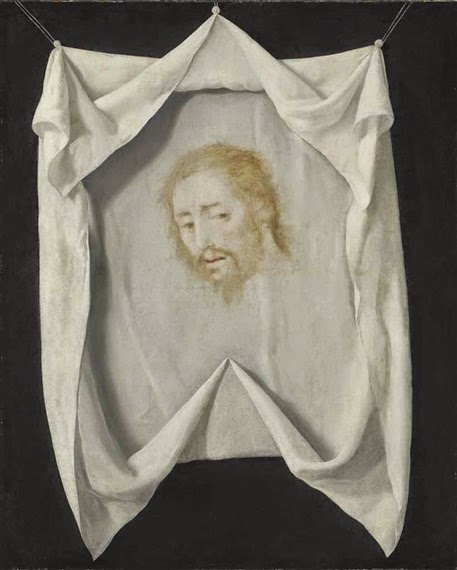
Veronica's Veil
oil on canvas
40 x 32¾ in. (101.6 x 83.2 cm.)

Francisco de Zurbarán (baptized November 7, 1598 – August 27, 1664) was a Spanish painter. He is known primarily for his religious paintings depicting monks, nuns, and martyrs, and for his still-lifes. Zurbarán gained the nickname Spanish Caravaggio, owing to the forceful, realistic use of chiaroscuro in which he excelled.

The Veil of Veronica, or Sudarium is a Catholic relic of a piece of cloth, which, according to legend, bears the likeness of the face of Jesus not made by human hand (i.e. an Acheiropoieton). 
Doménikos Theotokópoulos, called El Greco (Crete 1541-1614 Toledo)
Saint Maurice
oil on canvas, a fragment
10 x 7 ¼ in. (25.4 x 18.4 cm.)

El Greco, born Doménikos Theotokópoulos (1541 – 7 April 1614), was a painter, sculptor and architect of the Spanish Renaissance. "El Greco" ("The Greek") was a nickname, a reference to his Greek origin, and the artist normally signed his paintings with his full birth name in Greek letters, often adding the word Κρής (Krēs, "Cretan")


Saint Maurice (also Moritz, Morris, or Mauritius) was the leader of the legendary Roman Theban Legion in the 3rd century, and one of the favorite and most widely venerated saints of that group. He was the patron saint of several professions, locales, and kingdoms. He is also a highly revered saint in the Coptic Orthodox Church and Oriental Orthodox churches.


Maurice was born in AD 250 in Thebes, an ancient city in Egypt near the site of the 20th-century Aswan Dam. He became a soldier in the Roman army and was gradually promoted until he became the leader of the Theban legion, formed of 6600 soldiers. Maurice was an acknowledged Christian at a time when the Church was considered to be a threat to the Roman Empire.

The legion, entirely composed of Christians, had been called from  Egypt to Gaul to assist Maximian to defeat a revolt by the bagaudae. The Theban Legion was dispatched with orders to clear the St. Bernard Pass across Mt. Blanc. Before going into battle, they were instructed to offer sacrifices to the pagan gods and pay homage to the emperor.

When Maximian ordered them to harass some local Christians, they refused. Ordering the unit to be punished, Maximian had every tenth soldier killed, a military punishment known as decimation. More orders followed, the men refused as encouraged by Maurice, and a second decimation was ordered. In response to the Theban Christians' refusal to attack fellow Christians, Maximian ordered all the remaining members of the 6,600 unit to be executed. The place in Switzerland where this occurred, known as Agaunum, is now named Saint Maurice-en-Valais, site of the Abbey of Saint Maurice-en-Valais.

So reads the earliest account of their martyrdom, contained in the public letter which Eucherius, bishop of Lyon (c. 434–450), addressed to his fellow bishop Salvius. Alternative versions[citation needed] have the legion refusing Maximian's orders only after discovering a town they had just destroyed had been inhabited by innocent Christians, or that the emperor had them executed when they refused to sacrifice to the Roman gods.


Pasqualino Veneziano (Venice, active 1490 - before 1504)
The Madonna and Child
signed with initials 'P.V.P.' (lower center) 
oil and tempera on panel, transferred to another panel
31¼ x 24½ in. (79.5 x 62.2 cm.) 

Attributed to Alvise Vivarini (Venice or Murano 1442/53-1503/5)
The Madonna and Child
tempera and oil on panel
26½ x 20 in. (67.3 x 51 cm.)

Alvise or Luigi Vivarini, (1442/1453–1503/1505), was the leading Venetian artist before Giovanni Bellini. Like Bellini, he was part of a dynasty of painters. His father was Antonio Vivarini and his uncle, with whom he may have trained, was Bartolomeo Vivarini. Another uncle, on his mother's side, was the artist known as Giovanni d'Alemagna, who worked with his brother-in-law Antonio. Alvise may have trained Jacopo de' Barbari.

The works of Vivarini show an advance on those of his predecessors, and some of them are productions of high attainment; one of the best was executed for the Scuola di San Girolamo in Venice, representing the saint caressing his lion, and some monks decamping in terror. The architecture and perspective in this work are superior.

School of Antwerp, c. 1510-1520
Saint Bartholomew; and Saint Barbara

oil on panel
each 18 x 9¼ in. (45.7 x 23.5 cm.)
(2)a pair

Bartholomew was one of the Twelve Apostles of Jesus. He has been identified with Nathanael, who appears in the Gospel according to John as being introduced to Christ by Philip (who would also become an apostle), although most modern commentators reject the identification of Nathanael with Bartholomew.


Saint Barbara is known in the Eastern Orthodox Church as the Great Martyr Barbara, was an early Christian saint and martyr. Accounts place her in the 3rd century in Nicomedia, present-site Turkey or in Heliopolis of Phoenicia, present-day Lebanon. 


Barbara, was the the daughter of a rich pagan named Dioscorus, who kept her locked up in a tower in order to preserve her from the outside world. Having secretly become a Christian, she rejected an offer of marriage that she received through him. When she admitted being a Christian; her father drew his sword to kill her, but her prayers miraculously transported her to a mountain gorge, where two shepherds watched their flocks. Dioscorus, in pursuit of his daughter, was rebuffed by the first shepherd, but the second betrayed her and was turned to stone and his flock changed to locusts.

Dragged before the prefect of the province, Martinianus, who had her cruelly tortured, Barbara held true to her faith. During the night, the dark prison was bathed in light and new miracles occurred. Every morning her wounds were healed. Torches that were to be used to burn her went out as soon as they came near her. Finally she was condemned to death by beheading. Her father himself carried out the death-sentence. As punishment for this, he was struck by lightning on the way home and his body was consumed by flame. Barbara was buried by a Christian, Valentinus, and her tomb became the site of miracles.


Workshop of Jacob Cornelisz. van Oostsanen, 
called Jacob van Amsterdam (Oostsanen c. 1472/7-c. 1533 Amsterdam) 
Jacob and Esau
oil on panel
16½ x 12 3/8 in. (41.9 x 31.3 cm.)

The Book of Genesis contains the story of Jacob and Esau focusing on Esau's loss of his birthright to Jacob and the conflict that had spawned between their descendant nations because of Jacob's deception of their aged and blind father, Isaac, in order to receive Esau's birthright/blessing from Isaac.

Jacob Cornelisz van Oostsanen (before 1470, OostzaanNorth Holland – 1533) was a Northern Netherlandish designer of woodcuts and painter. He was one of the first important artists working in Amsterdam, at a time when it was a flourishing provincial town.

Studio of Quentin Metsys (Leuven 1466-1530 Antwerp)

The Virgin and Child

oil on panel, arched top
15 ¾ x 11 ¾ in. (40 x 29.8 cm.)


Follower of Hieronymous Bosch
Saint Christopher carrying the Christ Child through a sinful world
oil on panel
25 ¼ x 37 in. (64 x 94 cm.)


Acknowledgment: Old Master Paintings at Christie's New York, Sale 3747