Maestro de Borbotó, ACTIVE IN VALENCIA FIRST QUARTER OF THE 16TH CENTURY
SAINT LUCY
oil on panel
10 3/8 by 12 1/2 in.; 26.5 by 31.8 cm.
Private collection
Saint Lucy, Italian Santa Lucia (died 304, Syracuse,
Sicily), virgin and martyr who was one of the earliest Christian saints
to achieve popularity, having a widespread following before the 5th century.
She is the patron saint of the city of Syracuse (Sicily). Because of various
traditions associating her name with light, she came to be thought of as the
patron of sight.
Lucy came
from a wealthy Sicilian family. Spurning marriage and worldly goods, however,
she vowed to remain a virgin in the tradition of St. Agatha. An angry suitor
reported her to the local Roman authorities, who sentenced her to be removed to
a brothel and forced into prostitution. This order was thwarted, according to
legend, by divine intervention; Lucy became immovable and could not be carried
away. She was next condemned to death by fire, but she proved impervious to the
flames. Finally, her neck was pierced by a sword and she died.
Lucy was a victim of the wave of persecution of Christians
that occurred late in the reign of the Roman emperor Diocletian. References to
her are found in early Roman sacramentaries and, at Syracuse, in an inscription
dating from 400 ce. As evidence of her early fame, two churches are known to
have been dedicated to her in Britain before the 8th century, at a time when
the land was largely pagan. More Saint Lucy
Giovanni Battista Salvi, called Sassoferrato, SASSOFERRATO 1609 - 1685 ROME
THE MADONNA AND CHILD
Oil on canvas
19 1/8 by 15 1/4 in.; 48.5 by 38.5 cm
Private collection
Sassoferrato specialized in the production of private devotional works, and was primarily employed by his patrons to provide images for personal spiritual contemplation. This composition is one of his most famous and successful designs. Known in a number of variants. The design appears to derive from a lost work by Guido Reni, now known only through contemporary engravings, but the distinctive coloring and handling of the drapery is entirely Sassoferrato's own. More on this painting
Giovanni Battista Salvi, called Il
Sassoferrato (1609-1685). Giovanni
Battista Salvi was born in Sassoferrato and went to Rome at an early age to
study the paintings of Raphael. Later he sojourned in Naples to study the works
of Annibale Carracci and his circle, especially Guido Reni. For most of his
life he worked in Rome. His favorite subjects were Madonnas which he often
depicted praying and along with the sleeping child. Paintings by Sassoferrato
are in many churches and galleries in Italy. More on Giovanni Battista Salvi
Studio of Jusepe de Ribera, called Lo Spagnoletto, JÁTIVA, VALENCIA 1591 - 1652 NAPLES
SAINT ANDREW
Oil on canvas
51 by 40 in.; 130 by 101.7 cm.
Private collection
Andrew the Apostle (from the early
1st century – mid to late 1st century AD), also known as Saint Andrew was
a Christian Apostle and the brother of Saint Peter.
The name "Andrew", like other
Greek names, appears to have been common among the Jews, Christians, and other
Hellenized people of Judea. No Hebrew or Aramaic name is recorded for him.
According to Orthodox tradition, the apostolic successor to Saint Andrew is the
Patriarch of Constantinople. More Andrew the Apostle
Most references to Andrew in the New Testament simply
include him on a list of the Twelve Apostles, or group him with his brother,
Simon Peter. But he appears acting as an individual three times in the Gospel
of John. When a number of Greeks wish to speak with Jesus, they approach
Philip, who tells Andrew, and the two of them tell Jesus. (It may be relevant
here that both "Philip" and "Andrew" are Greek names.)
Before Jesus feeds the Five Thousand, it is Andrew who says, "Here is a
lad with five barley loaves and two fish." And the first two disciples
whom John reports as attaching themselves to Jesus are Andrew and another
disciple (whom John does not name, but who is commonly supposed to be John
himself). Having met Jesus, Andrew then finds his brother Simon and brings him
to Jesus. Thus, on each occasion when he is mentioned as an individual, it is
because he is instrumental in bringing others to meet the Saviour. In the
Episcopal Church, the Fellowship of Saint Andrew is devoted to encouraging
personal evangelism, and the bringing of one's friends and colleagues to a
knowledge of the Gospel of Christ. More Andrew
José de Ribera (January 12, 1591 –
September 2, 1652) was a Spanish
Tenebrist painter and printmaker, better known as Jusepe de Ribera. He also was
called Lo Spagnoletto ("the Little Spaniard") by his contemporaries
and early writers. Ribera was a leading painter of the Spanish school, although
his mature work was all done in Italy. More on José de Ribera
Roman School, first half of the 17th Century
THE LAMENTATION
Oil on canvas
45 5/8 by 62 in.; 116 by 157.7 cm
Private collection
The Lamentation of Christ is a very common
subject in Christian art from the High Middle Ages to the Baroque. After Jesus
was crucified, his body was removed from the cross and his friends mourned over
his body. This event has been depicted by many different artists.
Lamentation works are very often included in
cycles of the Life of Christ, and also form the subject of many individual
works. One specific type of Lamentation depicts only Jesus' mother Mary
cradling his body. These are known as Pietà (Italian for "pity") More The Lamentation of Christ
Roman School, 17th Century. Both Michelangelo and Raphael worked in Rome, making it the centre
of High Renaissance; in the 17th century it was the centre of the Baroque
movement represented by Bernini and Pietro da Cortona. From the 17th century
the presence of classical remains drew artists from all over Europe including
Poussin, Claude Lorrain, Piranesi, Pannini and Mengs.
In the
17th century Italian art was diffused mainly from Rome, the indisputable centre
of the Baroque.
Roman
Mannerism, spread abroad by the prolific work of Federico and Taddeo Zuccari,
was continued by Roncalli, called Pomarancio and especially by Giuseppe Cesari,
called Cavaliere d'Arpino, whose reputation was immense. The reaction against
Mannerism engendered two different movements, which were sometimes linked
together: one was realist with Caravaggio, the other eclectic and decorative
with the Carracci.
Caravaggio
brought about the greatest pictorial revolution of the century. His imposing
compositions, deliberately simplified, are remarkable for their rigorous sense
of reality and for the contrasting light falling from one side that accentuates
the volumes. He changed from small paintings of genre and still-life, clear in
light and cool in colour, to harsh realism, strongly modelled volumes and
dramatic light and shade. His work, like his life, caused much scandal and
excited international admiration.
Among the Italian disciples of Caravaggio Carlo
Saraceni was the only direct Venetian follower. Bartolomeo Manfredi imitated
Caravaggio's genre paintings; Orazio Gentileschi and his daughter Artemisia
Gentileschi showed a marked realism. Caravaggio's biographer and enemy,
Giovanni Baglione underwent his influence. More Roman School, 17th Century
Scipione Pulzone, GAETA 1544 - 1598 ROME
THE MADONNA ANNUNCIATE
Oil on canvas
24 by 19 in.; 61.1 by 48.2 cm.
Private collection
This Madonna Annunciate is characteristic of Pulzone's style from the early 1590s and is a reworking of the same figure in the artist's Annunciation from 1587 which hangs in the Museo di Capodimonte, Naples. More this painting
The Annunciation referred to as the
Annunciation to the Blessed Virgin Mary, the Annunciation of Our Lady, or the
Annunciation of the Lord, is the Christian celebration of the announcement by
the angel Gabriel to the Virgin Mary that she would conceive and become the mother
of Jesus, the Son of God, marking his Incarnation. Gabriel told Mary to name
her son Yehoshua , meaning "YHWH is salvation".
According to Luke 1:26, the Annunciation
occurred "in the sixth month" of Elizabeth's pregnancy. Many
Christians observe this event with the Feast of the Annunciation on 25 March,
an approximation of the northern vernal equinox nine full months before
Christmas, the ceremonial birthday of Jesus. In England, this came to be known
as Lady Day. It marked the new year until 1752. The 2nd-century writer Irenaeus
of Lyon regarded the conception of Jesus as 25 March coinciding with the
Passion. More The
Annunciation
Scipione Pulzone (1544 – February 1, 1598), also known
as Il Gaetano, was a Neapolitan painter of the late Italian Renaissance.
His work differs in several respects from the Mannerist predominant at the
time. He was active mainly in Rome, but also worked in Naples and Florence. It
is thought that he studied under Jacopino del Conte in Rome.
Best known
for his portraits, Pulzone painted Pope Gregory XIII, Cardinal de' Medici and
Francesco I de' Medici, Grand Duke of Tuscany, Eleanor de' Medici, and Marie
de' Medici. He also painted an Assumption with the Apostles for San Silvestro
al Quirinale; a Pietà for the Gesù; and a Crucifixion for Santa Maria in
Vallicella.
Pulzone's Mater Divinae Providentiae, painted
around 1580, inspired the Roman Catholic cult of devotion to Our Lady of
Providence. More on Scipione Pulzone
Luca Giordano, called Fa Presto, NAPLES 1634 - 1705
SAMSON SLAYING THE PHILISTINES
Oil on canvas
50 3/4 by 70 1/2 in.; 129 by 179 cm.
Private collection
Giordano reprised the subject much later in his career, around 1695-96, for a series of paintings depicting episodes from the life of Samson, now in the Museo del Prado, Madrid and again in a canvas dating to around 1703, published by Scavizzi while in the del Bosco collection, Poirino, Turin. More this painting
Samson was an Old Testament judge who is known more as an adventurer of great physical strength as well as a womanizer. Like Hercules, he slayed a lion with his bare hands and then wore the skin to broadcast his super-human capabilities. Taunted by the Philistines, Samson wielded an ass’s jawbone and slew a thousand of them until they lay in heaps on the ground. The medieval church regarded Samson as a prefiguring of Christ; he also often represents Fortitude. More on Samson Slaying the Philistines.
Luca Giordano (18 October 1634 – 12 January
1705) was an Italian late Baroque painter and printmaker in
etching. Fluent and decorative, he worked successfully in Naples and Rome,
Florence and Venice, before spending a decade in Spain.
Born in
Naples, Giordano was the son of the painter Antonio Giordano. In around 1650 he
was apprenticed to Ribera, and his early work was heavily influenced by his
teacher. Like Ribera, he painted many half-length figures of philosophers,
either imaginary portraits of specific figures, or generic types.
He
acquired the nickname Luca fa presto, which translates into "Luca paints
quickly." His speed, in design as well as handiwork, and his versatility,
which enabled him to imitate other painters deceptively, earned for him two
other epithets, "The Thunderbolt" (Fulmine) and "The
Proteus" of painting.
Following a period studying in Rome, Parma and Venice,
Giordano developed an elaborate Baroque style fusing Venetian and Roman
Influences. His mature work combines the ornamental pomp of Paul Veronese with
the lively complex schemes, the "grand manner", of Pietro da Cortona.
He is also noted for his lively and showy use of colour. More Luca Giordano
Follower of Follower of Rembrandt Harmensz. van Rijn, circa 1642
THE DESCENT FROM THE CROSS
Oil on panel
35 1/2 by 29 7/8 in.; 90.3 by 70.6 cm.
Private collection
This highly refined panel closely follows Rembrandt’s celebrated composition The Descent from the Cross, which was part of the founding collection of the Alte Pinakothek in Munich in 1836 (below). Rembrandt’s prototype from circa 1633 is one of seven paintings commissioned for the Stadtholder Frederick Hendrik, Prince of Orange, between the years 1633 and 1646.
Rembrandt, (1606–1669)
The Deposition, c. 1632-1633
Oil on cedar panel
Height: 89.4 cm (35.2 in). Width: 65.2 cm (25.7 in).
Alte Pinakothek, Munich, Germany
Rembrandt received a commission from the court in about 1628 for five paintings of the Passion of Christ. The series started with the Raising of the Cross and Descent from the Cross. He was hired to create small versions of Rubens famous altarpieces in Antwerp (below). It must also have been agreed between Huygens and Rembrandt that the artist would inset himself into the composition of the Descent from the Cross as one of the followers of Christ who eased the body to the ground. More on Rembrandt's commission
Rembrandt Harmenszoon van Rijn (15 July 1606 – 4
October 1669) was a Dutch painter and etcher. He is generally
considered one of the greatest painters and printmakers in European art and the
most important in Dutch history. His contributions to art came in a period of
great wealth and cultural achievement that historians call the Dutch Golden Age
when Dutch Golden Age painting, although in many ways antithetical to the
Baroque style that dominated Europe, was extremely prolific and innovative, and
gave rise to important new genres in painting.
Having
achieved youthful success as a portrait painter, Rembrandt's later years were
marked by personal tragedy and financial hardships. Yet his etchings and
paintings were popular throughout his lifetime, his reputation as an artist
remained high, and for twenty years he taught many important Dutch painters.
Rembrandt's greatest creative triumphs are exemplified most notably in his
portraits of his contemporaries, self-portraits and illustrations of scenes
from the Bible. His self-portraits form a unique and intimate biography, in
which the artist surveyed himself without vanity and with the utmost sincerity.
In his paintings and prints he exhibited knowledge of
classical iconography, which he molded to fit the requirements of his own
experience; thus, the depiction of a biblical scene was informed by Rembrandt's
knowledge of the specific text, his assimilation of classical composition, and
his observations of Amsterdam's Jewish population. Because of his empathy for
the human condition, he has been called "one of the great prophets of
civilization." More on Rembrandt Harmenszoon van Rijn
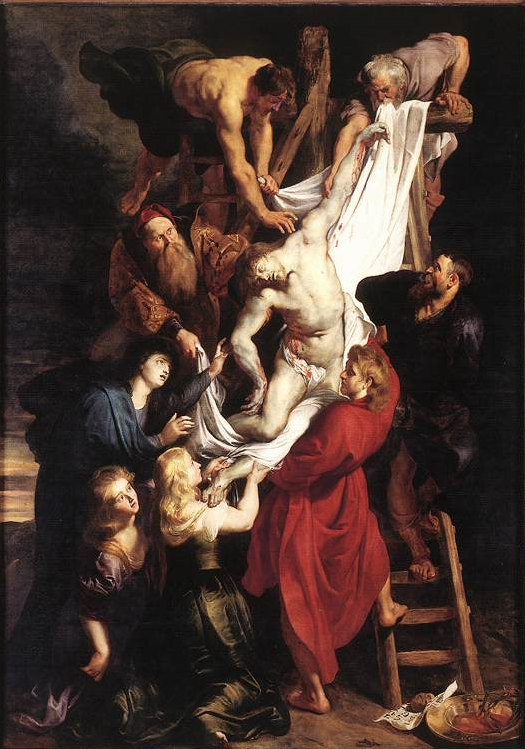
RUBENS, Peter Paul, (b. 1577, Siegen, d. 1640, Antwerpen)
Descent from the Cross, c. 1612-14
Oil on panel
421 x 311 cm (centre panel), 421 x 153 cm (wings)
O.-L. Vrouwekathedraal, Antwerp
RUBENS, Peter Paul, (b. 1577, Siegen, d. 1640, Antwerpen)
Descent from the Cross, c. 1612-14
Detail of the Centre panel
In 1611, the Arquebusiers - Antwerp's civic guard - commissioned a Descent from the Cross by Rubens for their altar in the cathedral. The dean of the guild at that time was Burgomaster Nicolaas Rockox, who appears in the painting. The Descent from the Cross is the second of Rubens's great altarpieces for the Antwerp Cathedral. It shows the Visitation, and the Presentation of the Temple on either side of the Descent from the Cross. More on this painting
RUBENS, Peter Paul, (b. 1577, Siegen, d. 1640, Antwerpen)
Descent from the Cross, c. 1612-14
Detail of the Visitation, left panel
The Visitation. Mary visits her relative Elizabeth; they are both pregnant. Mary is pregnant with Jesus and Elizabeth is pregnant with John the Baptist. Elizabeth was in the sixth month before Mary came. Mary stayed three months, and most scholars hold she stayed for the birth of John. The apparition of the angel, mentioned in Matthew, may have taken place then to end the tormenting doubts of Joseph regarding Mary's maternity.
In Catholicism, it is held that the purpose of this visit was to bring divine grace to both Elizabeth and her unborn child. Even though he was still in his mother's womb, John became aware of the presence of Christ, and leapt for joy as he was cleansed from original sin and filled with divine grace. Elizabeth also responded and recognised the presence of Jesus, and thus Mary exercised her function as mediatrix between God and man for the first time. More on The Visitation
RUBENS, Peter Paul, (b. 1577, Siegen, d. 1640, Antwerpen)
Descent from the Cross, c. 1612-14
Detail of the Presentation, right panel
The Presentation of Jesus at the
Temple, according
to the gospel, Mary and Joseph took the Infant Jesus to the Temple in Jerusalem
forty days after his birth to complete Mary's ritual purification after
childbirth, and to perform the redemption of the firstborn son. Luke explicitly
says that Joseph and Mary take the option provided for poor people (those who
could not afford a lamb), sacrificing "a pair of turtledoves, or two young
pigeons." Leviticus indicates that this event should take place forty days
after birth for a male child, hence the Presentation is celebrated forty days
after Christmas. More on The Presentation
Sir Peter Paul Rubens (28 June 1577
– 30 May 1640) was a Flemish Baroque painter. A proponent of an
extravagant Baroque style that emphasized movement, colour, and sensuality,
Rubens is well known for his Counter-Reformation altarpieces, portraits,
landscapes, and history paintings of mythological and allegorical subjects.
In addition to running a large studio in Antwerp that
produced paintings popular with nobility and art collectors throughout Europe,
Rubens was a classically educated humanist scholar and diplomat who was
knighted by both Philip IV of Spain and Charles I of England. More Sir Peter Paul
Rubens
Dirck Dircksz. van Santvoort, AMSTERDAM CIRCA 1610 - 1680
JOSEPH IN PRISON
oil on panel
12 by 15 3/4 in.; 30.5 by 40 cm.
Private collection
Joseph was taken to Egypt by the Ishmaelite traders, he was purchased by Potiphar, an Egyptian officer. Potiphar was captain of the guard for Pharaoh, the king of Egypt. Joseph works hard for his master, Potʹi·phar. So when Joseph grows older, Potʹi·phar puts him in charge of his whole house.
Joseph was a very handsome and well-built young man, and Potiphar’s wife soon began to look at him lustfully. “Come and sleep with me,” she demanded. Joseph refused. “Look,” he told her, “my master trusts me with everything in his entire household. 9 No one here has more authority than I do. He has held back nothing from me except you, because you are his wife. How could I do such a wicked thing? It would be a great sin against God.”
So when her husband comes home, she lies to him and says: ‘Joseph tried to lie down with me!’ Potʹi·phar believes his wife, and he is very angry with Joseph. So he has him thrown into prison. More on Joseph in prison
Dirck Dircksz van Santvoort (1610–1680) was a Dutch Golden Age painter. Santvoort was born and died in Amsterdam. Though not registered as a Rembrandt pupil, he is considered a member of Rembrandt's school of painting, creating portraits and historical allegories. More Dirck Dircksz van Santvoort
Please visit my other blogs: Art Collector, Mythology, Marine Art, Portrait of a Lady, The Orientalist, Art of the Nude and The Canals of Venice, Middle East Artists, 365 Saints and 365 Days, also visit my Boards on Pinterest
Images are copyright of their respective owners, assignees or others.
Some Images may be subject to copyright
I don't own any of these images - credit is always given when due unless
it is unknown to me. if I post your images without your permission, please tell
me.
I do not sell art, art prints, framed posters or reproductions. Ads are
shown only to compensate the hosting expenses.
If you enjoyed this post, please share with friends and family.
Thank you for visiting my blog and also for liking its posts and pages.
Please note that the content of this post primarily consists of articles
available from Wikipedia or other free sources online.