Showing posts with label Paul Gauguin. Show all posts

07 Paintings, RELIGIOUS ART - Interpretations of the Bible! by The Old Masters, With Footnotes # 61

Central Italian School, 13th Century
Madonna and Child with Saint Peter and an Apostle
Tempera on canvas, laid down on panel
98 x 67.5 cm
Private collection

The present panel painting represents the enthroned Virgin Lactans. The Christ Child is shown holding a scroll in his left hand. Behind them, on a much smaller scale than the foreground group, are an un-identified apostle saint also holding a scroll, and Saint Peter with his characteristic attribute, keys. This refined painting belongs to a type of devotional production that derived from the abstracted, hieratic, Byzantine style, in which however it is possible to note, in contrast to the typically fixed rigidity of the Madonna, a greater degree of animation in the expressions of the apostles at her shoulders. More on this painting

The Nursing Madonna, Virgo Lactans, or Madonna Lactans, is an iconography of the Madonna and Child in which the Virgin Mary is shown breastfeeding the infant Jesus.

Saint Peter (AD 30; d. between AD 64 and 68), according to the New Testament, was one of the Twelve Apostles of Jesus Christ, leaders of the early Christian Church. He is also the "Apostle of the Apostles". The Catholic Church considers him to be the first pope, ordained by Jesus in the "Rock of My Church" dialogue in Matthew. More on Saint Peter

In the Middle Ages, the middle and upper classes usually contracted breastfeeding out to wetnurses, and the depiction of the Nursing Madonna was linked with the Madonna of Humility, a depiction that showed the Virgin in more ordinary clothes than the royal robes shown, for instance, in images of the Coronation of the Virgin.  More on the nursing Madonna

Italian School, 13th Century. Italian painting began to develop beyond the influence of Byzantium in the Duecento or 13th century, with Cimabue, Duccio and Giotto, maintaining its lead throughout the Italian Renaissance, and reaching a particular peak in the High Renaissance of Leonardo da Vinci, Michelangelo and Raphael, despite great political turbulence. Italy retained its artistic dominance into the 17th century with Mannerism and the Baroque, and cultural tourism became a major prop to an otherwise faltering economy. More on Italian School, 13th Century

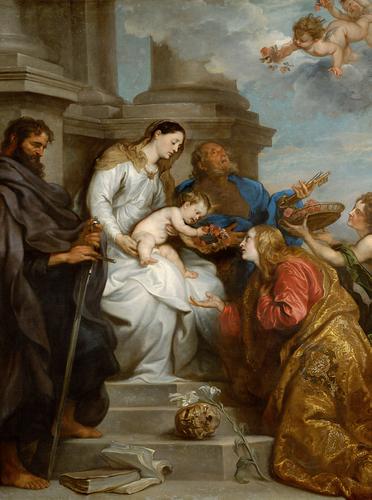
Anthony van Dyck, (1599–1641)
Maria with child and the saints Rosalia , Peter and Paul, c. 1629
Color on canvas
275 × 210 cm (108.3 × 82.7 in)
Kunsthistorisches Museum, Antwerp

Santa Rosalia is depicted on the right, before St. Mary

Saint Rosalia (1130–1166), is the patron saint of Palermo in Italy, and three towns in Venezuela: El Hatillo, Zuata, and Anzoátegui.

Rosalia was born of a Norman noble family that claimed descent from Charlemagne. Devoutly religious, she retired to live as a hermit in a cave on Mount Pellegrino, where she died alone in 1166. Tradition says that she was led to the cave by two angels. On the cave wall she wrote "I, Rosalia, daughter of Sinibald, Lord of Roses, and Quisquina, have taken the resolution to live in this cave for the love of my Lord, Jesus Christ." In 1624, a plague beset Palermo. During this hardship Saint Rosalia appeared first to a sick woman, then to a hunter, to whom she indicated where her remains were to be found. She ordered him to bring her bones to Palermo and have them carried in procession through the city.

The hunter climbed the mountain and found her bones in the cave as described. He did what she had asked in the apparition. After her remains were carried around the city three times, the plague ceased. After this Saint Rosalia was venerated as the patron saint of Palermo, and a sanctuary was built in the cave where her remains were discovered. More on Saint Rosalia

Sir Anthony van Dyck, ( 22 March 1599 – 9 December 1641) was a Flemish Baroque artist who became the leading court painter in England, after enjoying great success in Italy and Flanders. He is most famous for his portraits of Charles I of England and his family and court, painted with a relaxed elegance that was to be the dominant influence on English portrait-painting for the next 150 years. He also painted biblical and mythological subjects, displayed outstanding facility as a draughtsman, and was an important innovator in watercolour and etching. The Van Dyke beard is named after him. More Sir Anthony van Dyck


Paul Gauguin,  (1848–1903)
The Yellow Christ, c. 1889
Oil on canvas
92.1 × 73 cm (36.3 × 28.7 in)
Albright-Knox Art Gallery, Buffalo, New York

The Yellow Christ is a painting executed by Paul Gauguin in 1889 in Pont-Aven. Together with The Green Christ (below), it is considered to be one of the key works of Symbolism in painting.

The Yellow Christ is a symbolic piece that shows the crucifixion of Christ taking place in nineteenth-century northern France as Breton women are gathered in prayer. Gauguin relies heavily on bold lines to define his figures and reserves shading only for the women. The autumn palette of yellow, red and green in the landscape echoes the dominant yellow in the figure of Christ. The bold outlines and flatness of the forms in this painting are typical of the cloisonnist style. More on the Yellow Christ

Paul Gauguin,  (1848–1903)
The Green Christ, or Breton Calvar, c. 1889
Oil on canvas
92 × 73 cm (36.2 × 28.7 in)
Royal Museums of Fine Arts of Belgium

The Green Christ depicts a Breton woman at the foot of a calvary, or sculpture of Christ's crucifixion. Calvaries are common in town squares in Brittany.

Topographically, the site depicted is the Atlantic coast at Le Pouldu. But the calvary depicted is an amalgam of calvaires from different sites; the cross is based upon that in the centre of Névez, a community close to Pont-Aven and several miles from the coast. The figure of Christ is based upon the calvaire at Briec - also some distance from the sea. More on the Green Christ 

Christ of the church of Trémalo, at Pont-Aven
Seventeenth century
 189 x 133 cm

Gauguin first visited Pont-Aven in 1886. He returned to the village in early 1888 to stay until mid-October. Early in 1889, Gauguin was back to Pont-Aven to stay there until spring 1890. It was only for a short visit in summer 1889 to Paris to see the Exposition universelle and to arrange the Volpini Exhibition that Gauguin interrupted this sojourn. Soon after his return to Pont-Aven he painted The Yellow Christ.

Eugène Henri Paul Gauguin (7 June 1848 – 8 May 1903) was a French post-Impressionist artist. Underappreciated until after his death, Gauguin is now recognized for his experimental use of color and Synthetist style that were distinctly different from Impressionism. His work was influential to the French avant-garde and many modern artists, such as Pablo Picasso and Henri Matisse. Gauguin's art became popular after his death.
He was an important figure in the Symbolist movement as a painter, sculptor, printmaker, ceramist, and writer. His bold experimentation with color led directly to the Synthetist style of modern art, while his expression of the inherent meaning of the subjects in his paintings, under the influence of the cloisonnist style, paved the way to Primitivism and the return to the pastoral. He was also an influential proponent of wood engraving and woodcuts as art forms. More on Eugène Henri Paul Gauguin

Circle Peter Paul Rubens
The Miracles of Saint Ignatius of Loyola
oil on copper
49.5 x 34.5 cm
Private collection

Saint Ignatius of Loyola (October 23, 1491 – July 31, 1556) was a Spanish Basque priest and theologian, who founded the religious order called the Society of Jesus (Jesuits) and became its first Superior General. The Jesuit order served the Pope as missionaries, and they were bound by a vow of special obedience to the sovereign pontiff in regard to the missions. They therefore emerged as an important force during the time of the Counter-Reformation.

Ignatius is remembered as a talented spiritual director. He recorded his method in a celebrated treatise called the Spiritual Exercises, a simple set of meditations, prayers, and other mental exercises, first published in 1548.

Ignatius was beatified in 1609, and then canonized, receiving the title of Saint on March 12, 1622. His feast day is celebrated on July 31. He is the patron saint of the Basque provinces of Gipuzkoa and Biscay as well as the Society of Jesus, and was declared patron saint of all spiritual retreats by Pope Pius XI in 1922. Ignatius is also a foremost patron saint of soldiers. More on Saint Ignatius of Loyola

Sir Peter Paul Rubens (28 June 1577 – 30 May 1640) was a Flemish Baroque painter. A proponent of an extravagant Baroque style that emphasized movement, colour, and sensuality, Rubens is well known for his Counter-Reformation altarpieces, portraits, landscapes, and history paintings of mythological and allegorical subjects.
In addition to running a large studio in Antwerp that produced paintings popular with nobility and art collectors throughout Europe, Rubens was a classically educated humanist scholar and diplomat who was knighted by both Philip IV of Spain and Charles I of England.  More Sir Peter Paul Rubens


Please visit my other blogs: Art CollectorMythologyMarine ArtPortrait of a Lady, The OrientalistArt of the Nude and The Canals of VeniceMiddle East Artists365 Saints and 365 Days, also visit my Boards on Pinterest

Images are copyright of their respective owners, assignees or others. Some Images may be subject to copyright

I don't own any of these images - credit is always given when due unless it is unknown to me. if I post your images without your permission, please tell me.

I do not sell art, art prints, framed posters or reproductions. Ads are shown only to compensate the hosting expenses.

If you enjoyed this post, please share with friends and family.

Thank you for visiting my blog and also for liking its posts and pages.

Please note that the content of this post primarily consists of articles available from Wikipedia or other free sources online.

08 Paintings, RELIGIOUS ART - Interpretations of the Bible! by Paul Gauguin, Louis B. Davis, Callisto Piazza, and Dante Gabriel Rossetti, With Footnotes # 56

Dante Gabriel Rossetti,  (1828–1882)
Lady Lilith, c. 1866-68 (altered 1872-73)
Oil on canvas
97.8 × 85.1 cm (38.5 × 33.5 in)
Delaware Art Museum

Lilith, the subject of this painting, is described in Judaic literature as the first wife of Adam. She is associated with the seduction of men and the murder of children. The depiction of women as powerful and evil temptresses was prevalent in 19th-century painting, particularly among the Pre-Raphaelites. The artist depicts Lilith as an iconic, Amazon-like female with long, flowing hair. Her languid nature is reiterated in the inclusion of the poppy in the lower right corner—the flower of opium-induced slumber.

A large 1867 replica of Lady Lilith, painted by Rossetti in watercolor, which shows the face of Cornforth, is now owned by New York's Metropolitan Museum of Art (below). More on this painting

Dante Gabriel Rossetti,  (1828–1882)
Lady Lilith, c. 1867
Watercolor and gouache on paper
51.3 × 44 cm (20.2 × 17.3 in)
Metropolitan Museum

The subject of Lilith can be found in Babylonian mythology from the Third and Fourth Centuries and was retold in Hebrew scripture in the Alphabet of Sirach, which explains how she was created from the same earth as Adam before the creation of Eve. In a variation of her story from the Thirteenth Century, Lilith had refused to be subservient to Adam and had abandoned the Garden of Eden and coupled with the archangel Samael. By the nineteenth century the name Lilith had become synonymous with powerful female independence and primordial sexual allure and she was identified either as a demoness or enchantress, the original femme fatale. Rossetti seems to have regarded her as the latter. More on Lady Lilith

Dante Gabriel Rossetti (12 May 1828 – 9 April 1882) was an English poet, illustrator, painter and translator. He founded the Pre-Raphaelite Brotherhood in 1848 with William Holman Hunt and John Everett Millais. Rossetti was later to be the main inspiration for a second generation of artists and writers influenced by the movement. His work also influenced the European Symbolists and was a major precursor of the Aesthetic movement.

Rossetti's personal life was closely linked to his work, especially his relationships with his models and muses Elizabeth Siddal, Fanny Cornforth and Jane Morris. More on Dante Gabriel Rossetti


Callisto Piazza, (1500–1561), LODI
NOLI ME TANGERE
Oil on panel
47,5 x 34,5 cm ; 18 3/4  by 13 1/2  in
Private collection

Noli me tangere, meaning "don't touch me" or "don't tread on me", is the Latin version of words spoken, according to John 20:17, by Jesus to Mary Magdalene when she recognized him after his resurrection.
The biblical scene became the subject of a long, widespread and continuous iconographic tradition in Christian art from Late Antiquity to the present. More on Noli me tangere

Callisto Piazza (1500–1561) was an Italian painter, was born in Lodi, Lombardy.

In 1523 he was working in Brescia. His first dated and signed work is from the following year, and shows a typical Brescian style. This style was then emerging, and included artists such as Romanino and Moretto. Piazza shows influences from contemporaries such as Dosso Dossi and Ludovico Mazzolino of the Ferrarese school, as well as Giovanni Agostino da Lodi.

In 1529 he formed a workshop with his brothers Cesare and Scipione (died 1552). In 1538, while in Crema, he married the noblewoman Francesca Confalonieri. Later Callisto moved to Milan, where he received numerous commissions, largely executed with the assistance of his son Fulvio. He also worked in Lodi at the Incoronata (1454), Novara, at the Abbey of Chiaravalle and other areas of Lombardy.

His graphic style is often confused with that of Romanino, who exerted a deep influence on his work. More on Callisto Piazza

Paul Gauguin,  (1848–1903)
Te Tamari no Atua / The Birth of Christ the Son of God ', c. Tahiti, 1896
Oil on canvas
96 × 128 cm
Neue Pinakothek,  Munich, Germany


Te tamari no atua ("The son of God", in Polynesian ) is a painting by the French painter Paul Gauguin realized in 1896 . 

Paul Gaugin, who has always been attracted by "primitive" societies , embarked in 1891 for Polynesia . He remained there until 1893. It was during his second stay (from 1895) that he painted Te tamari no atua . Gauguin found in Tahiti his terrestrial paradise: a colony sufficiently distant from a Western civilization which horrified him.

Te tamari no atua is undoubtedly one of the most surprising Nativities: no Magi or Joseph , the divine child relegated to the background, and a Marie en pareo lying on her Bed decorated, seeming exhausted by childbirth.

The model is a teenager of 14 years, mistress of the painter then 48 years old. Waiting for a child who was to come into the world around Christmas, she inspired him with this iconoclastic representation of the birth of Christ. It was not the first time that Gauguin, who had received a religious education, was delivering "a radical reinterpretation of an image of Christianity": eight years earlier he had painted in Brittany the Vision after the sermon (below), Was represented in Jesus on the eve of the crucifixion, which had led to his break with Van Gogh. More on Te tamari no atua

Paul Gauguin,  (1848–1903)
Vision After the Sermon (Jacob wrestling with the Angel), c. 1888
Oil on canvas
73 × 92 cm (28.7 × 36.2 in)
Scottish National Gallery

Among Gauguin's masterpieces painted in Brittany are the Vision after the Sermon (1888) and the Yellow Christ (1889) (below). In both paintings Breton peasants, to whom Gauguin was attracted as exotic, noncultivated types, figure prominently. Gauguin's usual bright colours and simplified shapes treated as flat silhouettes are present, but these paintings also reveal his symbolist leanings. Objects and events are taken out of their normal historical contexts.

In the Vision Breton women observe an episode described in Genesis: Jacob wrestling with a stranger who turns out to be an angel. Gauguin suggests thereby that the faith of these pious women enabled them to see miraculous events of the past as vividly as if they were occurring before them.

The painting is divided into two parts by the large diagonal tree-trunk, an arrangement taken from Japanese woodcuts. The foreground is filled by group of women, dressed in traditional Breton costumes, as they return from the Mass. The background depicts the biblical scene of Jacob's battle with the angel. More on Vision After the Sermon 

Paul Gauguin,  (1848–1903)
The Yellow Christ, c. 1889
Oil on canvas
92 x 73 cm
Albright-Knox Art Gallery, Buffalo

In Yellow Christ, Gauguin returned to religious subject matter for the first time since painting The Vision a year previously. In fact, the two works have a number of similarities. Both are essentially synthetic, distilling the essence of the subject in order to render it as forcibly as possible, and relying on the use of colour to symbolic ends. They share the same theme; of the naivety of the allegedly simple Breton peasants, who by their faith transform what was simply a statue of Christ into a living embodiment of his suffering. The use of this kind of folk art, part of his repertoire of 'primitive' imagery, was used in the slightly later Green Christ (below). He painted this cross also in the background of his self-portrait. More on Yellow Christ

Paul Gauguin,  (1848–1903)
The Green Christ or The Calvary, c. 
1889
Oil on canvas
92 x 73 cm
Musées Royaux des Beaux-Arts, Brussels

Like the statue in the Yellow Christ, the Green Christ had an identifiable source in a mossy stone calvary that Gauguin had seen at Nizon near Pont-Aven. He has again treated the impact of religious faith on the Breton woman, who crouches in the foreground in front of the deposition, a graphic blending of the real and the illusory that had already been explored in both The Vision and the Yellow Christ. Again, the counterpoise of the quotidian is suggested by expressive, apparently uninterested background figures, here a seaweed gatherer returning from the beach.

The picture may be seen as a later event in Christ's Passion - the bright colours of the Yellow Christ have given way to sombre tones, as his dead body is lifted down from the cross. Again, the face is a thinly-disguised self-portrait, another in the line of works in which Gauguin has dealt with the theme of martyrdom, likening his suffering to that of Christ. More on the Green Christ

Eugène Henri Paul Gauguin (7 June 1848 – 8 May 1903) was a French post-Impressionist artist. Underappreciated until after his death, Gauguin is now recognized for his experimental use of color and Synthetist style that were distinctly different from Impressionism. His work was influential to the French avant-garde and many modern artists, such as Pablo Picasso and Henri Matisse. Gauguin's art became popular after his death.

He was an important figure in the Symbolist movement as a painter, sculptor, printmaker, ceramist, and writer. His bold experimentation with color led directly to the Synthetist style of modern art, while his expression of the inherent meaning of the subjects in his paintings, under the influence of the cloisonnist style, paved the way to Primitivism and the return to the pastoral. He was also an influential proponent of wood engraving and woodcuts as art forms. More on Eugène Henri Paul Gauguin


Louis B. Davis, 1861-1941
ST. GEORGE, STUDY FOR A WINDOW AT WYNYARD PARK
Coloured chalk with black ink
135 by 49cm., 53 by 19in.
Private collection

Saint George (circa 275/281 – 23 April 303 AD) was a soldier in the Roman army who later became venerated as a Christian martyr. His parents were Christians of Greek background; his father Gerontius was a Roman army official from Cappadocia and his mother Polychronia was from Lydda, Syria Palaestina. Saint George became an officer in the Roman army in the Guard of Diocletian, who ordered his death for failing to recant his Christian faith.

In the fully developed Western version of the Saint George Legend, a dragon, or crocodile, makes its nest at the spring that provides water for the city of "Silene" (perhaps modern Cyrene in Libya or the city of Lydda in Palistine, depending on the source). Consequently, the citizens have to dislodge the dragon from its nest for a time, to collect water. To do so, each day they offer the dragon at first a sheep, and if no sheep can be found, then a maiden is the best substitute for one. The victim is chosen by drawing lots. One day, this happens to be the princess. The monarch begs for her life to be spared, but to no avail. She is offered to the dragon, but then Saint George appears on his travels. He faces the dragon, protects himself with the sign of the Cross, slays the dragon, and rescues the princess. The citizens abandon their ancestral paganism and convert to Christianity. More on Saint George 

Louis Davis (May 1860 – 1941) was an English watercolourist, book illustrator and stained-glass artist. He was active in the Arts and Crafts Movement and Nikolaus Pevsner referred to him as the last of the Pre-Raphaelites. He was born and raised in Abingdon, Oxfordshire. His father was a manufacturer, with an interest in the Davis Engineering and Launch Building Company, which built and refurbished boats, barges and canals. Gabriel Davis was also a grain, alcohol and coal merchant. Louis Davis had two older brothers, Arthur and David, and a younger brother named Oliver.

Davis married the much younger Edith Jane Webster in 1901 in Tewkesbury, Gloucestershire. Due to the similarity between the faces of women in his works and that of a picture of Edith, it is probable that she was his model for much of his glass work. The couple never had children.

Edith and Louis were both injured due to an accidental gas fire and the resulting fumes in 1915. Davis seemed to have suffered a stroke, lost his ability to speak, and occasionally required a wheelchair for mobility. Edith fully recovered from the incident.

Davis died in 1941 after which Edith sold their home and studio and returned to East Anglia where she was raised. She died in the late 1970s. More on Louis Davis


Please visit my other blogs: Art CollectorMythologyMarine ArtPortrait of a Lady, The OrientalistArt of the Nude and The Canals of VeniceMiddle East Artists365 Saints and 365 Days, also visit my Boards on Pinterest

Images are copyright of their respective owners, assignees or others. Some Images may be subject to copyright

I don't own any of these images - credit is always given when due unless it is unknown to me. if I post your images without your permission, please tell me.

I do not sell art, art prints, framed posters or reproductions. Ads are shown only to compensate the hosting expenses.

If you enjoyed this post, please share with friends and family.

Thank you for visiting my blog and also for liking its posts and pages.

Please note that the content of this post primarily consists of articles available from Wikipedia or other free sources online.