Netherlandish, Malines, circa 1600
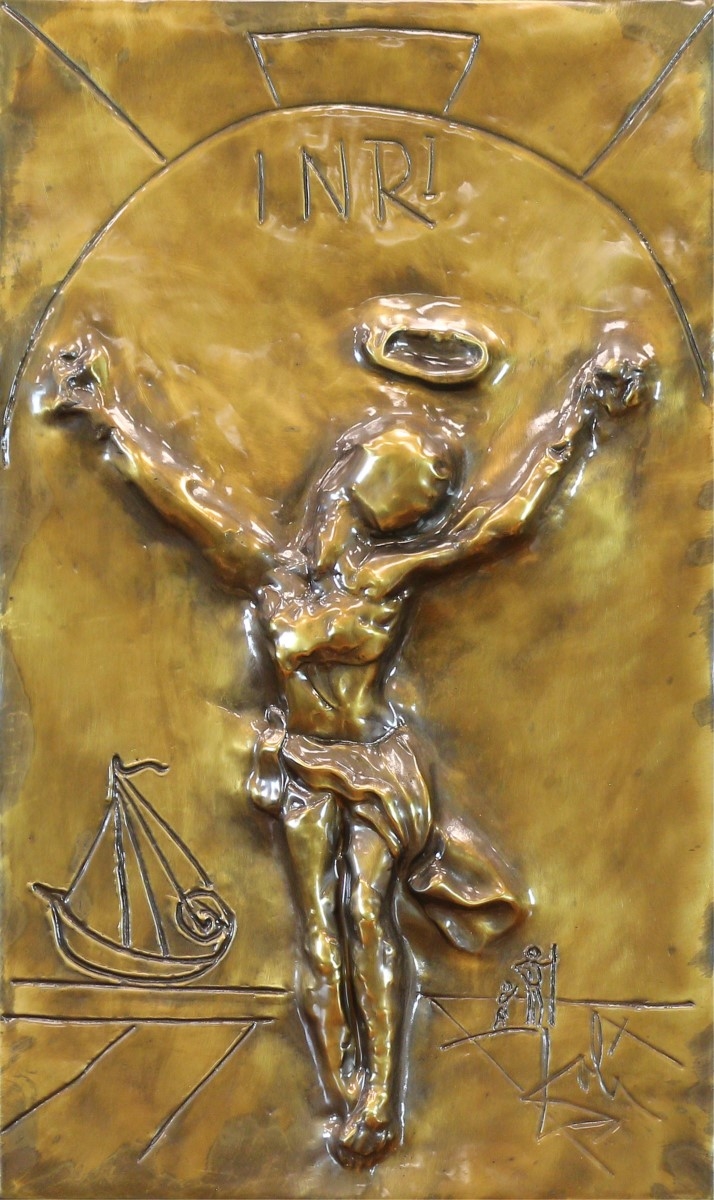
THE DESCENT INTO HELL
Partially gilt alabaster relief
20 x 15 cm, 7 3/4 by 6 in
Private collection
Mechelen (French: Malines) is one of Flanders' prominent cities of historical art, with Antwerp, Bruges, Brussels, Ghent, and Leuven. It was notably a centre for artistic production during the Northern Renaissance, when painters, printmakers, illuminators and composers of polyphony were attracted by patrons such as Margaret of York, Margaret of Austria and Hieronymus van Busleyden. More on Mechelen
Descent into Hell (Hades). Between his crucifixion and resurrection Christ descended into the abode of the dead, as confessed in the Apostles' Creed. Since the New Testament declares that Christ really died, it is to be assumed that he went to hell, the abode of the dead. This is affirmed by the many declarations in the New Testament that Christ was raised from the dead.
The descent into Hades is a common motif in ancient religions. The heroes or the gods descend into Hades to perform a rescue, to triumph over death, or as part of the recurring seasons of the agricultural year. More on Descent into Hell

Netherlandish, Malines, circa 1600
SAINT ANTOINE
Alabaster relief
12 x 9,5 cm, 4 3/4 by 3 3/4 in.
Private collection
Saint Anthony or Antony (c. 251–356) was a
Christian monk from Egypt, revered since his death as a saint. He is known as
the Father of All Monks. His feast day is celebrated on January 17 among the
Orthodox and Catholic churches and on Tobi 22 in the Egyptian calendar used by
the Coptic Church.
The
biography of Anthony's life helped to spread the concept of Christian
monasticism, particularly in Western Europe via its Latin translations. He is
often erroneously considered the first Christian monk. Anthony was, however,
the first to go into the wilderness (about ad 270), a geographical move that
seems to have contributed to his renown. Accounts of Anthony enduring
supernatural temptation during his sojourn in the Eastern Desert of Egypt
inspired the often-repeated subject of the temptation of St. Anthony in Western
art and literature.
Anthony is appealed to against infectious diseases,
particularly skin diseases. In the past, many such afflictions, including
ergotism, erysipelas, and shingles, were historically referred to as St.
Anthony's fire. More on Saint Anthony

SAINT ROCH France, seventeenth century
Polychrome wood
H. 120 cm, L. 40 cm, P. 36 cm
Private collection
Saint Roch or Rocco (lived c. 1348 – 15/16 August 1376/79 (traditionally c. 1295 – 16 August 1327)) was a Catholic saint, a confessor whose death is commemorated on 16 August; he is specially invoked against the plague. He may also be called Rock in English, and has the designation of St Rollox in Glasgow, Scotland. He is a patron saint of dogs, falsely accused people, bachelors, and several other things.
Sources say he was born at Montpellier, France, son of the governor. He went on pilgrimage to Rome and devoted himself to caring for the victims of a plague that was ravaging Italy. He became a victim himself at Piacenza but recovered and was reputed to have performed many miracles of healing.
On his return to Montpellier, he was imprisoned for five years as a spy in pilgrim's disguise when his uncle, who was governor, ordered him imprisoned (His uncle failed to recognize him, and Roch failed to identify himself.) Roch died in prison and was only then identified as the former governor's son by a birthmark in the form of a cross on his chest. Another biographer says that he was arrested as a spy at Angers, Lombardi, and died in prison there.
When miracles were reported at his intercession after his death, a popular cult developed and he is invoked against pestilence and plague. He is also the patron of invalids. More on Saint Roch

Mary Immaculate
Polychromed, gilded and stewed terracotta sculpture. Portugal. 17th century.
Height: 42,5 cm
Private collection
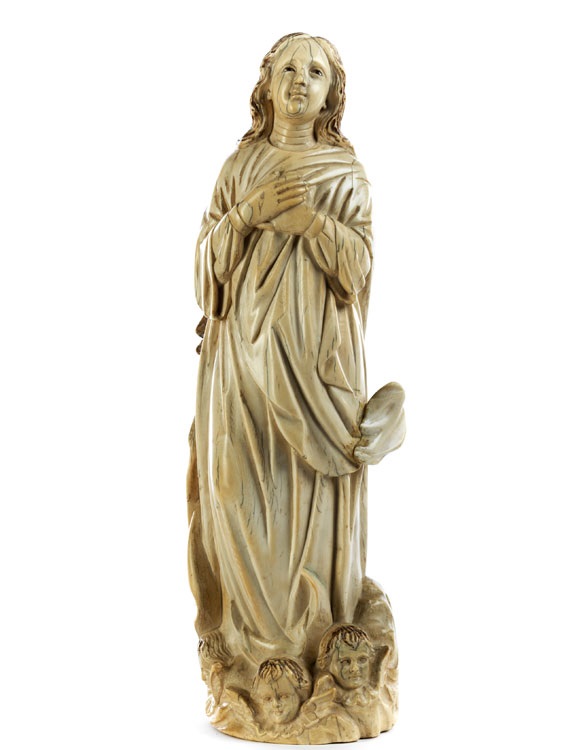
Delicate terracotta work, in which the mastery of the sculptor is outstanding, as the group has been given great movement. The virgin gathers up the edge of her cloak to her chest. Her clothing is decorated meticulously with bunches of polychromed flowers on a gilded and starry base. At her feet are five cherubs with incredibly delicate features, as well as the snake and the apple. More on this work
Mary Immaculate commonly refers to the Virgin Mary and her Immaculate Conception in the teachings of the Catholic Church.

Mary Immaculate
Polychromed, gilded and stewed terracotta sculpture. Portugal. 17th century.
Detail
The Immaculate Conception, according to the teaching of the
Catholic Church, was the conception of the Blessed Virgin Mary in the womb of
her mother, Saint Anne, free from original sin by virtue of the foreseen merits
of her son Jesus Christ. The Catholic Church teaches that Mary was conceived by
normal biological means, but God acted upon her soul (keeping her
"immaculate") at the time of her conception.
The Immaculate Conception is commonly and
mistakenly taken to mean the conception of Mary's son Jesus Christ in her own
womb, and the Virgin Birth of Jesus. These are covered by the Doctrine of
Incarnation, while the Immaculate Conception deals with the conception of Mary
herself, not that of her son. More on The Immaculate Conception


Southern Germany, circa 1900
Saint Hubert,
Wood carved, colored and partly gilded
H 85 cm.
Saint Hubertus or Hubert (c. 656–727 AD) Bishop of Maastricht, Netherlands, and disciple of St. Lambert. Hubert was a married courtier serving Pepin of Heristal, France. He reportedly had a vision of a crucifix between the horns of a stag while hunting. Widowed, he is believed to have entered Stavelot Monastery, Belgium, and was ordained by St. Lambert at Maastricht. He succeeded St. Lambert about 705 as bishop. Hubert erected a shrine for St. Lambert's relics at Liege, France. He was noted for his miracles and for converting hundreds. Hubert died at Tervueren, near Brussels, Belgium, on May 30. He is a patron saint of hunters. More on Saint Hubertus

Anna Selbdritt, 16th cent
Solid oak, carved and colored
H 41 cm
Private collection
Anna Selbdritt (Ger. Anna third part), is a description of the image which shows St. Anne, carrying on in her arms the Mother of God as well as the Christ child; a subject in Christian art depiction, popular in Germany and neighboring countries since the 14th century.

Saint Michael Archangel
Carved, polychromed and gilded wooden sculpture. Mexico. 17th century.
66 x 32 x 24 cm.
Private collection
This sculpture depicts one of the archangels, Saint Michael, who conquered the devil and is prince of the holy army. Depicted in accordance with his most typical iconography, wearing a breastplate and armed with a sword, of which only the hilt remains, and a shield. At his feet is the devil who he beats, represented by a diabolical figure. The saint rests on just one foot, which is standing on the devil, it is elegant and has movement and life. The movement of the clothing and the cloak which flies towards his back gives the group even more realism. Original polychrome and gilding. The sculpture rests on its own wooden plinth with original polychrome and gilding. More on this work
ARCHANGEL MICHAEL, is an archangel in Judaism, Christianity,
and Islam. In Roman Catholic, Eastern Orthodox, Anglican, and Lutheran
traditions, he is called "Saint Michael the Archangel" and
"Saint Michael". In the Oriental Orthodox and Eastern Orthodox
traditions, he is called "Taxiarch Archangel Michael" or simply
"Archangel Michael".
Michael is
mentioned three times in the Book of Daniel, once as a "great prince who
stands up for the children of your people". The idea that Michael was the
advocate of the Jews became so prevalent that, in spite of the rabbinical
prohibition against appealing to angels as intermediaries between God and his
people, Michael came to occupy a certain place in the Jewish liturgy.
In the New
Testament Michael leads God's armies against Satan's forces in the Book of
Revelation, where during the war in heaven he defeats Satan. In the Epistle of
Jude Michael is specifically referred to as "the archangel Michael".
Christian sanctuaries to Michael appeared in the 4th century, when he was first
seen as a healing angel, and then over time as a protector and the leader of
the army of God against the forces of evil. By the 6th century, devotions to
Archangel Michael were widespread both in the Eastern and Western Churches.
Over time, teachings on Michael began to vary among Christian denominations. More Archangel Michael

Saint Joseph
Lacquered, polychromed and gilded wooden sculpture. Mexico. 17th century.
Height: 46 cm
Private collection
Sculpture depicting Saint Joseph with the baby Jesus in his arms. He has a tender, paternal gaze. Imposing ornamental work on the saint´s tunic in pricked gold, with flower motifs, as well as the cloak, which has a lining decorated with green lacquer and golden flowers. More on this work
Joseph is a
figure in the Gospels, the husband of Mary, mother of Jesus, and is venerated
as Saint Joseph. In both Catholic
and Protestant traditions, Joseph is regarded as the patron saint of workers
and is associated with various feast days. Pope Pius IX declared him to be both
the patron and the protector of the Catholic Church, in addition to his
patronages of the sick and of a happy death, due to the belief that he died in
the presence of Jesus and Mary. In popular piety, Joseph is regarded as a model
for fathers and has also become patron of various dioceses and places.
Several
notable images of Saint Joseph have been granted a Canonical coronation by a
Pope. In popular religious iconography he is associated with lilies or a
spikenard. With the present-day growth of Mariology, the theological field of
Josephology has also grown and since the 1950s centers for studying it have
been formed.
According to the New Testament, Joseph was the father of
James, Joses, Jude, Simon, and at least two daughters. More on Saint Joseph


Attributed to Jan Crocq (Netherlandish, 1486–1510).
Saint John the Baptist, c. 1500
Limestone
163 x 59 x 40 cm (64 1/4 x 23 3/8 x 15 3/4 in)
The Cleveland Museum of Art
Saint John the Baptist, much beloved and widely venerated during the Middle Ages, is depicted in this sculpture in a formal manner typical of Netherlandish art of the 1400s and early 1500s. The sculpture is impressive for the deeply undercut folds of drapery as well as the saint’s curling hair and beard that achieve an almost photographic realism characteristic of Burgundian and Netherlandish art of this period. More on this sculpture
John the Baptist (sometimes called John in the
Wilderness; also referred to as the Angel of the Desert) was the subject of at least eight paintings by the Italian Baroque
artist Michelangelo Merisi da Caravaggio (1571–1610).
The story
of John the Baptist is told in the Gospels. John was the cousin of Jesus, and
his calling was to prepare the way for the coming of the Messiah. He lived in
the wilderness of Judea between Jerusalem and the Dead Sea, "his raiment
of camel's hair, and a leather girdle about his loins; and his meat was locusts
and wild honey." He baptised Jesus in the Jordan.
According to the Bible, King Herod's daughter Salome requested
Saint John the Baptist's beheading. She was prompted by her mother, Herodias,
who sought revenge, because the prophet had condemned her incestuous marriage
to Herod. More John the Baptist

19th century
Hildegard of Bingen
Wood carved, embossed, colored and partially gilded, original three-sided glazed shrine with turned columns
H 35 cm
Private collection
Hildegard of Bingen, O.S.B. (1098 – 17 September 1179), also known as Saint Hildegard and Sibyl of the Rhine, was a German Benedictine abbess, writer, composer, philosopher, Christian mystic, visionary, and polymath. She is considered to be the founder of scientific natural history in Germany.

19th century
Hildegard of Bingen
Detail
Hildegard was elected magistra by her fellow nuns in 1136; she founded the monasteries of Rupertsberg in 1150 and Eibingen in 1165. One of her works as a composer, the Ordo Virtutum, is an early example of liturgical drama and arguably the oldest surviving morality play. She wrote theological, botanical, and medicinal texts, as well as letters, liturgical songs, and poems, while supervising miniature illuminations in the Rupertsberg manuscript of her first work, Scivias. She is also noted for the invention of a constructed language known as Lingua Ignota.
Although the history of her formal consideration is complicated, she has been recognized as a saint by branches of the Roman Catholic Church for centuries. On 7 October 2012, Pope Benedict XVI named her a Doctor of the Church. More on Hildegard of Bingen
Images are copyright of their respective owners, assignees or others
We do not sell art prints, framed posters or reproductions. Ads are shown only to compensate the hosting expenses.
If you enjoyed this post, please share with friends and family.