Showing posts with label Virgin Mary. Show all posts

10 Ivory Carvings & Sculpture from the Bible! 15 & 16th Century. With Footnote, # 13

Maria lactans, c. mid-15th century, France
Ivory
Height: 17 cm
Private collection

The Nursing Madonna, Virgo Lactans, or Madonna Lactans, is an iconography of the Madonna and Child in which the Virgin Mary is shown breastfeeding the infant Jesus.

The depiction is mentioned by Pope Gregory the Great, and a mosaic depiction probably of the 12th century is on the facade of Santa Maria in Trastevere in Rome, though few other examples survive from before the late Middle Ages. It continued to be found in Orthodox icons, especially in Russia.

In the Middle Ages, the middle and upper classes usually contracted breastfeeding out to wetnurses, and the depiction of the Nursing Madonna was linked with the Madonna of Humility, a depiction that showed the Virgin in more ordinary clothes than the royal robes shown, for instance, in images of the Coronation of the Virgin, and often seated on the ground. The appearance of a large number of such depictions in Tuscany in the early 14th century was something of a visual revolution for the theology of the time, compared to the Queen of Heaven depictions. After the Council of Trent in the mid-16th century, clerical writers discouraged nudity in religious subjects, and the use of the Madonna Lactans iconography began to fade away. More on the nursing Madonna

The thorny crown of Christ
Two-ivory carvings
Height: 15 cm. 
17th century.
Private collection

Jesus sitting on a stone block with his head pressed down by a soldier, while the soldier places the crown of his thorn with iron gloves. More on this sculpture 
19th century.
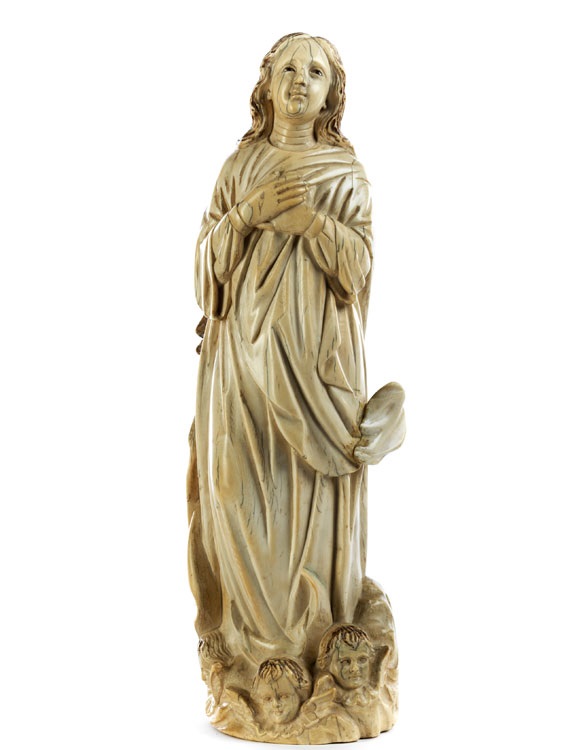
A youthful Madonna
Ivory. 
Height: 35 cm. 
Private collection


On a cloud base, this busy winged angel with three heads and a crescent moon. put your hands over your chest, facing the view with inset glass eyes upward. More on A youthful Madonna

The two Marys, Johannes Evangelist with gospel book, and Nicodemus
Pair of ivory figures
Height: 17 per cm. Early 17th century.
Private collection

The two Marys and Johannes Evangelist with gospel book, behind the Holy Nicodemus. The ivory figures formerly colored calm, still preserved remains of the holder into the garment depths. flattened at the back. More on the 2 Marys

As the depiction of the Passion of Christ increased in complexity towards the end of the first millennium, a number of scenes were developed covering the period between the death of Jesus on the Cross and his being placed in his tomb. The accounts in the Canonical Gospels concentrate specifically mention the Virgin Mary and Mary Magdalene as present. More on the 2 Marys

John the Evangelist is the name traditionally given to the author of the Gospel of John. Christians have traditionally identified him with John the Apostle, John of Patmos, and John the Presbyter, though this has been disputed by modern scholars.

Christian tradition says that John the Evangelist was John the Apostle. A historical figure, one of the "pillars" of the Jerusalem church after Jesus' death. He was one of the original twelve apostles and is thought to be the only one to have lived into old age and not be killed for his faith. John is associated with the city of Ephesus, where he is said to have lived and been buried. Some believe that he was exiled (around 95 AD) to the Aegean island of Patmos, where he wrote the Book of Revelation. More

He wrote to the seven Christian churches in Asia to warn them of various challenges and temptations that confront them, which have been revealed to him in a vision. He then relates several additional powerful visions concerning the Last Days and the Second Coming of Christ. More

Nicodemus is a Pharisee and a member of the Sanhedrin mentioned in three places in the Gospel of John: 1- He first visits Jesus one night to discuss Jesus' teachings. 2- The second time Nicodemus is mentioned, he reminds his colleagues in the Sanhedrin that the law requires that a person be heard before being judged. 3- Finally, Nicodemus appears after the Crucifixion of Jesus to provide the customary embalming spices, and assists Joseph of Arimathea in preparing the body of Jesus for burial

An apocryphal work under his name—the Gospel of Nicodemus—was produced in the mid-4th century, and is mostly a reworking of the earlier Acts of Pilate, which recounts the harrowing of Hell. More Nicodemus 

VIRGIN AND CHILD
IVORY SCULPTURE. CIRCA 1800
Height: 11,5 cm.
Private collection


Jesus Christ bust 
Mammoth Ivory Figurine
Height: 8, Width:7 , Length: 3.5 Cm
Private collection


This Figurine is Hand carved by a Master Carver to perfection. This Figurine is made of 100% genuine Mammoth Ivory Tusk. The extinct woolly Mammoth roamed the earth before 10,000-40,000 years ago. Today we can find Mammoth ivory tusk in the arctic regions like Siberia in Russia. Mammoth ivory figurines are absolutely legal worldwide. More on Mammoth Ivory

Trade in the ivory from the tusks of dead mammoths has occurred for 300 years and continues to be legal. Mammoth ivory is used today to make handcrafted knives and similar implements. Mammoth ivory is rare and costly because mammoths have been extinct for millennia, and scientists are hesitant to sell museum-worthy specimens in pieces.[39] Some estimates suggest that 10 million mammoths are still buried in Siberia. More on Mammoth Ivory


Saint Joseph holding in his hands baby Jesus
Mammoth Ivory figurine
Height: 14 Cm / 5.5 In
Private collection

Joseph is a figure in the Gospels, the husband of Mary, mother of Jesus, and is venerated as Saint Joseph. In both Catholic and Protestant traditions, Joseph is regarded as the patron saint of workers and is associated with various feast days. Pope Pius IX declared him to be both the patron and the protector of the Catholic Church, in addition to his patronages of the sick and of a happy death, due to the belief that he died in the presence of Jesus and Mary. In popular piety, Joseph is regarded as a model for fathers and has also become patron of various dioceses and places.

Several notable images of Saint Joseph have been granted a Canonical coronation by a Pope. In popular religious iconography he is associated with lilies or a spikenard. With the present-day growth of Mariology, the theological field of Josephology has also grown and since the 1950s centers for studying it have been formed.

According to the New Testament, Joseph was the father of James, Joses, Jude, Simon, and at least two daughters. More on Saint Joseph

Virgin with Child
Gothic style  French work. Period: XIXth century
Carved ivory
H.:50cm. 
Private collection

Virgin Mary Holding Baby Jesus
Mammoth Ivory figurine 
H:22Cm
Private collection

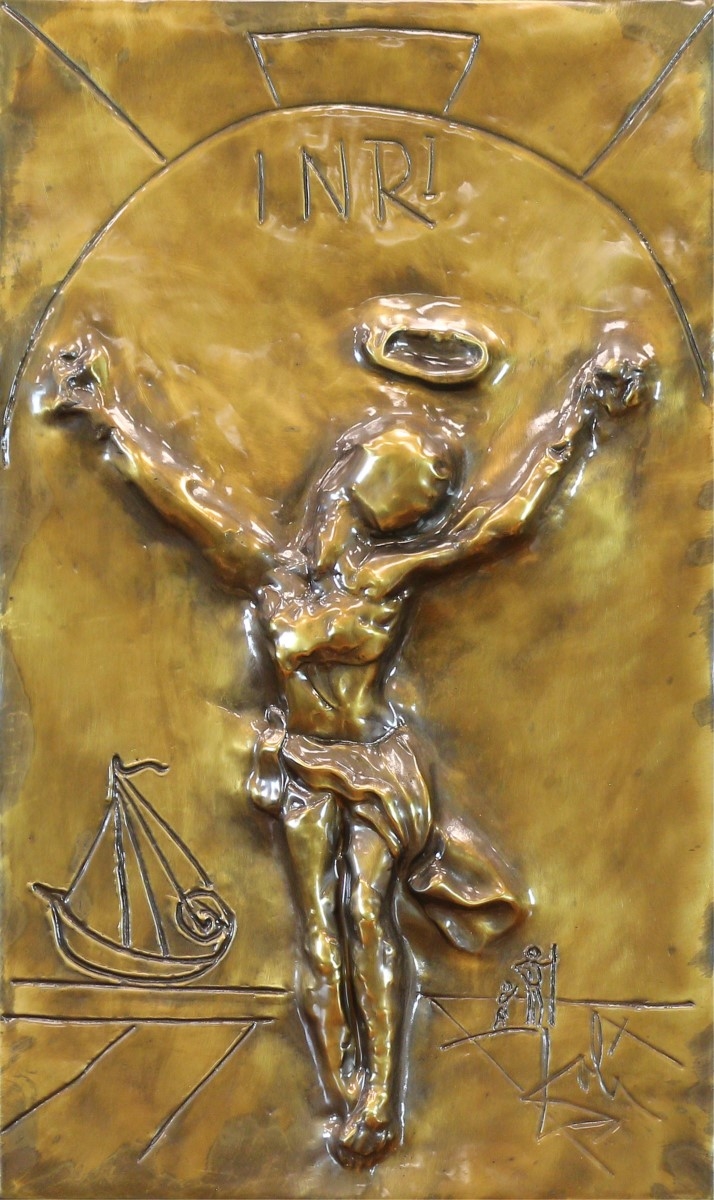
Salvador Dalí, 1904 - 1989
CHRIST OF ST. JOHN OF THE CROSS, 1978
Patinated metal bas relief sculpture
30 x 18 x 2 in. (76.2 x 45.7 x 5.1 cm)
Signed, 99/195.
Private collection

The sculpture is known as the Christ of Saint John of the Cross, because its design is based on a drawing by the 16th-century Spanish friar John of the Cross. The composition of Christ is also based on a triangle and circle (the triangle is formed by Christ's arms; the circle is formed by Christ's head). The triangle, since it has three sides, can be seen as a reference to the Trinity, and the circle may be an allusion to Platonic thought. The circle represents Unity: all things do exist in the "three" but in the four, merry they be. More on  the Christ of Saint John of the Cross

Salvador Domingo Felipe Jacinto Dalí i Domènech, Marqués de Dalí de Púbol (11 May 1904 – 23 January 1989), known professionally as Salvador Dalí, was a prominent Spanish surrealist painter born in Figueres, Catalonia, Spain.

Dalí was a skilled draftsman, best known for the striking and bizarre images in his surrealist work. His painterly skills are often attributed to the influence of Renaissance masters. His best-known work, The Persistence of Memory, was completed in August 1931. Dalí's expansive artistic repertoire included film, sculpture, and photography, in collaboration with a range of artists in a variety of media.

Dalí attributed his "love of everything that is gilded and excessive, my passion for luxury and my love of oriental clothes" to an "Arab lineage", claiming that his ancestors were descended from the Moors.

Dalí was highly imaginative, and also enjoyed indulging in unusual and grandiose behavior. His eccentric manner and attention-grabbing public actions sometimes drew more attention than his artwork, to the dismay of those who held his work in high esteem, and to the irritation of his critics. More Salvador Dalí


Acknowledgement: HAMPEL, IvoryAndArt, and others

Images are copyright of their respective owners, assignees or others

We do not sell art prints, framed posters or reproductions. Ads are shown only to compensate the hosting expenses.

If you enjoyed this post, please share with friends and family.


13 Paintings, scenes from the Bible, by The Old Masters, with footnotes # 33

Circle of Frans Francken
Bible Story, c. 17th C.
Oil on Canvas
53 x 117.2 cm
Private Collection

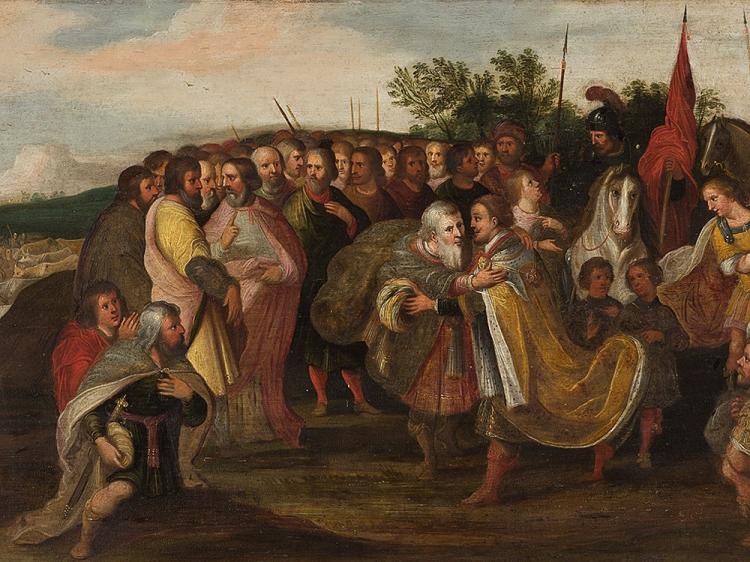
The painting made by the circle of the Flemish painter Frans Francken the Younger, who belonged to the famous painter family Francken, shows presumably the Bible story of Jacob and Esau – with view to an idyllic landscape and animals at the left side of the horizontal format. More

Frans Francken the Younger (Antwerp, 1581 – Antwerp, 6 May 1642) was a Flemish painter and the best-known member of the large Francken family of artists. He played an important role in the development of Flemish art in the first half of the 17th century through his innovations in genre painting and introduction of new subject matter. Francken was born in Antwerp where he trained with his father Frans Francken the Elder. He may also have trained with his uncle Hieronymus Francken I in Paris, together with his brother Hieronymus Francken II. He became a master in the Antwerp Guild of Saint Luke in 1605 and was deacon of the Guild in 1616. More

Workshop of Paolo Veronese
Rebecca at the Well, 16th/17th C
Oil on Canvas
129.5 x 151.5 cm
Private Collection

A depiction of the biblical scene presenting Rebecca and Abraham's servant Eliezer at the well. He offers her a presents to make her become the wife of Abraham's son Issac (1st book of Moses, 24). The artists are presumably the sons of Paolo Veronese They painted the protagonists brighter than the others figures. The painting, which has been family-owned since the 18th century, was in the past presented in Palazzo Sarcinelli in Conegliano.

Paolo Caliari, known as Paolo Veronese (1528 – 19 April 1588) was an Italian Renaissance painter based in Venice, most famous for large history paintings of both religious and mythological subjects, such as The Wedding at Cana and The Feast in the House of Levi. With Titian, who was at least a generation older, and Tintoretto, ten years older, he was one of the "great trio that dominated Venetian painting of the cinquecento" or 16th-century late Renaissance. Veronese is known as a supreme colorist, and after an early period with Mannerist influence turned to a more naturalist style influenced by Titian.

His most famous works are elaborate narrative cycles, executed in a dramatic and colorful style, full of majestic architectural settings and glittering pageantry. His large paintings of biblical feasts, crowded with figures, painted for the refectories of monasteries in Venice and Verona are especially famous, and he was also the leading Venetian painter of ceilings. Most of these works remain in situ, or at least in Venice, and his representation in most museums is mainly composed of smaller works such as portraits that do not always show him at his best or most typical.

He has always been appreciated for "the chromatic brilliance of his palette, the splendor and sensibility of his brushwork, the aristocratic elegance of his figures, and the magnificence of his spectacle", but his work has been felt "not to permit expression of the profound, the human, or the sublime", and of the "great trio" he has often been the least appreciated by modern criticism. Nonetheless, "many of the greatest artists ... may be counted among his admirers, including Rubens, Watteau, Tiepolo, Delacroix and Renoir". More

Adam van Noort (1561/62 – 1641)
Crucifixion, 16th /17th C.
Oil on Canvas
84 x 114 cm
Private Collection

Adam van Noort (1561/62 – 1641) was a Flemish painter and draughtsman and one of the teachers of Peter Paul Rubens. Hewas born and died in Antwerp. Adam van Noort probably initially trained with his father but must have had other teachers as his father died when he was still young. He became a master of the Guild of Saint Luke in 1587. 

Van Noort served as dean of the Guild of Saint Luke from 1597 until 1602. He had problems with the Guild who accused him of poor management of the accounts and misappropriation of materials of the Guild.

Adam’s claim to fame largely rests on the fact that he was the teacher of two of the leading Flemish Baroque painters Peter Paul Rubens and Jacob Jordaens. Rubens only stayed for a little over a year and is not believed to have been influenced much by van Noort's training. More

Pietro della Vecchia (1602/03-1678)
Christ And The Adultress,  17th C.
Oil on Canvas
112 x 148 cm
Private Collection

The present painting depicts the well-known biblical scene ‘Christ and the Adulteress’, derived from the Gospel of John. Here, Jesus contradicts the scribes who had caught a woman in the act of adultery and therefore wanted to stone her to death. The subject belongs to the typical repertoire of the artist.

Pietro della Vecchia (1602/03-1678), also known as Pietro Muttoni or Pietro della Vecchia Muttoni, was the son of a prominent Venetian family. His early works are deeply influenced by Carlo Saraceni and his student, which has led to the assumption that the painter may has initially been trained by them. After a possible short stay in Rome around 1621-22, he was active in the studio of Alessandro Varotari, called Padovanino, around 1625 and first familiarized with the masters of the Venetian Cinquecento, such as Titian and Giorgione. Many works by the artist can be still found in churches in Venice, as well as in important international collections, such as the Kunsthistorisches Museum in Vienna, the Louvre in Paris, the Gemäldegalerie in Dresden and the National Gallery in Dublin. More

Attributed to Caspar de Crayer, (1584-1669) – Flemish
Christ as Man of Sorrows, 17th C.
Oil on Canvas
98.5 x 77.5 cm
Private Collection

Empathic depiction of the suffering Christ crowned with thorns: The painting is characterized by the quality of the painting and the motif since the artist rarely painted portraits. The close approach to Christ and his physiognomy and gestures provide the moving impact of the painting. More

Gaspard de Crayer (1584-1669) was a Flemish painter born in Antwerp and worked in the region, as well as in the Netherlands and in Spain. The artist who is famous for his sacral paintings, his oeuvre contains hundreds of altarpieces painted only rarely profane subjects, such as the lifesize portrait of Philipp IV. king of Spain in the 17th century. Gaspard de Crayer began his education attending the school of Raphael van Coxcie. He was guided by the works of the masters of the Italian Renaissance as well as by those of his contemporary and compatriot Peter Paul Rubens (1577-1640). Later the artist became painter at the court of Philipp IV. De Crayer, joining the important church painters of his time and created a lot of major works of the Counterreformation. More

Pietro Bardellino (1728-1806)
Presentation of the Virgin Mary, c.1780
Oil on Canvas
163 x 150 cm
Private Collection

Shown is a scene from the apocryphal Gospel of James, known as the Presentation of the Blessed Virgin Mary, in which Mary, at the age of three years, was taken by her parents Joachim and Anna to the temple of Jerusalem, where she would be raised and educated by the virgins. More

Pietro Bardellino (1728–1806) was an Italian painter. He was born in Naples, and initially trained by Francesco de Mura. In 1773 he became director of the Accademia Napoletana del Disegno which later became the Royal Academy of Fine Arts in Naples. Bardellino joined with the Rococo movement, influenced by Corrado Giaquinto. He primarily painted religious and mythological themes in oil paintings and frescoes. He frescoed the ceiling of the church of San Giuseppe in Naples. He died in Naples in 1819 More

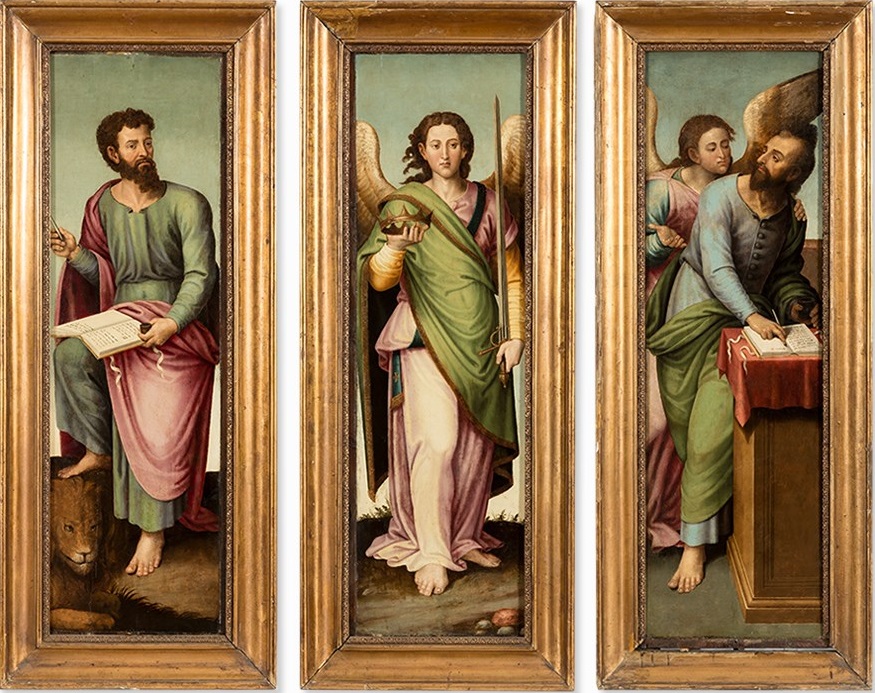
Vicente Joanes (c.1555 - after 1621)
3 Altarpieces, Spain, c.1580
Oil on panel
134 x 43 cm each
Private Collection

The panels featuring the evangelists Matthew and Mark as well as Archangel Gabriel were originally part of the Retablo Mayor created for the parish church of Bocairente in the province of Valencia. It included a total of 26 panels and measured 9 x 5.50 meters. The commission from 6.7.1578 was actually to be executed by Vicente Juan Macip (c. 1500-1579), the father of Vicente Joanes; However, he died shortly after the start of the work. The Retablo is the first documented large commissioned work by Vicente Joanes. It was finished in 1583. More

Vicente Joanes (c.1555 - after 1621) was born in Fuente la Higuera and moved to Boicarente in 1578 to work in the succession of his father at the altar of the parish church. In addition to this work, he also completed works by his father in the Cathedral of Valencia. Vicente Joanes continued the style of his father until the 17th century, ignoring the new naturalistic currents. More

Vicente Juan Masip (1510–1579)
The Last Supper, circa 1562
Oil on panel
Height: 116 cm (45.7 in). Width: 191 cm (75.2 in).
Prado Museum,  Madrid, Spain

Vicente Juan Masip (La Font de la Figuera 1507 – Bocairent 1579) was a Spanish painter of the Renaissance period. He is commonly considered the foremost member of the Valencian school of painters. Born in La Font de la Figuera, he is said to have studied his art for some time in Italy due to Sebastiano del Piombo's influence, with which school his affinities are closest, but maybe he never went to Italy, and he received this influence by the Italian peintures arriving to Valencia. Furthermore, two Italian painters Paolo da San Leocadio and Francesco Pagano, were engaged by cardinal Rodrigo Borgia for painting in Valencia Cathedral. Otherwise, the greater part of his professional life was spent in the city of Valencia, where most of the extant examples of his work are now found. All relate to religious subjects, and are characterized by dignity of conception, accuracy of drawing, beauty of color, and minuteness of finish. He died at Bocairent (near Xàtiva) while working on an altarpiece in the church there.

He never painted a profane subject, and emulated Luis de Vargas and Fra Angelico, in never painting unless he had received holy communion. Painting for him was a solemn exercise, an oratory process, full of prayers and fasts. He never lacked church patronage; the archbishop of Valencia, St. Thomas of Villanova, ordered a set of cartoon panels about the Life of the Virgin to model for some tapestries. He also painted for the churches of the Jesuits, Dominicans, Minims, Augustinians, Franciscans, and for the churches of San Nicolás, Santa Cruz, Carmen Calzado, St Esteban, Corona, Temple, San Andrés, San Bartolomé and San Miguel de los Reyes. More

Abraham Bloemaert (1564-1651)
St. Frederik I., c.1650
Oil on Canvas
125.5 x 96,5 cm
Private Collection

Frederick I was Bishop of Utrecht between 815/816 and 834/838 AD, and is a saint of the Eastern Orthodox Church and Roman Catholic Church.

Frederick was born around 780 in Friesland and was a grandson of the Frisian King Radboud. According to Church records, he died on 18 July 838 but other sources give dates between 834 and 838. In any case it is certain that he was murdered.

At a young age he was taught at Utrecht by the clergy, including Bishop Ricfried. After completing his studies he was ordained priest and put in charge of converting the remaining heathens in the northern areas of the diocese, but also in areas outside of the diocese. It is known that he preached at Walcheren and together with St. Odulfus in Stavoren and its surroundings.

After the death of Ricfried in 815/816, Frederick was chosen as Bishop of Utrecht. He was known for his piety and erudition. He maintained a correspondence with Rabanus Maurus. He was praised for his knowledge and understanding during the synod of Mainz in 829. The hagiographyVita S. Bonifacii has been attributed to him.

It is unclear exactly how Frederick came to an end. It has been established that he was murdered, but by whom and why is unclear. Legend tells that he was stabbed by two men after the offering of the Mass on 18 July 838. According to the 11th and 12th century writers Bishop Otbert of Liège (Passio Frederici) and William of Malmesbury, the killers were hired by Empress Judith, because of Frederick's regular criticism of her dissolute way of life. Later writers like Cesare Baronio and Jean Mabillon write that the inhabitants of Walcheren, who were hostile to Christianity, sent them as a response to Frederick's preaching there.

The latter seems the most plausible. There are no sources of writers of the time showing that the empress was unchaste or immoral, or that Frederick had made that allegation. Moreover, Walcheren was quite hostile to the missionaries from Utrecht.

Shortly after his death, Frederick was canonized. His feast day is 18 July and he is the patron saint of the deaf. He was buried in St. Salvator's Church in Utrecht. More

Abraham Bloemaert (1564-1651) was a Dutch painter and son of sculptor and architect Cornelis Bloemaert received his education in Utrecht and Paris. In 1597 he registered as a citizen in Amsterdam and was active in Utrecht from 1611 onwards. Bloemaert was a representative of the Flemish school and refined history painting, portrait painting, genre and landscape painting. He greatly influenced Dutch painting, one of his students was Gerrit van Honthorst. Bloemaert's works can be admired at the Fine Arts Museums of San Francisco, at the Louvre in Paris and at the galleries of Berlin. More

Venetian School, late 16th C.
Death of Jezebel
Oil on Canvas
84.5 x 73 cm
Private Collection

Dramatic scenery featuring the death of queen Jezebel in a cruel way; presumably painted by an anonymous Venetian painter and follower of Bonifazio Veronese (c. 1487-1553). More

Death of Jezebel. In 2Kgs 9:30-37, Jezebel meets her demise at the hands of Jehu, her own eunuchs, a team of horses, and a pack of dogs—it takes a lot to kill a queen. When she hears of Jehu’s arrival in Jezreel, she arranges her hair and paints her eyes, actions that are often seen as sexually suggestive. However, these acts are those of a proud and powerful queen. She arrays herself in full royal splendor and stands at the window to await the usurper. The idea that these acts are more about political power than sexual seduction is confirmed by her words to Jehu when he arrives at the gate. She throws out a taunt: “Is it peace, Zimri, murderer of your master?” Her reference is to the earlier coup of Zimri, who killed King Elah and all of the other claimants to the throne (1Kgs 16:8-14). Her statement may also be a curse meant to thwart the success of Jehu’s insurrection, since Zimri ruled for only one week before he too became the victim of political violence (1Kgs 16:15-20). Jezebel’s last words are clearly meant not to entice but to deride Jehu; her last beautifying acts can be understood in the same way.

Jehu responds, “Who is on my side?” Responding to his call, Jezebel’s own eunuchs throw her out the window, her blood splattering as she hits the ground. Jehu’s now bespattered horses then trample her. The image of an adorned woman at a window suggests not only royal power but also goddesses (especially Hathor, Asherah, and Astarte), who are also depicted looking out windows. In this way, the death of Jezebel is not just the death of a Phoenician princess who became queen of Israel but also the symbolic death of the goddesses she worships and represents. It is not enough simply to kill her; she must be violently expelled from the political and religious community. More

Venetian school (art). From the later part of the 15th century, Venice had a distinctive, thriving and influential art scene. Beginning with the work of Giorgione (c. 1477–1510), and the workshop of Giovanni Bellini (c. 1430–1516), major artists of the Venetian school included Titian (1489–1576), Tintoretto (1518–1594), Veronese (1528–1588) and the Bassano (1510–1592). Considered to bring a primacy of color over line, this tradition was seen to contrast with the Mannerism then prevalent in the rest of Italy, and the Venetian style is viewed as having had a great influence on the subsequent development of painting. More

EDUARD (Carl Friedrich E.) Holbein (German, 1807-1875)
Ruth and Boaz
Oil on Canvas
54 1/2 x 68in (138 x 172.5cm)
Private Collection

Ruth and Boaz. Ruth was a Moabite woman had come to Israel as the widow of an Israelite man. She had returned with her mother-in-law, Naomi, who had also lost her husband. They lived together in a humble situation, and Ruth would go to the fields each day to glean food in the fields during the harvest.

Boaz was a landowner where Ruth came to find grain. He knew of her situation and told his workers to leave plenty of grain for her to find. Boaz also offered her food with the other workers and encouraged her to work in the safety of his fields throughout the harvest.

Naomi noted that Boaz was a close relative who, according to Jewish law, had the right to marry Ruth after the death of her husband. Naomi encouraged Ruth to go to Boaz in the evening and present herself willing to accept a marriage proposal from him. When she did, he was pleased, yet noted that there was one relative who was closer in line to marry Ruth.

The next day, Boaz met with this relative and presented the situation. The relative turned down the offer as he felt it would cause harm to his own family situation. Boaz then made a commitment in front of the town’s leaders that he would take Ruth as his wife. More

Carl Eduard Holbein (* 1807 in Berlin ; † 19th February 1875 ) was a German painter and illustrator . Holbein was born in 1807 in Berlin. He visited the Berlin Academy and studied, from 1832 to 1839, at the studio of Carl Joseph Begas. From 1851 he taught at the at the Berlin Academy, which appointed him a professor in 1853. In addition, he gave Max Liebermann and Hans von Marées private drawing lessons. At the beginning of the 1850s he painted, together with Karl striker, portraits of the German Emperor in the ceiling medallions in the Medieval hall of the Neues Museum in Berlin. In 1856 he restored, with his brother, the sculptor Friedrich Wilhelm Holbein , the high altar in St. Nikolai in Stralsund . He died on 19 February 1875 in Berlin. More

William Charles Thomas Dobson RA RWS (1817 – 30 January 1898)
The prosperous days of Job
Oil on Canvas
44 x 35in (111.7 x 88.9cm)
Private Collection

The Bible passage referred to in the painting is Job, 42:12-15 when God rewards Job after all his tribulations. "So the Lord blessed the latter end of Job more than his beginning.." Job is depicted at the center of the composition lifting his hands in thanks to the Lord and is surrounded by his generations. More

William Charles Thomas Dobson RA RWS (1817 – 30 January 1898) was an English painter born in Hamburg, the son of the merchant John Dobson, who had married in Germany. The family came to England in 1826, and Dobson was educated in London. He studied in the British Museum, and was taught by Edward Opie. In 1836 he entered the Royal Academy Schools, and was instructed by Charles Lock Eastlake.

Through Eastlake's influence Dobson obtained a post in the government school of design established in the old Royal Academy rooms at Somerset House. In 1843 he became head-master of the government school of design in Birmingham, resigning in 1845, and went to Italy, where he spent most of his time in Rome. Moving on to Germany, he was impressed by the Nazarene school of that time. On returning to England he took up religious painting.

Dobson was elected an Associate of the Royal Academy on 31 January 1860, and an academician in January 1872. He was a member of the Etching Club, founded in 1842. In 1870 he was elected an associate of the Royal Watercolour Society, of which he became a full member in 1875. He remained a constant exhibitor, both at the Royal Academy and at the Royal Watercolour Society, contributing about a hundred and twenty pictures to the former and about sixty to the latter. He was appointed a British juror for the Exposition Universelle, Paris in 1878 and was represented there by 3 watercolours. He became a retired academician in 1895, and died at Ventnor on 30 January 1898. More

Robert Brydall, (1839-1907)
Fairies leading the crusaders
Oil on Canvas
20 x 30in (51 x 76cm)
Private Collection

Robert Brydall, (1839-1907) was a nineteenth century Glasgow-born painter and art historian. Although he spent most of his career in Scotland, he made frequent trips to Italy, as did many of his contemporaries. Brydall was both a student and teacher at Glasgow School of Art. In 1889 he published “Art in Scotland: its Origin and Progress” – the first major text on the subject. The London Quarterly Review characterized Brydall’s book as “one of the best and most interesting histories of art ever written.” 

In 1881, Brydall left the Glasgow School of Art to set up a new private school called St George’s Art School, also in Glasgow. It is unclear when the School ceased operating, but it is believed that he was still running it in 1896.

Brydall was a regular exhibitor at the Royal Glasgow Institute (1862-1907), and the Royal Scottish Academy (1862-1887); in addition, he exhibited in London at the Royal Academy (1906) and the Royal Scottish Society of Painters in Watercolor. His subjects included historical scenes and landscapes. He also showed a number of fairy subjects, including The Elf Dance (RGI, 1871) and Fairy Treasure, (RSA, 1874), and works inspired by Shakespeare’s Midsummer Night’s Dream. More


Acknowledgement: BONHAMS NEW YORKAuctionata

Images are copyright of their respective owners, assignees or others

51 Icons, RELIGIOUS ART - Icons from the Bible, with footnotes, 4

1
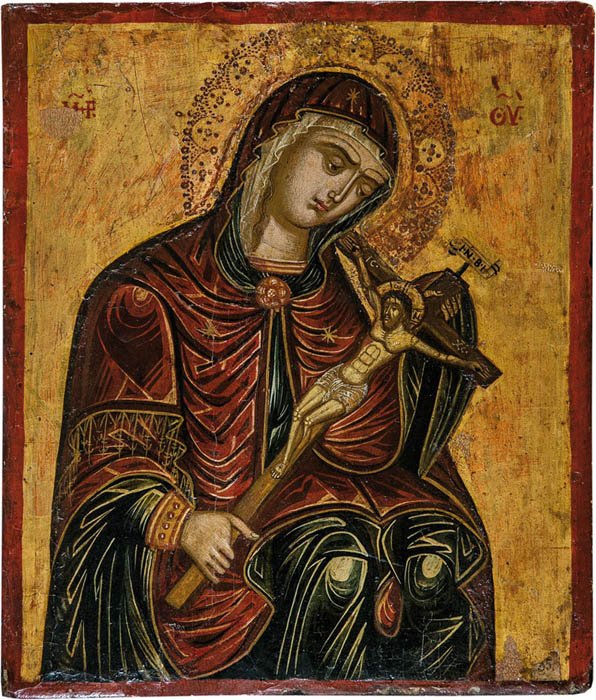
Lady Achtyrskaja (of Akhtyrka), Veneto-Cretan, 17th century. Hardwood single panel, back tiling. Tempera on chalk ground, background gilded, Nimbus hallmarked ornamental. Image-filling representation of the seated Virgin in three-quarter figure,  holding the crucifix with the crucified Christ in her hands. About her green tunic she wears the red maphorion which is contoured by white and black shades.  a western-style transparent head-cover complimented by the traditional maphorion. The halo is finely tooled. 29.5 x 25.5 cm 

Okhtyrka, also known by its Russian variant Akhtyrka, is a small city in Ukraine, a town of Hussar and Cossack Fame. It was also once a regional seat of Sloboda Ukraine and the Ukrainian SSR. It is home to historical and religious places of interest. More

In the town of Akhtyrka, there had long been a parish dedicated to the Protection of the Most-pure Theotokos (The Virgin Mary). In 1739, Fr. Daniel Vasiliev was serving at that church. Once, as he was mowing the grass in his garden he saw an icon of the Mother of God praying before the crucified Lord Jesus Christ, and shining with an indescribable light. In awe, Fr. Daniel carried it into his house. Three years later, while dozing, he dreamt of the Mother of God, and heard her direct that he wash the icon with clean water, and then drape a cover over the icon. The priest did as he was told, intending to later pour the water into the river, he put the water into a container. He again fell asleep, whereby the Most-holy Theotokos said to him: “Keep this water; it will heal all those who suffer from the fever.” The priest had a daughter who suffered with fever. Awaking, he gave her some of the water to drink, and she immediately was healed. 


Thereafter, all those who suffered with fever would run to the Most-holy Theotokos, and as soon as they drank of the water from her icon, would be healed. Recognizing the miraculous signs coming from the icon, the priest took it to his parish church. There the icon shone forth with the power of working miracles. 

One noteworthy miracle was to Elizabeth, the ill wife of General Vedel, who came and fervently prayed before the icon that she might be healed. The next night she saw the Mother of God in a dream, and heard her direction: “You ask in vain for healing from illness. You do not need that. You will soon depart from life. Give all of your possessions to the churches and to the poor. That sacrifice will be for the good of your soul.” The ill one answered, “O Mother of God, I have children, and if I give away my estate, my children will be left in extreme poverty and need.” In response, the Mother of God said, “Do not be concerned for your children. I will be their eternal protectress.” Then, the Mother of God became invisible. Elizabeth, five days later, as told to her by the Mother of God, peacefully reposed. Empress Catherine II, learning of the miraculous protection promised to the children of the late Mrs. Vedel, took her two daughters into her care, and later gave them in marriage, one to Count Palen, the other to Count Chernishev. This miraculous icon used to be in the cathedral church of the town of Akhtyrka, Kharkov province. More

1

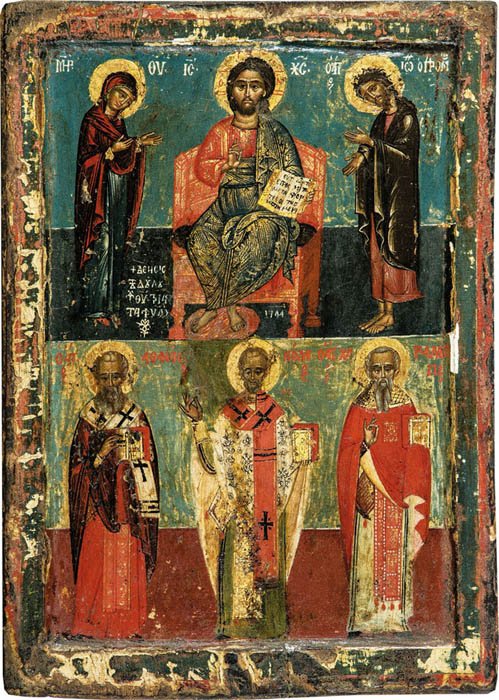
An icon painted in two registers. Greece, 1744 Heavy Softwood single panel. Egg tempera on gesso (gypsum), Konturritzungen, partially gilded. In the upper frame a full figure enthroned Christ flanked by the Virgin Mary and John the Baptist. The underlying three selected saints: St. Athanasius, St. Nicholas and St. Charalampi.... The upper frame is dated '1744' '. Loss of substance in the edge region. 36.4 x 26.6 cm .

Saint Athanasius of Alexandria (c. 296–298 – 2 May 373), was the twentieth bishop of Alexandria (as Athanasius I). His episcopate lasted 45 years (c. 8 June 328 – 2 May 373), of which over 17 were spent in five exiles ordered by four different Roman emperors. Athanasius is a renowned Christian theologian, a Church Father, the chief defender of Trinitarianism against Arianism, and a noted Egyptian leader of the fourth century.


Conflict with successive Roman emperors shaped Athanasius's career. In 325, at the age of 27, Athanasius began his leading role against the Arians as his bishop's assistant during the First Council of Nicaea. Roman emperor Constantine the Great had convened the council in May–August 325 to address the Arian position that the Son of God, Jesus of Nazareth, is of a distinct substance from the Father. Three years after that council, Athanasius succeeded his mentor as archbishop of Alexandria. In addition to the conflict with the Arians (including powerful and influential Arian churchmen led by Eusebius of Nicomedia), he struggled against the Emperors Constantine, Constantius II, Julian the Apostate and Valens. He was known as "Athanasius Contra Mundum" (Latin for Athanasius Against the World). More

Arianism is a nontrinitarian belief which asserts that Jesus Christ is the Son of God, but is entirely distinct from and subordinate to God the Father. Arianism is defined as those teachings attributed to Arius, which are in opposition to current mainstream Christian teachings on the nature of the Trinity and the nature of Christ. It was first attributed to Arius (c. AD 250–336), a Christian presbyter in Alexandria, Egypt. The Arian concept of Christ is that the Son of God did not always exist, but was created by—and is therefore distinct from—God the Father. This belief is grounded in the Gospel of John (14:28) passage: "You heard me say, 'I am going away and I am coming back to you.' If you loved me, you would be glad that I am going to the Father, for the Father is greater than I." More

Saint Nicholas (15 March 270 – 6 December 343), also called Nikolaos of Myra, was a historic 4th-century Christian saint and Greek Bishop of Myra, in modern-day Demre, Turkey). He had a reputation for secret gift-giving, such as putting coins in the shoes of those who left them out for him, a practice celebrated on his feast day―St Nicholas Day (6 December, and thus became the model for Santa Claus, whose modern name comes from the Dutch Sinterklaas, itself from a series of elisions and corruptions of the transliteration of "Saint Nikolaos". His reputation evolved among the faithful, as was common for early Christian saints. In 1087, part of his relics (about half of his bones) were furtively transported to Bari, in Apulia, Italy; for this reason, he is also known as Nikolaos of Bari. The remaining bones were taken to Venice in 1100.

Saint Nicholas is the patron saint of sailors, merchants, archers, repentant thieves, children, brewers, pawnbrokers and students in various cities and countries around Europe. More

Saint Charalambos was an early Christian bishop in Magnesia, a region of Asia Minor. He lived during the reign of Septimius Severus (193-211), when Lucian was Proconsul of Magnesia. It is believed that at the time of his martyrdom in 202, Charalambos was 113 years old.

Charalambos spread the Gospel in that region for many years. However, when news of his preaching reached the authorities of the area, the proconsul Lucian and military commander Lucius, the saint was arrested and brought to trial, where he confessed his faith in Christ and refused to offer sacrifice to idols.

Despite his advanced age, he was tortured mercilessly. They lacerated his body with iron hooks, and scraped all the skin from his body. The saint had only one thing to say to his tormentors: "Thank you, my brethren, for scraping off the old body and renewing my soul for new and eternal life."

More tortures, the legend says, were wrought upon the saint after he was brought to Septimius Severus himself. Condemned to death and led to the place of execution, Charalambos prayed that God grant that the place where his relics would repose would never suffer famine or disease. After praying this, the saint gave up his soul to God even before the executioner had laid his sword to his neck. Tradition says that Severus' daughter Gallina[4] was so moved by his death, that she was converted and buried Charalambos herself. More

1

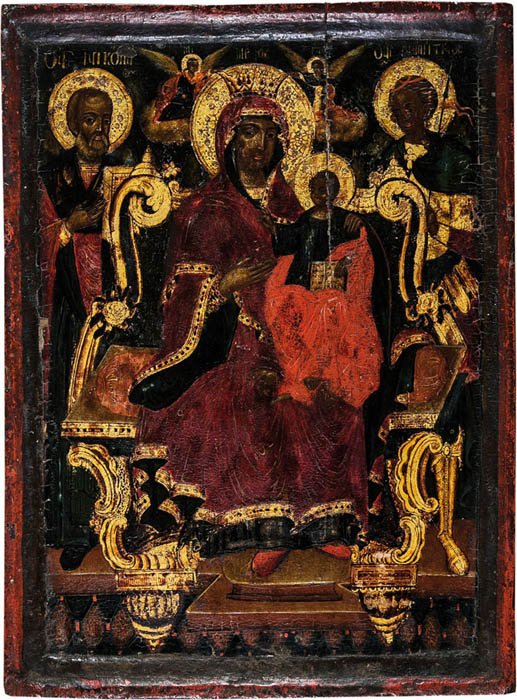
Enthroned Virgin Mary, Greece, 19th century. Wooden single panel. Double Kowtscheg. Tempera on gesso, gold plated. The Mother of God sits on a richly ornamented, gilded throne with the Christ Child on her lap. It is crowned by two angels. In the background St. Nicholas and St. Demetrius. 27.5 x 20.5 cm 

The theme of the Madonna and Child was rare in the first centuries of early Christian art (c. 3rd–6th century). In 431, however, the establishment of Mary’s title of Theotokos (“Mother of God”) definitively affirmed the full deity of Christ. Thereafter, to emphasize this concept, an enthroned Madonna and Child were given a prominent place in monumental church decoration. More

St. Nicholas: See above

Saint Demetrius of Thessaloniki  is a Christian martyr of the early 4th century AD. During the Middle Ages, he came to be revered as one of the most important Orthodox military saints, often paired with Saint George.  In the Roman Catholic church he is most commonly called "Demetrius of Sermium." 

The earliest written accounts of his life were compiled in the 9th century, although there are earlier images of him, and the 7th-century Miracles of Saint Demetrius collection. According to these early accounts, Demetrius was born to pious Christian parents in Thessaloniki, Illyricum in 270. The biographies have Demetrius as a young man of senatorial family who was run through with spears in around 306 AD in Thessaloniki, during the Christian persecutions of Diocletian and Galerian.

St. Demetrius was initially depicted in icons and mosaics as a young man in patterned robes with the distinctive tablion of the senatorial class across his chest. Miraculous military interventions were attributed to him during several attacks on Thessaloniki, and he gradually became thought of as a soldier: a Constantinopolitan ivory of the late 10th century shows him as an infantry soldier (Metropolitan Museum of Art). But an icon of the late 11th century in Saint Catherine's Monastery on Mount Sinai shows him as before, still a civilian. More


1


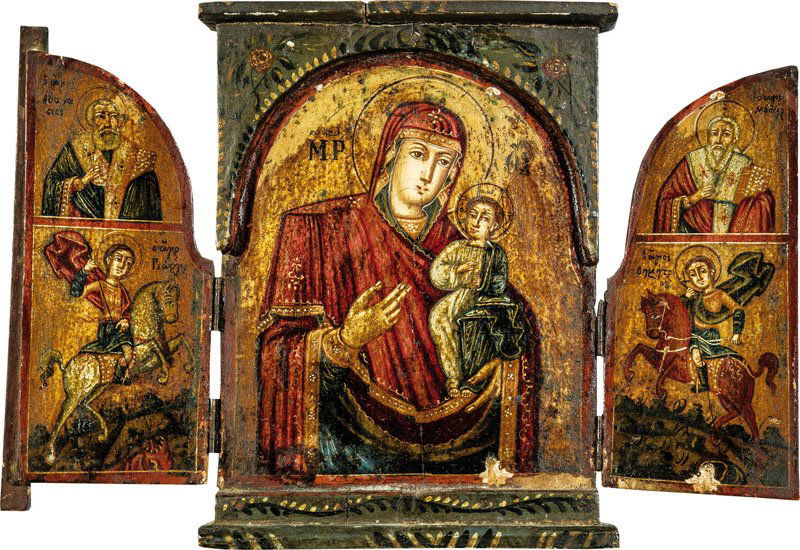
Triptych Greece, 18th century. Hardwood, egg tempera on gesso, partial gilding. The central frame with the Mother of God holding the Christ child in her right hand. Wings with two registers. Side wings with two registers: St. George the Dragon Slayer and the Holy Dimitrius. Garments mainly in red and green.  31 x 44 (unfolded)

A triptych ("three-fold"),  is a work of art (usually a panel painting) that is divided into three sections, or three carved panels that are hinged together and can be folded shut or displayed open. It is therefore a type of polyptych, the term for all multi-panel works. The middle panel is typically the largest and it is flanked by two smaller related works, although there are triptychs of equal-sized panels. The form can also be used for pendant jewelry. More

Saint George (AD 275–281 to 23 April 303) was a soldier in the Roman army who later became venerated as a Christian martyr. His parents were Christians of Greek background; his father Gerontius was a Roman army official from Cappadocia and his mother Polychronia was a Christian from Lydda in the Roman province of Syria Palaestina. Accounts differ regarding whether George was born in Cappadocia or Syria Palaestina, but agree that he was raised at least partly in Lydda. Saint George became an officer in the Roman army in the Guard of Diocletian, who ordered his death for failing to recant his Christian faith.


In hagiography, Saint George is one of the most venerated saints.  He is immortalized in the myth of Saint George and the Dragon and is one of the Fourteen Holy Helpers), and is regarded as one of the most prominent military saints. More

Saint Demetrius of Thessaloniki: See above


1


Large-sized icon with the Virgin Hodegetria Romania, circa 1800 Softwood single board with two back side Sponki. Tempera on gesso. Full-length depiction of the Virgin Mary carrying the Christ child in her left arm. Christ holding a globe in his left hand. They are flanked by two monks blessing them, including St. login.  53 x 44 cm

Wooden Icons were likely to warp. Slats inserted in the back to prevent warping, and that name is SHPONKI.  One usually finds two SHPONKI, one coming in from either side toward the center, but occasionally just one SHPONKA

Gesso, from the Latin gypsum, is a white paint mixture consisting of a binder mixed with chalk, gypsum, pigment...

A Hodegetria (literally: "She who shows the Way"; or Virgin Hodegetria, is an iconographic depiction of the Theotokos (Virgin Mary) holding the Child Jesus at her side while pointing to Him as the source of salvation for mankind. In the Western Church this type of icon is sometimes called Our Lady of the Way.

The most venerated icon of the Hodegetria type, regarded as the original, was displayed in the Monastery of the Panaghia Hodegetria in Constantinople, which was built specially to contain it. Unlike most later copies it showed the Theotokos standing full-length. It was said to have been brought back from the Holy Land by Eudocia, the Empress of Theodosius II (408–450), and to have been painted by Saint Luke. The icon was double-sided, with a crucifixion on the other side, and was "perhaps the most prominent cult object in Byzantium".

The original icon has probably now been lost, although various traditions claim that it was carried to Russia or Italy. There are a great number of copies of the image, including many of the most venerated of Russian icons, which have themselves acquired their own status and tradition of copying.

Luke the Evangelist is one of the Four Evangelists/authors of canonical Gospels of Jesus Christ. Luke was a native of the Hellenistic city of Antioch in Syria. The early church fathers ascribed to him authorship of both the Gospel according to Luke and the book of Acts of the Apostles, which originally formed a single literary work, referred to as Luke–Acts.

The New Testament mentions Luke briefly a few times, and the Pauline epistle to the Colossians refers to him as a doctor; thus he is thought to have been both a physician and a disciple of Paul. Christians since the faith's early years have regarded him as a saint. He is believed to have died a martyr, although accounts of the events do vary.

The Roman Catholic Church and other major denominations venerate him as Saint Luke the Evangelist and as a patron saint of artists, physicians, surgeons, students and butchers. More


St. login: I could not find any information about this Saint!

Aelia Eudocia Augusta] (c. 401–460) was the wife of Theodosius II, and a prominent historical figure in understanding the rise of Christianity during the beginning of the Byzantine Empire. Eudocia lived in a world where Greek paganism and Christianity were existing side by side with both pagans and unorthodox Christians being persecuted.[1] Although Eudocia's work has been mostly ignored by modern scholars, her poetry and literary work are great examples of how her Christian faith and Greek upbringing were intertwined, exemplifying a legacy that the Byzantine Empire left behind on the Christian world. More


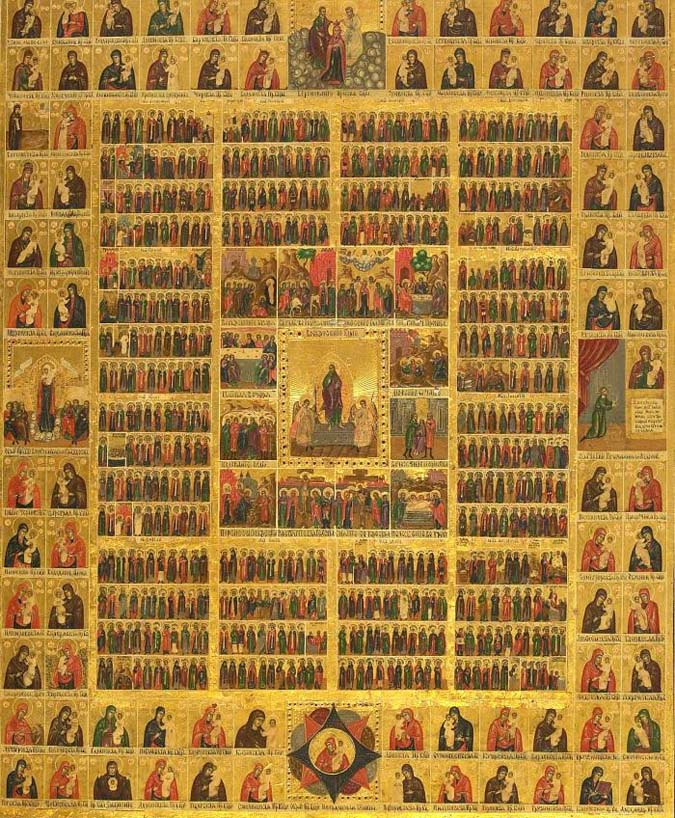
Icon of Chetyi-Minei (calendar of saints). In the very centre is the Resurrection of Christ surrounded by scenes from Holy Week and the feasts of the Paschal cycle. Around them are twelve groupings of saints: one for each month of the calendar year. In the border are icons of the Theotokos (Mother of God), each of which has a feast day during the liturgical year.

The Eastern Orthodox Liturgical Calendar describes and dictates the rhythm of the life of the Eastern Orthodox Church. Associated with each date are passages of Holy Scripture, Saints and events for commemoration, and many times special rules for fasting or feasting that correspond to the day of the week or time of year in relationship to the major feast days.

Three-level composition for the traditional XVI-XVII centuries. The upper tier - Christ in Majesty sitting with Virgin and John the Baptist, accompanied by a host of angels. The following is presented in two tiers of saints. In the middle tier, under the image of the Savior - A Hetoimasia/Throne, carried by two angels. Saints are divided into ten faces, six in the bottom row and four on middle. The pommel of the centerpiece depicts the Holy Trinity (Old Testament), the Cherubim and Seraphim.  - the Annunciation. Below, on the wings of three series of 12 stamps holidays (from left to right, with the left wing to the right): Christmas, Candlemas; Epiphany, the Transfiguration; Entry into Jerusalem, Raising of Lazarus; Crucifixion, Deposition from the Cross; Resurrection, the Ascension; Doubting Thomas, Descent of the Holy Spirit. The iconography of the traditional holidays, the options applied with a small number of figures. Painting on the centerpiece, and the wings is different in style and probably at runtime. On the wings, which could be written in the second quarter, and in the middle of the century, the surface of the painting is dense, enamel, both in Moscow painting 1640s .; Slides are typical for the second quarter of the XVII century. At the centerpiece of the letter fairly planar, graphically modeling, Linear. Private with a monochrome, slightly lightening ohreniem. 

VM Sorokaty


Hodegetria Balkans, 19th century. Hardwood single panel. Tempera on  ground chalk, gilded background . Image-filling representation of The God Mother showing half-length with Christ in her left arm. He is blessing and holding a scroll in his right arm. Framed. Losses. 26.5 x 20 cm

A Hodegetria (literally: "She who shows the Way"; or Virgin Hodegetria, is an iconographic depiction of the Theotokos (Virgin Mary) holding the Child Jesus at her side while pointing to Him as the source of salvation for mankind. In the Western Church this type of icon is sometimes called Our Lady of the Way.

The designation of Hodegetria or “She Who Points the Way” did not originate from Mary’s gesture toward her son. Instead, it refers to the famous prototype of the miraculous icon of the Virgin—the model for all other icons of this type—belonging to the Hodegon Monastery of Constantinople.

No evidence exists for the Hodegon Monastery, or any Hodegetria icons, before the Byzantine iconoclastic controversies of the 700s and early 800s.

The Virgin Hodegetria came to prominence in the early 11th century, triggering the creation of a myth that linked its origin with the early history of Byzantium. As a way of supporting the legitimacy of icon veneration during the Iconoclasm (controversies that barred the production and use of figural images, spanning roughly a century  726–87 and 815–43) this specific icon was said to trace back to a mid-8th-century legend of a portrait of Mary painted during her lifetime by the Apostle Luke. By claiming the involvement of the hand of the evangelist, the legend around the Hodegetria was fabricated, evidence for the apostolic origins and divine approval of images. More


1

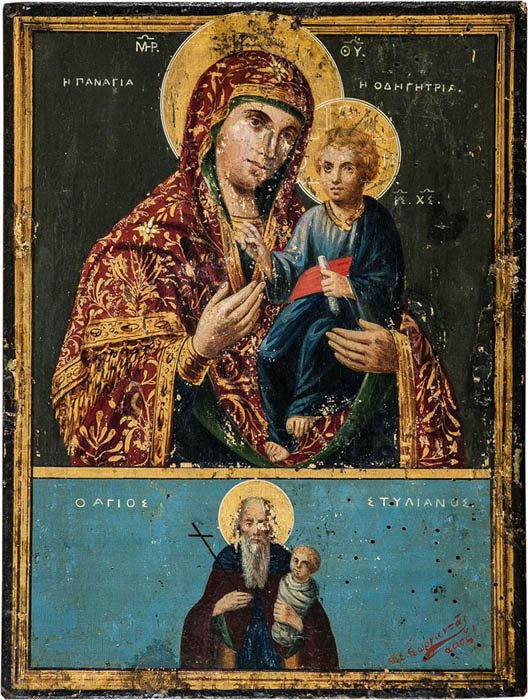
Signed two fields icon, Balkan, dated. 1877 Walnut board with two back side Sponkis. TeA signed icon painted in two registermpera on gesso. The upper frame shows the Hodegetria. The Blessed Mother in half figure carries the Christ child in her left arm. With her ​​right hand she has her son, who holds a scroll, he raises his right hand in a blessing gesture. The maphorion of the Mother of God is rich with Chrysographie. In the lower frame half-length depiction of the Saint Stylianos of Paphlagonians, the patron saint of children. Signed '' Georgantas (?) '' And dated. Berieben. 34.5 x 26 cm.

Maphorion: a garment covering the head and shoulders, mentioned in papyri of the 4th–6th Century

Chrysographie: a technique used in manuscripts, letters, or painted objects (crowns, nimbuses) where a gold tincture has been designed. In the early Middle Ages were also writings held exclusively in gold letters in both the Byzantine and the Western culture. These fonts are also calledCodex Aureus . In the High Middle Ages, the use of gold was reduced and limited mostly to larger initials.

Saint Stylianos was born during the 6th century in Adrianopolis (in modern day Turkey) into a very wealthy family. At a young age, Stylianos joined the hermits of the desert with a view toward cleansing his soul and pledging his life to Jesus Christ. Unlike most other hermits, however, he did not withdraw from society altogether, preferring to occasionally go among the people for whatever good he might do.

According to the church tradition, one night while he prayed, Stylianos felt a divine presence of the Holy Spirit. The next day, with a spirit of exultation and serenity he had never known before, he started his customary rounds, wherein he counselled and comforted, he felt compelled to place his hand on a stricken child, something he had not up to that time dared to do; he felt the power of the Lord being transferred to the ailing youngster through his extended arm. The child immediately recovered, and thenceforth Stylianos was sought after by every suffering soul for miles around, young and old. His cave became a magnet for the sick and suffering, many of whom received complete cures.

During this period, Stylianos concerned himself primarily with children, not just the physically afflicted but also with those who were in need of spiritual guidance. Families from all walks of life were said to have entrusted to Stylianos the enlightenment of their children, and he was forced to seek out larger headquarters and to recruit from the ranks of his hermit friends the assistance needed to tend to so many. His was probably the first day-care centre in the world, where mothers could safely leave their children while tending to other matters of the home.

Stylianos was to become the patron saint of children yet to be born, owing to stories of his miraculous intercession for a young woman who helped him with children but could bear none of her own. When the woman conceived, her husband out of sheer joy spread the word of this miracle, and before long many barren women came to the great hermit. More
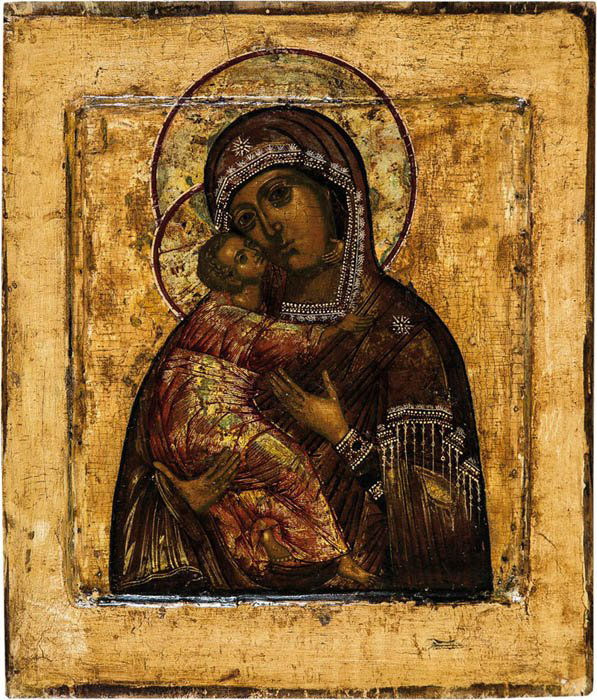
1

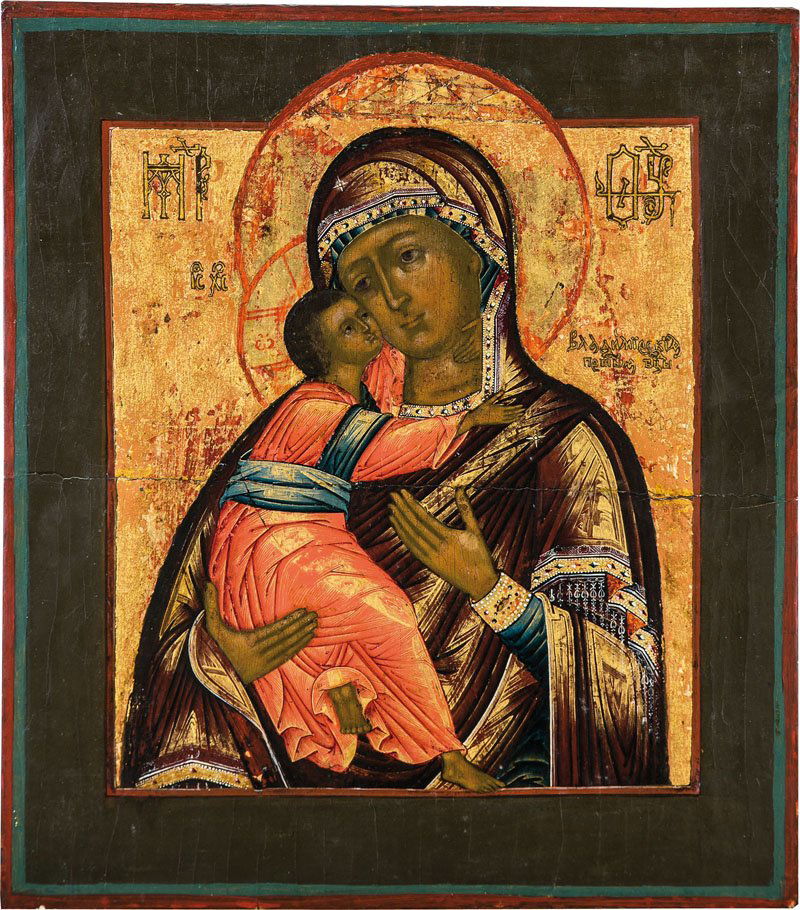
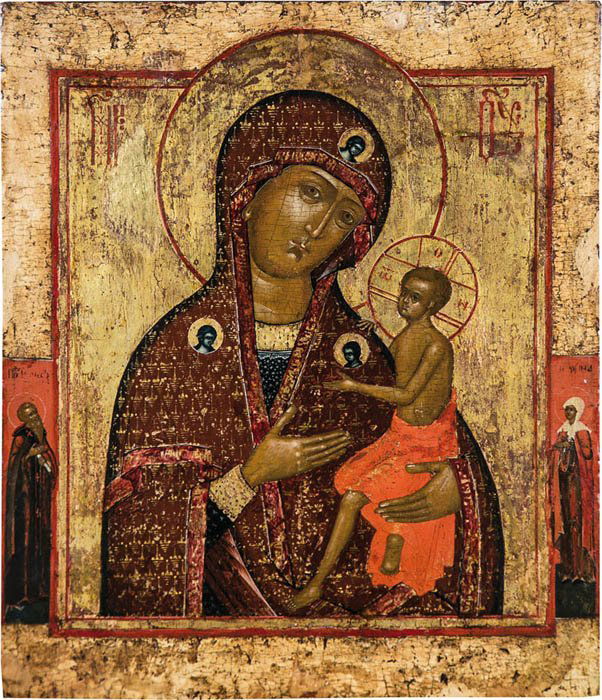
Mother of God Vladimirskaya, Central Russia, mid-18th century. Hardwood single panel with two Sponki (lost). Kowtscheg, tempera on chalk ground on canvas, Assist Gold and gold dispersion. Border and the background is exposed. Half-length, frontal representation of Mother of God, holding the Christ Child on her right arm. Christ pressed his cheek against his mother and hugs her tenderly. The dark maphorion of the Blessed Mother and the folds of the chiton of the Christ Child are in fine Assist gilding. 31.3 x 28.6 cm

Maphorion: garment covering the head and shoulders, mentioned in papyri of the 4th–6th Century

Chiton: a long woollen tunic worn in ancient Greece.

Mother of God Vladimirskaya: The Mother of God of Vladimir, also known under the name of Our Lady of Vladimir, Virgin of Vladimir Vladimirskaya, Our Lady of Vladimir, Our Lady of Tenderness, The Lady Who Saves Russia, is one of the icons orthodox most revered in Russia. The Theotokos (Greek Theotokos: Marie) is considered the patron saint of Russia.

The miraculous image given the title, Our Lady of Vladimir, is known as an Eleousa,the Greek word meaning, Mother of Tenderness. The Christ Child nestles tenderly close to his mother, he gazes at her and is so closely linked to her that his left arm embraces her fully. His right hand gently touches her left cheek. The original image is a large painting of the type known as the St. Luke icons. Mary looks out at the people. Yet, there is no doubt that she is intimately united to her Divine Son.

The origin of the ancient Marian icon, Our Lady of Vladimir, can be traced back to 1125. The oldest known representation of Our Lady of Vladimir  was commissioned in Constantinople by a Russian, who then had the painting taken from city to city during the period of united Ukranian-Russian history. In 1169, Duke Andrej Bogoljubskij had the icon brought from Kiev to the new cathedral of Vladimir. Due to the honor and reverence of the people, who attributed gracious assistance to Our Lady's help throughout the Ukraine, a large cathedral was built for her in Vladimir.


When the Mongol invasion threatened Moscow in 1395, the original icon was brought to Moscow, where she was honored as the unconquerable shield of the Russian people. Important state transactions took place before her image; her blessing was sought before battle. In time, Our Lady of Vladimir became the sign of the Russian Orthodox Church. More

Vladimir  is a city in Russia and the administrative center of the oblast Vladimir. Vladimir is part of the Golden Ring of ancient Russia around Moscow.
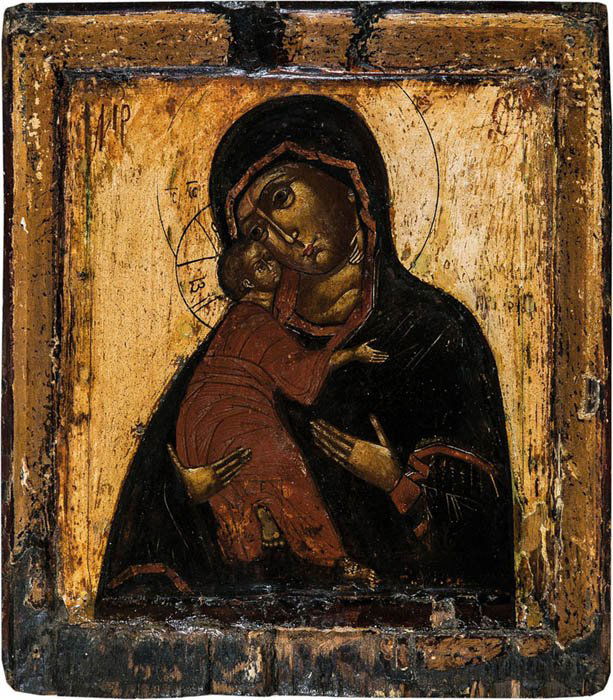
1

Our Lady of Vladimir (Vladimirskaya) Mother of God, Russia, 17th / 19th Century. Hardwood single board with two back side Sponki (lost). Double Kowtscheg (Ark), tempera on groundchalk . Background and border uncovered. Field used later in old board. Verso Cyrillic labels (scratched). Presentation of the The Mother of God shown in half-length with Christ in her right arm. Christ touching his cheek to his Mother's face. Border with losses. Almost Completely restored. . Field largely in the 19th century. Revised. Rand strong substance losses. 31.5 x 27.5 cm

Description: See Above

1

Hodegetria (Smolenskaya) Russia. 17C. Hardwood single board with two back side Sponki. Double Kowtscheg, Tempera exposed on chalk ground, background and border. Half-length depiction of the Virgin Mary with the Christ child in her left arm. With her ​​right hand she has him. He holds a scroll in his left hand. Edge dam. Rest. 31.5 x 27.5 cm The Mother of God Hodegetria (Smolenskaya). Russia, 17th century. Tempera on gesso on wood panel with double-Kovcheg. Background and Border stripped to gesso. Painted traditionally. Border damaged. Restored. 31.5 x 27.5 cm.

1

Our Lady of Kazan Russia, Black Madonna of Kazan18th century. Hardwood single board with two back side Sponki (lost). Tempera on gesso (plaster). Brustbildnis (half-lengthportrait) of the Virgin with the Christ Child standing on her left. He raises his right hand in a blessing gesture. Driven, engraved and gilded Metall oklad with floral decor. 31 x 28 cm

Kazan is the capital and largest city of the Republic of Tatarstan, Russia. It is the eighth most populous city in Russia, and lies at the confluence of the Volga and Kazanka Rivers in European Russia.

Our Lady of Kazan, Black Madonna of Kazan (so-called both because of the often dusky color of their skin (in some cases, after cleaning, attributed to the accumulation of generations of soot from candles burnt under the images) and because in many cases they were either excavated from underground ruins or were originally worshipped in underground caverns, perhaps due to Marian persecutions). The history of the convent of Our Lady of Kazan is inseparably linked with finding, glorifying and honoring the mira­cle-working icon of Our Lady of Kazan in Russia. This icon is one of the most honored and esteemed in the Russian Church.

At the beginning of July, 1579 there was a conflagration in Kazan, the capital of Tatarstan. The fire enveloped quite a district that joined the Kremlin's north­east. The yard of Danila Onuchin, the strelets sotnik (Russian light infantry command of a hundred men in Age of Empires), were burned down. Many families had lost their homes, and had to rebuild  before the Russian winter would come. Among those people trying to restore their homes was Daniel Onuchin. He had a daughter Matrona, nine years old.

The Mother of God appeared in a dream to Matrona and commanded her to find Her icon, hidden in the ground by secret confessors of Orthodoxy, in the time of Moslem rule. Thrice the Mother of God appeared and pointed out the spot, where the wonder working icon had been concealed. Finally, Matrona, with her mother began to dig in the indicated place and they found the sacred icon. To the place of the miraculous discovery came archbishop Jeremii at the head of his clergy and transported the holy image into a church of Saint Nicholas situated nearby; then,  amidst a church procession they transferred it to the Annunciation cathedral – the first Orthodox temple in the city of Kazan, erected by tsar Ivan the Terrible. During the procession there occurred the healing of two blind men – Iosif and Nikita.

Tsar Ivan the Terrible gave orders to build at the place of its appearance a temple in honour of the Kazan Icon, and to found there also a women's monastery. Matrona and her mother, instrumental in finding the sacred icon, accepted monastic tonsure at this monastery.

Invocation of the Virgin Mary through the icon was credited to the Russian commanders, Dmitry Pozharsky and Mikhail Kutuzov, with helping the country to repel the Polish invasion of 1612, the Swedish invasion of 1709, and Napoleon's invasion of 1812.

On the night of June 29, 1904, the icon was stolen from the church in Kazan where it had been kept for centuries (the cathedral was later blown up by the communist authorities). Thieves apparently coveted the icon's gold frame. The Orthodox Church interpreted the disappearance of the icon as a sign of tragedies that would plague Russia after the image of the Holy Protectress of Russia had been lost. Indeed, the Russian peasantry was wont to credit all the evils of the Revolution of 1905, as well as Russia's defeat in the Russo-Japanese War, to the desecration of the image. More

Vladimir Putin ordered that the Black Madonna of Kazan, the holiest icon of the Russian Orthodox Church, be flown over the Black Sea, many believed he wished to secure blessings for the Winter Olympics in Sochi.
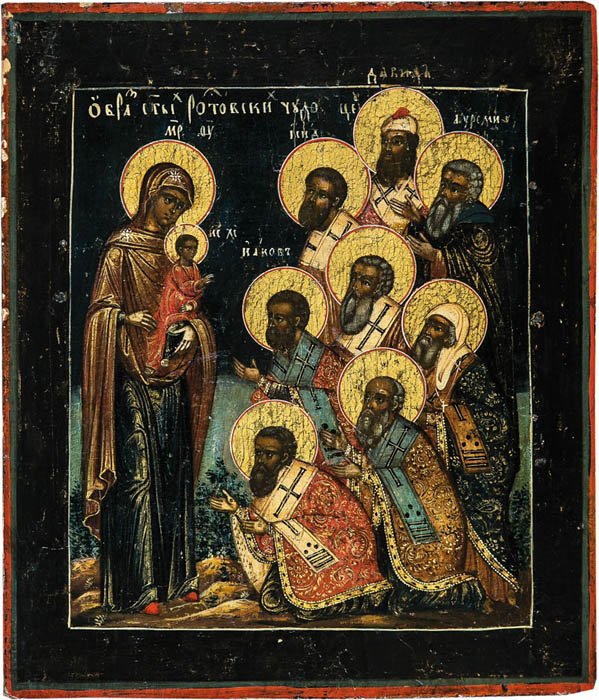
1

Our Lady of Rostov Russia, early 18th century. Softwood single table with two top-side Sponki. Egg tempera on gesso. On the left side full-length depiction of the Virgin Mary, holding the Christ Child in her arms. To the right, Eight Saints Represented full-length in the Episcopal vestments making a gesture of supplication included Isaiah, Leontius and Ignatius. 31 x 27 cm.

Rostov  is a town in Yaroslavl Oblast, Russia, one of the oldest in the country. It is located on the shores of Lake Nero

Saint Isaiah of Rostov (fl. 1062 – died 1089 or 1090) was a Russian Christian missionary and bishop. Isaiah was born near Kiev. He was tonsured at Kiev Pechersk Lavra, and became abbot of Saint Dmitry's Monastery. In 1077, he became the second bishop of Rostov. As Christianity was not yet well established in the area, he spent his tenure converting pagans, destroying idolatry and encouraging the spread of Christianity.

St Leontius the Bishop and Wonderworker of Rostov. A Greek from Constantinopole, Leontius became a monk at the famous Monastery of Caves in Kiev (Ukraine). He was first monk of this house to become a bishop when he was appointed to Rostov (Yaroslavsk) in 1501. Although persecuted by the pagans, he became their apostle. Reputed to have had a gift of miracles, he did not escape death at their hands; however, this was from the ill-treatment he received rather than by formal sence of death. Leontius was the first martyr who was also a priest (heiromartyr).

St Ignatius the Bishop and Wonderworker of Rostov. Saint Ignatius was Bishop of Rostov, and shepherded his flock for twenty-six years. After his death on May 28, 1288, his body was broght to the church. Some people saw him leave his coffin, and float in the air above the church. He blessed the people and the city, then went back to his coffin.


The Saints of Rostov: Archimandrite Abraham the wonderworker (October 29, 1073-1077) Prince Basil (+ 1238) Metropolitan Demetrius (+ October 28, 1709 and September 21) Bishop Ignatius (+ May 28, 1288) Monk Irenarchus the Hermit (+ 1616) Bishop Isaiah, wonderworker (+ May 15, 1090) Blessed Isidore, Fool-for-Christ (+ 1474) Bishop James (+ November 27, 1391) Blessed John of the Hair-Shirt (the Merciful), Fool-for-Christ (+ 1580) Bishop Leontius (+ May 23, 1073) Peter, Tsarevich of Ordynsk (+ 1290) Archbishop Theodore (+ November 28, 1394) Yaroslav Wonderworkers: Princes Basil (+ 1249), Constantine (+ 1257), Theodore (+ 1299) and his sons David (+ 1321) and Constantine (XIV) Pereslavl Wonderworkers: Prince Alexander Nevsky (+ 1263) Prince Andrew of Smolensk (15th c.) Monk Daniel the Archimandrite (+ 1540) Monk Nikita the Stylite (+ 1186) Uglich Wonderworkers: Monk Cassian (+ 1504) Tsarevich Demetrius (+ 1591) Monk Ignatius of Lomsk (+ 1591) Monk Paisius (+ 1504) Prince Roman (+ 1285) Poshekhonsk Wonderworkers: Hieromartyr Adrian (+ 1550) Monk Gennadius of Liubimograd and ostroma (+ 1565) Monk Sebastian (+ 1542) Monk Sylvester of Obnora (+ 1379)


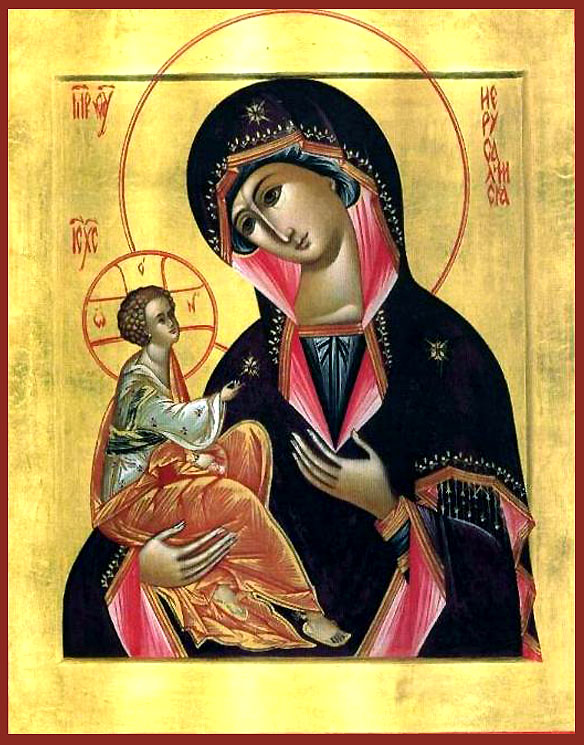
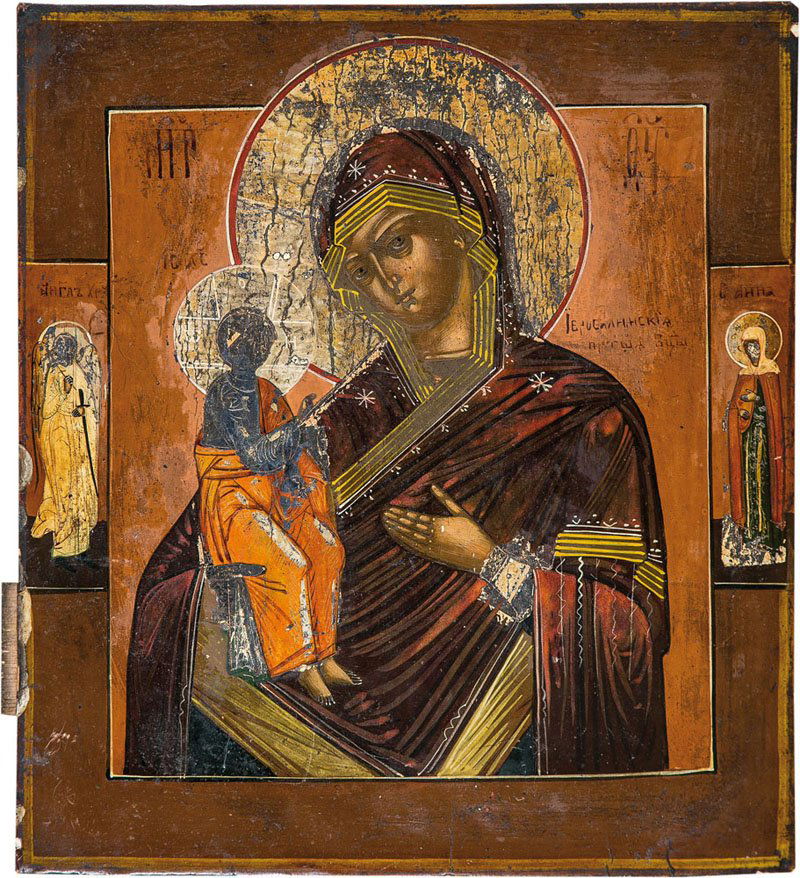
The Jerusalem Icon of the Mother of God, by tradition, was painted by the holy Evangelist Luke fifteen years after the Ascension of the Lord at Gethsemane.

In the year 463, the icon was transferred to Constantinople. The Byzantine army carried the Jerusalem Icon into battle when they turned back an invasion of the Scythians. In 988 the icon was transferred to Korsun and given to the holy Prince Vladimir. When the people of Novgorod accepted Christianity, St Vladimir sent them this icon. In 1571, Ivan the Terrible transferred the icon to the Moscow Dormition cathedral. During the Napoleonic invasion of 1812, the original was stolen by the French and brought to Paris. An authenticated copy was placed in the Dormition cathedral.

The Jerusalem Mother of God Icon

This Jerusalem Mother of God Icon comes from about the middle of the 19th century and, according to people who have seen the Holy Virgin, including elder Paisios the Athonite, it resembles more than any other icon the Holy Mother of God. A comparison with the Cappadocian Icon, next, is very interesting for the similarity of the two, with the Byzantine being, as always, more spiritual and symbolical, and the Jerusalem icon, influenced by the western type of painting, tending to seem rather like a photo. Yet it is obvious that both hagiographers refer to the same person, young, with big eyes and eyebrows, long nose, intense lips.. More

According to Holy Tradition this miraculous icon was painted through the revelation of the Holy Theotokos to a nun named Tatiana from the Holy Monastery of St. Mary Magdalene, around 1870 AD. In 1870, there lived a monastic iconographer called Tatiana. One night, a lady appeared to her in a vision saying, "Sister Tatiana, I have come so that you can paint me." Tatiana replied, "Let it be, Blessed Sister; however, I am an iconographer and not a painter." The lady replied, "... well then, you should paint me using your iconographic style." Sister Tatiana was furious with the boldness of this lady's response and said, "I do not have any plank of wood to use." The lady then gave her the plank of wood the sister would need and told her to "paint." In obedience to her guest, the sister started her iconography. Sister Tatiana glanced at her guest, and she noticed the guest's appearance transfigure in front of her. The lady's mantle started to turn into gold and her face was glowing intensely. This change in the appearance of the lady worried Tatiana but the lady spoke to her, saying: "O Blessed Tatiana, you are the only person, after the Apostles and the Evangelist Luke, to have this opportunity to write an icon of me again." Sister Tatiana then realised that she was in the presence of our Holy Mother the Theotokos. In shock she awoke from her vision. She immediately went and informed her Mother Superior of the vision in detail. The abbess did not believe in the story but told her to go to sleep and the following day she could paint an icon of the Panagia with her blessing. Tatiana returned to her cell and before entering she noticed a bright light shining through the door. She hastened to the abbess, once again, to bring her to her cell to witness this light and understand that she was not lying about the visions. Together they returned to Tatiana's cell. Inside, they could smell a beautiful and heavenly fragrance and the light was so bright that only then did they realise that the aroma and the light were coming from an icon of the Virgin Mary. The mysterious and miraculous appearance of the icon had the sisters in shock but our Holy Mother the Theotokos appeared once more to Tatiana and said, "Now take me from here down to my home in Gethsemane of Jerusalem." This is what the abbess and the sister did. In iconography, this is termed "acheiropoieto" (Gr. an image not painted by hands) and is now located exactly where the Panagia wanted it to be, in her "home," her final resting place at her holy tomb in Gethsemane. The name "Ierosolymitissa" has since been adopted since it means the Most Holy Lady from Jerusalem and is extremely miraculous. More


Mother of God, Buckle Church in Cappadocia. This icon comes from a Byzantine church in Cappadocia, known as church of the buckle (tokali kilise), the largest church in the area. The main nave contains ninth century frescoes in “provincial” style, the more recent additions are three apses of 11th century frescoes, in “metropolitan” style. More
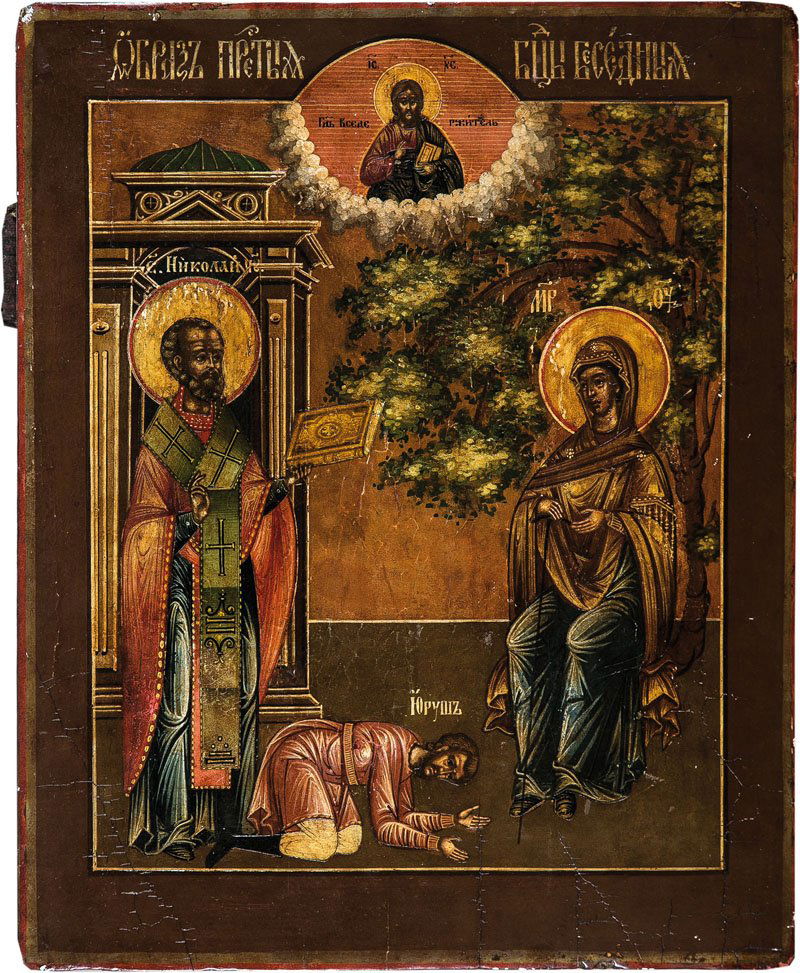
1

The Besadnaja Mother of God. Russia, 18th century.  Hardwood single board with two back side Sponki. Tempera on gesso, Konturritzungen. In the right frame, the Mother of God is depicted sitting in front of a tree. Before her kneels Jurij. Behind him is the blessing Nicholas, stretches of the Gospel toward the Mother of God, in front of an architectural backdrop. God the Father appears on a cloud bank at the top of the screen. Verso Cyrillic inscriptions. 30.5 x 25.5 cm

Sveti Jurij is a village in the Municipality of Grosuplje in central Slovenia. The area is part of the historical region of Lower Carniola.

Sveti Jurij is also known locally as Šent Jurij (Št. Jurij). The name of the settlement was changed from Sveti Jurij pri Grosupljem (literally, 'Saint George near Grosuplje') to Podtabor pri Grosupljem (literally, 'below the fort near Grosuplje') in 1952. The name was changed on the basis of the 1948 Law on Names of Settlements and Designations of Squares, Streets, and Buildings as part of efforts by Slovenia's postwar communist government to remove religious elements from toponyms. The name Sveti Jurij was restored in 1992. More

Saint Nicholas; also called Nikolaos of Myra, was a historic 4th-century Christian saint and Greek Bishop of Myra, in Asia Minor. Because of the many miracles attributed to his intercession, he is also known as Nikolaos the Wonderworker. More 
1

Our Lady of Arabia (Arabskaja) Russia, in 1800 Hardwood single table with two top-side Sponki. Kowtscheg, tempera on chalk ground, background gold-plated, exposed edge, Konturritzungen. Image-filling representation of the Blessed Mother in half figure. She holds the Christ Child in her left hand. The child is shown dressed without undergarment only in a red chiton. To the viewer it shows his right bare sole. Instead of the usual three star maphorion the Mother of God is busy with three angels' heads. The hem of Maphorions is peripherally decorated with an inscription. Loss of substance. 35 x 30.5 cm The Mother of God Arapet (Arabian). Russia, circa 1800. Eggtempera on gesso on wood panel, gilded background, border stripped. The icon Represents the Virgin waist-length with the hands slightly supporting the Child by the arm. His arms resting on the Virgin's breast, as if to embrace Her. The Virgin dressed in a dark maphorion, Angelic heads replace the traditional three stars on her head and shoulders. He is only dressed with a nearly gilded himation. Losses. 35 x 30.5 cm.
1

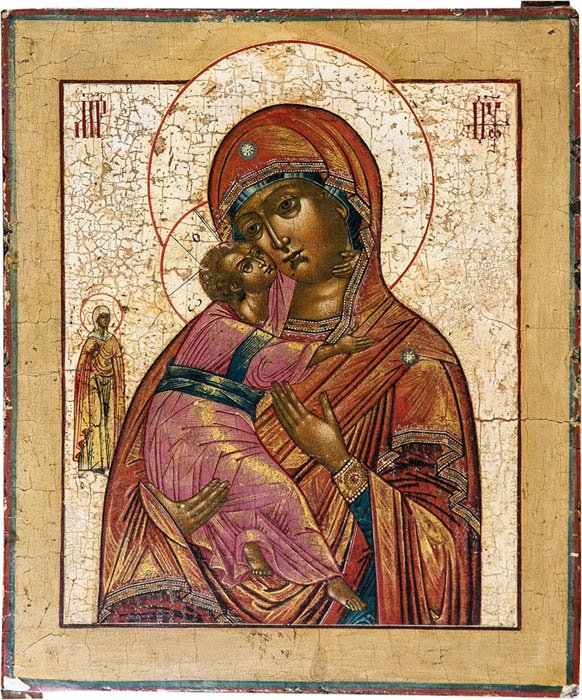
Our Lady of Vladimir Russia, mid-18th century. Massive wood single board with two lateral Sponki. Tempera on gesso on canvas. Background exposed. Half-length depiction of the Virgin Mary with the Christ child in her left arm. This nestles his face to hers. Rich Goldakzentuierung of garments. To her right, the St. Anne appears.. Chipping at the corners. 34.5 x 29 cm. The Vladimirskaya Mother of God. Russia, mid of the 18th century. Tempera on gesso on canvas on wood. Background stripped to gesso. The Mother of God and the Christ Child embracing each other in the traditional pose. St. Anna Appears on her right. Corners minimally damaged. 34.5 x 29 cm.
1

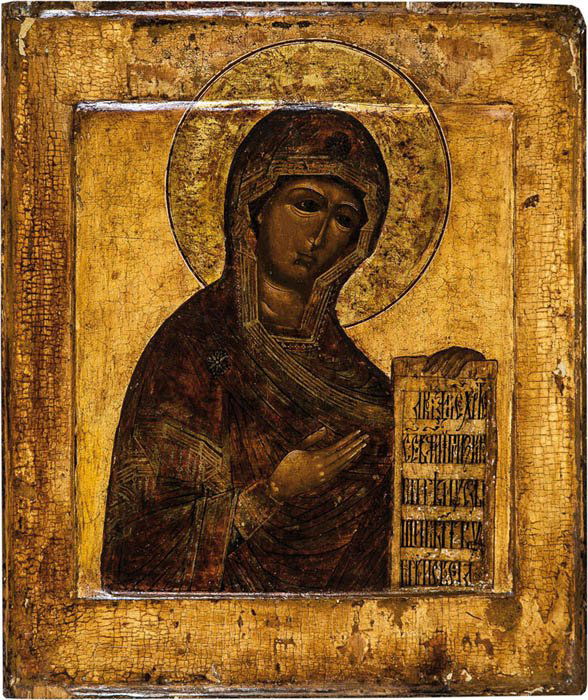
The intercessory Virgin from Deesis Central Russia, the end of the 18th century. Hardwood single panel with two Rückseitensponki (lost). Egg tempera on gesso on canvas, Kowtscheg plus edge ridge. Border and background exposed. Fine, image-filling representation of facing to the right Blessed Mother. In her left hand she holds an open scroll. Her dark red maphorion is rich with decorative ornaments. Small retouching, Nimbengold renewed. 31.5 x 27.5 cm The Mother of God from Deisis. Russia, end of 18th century. Tempera on gesso on canvas on wood panel, background and border stripped to gesso. The Mother of God shown half-length with scroll. The garments accented with jewel encrustations. Slightly restored. 31.5 x 27.5 cm.

1

Mother of God '' Soothe my sorrow '' Russia, 19th century. Hardwood single table with two top-side Sponki. Tempera on chalk ground, background gilded. The Mother of God half figure represented tilts her head slightly to the left and holding in her arms the infant Christ, which lies at an angle on the left. This holds an open scroll with the beginning of the Akathistos Hymn. Next to them the Holy Xenia appears. Driven, engraved, and gilded Metalloklad punziertes. The robes of the saints with glass beads, polished shells and apparent stones. Oklad with flaws, icon rubbed. 33.5 x 28.5 cm The Mother of God "Soothe My Sorrows". Russia, 19th century. Tempera on gesso on wood panel. Painted traditionally. St. Xenia on the right. Embossed and chased applies Basma metal. The garments with a covering composed with pearls, shells and semi-precious stones. Losses. 33.5 x 28.5 cm.
1

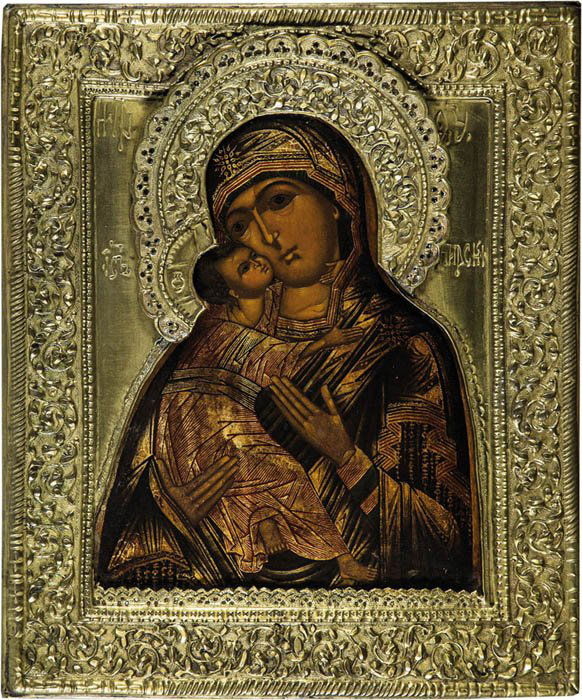
Our Lady of Vladimir (Vladimirskaya) Russia, 19th century. Hardwood single board with two back side Sponki (lost). Tempera on gesso. Presentation of the Blessed Mother in half figure with the Christ child, who clings to it, ih their rights. Getriebens Messingoklad decorated with floral decor. 31.5 x 26.5 cm The Vladimirskaya Mother of God. Russia, 19th century. Tempera on gesso on wood panel. Painted traditionally. Overlaid with a brass oklad decorated with strapwork. 31.5 x 26.5 cm.

1

The Feodorovskaja Mother of God. Russia, early 18th century. Tempera on gesso on wood panel. The Mother of God holding the Christ Child on her right arm who looks up at his mother and lovingly stetches his arm around her neck. Both clothes decorated with intense chrysography. Overlaid with a metal-gilt oklad chased and embossed with strapwork. 30.5 x 27.5 cm.

1

The Vladirmirskaja Mother of God. Russia, circa 1800. Tempera on gesso on wood panel with very flat kovcheg. Traditionally painted. Christ touching his cheek to his Mother's face, gazing into her eyes, the Mother pointing to her son. The faces with shaded contours, the garments in orange and brown, the maphorion and the himation accented with golt striations. Horizontal crack. 35.5 x 31.5 cm.

1

Large icon showing the Virgin from a Deesis Russia, 19th century. Wood single board with two back side Sponki. Tempera on gesso, Nimbus glazed golden. Image-filling representation of facing left Our Lady. Her dark red maphorion is staffed with three stars. Min. Rest. 52.5 x 43 cm A large icon with the Mother of God from a Deisis. Russia, 19th century. Tempera on gesso on wood panel. The Mother of God portrayed bust-length to the left. The maphorion with gold hems. Slightly restored. 52.5 x 43 cm.

1

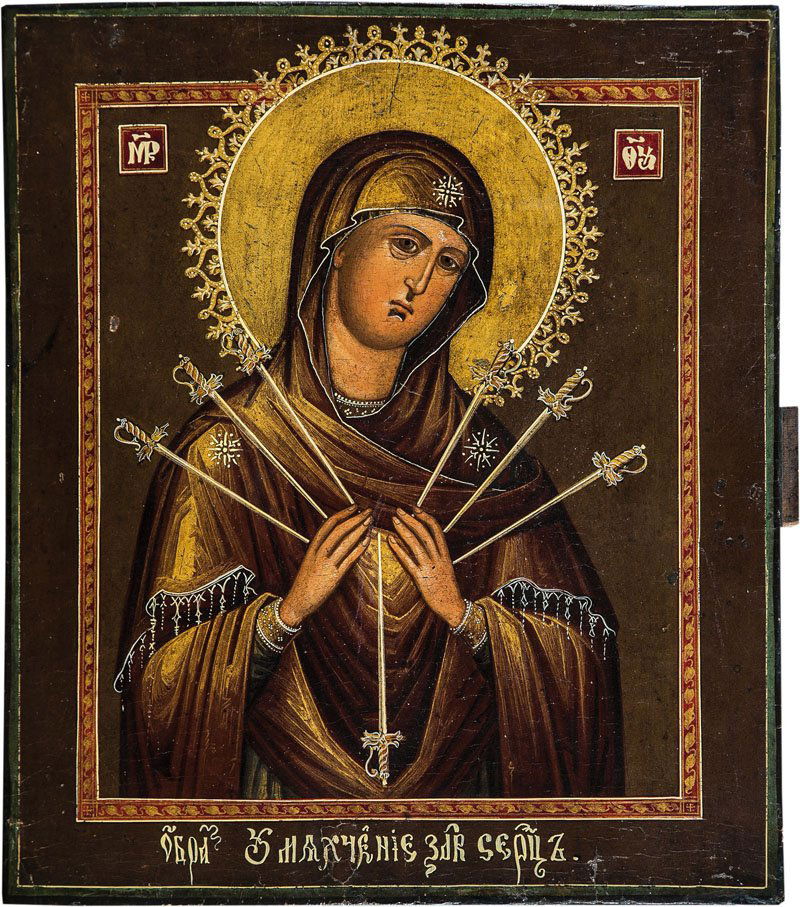
The Mother of God of the Seven Sorrows. Russia, mid of the 19th century. Tempera on gesso on wood panel. The Mother of God depicted frontally in half-length. Seven swords appearing on her chest. Her robes highlighted in gilt. 35 x 30.5 cm.

1

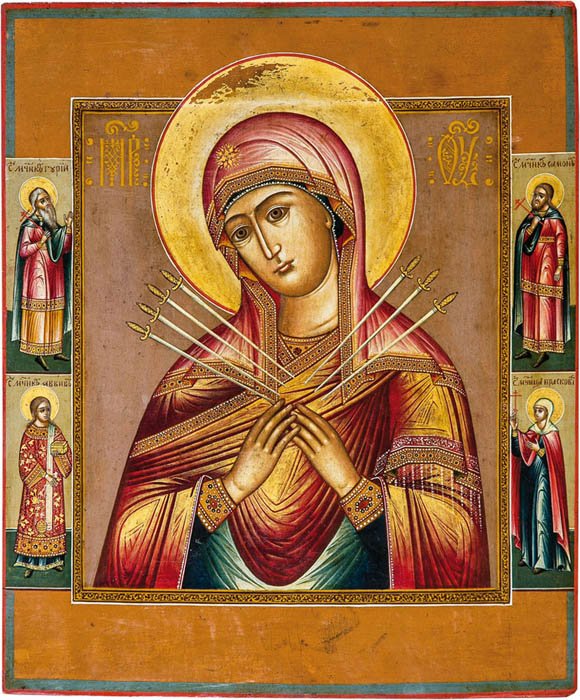
The Mother of God of the Seven Sorrows. Russia, late 19th century. Tempera on wood panel with kovcheg. The Mother of God depicted frontally in half-length. Seven swords appearing on her chest. The robes of the Mother highlighted in gilt. On the border Samon, Yuri and Aviv and St. Paraskeva. 37 x 30.5 cm.

1

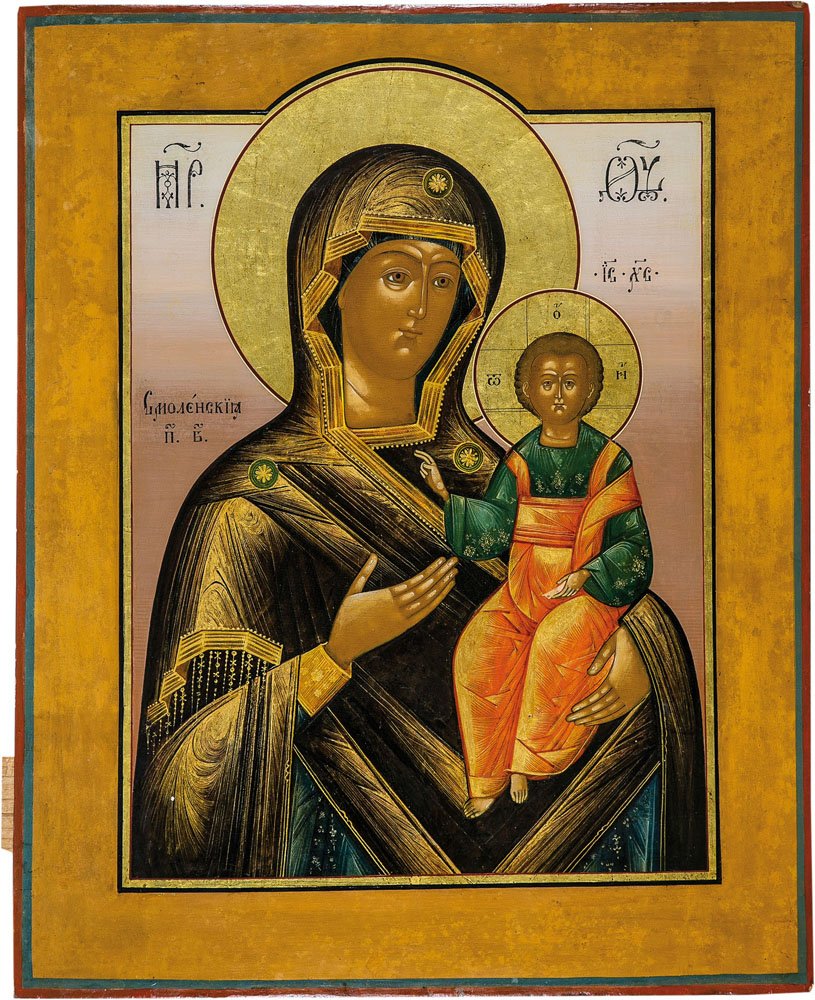
The Mother of God of Smolensk. Russia, late 19th century. Tempera on gesso on wood panel with golden halo. Holding Christ in her left arm. The faces of the Virgin and Child are gently painted with mild brown and white tones. The garments with chrysography. 53.5 x 43.5 cm.

1

The Smolenskaja Mother of God. Russia, late 19th century. Russia, 19th century. Tempera on canvas on wood panel. The icon shows the Mother of God in half-length. She holds the Child in her left arm. Restored. 31 x 26.5 cm.

1

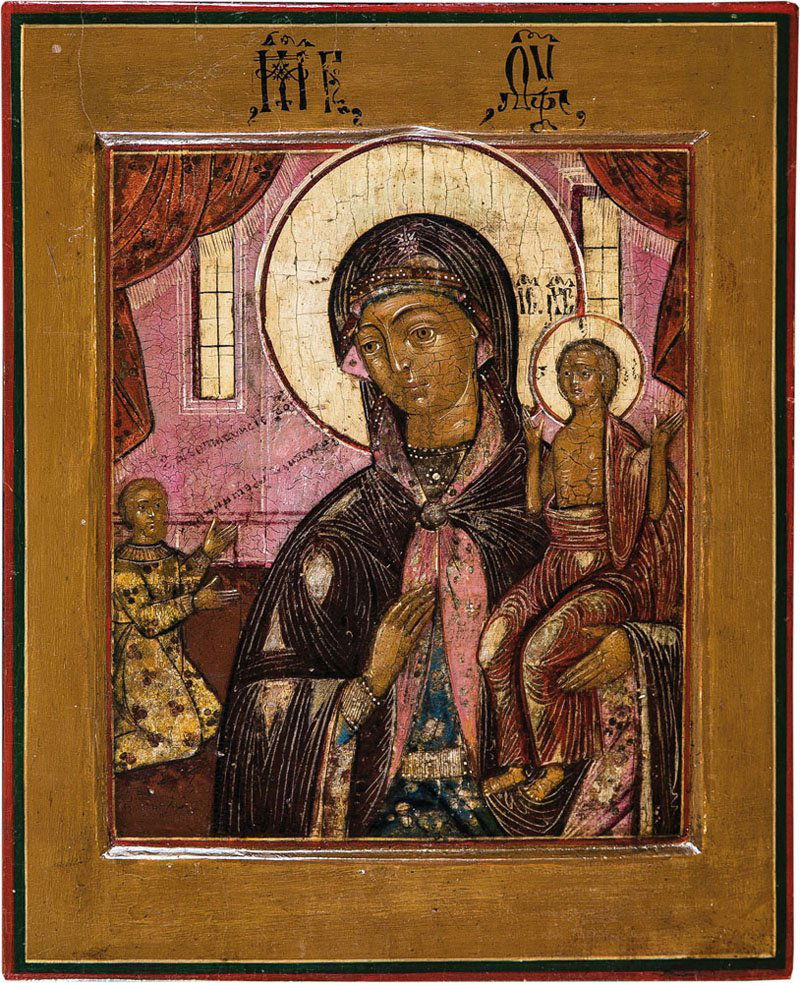
The Mother of God of "Unexpected Joy". Russia, 19th century. Tempera on gesso on wood panel with kovcheg. On the left side the sinner is kneeling in front of the Mother of God. She is holding Christ in her left arm. Againt an architectual setting. 31.5 x 26.5 cm.
1

The Mother of God "Soothe my sorrows". Russia, late 19th century. Tempera on gesso on wood panel. The Mother of God is shown in half-length holding the Christ Child. Border with guardian angel and St. Anna. Worn. 36 x 32 cm.

1

The Mother of God of "Unexspected Joy". Russia, 19th century. Tempera on gesso on wood panel with kovcheg. The icon shows the conversation between the Mother of God and the sinner in an interior. 28.5 x 23 cm.

1

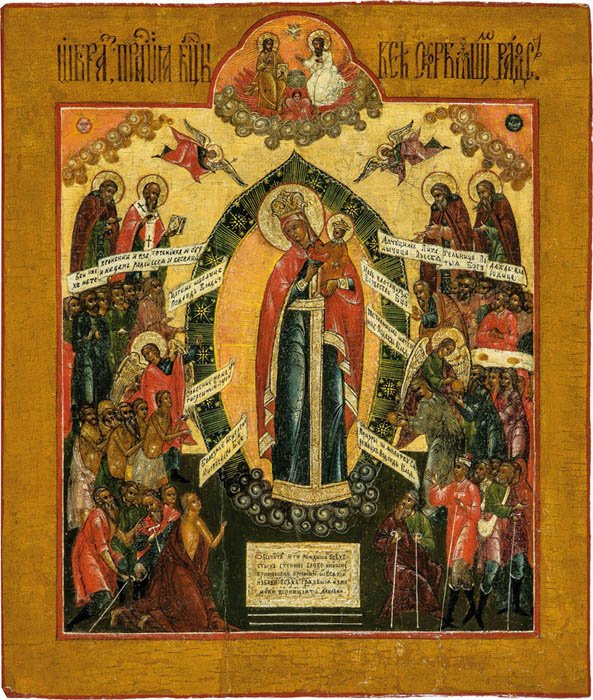
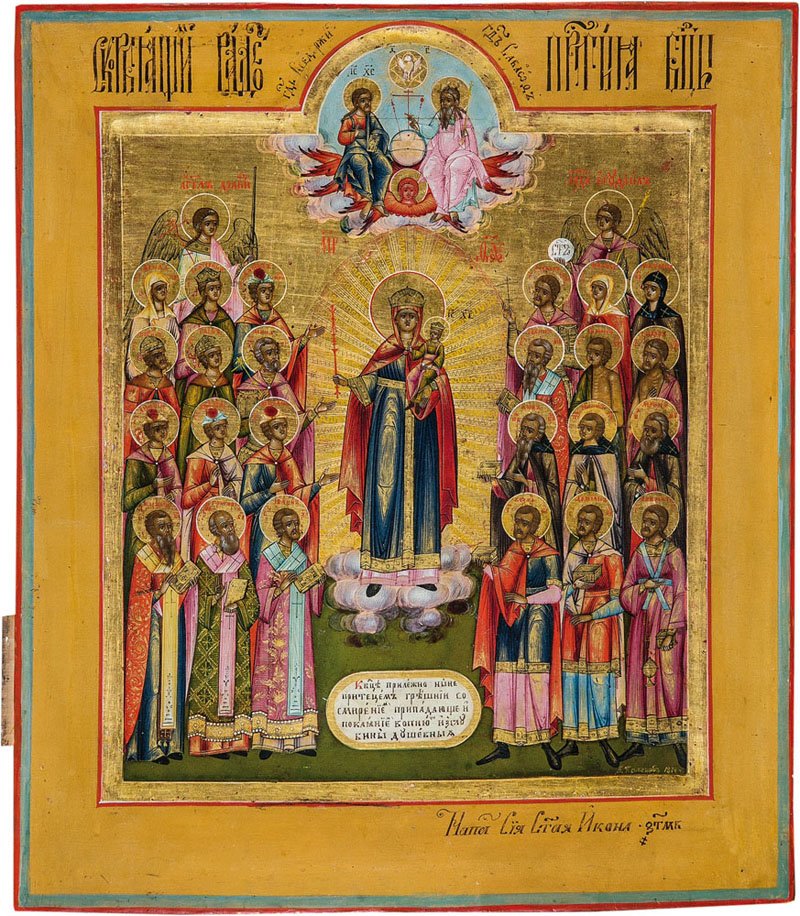
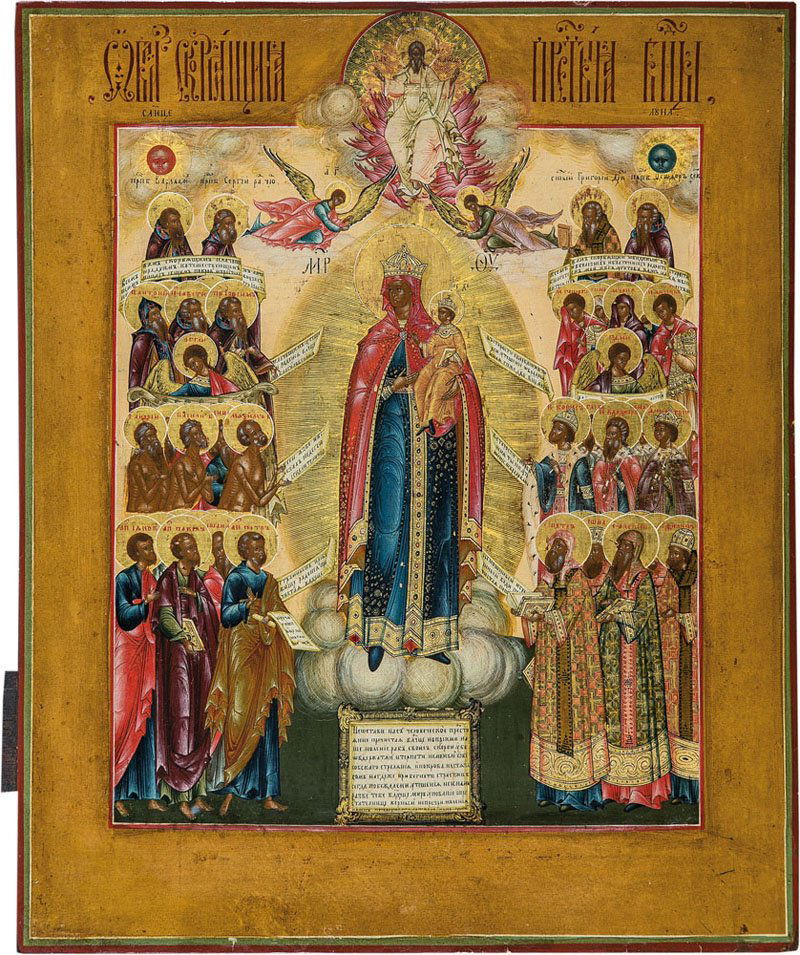
Mother of God '' Joy to all Sufferers '' Russia, around 1800 composite of two softwood panels with two back side Sponki. Kowtscheg, egg tempera on gesso, gold fund. Axialsymmtrische composition following the traditional picture scheme. About the standing in the center of The Virgin with the Christ Child, the New Testament Trinity appears on a bench formed by cherubim. At the top of the screen Titulus Church Slavonic. Min. Rest, vertical crack along the interconnection. 31.6 x 26.2 cm The Mother of God "Joy to all who grieve". Russia, circa 1800. Tempera on gesso on wood panel with Kovcheg and golden background. Axially symmetrical composition. Slightly restored, vertical crack. 31.6 x 26.2 cm
1

Large icon with the Mother of God Joy to all Sufferers Russia, Palekh, circa 1820 Softwood board with two back side Sponki. Kowtscheg, tempera on chalk ground, partial gilding. In the central vertical axis full-length representation of the Virgin with Christ in her left arm. On both sides they flank more, accompanied by angels groups Hilfsbedüftiger and sick, the contact with banners to the Blessed Mother. About her the blessing of God the Father enthroned above the clouds. In the upper corners of the sun and moon appear. The garments are designed primarily in red and contrasting shades of green. Structuring of the garments by folding in gold painting. The faces are modeled in soft light browns. 44 x 37 cm A large icon with the Mother of God "Joy to all who grieve". Russia, Palekh, circa 1820. Tempera on gesso on wood panel with Kovcheg. The Mother of God portrayed in full-length. Angels Indicating the Motherland to the afflicted people. Godfather emerging in blessing from the open skies. The Sun and the Moon on the upper corners. Painted predomintantly with reds, greens and gold. 44 x 37 cm.

1

A quadri-partite icon. Russia, ca. 1800. Tempera on gesso on wood panel. The crucifix divides the icon into four parts: Christ Pantokrator, the Mother of God, George and the dragon and the Feodorovskaya Mother of God. Slightly restored. 31 x 26.5 cm

1

Mother of God "Joy to all who grieve". Russia, dated 1834. Tempera on gesso on wood panel with kovcheg. In the center the enthroned Mother of God holding the Christ Child. She is flanked by 26 selected saints and angels. Above the New Testament Trinity. Dated. 26 x 31 cm.

1

The Mother of God "Joy to all who grieve". Russia, Palekh, first half of the 19th century. Egg tempera on gesso on wood panel with kovcheg. The Mother of God holding Christ, both crowned, appearing in a rayed mandorla. Two angels indicating the Mother and Child to the afflicted people. Lord Sabaoth emerging in blessing from the open skies, the Sun and the Moon on the upper corners. Painted predomintantly with reds, greens and gold. 32 x 26.5 cm.

1

The Bogolubskaja Mother of God. Russia, mid 19th century. Tempera on gesso on wood panel, golden background. The left side shows the Mother of God in full-length holding an open scroll with a prayer. 13 Saints of Moscow kneeling in front of her. Christ appears in the upper right corner. The Kremlin in the background. Slightly restored. 36 x 30.5 cm.

1

Mother of God '' life-giving source '' Russia, early 19th century. Composite of two Softwood boards with two back side Sponki (lost). Kowtscheg. Tempera on chalk ground, background gilded. Centrally situated in a gilded fountain bowl seated Virgin Mary with the Christ child in her womb. She is flanked by the Archangels Michael and Gabriel, standing on clouds. At the bottom of the screen to the fountain representing patients from all walks of life, to heal their suffering with the water. At the top of Church Slavonic Titulus. Eight border Saints. Min. Rest. 35 x 29 cm Mother of God of the "Life-Giving Source". Russia, early 19th century. Tempera on gesso on wood panel with Kovcheg. On the celestial plane, angels adoring the Mother of God and Christ. The lower part dominated by the marble fountain, surrounded by members of the Imperial family, clerics, soldiers and lay people. Eight Saints On The Border. Slightly restored. 35 x 29 cm.

1

Our Lady protect and shield (Pokrov) Russia, around 1800 composite of three Hardwood boards with two top-side Sponki. Tempera on gesso, gilded background. Traditional image segmentation in two registers before rich ornamented architecture backdrop. Centrally located in the upper area is the Mother of God with a set on her outstretched arms veil. About her the blessing Christ appears. In the center of the lower register Romanos is the Melod. Law has Andrew, the fool in Christ, Epiphany attention to the vision. 44.5 x 39.5 cm The Pokrov. Russia, about 1800. Tempera on gesso on wood panel, golden background. The upper part shows the Mother of God Extending her veil to the congregation below. The lower section showing the interior of a church. St. Romanos the Melodist Chanting his Kontakia to the Mother of God. To the right St. Andrew the Fool, turning to his disciple, Epiphanius, and pointing up at the vision. 44.5 x 39.5 cm.
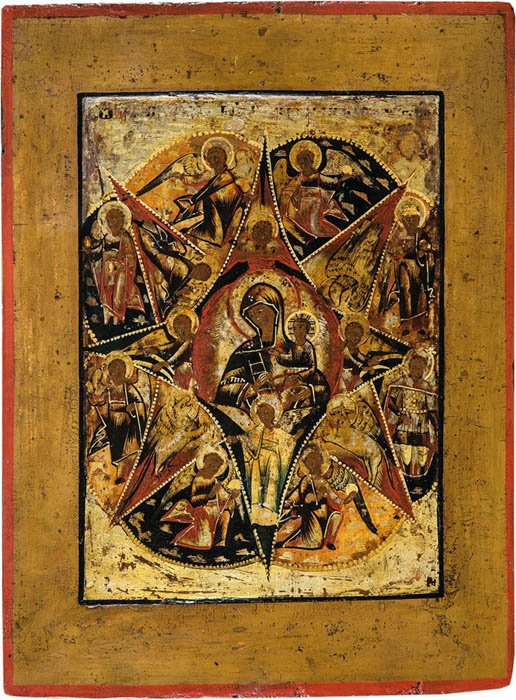
1

Mother of God '' Burning Bush '' Russia, early 19th century. Hardwood single board with two back side Sponki (lost). Kowtscheg, tempera on chalk ground, silvered background, glazed gold. Keeping Central surrounded by the half-length portrait Strahlenkranzaureole Mother of God, the blessing Christ Child in her left arm, her right in the Jacob's ladder. It is surrounded by four angels. In the corners of the underlying red quadrangle four evangelists symbols. In the eight arched fields between the star points eight angels are represented. Verso Cyrillic inscriptions. Edge rest. 35 x 26.5 cm The Mother of God of the Burning Bush. Russian, early 19th century. Egg tempera on gesso on wood panel with Kovcheg. The Mother of God with Christ, holding a ladder, against eight-states-pointed star. The center of the composition is surrounded by cherubs, angels and the apocalyptic personifications of the Evangelists. Border restored. 35 x 26.5 cm.

1

Mother of God '' Joy to all Sufferers '' Russia, 19th century. Wood single board with two back side Sponki. Kowtscheg, tempera on chalk ground, background gilded. Our Lady stands before a red-green halo and holding the Christ child in her left arm. On both sides they flank help seekers who are led by two angels. On the banners of their sufferings are listed. In the upper corners of the sun and moon are shown. God the Father appears at the top of the screen. Small touch-ups. 31 x 26 cm The Mother of God "Joy to all who grieve". Russia, 19th century. Tempera on gesso on wood panel with Kovcheg, golden background. The center depicting the upright standing Mother of God with Christ in her left arm. She is flanked by Saints and people with various afflictions Accompanied By Two Angels. Decorated with white scrolling foliage with inscriptions of Their sufferings. At the top godfather is enthroned on clouds. Slightly restored. 31 x 26 cm.
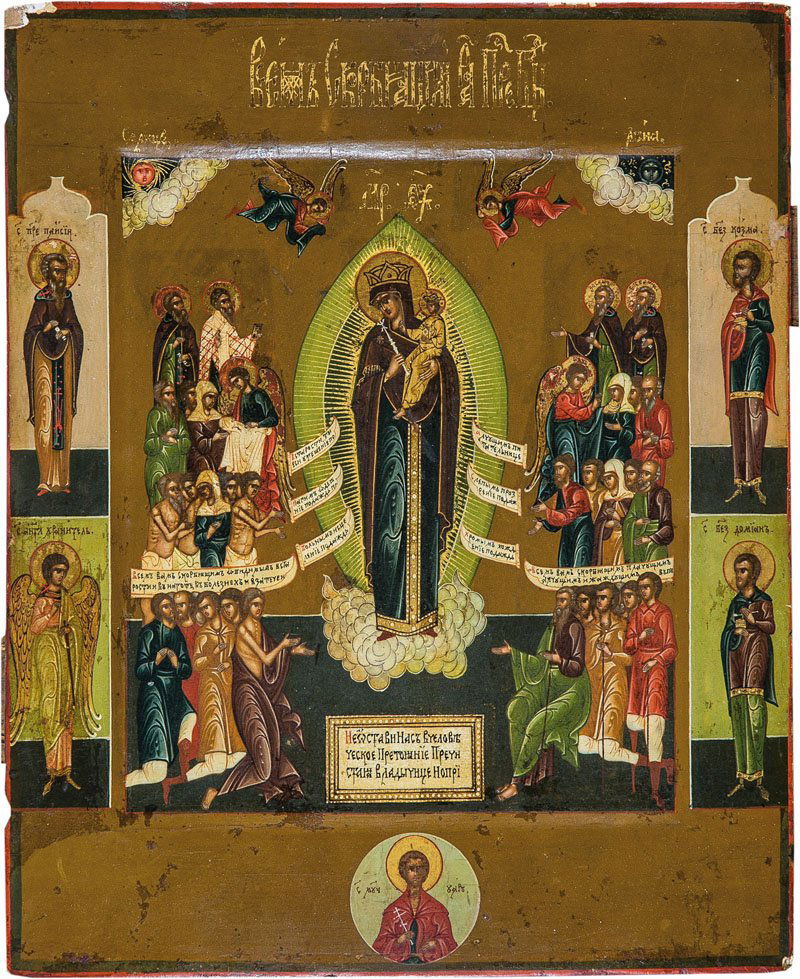
1

Mother of God '' Joy to all Sufferers '' Russia, around 1800 composite of two Hardwood panels with two back side Sponki. Kowtscheg, tempera on chalk ground, partially gilded. Centrally located in the image field is the crowned Mother of God before an aureole. She holds the Christ Child also crowned in her left arm. It is on both sides of four rows flanked needy who turn with their requests to them. Five border Saints, including the Guardian Angel and the doctor Saints Cosmas and Damian. Min. Rest. Best edges. 26.5 x 22 cm The Mother of God "Joy to all who grieve". Russia, circa 1800. Tempera on gesso on wood panel with Kovcheg. The Mother of God stands at center flanked by saints and people with various afflictions Accompanied By Two Angels. Decorated with white scrolling foliage with inscriptions of Their sufferings. Five Saints On The Border, Including the Guardian Angel and Sts. Cosmas and Damian, the patrons of the doctors. Slightly restored, corners minimally chipped. 26.5 x 22 cm.
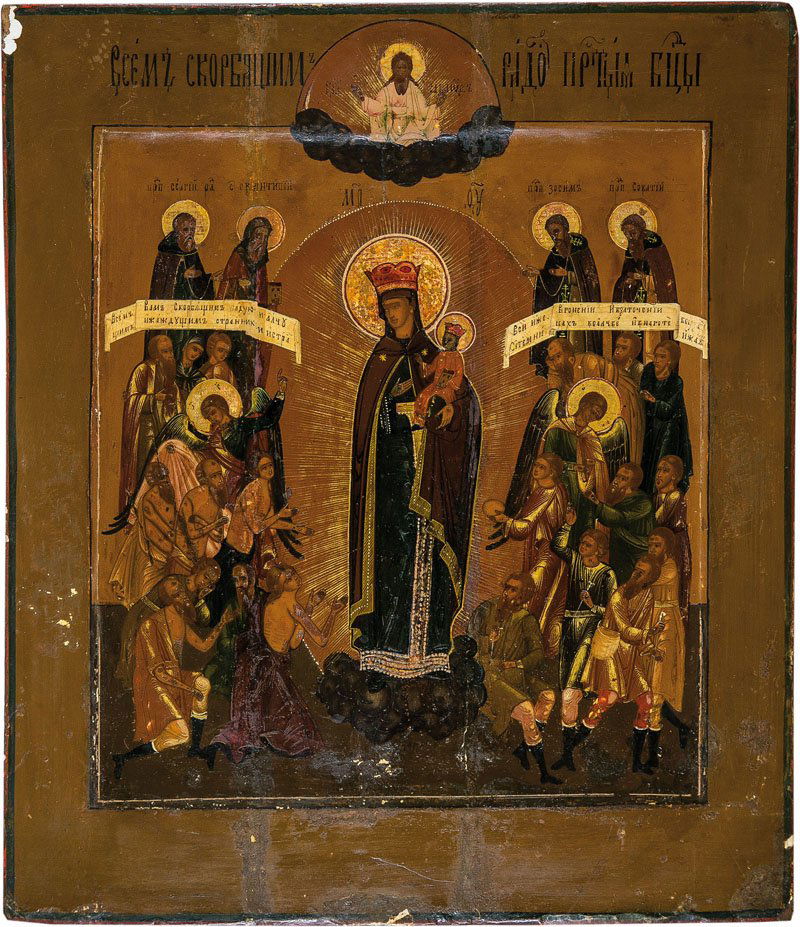
1

Mother of God '' Joy to all Sufferers '' Russia, around 1880 composite of three Hardwood boards with two back side Sponki. Kowtscheg, tempera on chalk ground. In the vertical axis, the Blessed Mother is with the Christ child in her arms. She is flanked by those seeking help are accompanied by two angels flanking. Rest. 35.5 x 30.5 cm The Mother of God "Joy to all who grieve". Russia, circa 1880. Tempera on gesso on wood panel with Kovcheg. Painted traditionally. Godfather above. Restored. 35.5 x 30.5 cm.
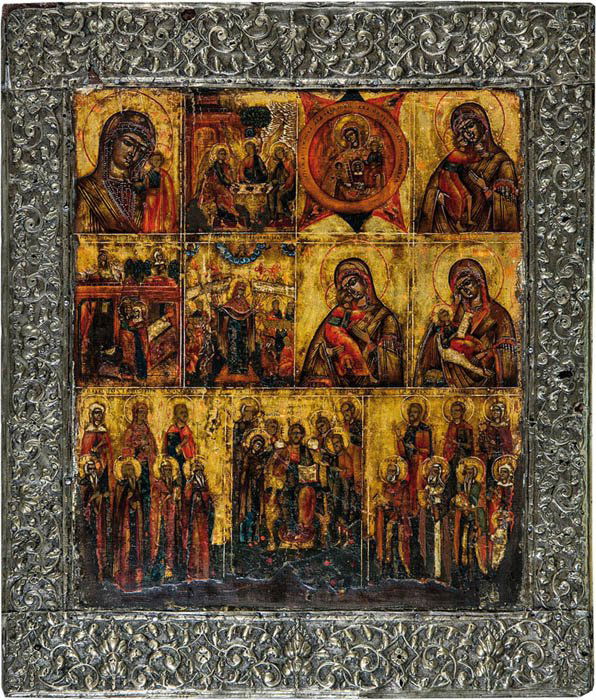
1

More fields Icon Russia, late 19th century. / Brett older composite of two Hardwood panels with two top-side Sponki. Tempera on gilded gesso on canvas, background. Distribution of the image field into three horizontal registers: Our Lady of Kazan, Old Testament Trinity, Mother of God '' Burning Bush '', Our Lady of Feodor, Anna and Joachim, Mother of God '' Joy to all Sufferers '' Our Lady of Waldimir, Mother of God '' Soothe my sorrow '', Deesis and baying selected saint. Drive, Silver Basma not original to belonging. Low Zone dam. 34.5 x 29 cm A multi-partite icon. Russia, late 19th century / panel older. Tempera on canvas on gesso on wood panel with golden background. The icon shows 10 parts with selected Saints in three horizontal registers. Embossed plated Basma supplemented. Restored. Lower part damaged. 34.5 x 29 cm.

1

Large Icon with 44 images grace the Blessed Mother Russia, 1st half of 19th century. Composite of three Softwood boards with two back side Sponki (one lost). Flat Kowtscheg. Egg tempera on gesso. Classification of the image field in six horizontal register with mostly half-length depiction of the Virgin Mary with the Christ child. Underneath each Titulus Church Slavonic. Color loss, vertical cracking. 46 x 38 cm A large icon with 44 miraculous images of the Mother of God. Russia, first half of the 19th century. Egg tempera on gesso on wood panel with Kovcheg. The panel divided into six rows with six or eight images of the Mother of God with Christ. All painted in detail. With an inscription at the bottom of each image. Losses, small vertical cracks. 46 x 38 cm.
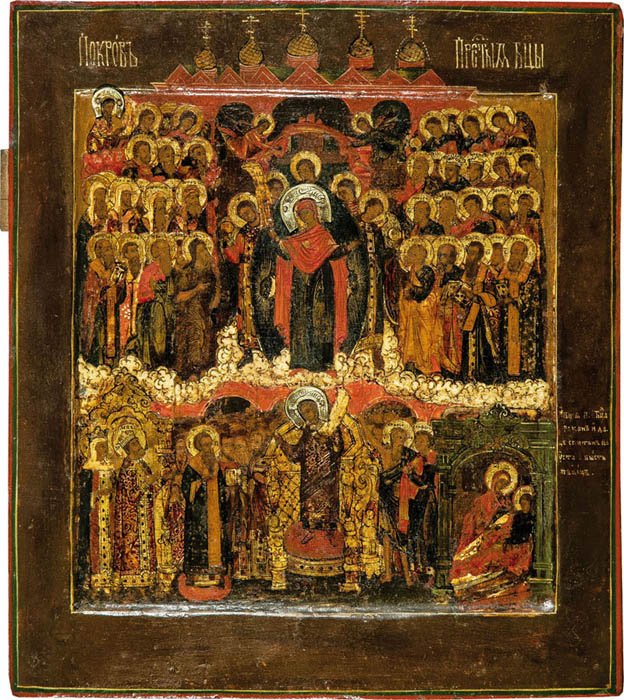
1

Fine icon with the Mother of God '' shelter and protection '' (Pokrov) Central Russia, E. 17 / A. 18C. Softwood single board. Kowtscheg, egg tempera on gesso. In the center of the top of the image field, the Mother of God is facing a green mandorla, surrounded by angels. Left and right of it are crowds of apostles and saints. In the background the Blachernae is watching. In the center of the lower image field Romanos stands with an open hymn role in his left. To his right is the half-naked fool Andreas, his disciple Epiphanius the Mother of God above him. According to legend, he had in the Blachernae church of Constantinople Opel a vision of the Blessed Mother holding the about their community to protect a cloth. Min. Rest. 31 x 28 cm A finely painted icon with the Pokrov Mother of God. Central Russia, end of 17th / beginning of 18th century. Egg tempera on gesso on wood panel with Kovcheg. Against the background of a large church. The upper part shows the Mother of God in front of a green mandorla flanked by angels, Saints and Apostle. In the center of the lower register St. Romanos Appears with a hymn. Andrew the Holy Fool pointing out to his desciple Epiphanius the appearance of the Mother of God. Slightly restored. 31 x 28 cm

Russian icon
Month calendar of January
Late 19th/early 20th century
Wood panel
17 3/8" h x 13 1/4" w.

1

SAINTS MODEST AND BLAISE Russian, 18th century Tempera in wood panel with double kovcheg. The figures of the saints are depicted full-length in Bishop's attire. Between them a two groups of animals at a river. The saints facing Christ Pantocrator represented in the quadrant in the upper part of the icon. The scene painted classically with predominantly red. The background stripped to gesso, restored. 31 x 25.6 cm. More
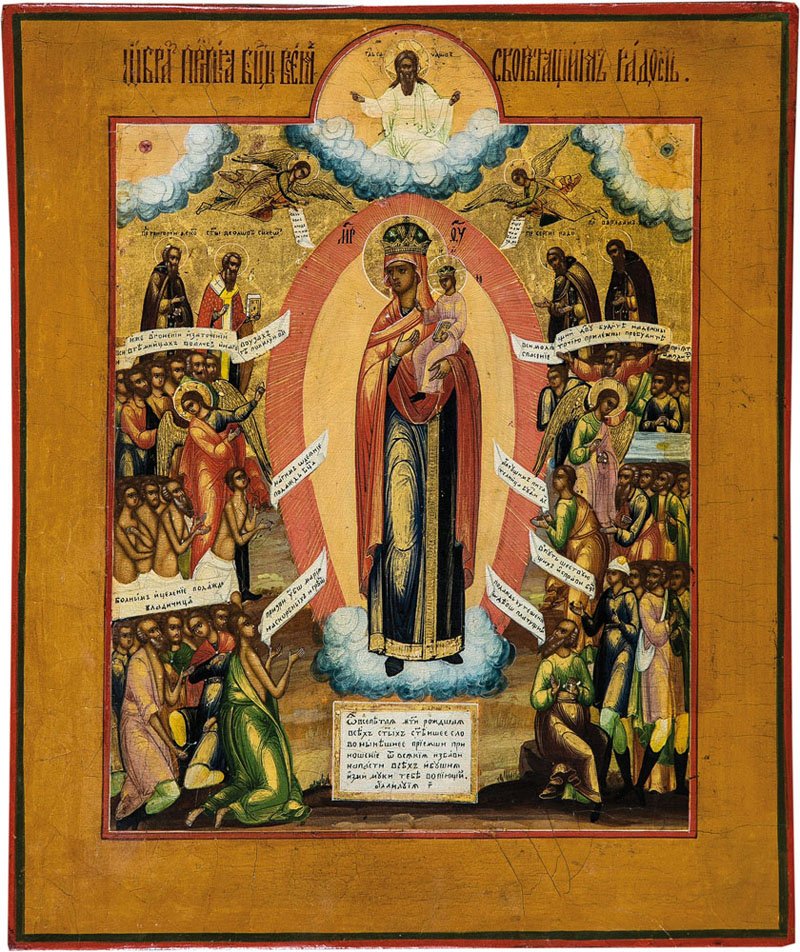


Please visit my other blogs: Art CollectorMythologyMarine ArtPortrait of a Lady, The OrientalistArt of the Nude and The Canals of VeniceMiddle East Artists365 Saints and 365 Days, also visit my Boards on Pinterest

Images are copyright of their respective owners, assignees or others. Some Images may be subject to copyright

I don't own any of these images - credit is always given when due unless it is unknown to me. if I post your images without your permission, please tell me.

I do not sell art, art prints, framed posters or reproductions. Ads are shown only to compensate the hosting expenses.

If you enjoyed this post, please share with friends and family.

Thank you for visiting my blog and also for liking its posts and pages.