RELIGIOUS ART - Icons from the Bible, Our Lady of Rostov Russia, early 18th century

1

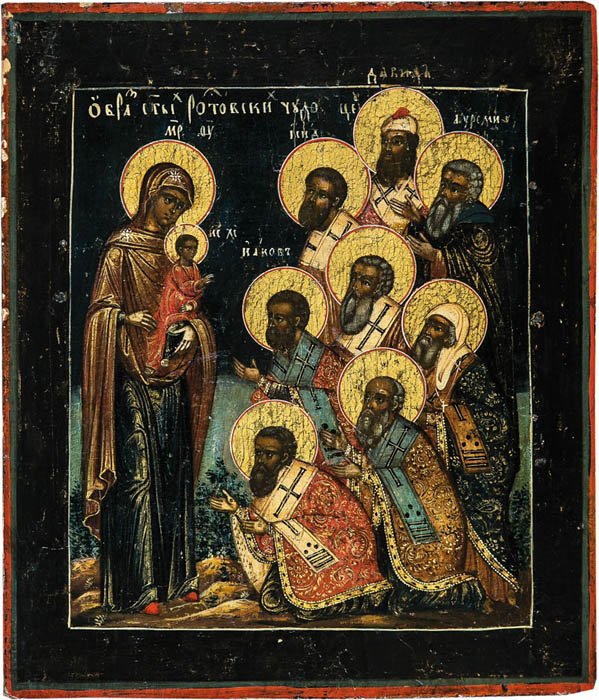
Our Lady of Rostov Russia, early 18th century. Softwood single table with two top-side Sponki. Egg tempera on gesso. On the left side full-length depiction of the Virgin Mary, holding the Christ Child in her arms. To the right, Eight Saints Represented full-length in the Episcopal vestments making a gesture of supplication included IsaiahLeontius and Ignatius. 31 x 27 cm.

Rostov  is a town in Yaroslavl Oblast, Russia, one of the oldest in the country. It is located on the shores of Lake Nero

Saint Isaiah of Rostov (fl. 1062 – died 1089 or 1090) was a Russian Christian missionary and bishop. Isaiah was born near Kiev. He was tonsured at Kiev Pechersk Lavra, and became abbot of Saint Dmitry's Monastery. In 1077, he became the second bishop of Rostov. As Christianity was not yet well established in the area, he spent his tenure converting pagans, destroying idolatry and encouraging the spread of Christianity.

St Leontius the Bishop and Wonderworker of Rostov. A Greek from Constantinopole, Leontius became a monk at the famous Monastery of Caves in Kiev (Ukraine). He was first monk of this house to become a bishop when he was appointed to Rostov (Yaroslavsk) in 1501. Although persecuted by the pagans, he became their apostle. Reputed to have had a gift of miracles, he did not escape death at their hands; however, this was from the ill-treatment he received rather than by formal sence of death. Leontius was the first martyr who was also a priest (heiromartyr).

St Ignatius the Bishop and Wonderworker of Rostov. Saint Ignatius was Bishop of Rostov, and shepherded his flock for twenty-six years. After his death on May 28, 1288, his body was broght to the church. Some people saw him leave his coffin, and float in the air above the church. He blessed the people and the city, then went back to his coffin.

RELIGIOUS ART - Icons from the Bible, Our Lady of Kazan Russia, Black Madonna of Kazan, 18th century

1

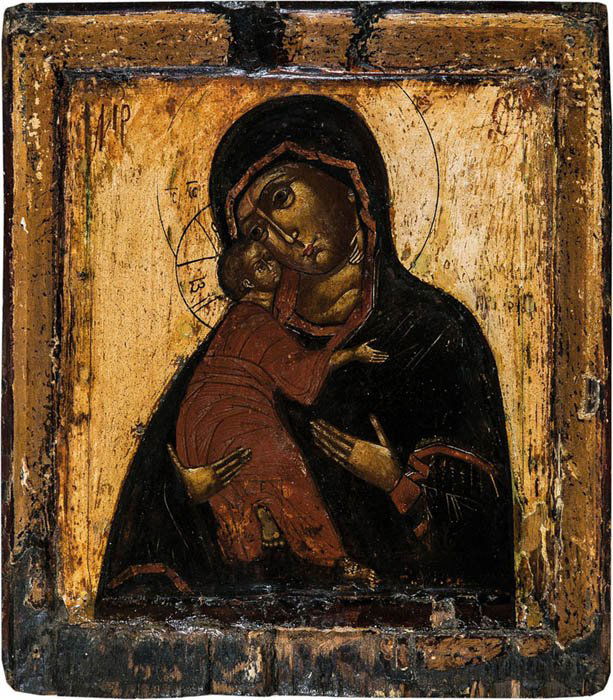
Our Lady of Kazan Russia, Black Madonna of Kazan18th century. Hardwood single board with two back side Sponki (lost). Tempera on gesso (plaster). Brustbildnis (half-lengthportrait) of the Virgin with the Christ Child standing on her left. He raises his right hand in a blessing gesture. Driven, engraved and gilded Metall oklad with floral decor. 31 x 28 cm

Kazan is the capital and largest city of the Republic of Tatarstan, Russia. It is the eighth most populous city in Russia, and lies at the confluence of the Volga and Kazanka Rivers in European Russia.

Our Lady of Kazan, Black Madonna of Kazan (so-called both because of the often dusky color of their skin (in some cases, after cleaning, attributed to the accumulation of generations of soot from candles burnt under the images) and because in many cases they were either excavated from underground ruins or were originally worshipped in underground caverns, perhaps due to Marian persecutions). The history of the convent of Our Lady of Kazan is inseparably linked with finding, glorifying and honoring the mira­cle-working icon of Our Lady of Kazan in Russia. This icon is one of the most honored and esteemed in the Russian Church. 

At the beginning of July, 1579 there was a conflagration in Kazan, the capital of Tatarstan. The fire enveloped quite a district that joined the Kremlin's north­east. The yard of Danila Onuchin, the strelets sotnik (Russian light infantry command of a hundred men in Age of Empires), were burned down. Many families had lost their homes, and had to rebuild  before the Russian winter would come. Among those people trying to restore their homes was Daniel Onuchin. He had a daughter Matrona, nine years old.  

The Mother of God appeared in a dream to Matrona and commanded her to find Her icon, hidden in the ground by secret confessors of Orthodoxy, in the time of Moslem rule. Thrice the Mother of God appeared and pointed out the spot, where the wonder working icon had been concealed. Finally, Matrona, with her mother began to dig in the indicated place and they found the sacred icon. To the place of the miraculous discovery came archbishop Jeremii at the head of his clergy and transported the holy image into a church of Saint Nicholas situated nearby; then,  amidst a church procession they transferred it to the Annunciation cathedral – the first Orthodox temple in the city of Kazan, erected by tsar Ivan the Terrible. During the procession there occurred the healing of two blind men – Iosif and Nikita.

Tsar Ivan the Terrible gave orders to build at the place of its appearance a temple in honour of the Kazan Icon, and to found there also a women's monastery. Matrona and her mother, instrumental in finding the sacred icon, accepted monastic tonsure at this monastery. 

Invocation of the Virgin Mary through the icon was credited to the Russian commanders, Dmitry Pozharsky and Mikhail Kutuzov, with helping the country to repel the Polish invasion of 1612, the Swedish invasion of 1709, and Napoleon's invasion of 1812.

On the night of June 29, 1904, the icon was stolen from the church in Kazan where it had been kept for centuries (the cathedral was later blown up by the communist authorities). Thieves apparently coveted the icon's gold frame. The Orthodox Church interpreted the disappearance of the icon as a sign of tragedies that would plague Russia after the image of the Holy Protectress of Russia had been lost. Indeed, the Russian peasantry was wont to credit all the evils of the Revolution of 1905, as well as Russia's defeat in the Russo-Japanese War, to the desecration of the image. More

Vladimir Putin ordered that the Black Madonna of Kazan, the holiest icon of the Russian Orthodox Church, be flown over the Black Sea, many believed he wished to secure blessings for the Winter Olympics in Sochi.
RELIGIOUS ART - Icons from the Bible, Our Lady of Vladimir (Vladimirskaya) Mother of God, Russia, 17th / 19th Century

1

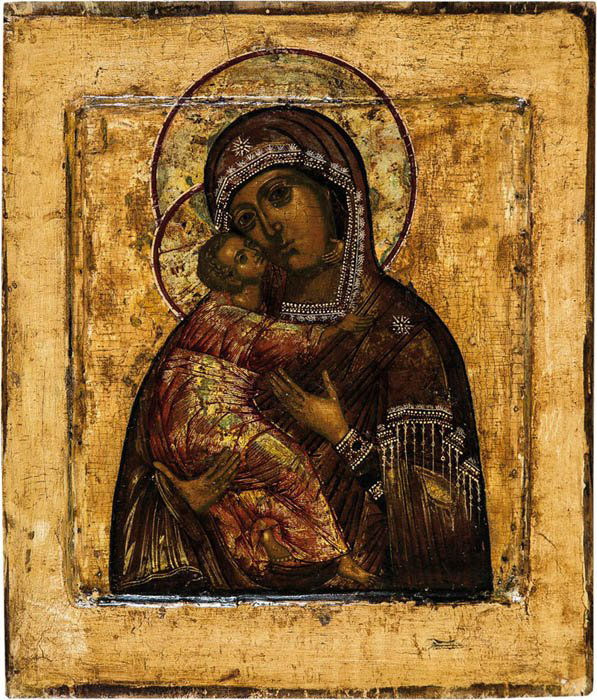
Our Lady of Vladimir (Vladimirskaya) Mother of God, Russia, 17th / 19th Century. Hardwood single board with two back side Sponki (lost). Double Kowtscheg (Ark), tempera on groundchalk . Background and border uncovered. Field used later in old board. Verso Cyrillic labels (scratched). Presentation of the The Mother of God shown in half-length with Christ in her right arm. Christ touching his cheek to his Mother's face. Border with losses. Almost Completely restored. . Field largely in the 19th century. Revised. Rand strong substance losses. 31.5 x 27.5 cm 

Mother of God Vladimirskaya: The Mother of God of Vladimir, also known under the name of Our Lady of Vladimir, Virgin of Vladimir Vladimirskaya, Our Lady of Vladimir, Our Lady of Tenderness, The Lady Who Saves Russia, is one of the icons orthodox most revered in Russia. The Theotokos (Greek Theotokos: Marie) is considered the patron saint of Russia.

The miraculous image given the title, Our Lady of Vladimir, is known as an Eleousa,the Greek word meaning, Mother of Tenderness. The Christ Child nestles tenderly close to his mother, he gazes at her and is so closely linked to her that his left arm embraces her fully. His right hand gently touches her left cheek. The original image is a large painting of the type known as the St. Luke icons. Mary looks out at the people. Yet, there is no doubt that she is intimately united to her Divine Son.

The origin of the ancient Marian icon, Our Lady of Vladimir, can be traced back to 1125. The oldest known representation of Our Lady of Vladimir  was commissioned in Constantinople by a Russian, who then had the painting taken from city to city during the period of united Ukranian-Russian history. In 1169, Duke Andrej Bogoljubskij had the icon brought from Kiev to the new cathedral of Vladimir. Due to the honor and reverence of the people, who attributed gracious assistance to Our Lady's help throughout the Ukraine, a large cathedral was built for her in Vladimir.

When the Mongol invasion threatened Moscow in 1395, the original icon was brought to Moscow, where she was honored as the unconquerable shield of the Russian people. Important state transactions took place before her image; her blessing was sought before battle. In time, Our Lady of Vladimir became the sign of the Russian Orthodox Church. More

Vladimir  is a city in Russia and the administrative center of the oblast Vladimir. Vladimir is part of the Golden Ring of ancient Russia around Moscow.

RELIGIOUS ART - Icons from the Bible, Mother of God Vladimirskaya, Central Russia, mid-18th century

1

Mother of God Vladimirskaya, Central Russia, mid-18th century. Hardwood single panel with two Sponki (lost). Kowtscheg, tempera on chalk ground on canvas, Assist Gold and gold dispersion. Border and the background is exposed. Half-length, frontal representation of Mother of God, holding the Christ Child on her right arm. Christ pressed his cheek against his mother and hugs her tenderly. The dark maphorion of the Blessed Mother and the folds of the chiton of the Christ Child are in fine Assist gilding. 31.3 x 28.6 cm

Maphorion: garment covering the head and shoulders, mentioned in papyri of the 4th–6th Century

Chiton: a long woollen tunic worn in ancient Greece.

Mother of God Vladimirskaya: The Mother of God of Vladimir, also known under the name of Our Lady of Vladimir, Virgin of Vladimir Vladimirskaya, Our Lady of Vladimir, Our Lady of Tenderness, The Lady Who Saves Russia, is one of the icons orthodox most revered in Russia. The Theotokos (Greek Theotokos: Marie) is considered the patron saint of Russia.

The miraculous image given the title, Our Lady of Vladimir, is known as an Eleousa,the Greek word meaning, Mother of Tenderness. The Christ Child nestles tenderly close to his mother, he gazes at her and is so closely linked to her that his left arm embraces her fully. His right hand gently touches her left cheek. The original image is a large painting of the type known as the St. Luke icons. Mary looks out at the people. Yet, there is no doubt that she is intimately united to her Divine Son.

The origin of the ancient Marian icon, Our Lady of Vladimir, can be traced back to 1125. The oldest known representation of Our Lady of Vladimir  was commissioned in Constantinople by a Russian, who then had the painting taken from city to city during the period of united Ukranian-Russian history. In 1169, Duke Andrej Bogoljubskij had the icon brought from Kiev to the new cathedral of Vladimir. Due to the honor and reverence of the people, who attributed gracious assistance to Our Lady's help throughout the Ukraine, a large cathedral was built for her in Vladimir.

When the Mongol invasion threatened Moscow in 1395, the original icon was brought to Moscow, where she was honored as the unconquerable shield of the Russian people. Important state transactions took place before her image; her blessing was sought before battle. In time, Our Lady of Vladimir became the sign of the Russian Orthodox Church. More

Vladimir  is a city in Russia and the administrative center of the oblast Vladimir. Vladimir is part of the Golden Ring of ancient Russia around Moscow.

RELIGIOUS ART - Icons from the Bible, Saint Stylianos of Paphlagonians

1

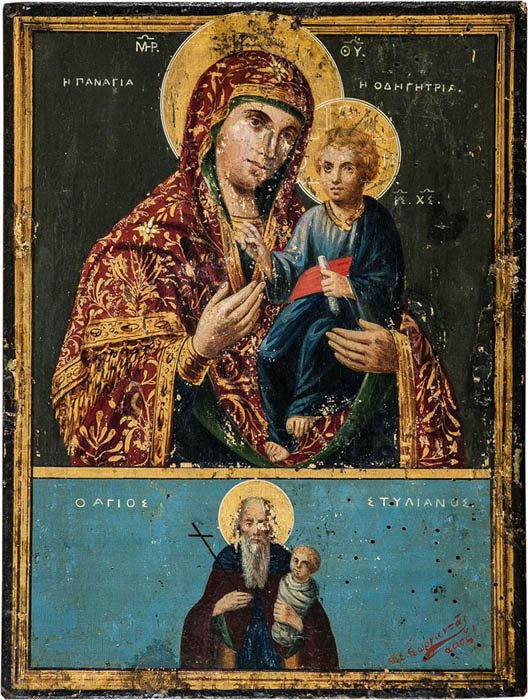
Signed two fields icon, Balkan, dated. 1877 Walnut board with two back side Sponkis. TeA signed icon painted in two registermpera on gesso. The upper frame shows the Hodegetria. The Blessed Mother in half figure carries the Christ child in her left arm. With her ​​right hand she has her son, who holds a scroll, he raises his right hand in a blessing gesture. The maphorion of the Mother of God is rich with Chrysographie. In the lower frame half-length depiction of the Saint Stylianos of Paphlagonians, the patron saint of children. Signed '' Georgantas (?) '' And dated. Berieben. 34.5 x 26 cm.

Maphorion: a garment covering the head and shoulders, mentioned in papyri of the 4th–6th Century

Chrysographie: a technique used in manuscripts, letters, or painted objects (crowns, nimbuses) where a gold tincture has been designed. In the early Middle Ages were also writings held exclusively in gold letters in both the Byzantine and the Western culture. These fonts are also called Codex Aureus . In the High Middle Ages, the use of gold was reduced and limited mostly to larger initials.

Saint Stylianos was born during the 6th century in Adrianopolis (in modern day Turkey) into a very wealthy family. At a young age, Stylianos joined the hermits of the desert with a view toward cleansing his soul and pledging his life to Jesus Christ. Unlike most other hermits, however, he did not withdraw from society altogether, preferring to occasionally go among the people for whatever good he might do.

According to the church tradition, one night while he prayed, Stylianos felt a divine presence of the Holy Spirit. The next day, with a spirit of exultation and serenity he had never known before, he started his customary rounds, wherein he counselled and comforted, he felt compelled to place his hand on a stricken child, something he had not up to that time dared to do; he felt the power of the Lord being transferred to the ailing youngster through his extended arm. The child immediately recovered, and thenceforth Stylianos was sought after by every suffering soul for miles around, young and old. His cave became a magnet for the sick and suffering, many of whom received complete cures.

During this period, Stylianos concerned himself primarily with children, not just the physically afflicted but also with those who were in need of spiritual guidance. Families from all walks of life were said to have entrusted to Stylianos the enlightenment of their children, and he was forced to seek out larger headquarters and to recruit from the ranks of his hermit friends the assistance needed to tend to so many. His was probably the first day-care centre in the world, where mothers could safely leave their children while tending to other matters of the home.

Stylianos was to become the patron saint of children yet to be born, owing to stories of his miraculous intercession for a young woman who helped him with children but could bear none of her own. When the woman conceived, her husband out of sheer joy spread the word of this miracle, and before long many barren women came to the great hermit. More

RELIGIOUS ART - Icons from the Bible, The Virgin Hodegetria, Balkan, 19th century.


Hodegetria Balkans, 19th century. Hardwood single panel. Tempera on  ground chalk, gilded background . Image-filling representation of The God Mother showing half-length with Christ in her left arm. He is blessing and holding a scroll in his right arm. Framed. Losses. 26.5 x 20 cm

A Hodegetria (literally: "She who shows the Way"; or Virgin Hodegetria, is an iconographic depiction of the Theotokos (Virgin Mary) holding the Child Jesus at her side while pointing to Him as the source of salvation for mankind. In the Western Church this type of icon is sometimes called Our Lady of the Way.

The designation of Hodegetria or “She Who Points the Way” did not originate from Mary’s gesture toward her son. Instead, it refers to the famous prototype of the miraculous icon of the Virgin—the model for all other icons of this type—belonging to the Hodegon Monastery of Constantinople.

No evidence exists for the Hodegon Monastery, or any Hodegetria icons, before the Byzantine iconoclastic controversies of the 700s and early 800s.

The Virgin Hodegetria came to prominence in the early 11th century, triggering the creation of a myth that linked its origin with the early history of Byzantium. As a way of supporting the legitimacy of icon veneration during the Iconoclasm (controversies that barred the production and use of figural images, spanning roughly a century  726–87 and 815–43) this specific icon was said to trace back to a mid-8th-century legend of a portrait of Mary painted during her lifetime by the Apostle Luke. By claiming the involvement of the hand of the evangelist, the legend around the Hodegetria was fabricated, evidence for the apostolic origins and divine approval of images. More

RELIGIOUS ART - Icons from the Bible, Icon of Chetyi-Minei (calendar of saints)


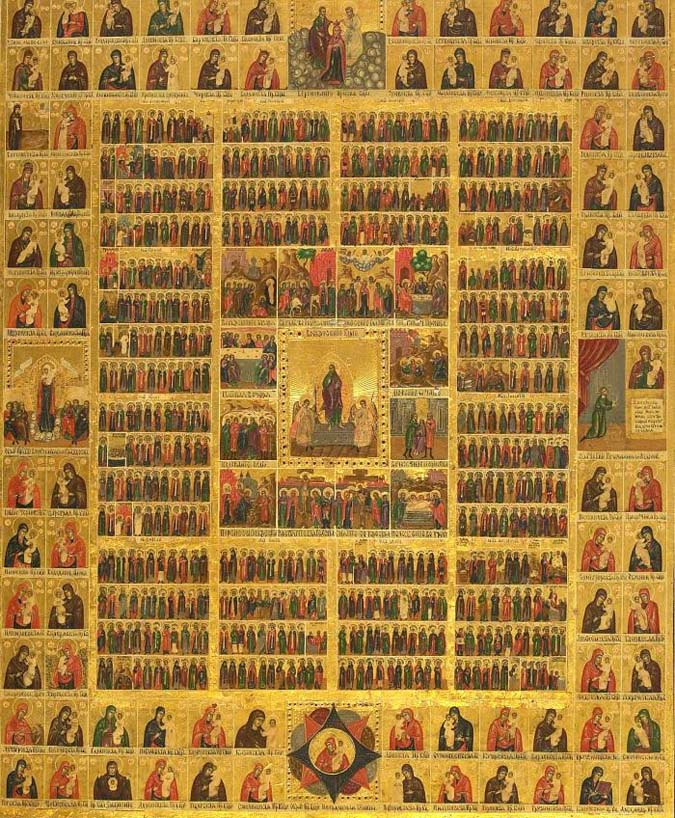
Icon of Chetyi-Minei (calendar of saints). In the very center is the Resurrection of Christ surrounded by scenes from Holy Week and the feasts of the Paschal cycle. Around them are twelve groupings of saints: one for each month of the calendar year. In the border are icons of the Theotokos (Mother of God), each of which has a feast day during the liturgical year.

The Eastern Orthodox Liturgical Calendar describes and dictates the rhythm of the life of the Eastern Orthodox Church. Associated with each date are passages of Holy Scripture, Saints and events for commemoration, and many times special rules for fasting or feasting that correspond to the day of the week or time of year in relationship to the major feast days.

Three-level composition for the traditional XVI-XVII centuries. The upper tier - Christ in Majesty sitting with Virgin and John the Baptist, accompanied by a host of angels. The following is presented in two tiers of saints. In the middle tier, under the image of the Savior - A Hetoimasia/Throne, carried by two angels. Saints are divided into ten faces, six in the bottom row and four on middle. The pommel of the centerpiece depicts the Holy Trinity (Old Testament), the Cherubim and Seraphim.  - the Annunciation. Below, on the wings of three series of 12 stamps holidays (from left to right, with the left wing to the right): Christmas, Candlemas; Epiphany, the Transfiguration; Entry into Jerusalem, Raising of Lazarus; Crucifixion, Deposition from the Cross; Resurrection, the Ascension; Doubting Thomas, Descent of the Holy Spirit. The iconography of the traditional holidays, the options applied with a small number of figures. Painting on the centerpiece, and the wings is different in style and probably at runtime. On the wings, which could be written in the second quarter, and in the middle of the century, the surface of the painting is dense, enamel, both in Moscow painting 1640s .; Slides are typical for the second quarter of the XVII century. At the centerpiece of the letter fairly planar, graphically modeling, Linear. Private with a monochrome, slightly lightening ohreniem. 
VM Sorokaty

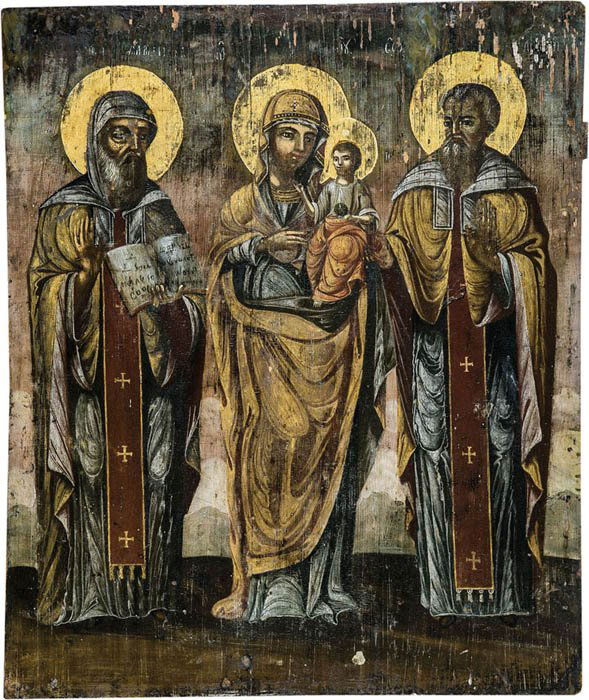
RELIGIOUS ART - Icons from the Bible, The Virgin Hodegetria, Romania, circa 1800

1

Large-sized icon with the Virgin Hodegetria Romania, circa 1800 Softwood single board with two back side Sponki. Tempera on gesso. Full-length depiction of the Virgin Mary carrying the Christ child in her left arm. Christ holding a globe in his left hand. They are flanked by two monks blessing them, including St. login.  53 x 44 cm 

Wooden Icons were likely to warp. Slats inserted in the back to prevent warping, and that name is SHPONKI.  One usually finds two SHPONKI, one coming in from either side toward the center, but occasionally just one SHPONKA 

Gesso, from the Latin gypsum, is a white paint mixture consisting of a binder mixed with chalk, gypsum, pigment...

A Hodegetria (literally: "She who shows the Way"; or Virgin Hodegetria, is an iconographic depiction of the Theotokos (Virgin Mary) holding the Child Jesus at her side while pointing to Him as the source of salvation for mankind. In the Western Church this type of icon is sometimes called Our Lady of the Way.

The most venerated icon of the Hodegetria type, regarded as the original, was displayed in the Monastery of the Panaghia Hodegetria in Constantinople, which was built specially to contain it. Unlike most later copies it showed the Theotokos standing full-length. It was said to have been brought back from the Holy Land by Eudocia, the Empress of Theodosius II (408–450), and to have been painted by Saint Luke. The icon was double-sided, with a crucifixion on the other side, and was "perhaps the most prominent cult object in Byzantium".

The original icon has probably now been lost, although various traditions claim that it was carried to Russia or Italy. There are a great number of copies of the image, including many of the most venerated of Russian icons, which have themselves acquired their own status and tradition of copying.

Luke the Evangelist is one of the Four Evangelists/authors of canonical Gospels of Jesus Christ. Luke was a native of the Hellenistic city of Antioch in Syria. The early church fathers ascribed to him authorship of both the Gospel according to Luke and the book of Acts of the Apostles, which originally formed a single literary work, referred to as Luke–Acts. 

The New Testament mentions Luke briefly a few times, and the Pauline epistle to the Colossians refers to him as a doctor; thus he is thought to have been both a physician and a disciple of Paul. Christians since the faith's early years have regarded him as a saint. He is believed to have died a martyr, although accounts of the events do vary.

The Roman Catholic Church and other major denominations venerate him as Saint Luke the Evangelist and as a patron saint of artists, physicians, surgeons, students and butchers. More

St. login: I could not find any information about this Saint!

Aelia Eudocia Augusta] (c. 401–460) was the wife of Theodosius II, and a prominent historical figure in understanding the rise of Christianity during the beginning of the Byzantine Empire. Eudocia lived in a world where Greek paganism and Christianity were existing side by side with both pagans and unorthodox Christians being persecuted.[1] Although Eudocia's work has been mostly ignored by modern scholars, her poetry and literary work are great examples of how her Christian faith and Greek upbringing were intertwined, exemplifying a legacy that the Byzantine Empire left behind on the Christian world. More

RELIGIOUS ART - Icons from the Bible, Triptych Greece, 18th century

1

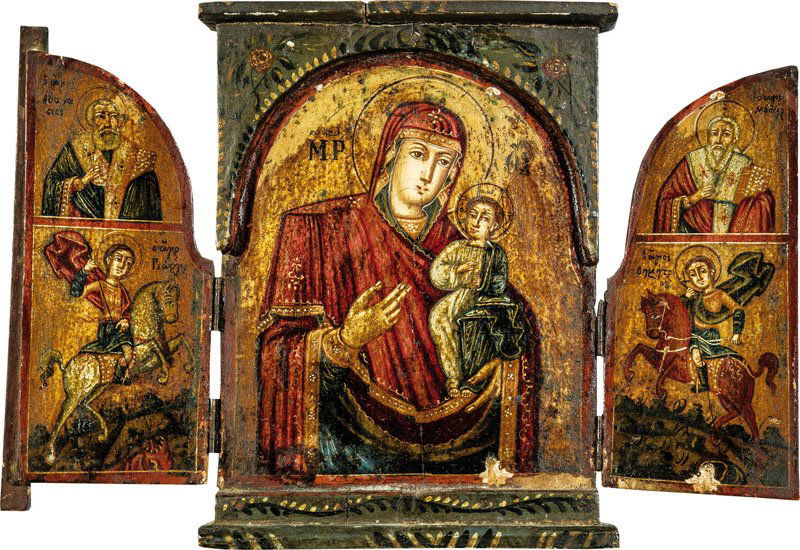
Enthroned Virgin Mary, Greece, 19th century. Wooden single panel. Double Kowtscheg. Tempera on gesso, gold plated. The Mother of God sits on a richly ornamented, gilded throne with the Christ Child on her lap. It is crowned by two angels. In the background St. Nicholas and St. Demetrius27.5 x 20.5 cm 

The theme of the Madonna and Child was rare in the first centuries of early Christian art (c. 3rd–6th century). In 431, however, the establishment of Mary’s title of Theotokos (“Mother of God”) definitively affirmed the full deity of Christ. Thereafter, to emphasize this concept, an enthroned Madonna and Child were given a prominent place in monumental church decoration. More

A triptych ("three-fold"),  is a work of art (usually a panel painting) that is divided into three sections, or three carved panels that are hinged together and can be folded shut or displayed open. It is therefore a type of polyptych, the term for all multi-panel works. The middle panel is typically the largest and it is flanked by two smaller related works, although there are triptychs of equal-sized panels. The form can also be used for pendant jewelry. More

Saint George (AD 275–281 to 23 April 303) was a soldier in the Roman army who later became venerated as a Christian martyr. His parents were Christians of Greek background; his father Gerontius was a Roman army official from Cappadocia and his mother Polychronia was a Christian from Lydda in the Roman province of Syria Palaestina. Accounts differ regarding whether George was born in Cappadocia or Syria Palaestina, but agree that he was raised at least partly in Lydda. Saint George became an officer in the Roman army in the Guard of Diocletian, who ordered his death for failing to recant his Christian faith. 

In hagiography, Saint George is one of the most venerated saints.  He is immortalized in the myth of Saint George and the Dragon and is one of the Fourteen Holy Helpers), and is regarded as one of the most prominent military saints. More

Saint Demetrius of Thessaloniki  is a Christian martyr of the early 4th century AD. During the Middle Ages, he came to be revered as one of the most important Orthodox military saints, often paired with Saint George.  In the Roman Catholic church he is most commonly called "Demetrius of Sermium." 

The earliest written accounts of his life were compiled in the 9th century, although there are earlier images of him, and the 7th-century Miracles of Saint Demetrius collection. According to these early accounts, Demetrius was born to pious Christian parents in Thessaloniki, Illyricum in 270. The biographies have Demetrius as a young man of senatorial family who was run through with spears in around 306 AD in Thessaloniki, during the Christian persecutions of Diocletian and Galerian.

St. Demetrius was initially depicted in icons and mosaics as a young man in patterned robes with the distinctive tablion of the senatorial class across his chest. Miraculous military interventions were attributed to him during several attacks on Thessaloniki, and he gradually became thought of as a soldier: a Constantinopolitan ivory of the late 10th century shows him as an infantry soldier (Metropolitan Museum of Art). But an icon of the late 11th century in Saint Catherine's Monastery on Mount Sinai shows him as before, still a civilian. More

RELIGIOUS ART - Icons from the Bible, Enthroned Virgin Mary, Greece, 19th century

1

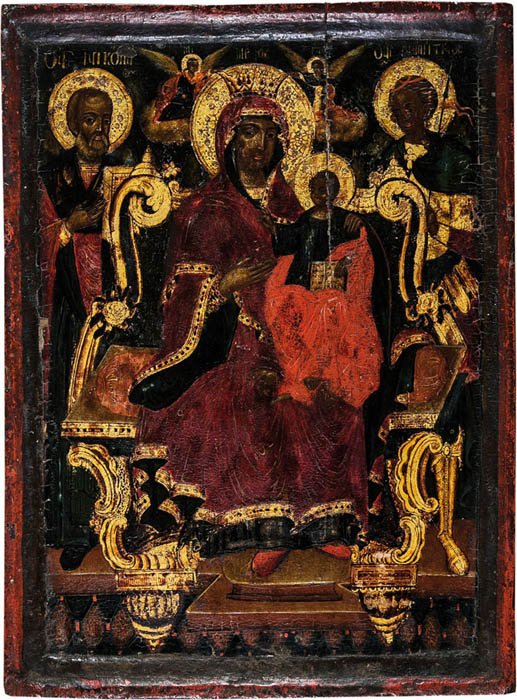
Enthroned Virgin Mary, Greece, 19th century. Wooden single panel. Double Kowtscheg. Tempera on gesso, gold plated. The Mother of God sits on a richly ornamented, gilded throne with the Christ Child on her lap. It is crowned by two angels. In the background St. Nicholas and St. Demetrius27.5 x 20.5 cm 

The theme of the Madonna and Child was rare in the first centuries of early Christian art (c. 3rd–6th century). In 431, however, the establishment of Mary’s title of Theotokos (“Mother of God”) definitively affirmed the full deity of Christ. Thereafter, to emphasize this concept, an enthroned Madonna and Child were given a prominent place in monumental church decoration. More

Saint Nicholas (15 March 270 – 6 December 343), also called Nikolaos of Myra, was a historic 4th-century Christian saint and Greek Bishop of Myra, in modern-day Demre, Turkey). He had a reputation for secret gift-giving, such as putting coins in the shoes of those who left them out for him, a practice celebrated on his feast day―St Nicholas Day (6 December, and thus became the model for Santa Claus, whose modern name comes from the Dutch Sinterklaas, itself from a series of elisions and corruptions of the transliteration of "Saint Nikolaos". His reputation evolved among the faithful, as was common for early Christian saints. In 1087, part of his relics (about half of his bones) were furtively transported to Bari, in Apulia, Italy; for this reason, he is also known as Nikolaos of Bari. The remaining bones were taken to Venice in 1100.

Saint Nicholas is the patron saint of sailors, merchants, archers, repentant thieves, children, brewers, pawnbrokers and students in various cities and countries around Europe. More

Saint Demetrius of Thessaloniki  is a Christian martyr of the early 4th century AD. During the Middle Ages, he came to be revered as one of the most important Orthodox military saints, often paired with Saint George.  In the Roman Catholic church he is most commonly called "Demetrius of Sermium." 

The earliest written accounts of his life were compiled in the 9th century, although there are earlier images of him, and the 7th-century Miracles of Saint Demetrius collection. According to these early accounts, Demetrius was born to pious Christian parents in Thessaloniki, Illyricum in 270. The biographies have Demetrius as a young man of senatorial family who was run through with spears in around 306 AD in Thessaloniki, during the Christian persecutions of Diocletian and Galerian.

St. Demetrius was initially depicted in icons and mosaics as a young man in patterned robes with the distinctive tablion of the senatorial class across his chest. Miraculous military interventions were attributed to him during several attacks on Thessaloniki, and he gradually became thought of as a soldier: a Constantinopolitan ivory of the late 10th century shows him as an infantry soldier (Metropolitan Museum of Art). But an icon of the late 11th century in Saint Catherine's Monastery on Mount Sinai shows him as before, still a civilian. More